
- 368 pages
- English
- ePUB (mobile friendly)
- Available on iOS & Android
eBook - ePub
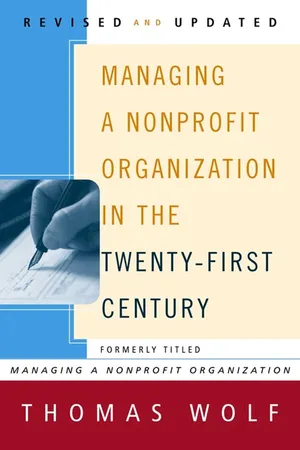
Managing a Nonprofit Organization in the Twenty-First Century
About this book
Since this classic work was originally published in 1984, there have been major shifts in the nonprofit world -- the growth of more profit-oriented ventures, the overhaul of accounting rules, new partnerships, and an emphasis on customer-oriented service and leadership. In easy-to-understand language, Thomas Wolf explains how to cope with these changes and deal with the traditional challenges of managing staff, trustees, and volunteers.
Frequently asked questions
Yes, you can cancel anytime from the Subscription tab in your account settings on the Perlego website. Your subscription will stay active until the end of your current billing period. Learn how to cancel your subscription.
No, books cannot be downloaded as external files, such as PDFs, for use outside of Perlego. However, you can download books within the Perlego app for offline reading on mobile or tablet. Learn more here.
Perlego offers two plans: Essential and Complete
- Essential is ideal for learners and professionals who enjoy exploring a wide range of subjects. Access the Essential Library with 800,000+ trusted titles and best-sellers across business, personal growth, and the humanities. Includes unlimited reading time and Standard Read Aloud voice.
- Complete: Perfect for advanced learners and researchers needing full, unrestricted access. Unlock 1.4M+ books across hundreds of subjects, including academic and specialized titles. The Complete Plan also includes advanced features like Premium Read Aloud and Research Assistant.
We are an online textbook subscription service, where you can get access to an entire online library for less than the price of a single book per month. With over 1 million books across 1000+ topics, weāve got you covered! Learn more here.
Look out for the read-aloud symbol on your next book to see if you can listen to it. The read-aloud tool reads text aloud for you, highlighting the text as it is being read. You can pause it, speed it up and slow it down. Learn more here.
Yes! You can use the Perlego app on both iOS or Android devices to read anytime, anywhere ā even offline. Perfect for commutes or when youāre on the go.
Please note we cannot support devices running on iOS 13 and Android 7 or earlier. Learn more about using the app.
Yes, you can access Managing a Nonprofit Organization in the Twenty-First Century by Thomas Wolf in PDF and/or ePUB format, as well as other popular books in Business & Management. We have over one million books available in our catalogue for you to explore.
Information
1
Understanding Nonprofit Organizations

The Spencer family lives in a small city in the western United States. Sam Spencer runs a plumbing supply business; Jane, his wife, teaches at a school for the learning disabled. On a typical day, their livesālike the lives of most Americansāare touched repeatedly by the world of nonprofit organizations.


There are over a million nonprofit organizations in the United States,1 a number that has increased over 25 percent in the past quarter century.2 They range from large universities with assets in the billions of dollars to small all-volunteer, community-based, grass roots organizations that seem to operate on a shoestring. Though they represent less than 5 percent of all institutions and they own only 2 percent of the nationās assets,3 their contribution to the nationās quality of life is incalculable. They contribute hundreds of billions of dollars to the nationās economy and employ over 15 million people. On a per capita basis, Americans contribute nearly $300 per year of their own personal money to nonprofits plus substantially more in contributed hours. In fact, at the end of the twentieth century, nearly one hundred million Americans (and almost 50 percent of the adult population) volunteered their time to nonprofit organizations with an estimated value of over $200 billion.4
Despite the tremendous size and impact of the nonprofit sector, it is not well understood by most people. The purpose of this chapter is to describe what nonprofit organizations are, what distinctive features they possess, and what special challenges they pose for the people who manage and govern them.
WHAT IS A NONPROFIT ORGANIZATION?
Suppose you asked someone, āWhat is an elephant?ā and the person answered, āAn elephant is a nonhorse.ā You would probably find the answer unsatisfactory. Yet, the term nonprofit organization describes something that is not something elseāit suggests a business enterprise not organized to make a profit. But it tells us very little about the essential characteristics of this type of entity.
It is not easy to describe nonprofit organizations and this is partly what makes managing them such a difficult task fraught with challenges and problems. Unlike management issues in the profit sector, which tend to be clear and related to specific economic measures, issues in the nonprofit environment are more nebulous because they relate to the somewhat abstract concept of public service. In a profit-making company, a manager generally knows whether he or she is doing a good job, but it is often less clear in a nonprofit organization in which the primary purpose is not to make money but to serve the public.
Some say that the essential defining characteristic of nonprofit organizations is the fact that they are established to provide a service to the public, and to some extent this is true. But this idea of a public service mission can be misleading. For one thing, there are a number of nonprofit organizations that are not organized to serve the public (for example, country clubs and labor unions). For another, the idea that nonprofit organizations are simply organized to solve some societal problem or deliver some much-needed public service flies in the face of the exclusivity often associated with their respective constituencies. This is perhaps most clear when nonprofit organizations are compared to public (or government) organizations and agencies working in the same field. Although the nonprofit organizations often have a stated public service mission, they do not necessarily have a requirement of equity (that is, a mandate to serve everyone) the way public agencies usually do. As a result, the nonprofit organizationās actual constituency may be far more limited than that of a public agency working in the same field.
Others claim that the essential defining characteristic of nonprofit organizations is that their mission is not to make money. Again, this is partly true. But many nonprofit organizations are quite entrepreneurial (again, this distinguishes them from public or governmental agencies working in the same field). Many engage in all sorts of money-making ventures that bear a close resemblance to profit-making entities and this has been cause for some concern among those working in commercial endeavors whose businesses must compete with nonprofits for customers.
In fact, a nonprofit organization is neither in the profit sector nor in the public sector but sits somewhere between the two. This position allows the nonprofit great flexibility in its operation but also requires great skill in its management. On the one hand, managers must learn the same management techniques and analytical strategies that apply in profit-making companies. However, while these techniques are relevant in the nonprofit world, their application is dissimilar. Although both profit-making and nonprofit organizations engage in planning, budgeting, accounting, and marketing; although both have to contend with issues of governance, personnel, and information management; and although both have to raise money from time to time, these activities are carried out in markedly different ways. Similarly, while it may be useful to know about the workings of a public agency and the development of public policy, it is not sufficient preparation for the nonprofit manager or trustee. Governance, organizational accountability, financial reporting, and long-range planning are very different in nonprofit organizations whose special defining characteristics are laid down in state and federal law.
Toward a Definition
In this book, the term nonprofit organization refers to those legally constituted, nongovernmental entities incorporated under state law as charitable or not-for-profit corporations that have been set up to serve some public purpose and are tax-exempt according to the IRS. All must have the following five characteristics:


Consequently, nonprofit organizations as described in this book do not include three other categories of organizations:


Because these various classes of organizations do not have all the characteristics previously listed, their missions, governance structures, or method of management may be significantly different from what is described in this book.
This chapter considers four major challenges that face nonprofit organizations as a consequence of these special characteristics. The challenges are:


By looking closely at each of these, we will continue to refine our understanding of the special nature of nonprofit organizations.
CONSEQUENCES OF A PUBLIC SERVICE MISSION
An essential difference between profit and nonprofit organizations centers on the concept of mission. The ultimate mission of the profit-making entity is to earn money for its owners. Ownership can come in many forms, of course, from outright ownership of the organization by a single individual to shared ownership (by partners or shareholders or some other group). The concept of ownership is completely absent from nonprofit organizations and consequently the nonprofitās mission has a totally different thrust. There can be no owners in a nonprofit organization because such an entity is intended to serve a broad public purpose and the law is clear in specifying that ownership (with concomitant private gain) is incompatible with public purpose. This is not to say that nonprofit organizations cannot make money. Nonprofit organizations can and do make moneyāin the same way profit-making entities doābut the money that is taken in must be directed toward the public purpose for which the organization was set up, held in reserve, or turned over to another organization with a public purpose.
It is much more difficult to identify and articulate the mission of a nonprofit organization and consequently to develop criteria by which success can be measured. In a profit-making organization, because the mission is clear, success criteria are also clear. The mission centers around...
Table of contents
- Cover Page
- Title Page
- Copyright Page
- Dedication
- Contents
- Preface
- Chapter 1: Understanding Nonprofit Organizations
- Chapter 2: The Board
- Chapter 3: Assembling the Workforce
- Chapter 4: Personnel Policy
- Chapter 5: Marketing
- Chapter 6: Financial Management
- Chapter 7: Financial Statements and Fiscal Procedures
- Chapter 8: Fund Raising
- Chapter 9: Planning
- Chapter 10: Sustainability and Leadership
- Chapter 11: Making Things Better
- Notes
- Index