House of Cards
eBook - ePub

House of Cards

  1. 352 pages
  2. English
  3. ePUB (mobile friendly)
  4. Available on iOS & Android
eBook - ePub

House of Cards

About this book

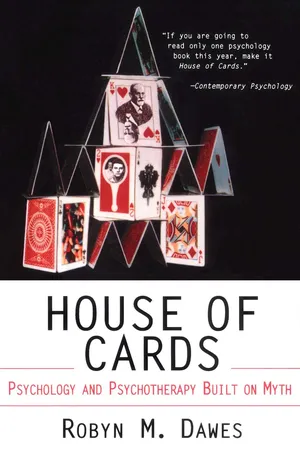
Robin Dawes spares no one in this powerful critique of modern psychotherapeutic practice. As Dawes points out, we have all been swayed by the "pop psych" view of the world--believing, for example, that self-esteem is an essential precursor to being a productive human being, that events in one's childhood affect one's fate as an adult, and that "you have to love yourself before you can love another."
Frequently asked questions

Yes, you can cancel anytime from the Subscription tab in your account settings on the Perlego website. Your subscription will stay active until the end of your current billing period. Learn how to cancel your subscription.
At the moment all of our mobile-responsive ePub books are available to download via the app. Most of our PDFs are also available to download and we're working on making the final remaining ones downloadable now. Learn more here.
Perlego offers two plans: Essential and Complete
  • Essential is ideal for learners and professionals who enjoy exploring a wide range of subjects. Access the Essential Library with 800,000+ trusted titles and best-sellers across business, personal growth, and the humanities. Includes unlimited reading time and Standard Read Aloud voice.
  • Complete: Perfect for advanced learners and researchers needing full, unrestricted access. Unlock 1.4M+ books across hundreds of subjects, including academic and specialized titles. The Complete Plan also includes advanced features like Premium Read Aloud and Research Assistant.
Both plans are available with monthly, semester, or annual billing cycles.
We are an online textbook subscription service, where you can get access to an entire online library for less than the price of a single book per month. With over 1 million books across 1000+ topics, we’ve got you covered! Learn more here.
Look out for the read-aloud symbol on your next book to see if you can listen to it. The read-aloud tool reads text aloud for you, highlighting the text as it is being read. You can pause it, speed it up and slow it down. Learn more here.
Yes! You can use the Perlego app on both iOS or Android devices to read anytime, anywhere — even offline. Perfect for commutes or when you’re on the go.
Please note we cannot support devices running on iOS 13 and Android 7 or earlier. Learn more about using the app.
Yes, you can access House of Cards by Robyn Dawes in PDF and/or ePUB format, as well as other popular books in Psychology & Psychotherapy. We have over one million books available in our catalogue for you to explore.

Information

Publisher
Free Press
Year
2009
eBook ISBN
9781439188880

Part One
THE CLAIMS OF THE MENTAL HEALTH EXPERTS VERSUS THE EVIDENCE

Many people suffer from emotional distress—ranging from psychosis through severe addictions to mild depressions. Such distress has been labeled “mental illness” in our culture, and until the late 1950s it was treated primarily by physicians. Particularly since the early 1970s, however, the number of people claiming to be experts in alleviating emotional distress has increased dramatically; by the later 1980s there were more clinical psychologists than psychiatrists, and more psychiatric social workers than clinical psychologists. Except for the prescription of psychoactive drugs, treatment of emotional distress is provided primarily by these nonmedical people. The practice of psychology, which requires postgraduate training and a Ph.D. or Sc.D. credential, has been licensed (hence restricted) in every state and territory since the middle 1970s, and psychiatric social workers are now being licensed in a majority of states as well. Licensing allows people to collect third-party fees for their services from insurance companies and the U.S. government. Moreover, licensed practitioners are increasingly relied upon as “experts” in court proceedings involving custody disputes, diagnosis of emotional problems, factual issues such as whether a child has been sexually abused, and even judgments and predictions about future behavior—such as whether someone is likely to be violent, or whether a convicted murderer is “irredeemable” (and hence eligible for execution).
Emotional suffering is very real, and the vast majority of people in these expanding professions sincerely wish to help those suffering. But are they really the experts they claim to be? Is our society justified in granting them special status and paying them from common funds? Are they better therapists than minimally trained people who may share their knowledge of behavioral techniques or empathetic understanding of others? Does possessing a license imply that they are using scientifically sound methods in treating people or providing an “expert opinion”? Should their opinions be recognized in our courts as having any more validity than the opinions of anyone else? In particular, are their opinions any better than those of judges, who have been selected on the basis of their legal record to make tough social decisions? Can these mental health practitioners, for example, make a better determination of whether a young child has been sexually abused than can be made by a careful consideration of the evidence without considering their opinions?
These questions have been studied quite extensively, often by psychologists themselves. There is by now an impressive body of research evidence indicating that the answer to these questions is no. Those claiming to be mental health experts—including many psychiatrists—often assert that their “experience” allows them to apply principles of psychology in a better manner than others could, but the research evidence is that a minimally trained person applying these principles automatically does at least as well. Moreover, the research evidence indicates that—unlike a surgeon, for example—mental health practitioners don’t develop skills in applying these principles through experience. Often, moreover, they don’t even attempt a systematic application of principles, instead claiming to base their practice and judgment on “trained intuition,” which presumably allows them to transcend or ignore these principles when they shouldn’t. There are “scientifically based” practitioners who attempt to base what they do on these principles, but there is no system of assurance that others will do so as well in these rapidly expanding fields, and they don’t. A license has become, unfortunately, a license to ignore the valid principles and generalizations that do in fact exist in the mental health areas (though not in impressive numbers). And when the practitioners ignore valid principles, they can even become outright dangerous to our civil liberties, as when they ignore what they presumably should know about the malleability of human memory or the suggestibility of young children. (“There was no really good evidence. It was the therapists’ notes that convinced me she was guilty.”)1
The purpose of Part One is to share with the reader the research basis for these negative conclusions. I will sometimes describe specific studies, sometimes rely on summaries of sets of studies. These results have very strong implications for public policy in the mental health area. We should not be pouring out resources and money to support high-priced people who do not help others better than those with far less training would, and whose judgments and predictions are actually worse than the simplest statistical conclusion based on “obvious” variables. Instead, we should take seriously the findings that the effectiveness of therapy is unrelated to the training or credentials of the therapist. We should take seriously the findings that the best predictors of future behavior are past behavior and performance on carefully standardized tests, not responses to inkblot tests or impressions gained in interviews, even though no prediction is as good as we might wish it to be. The conclusion is that in attempting to alleviate psychological suffering, we should rely much more than we do on scientifically sound, community-based programs and on “paraprofessionals,” who can have extensive contact with those suffering at no greater expense than is currently incurred by paying those claiming to be experts. We might also be better off relying more on ourselves in addressing our own problems.
This section of the book is based on a philosophy enunciated by Paul C. Stern. A major policy goal of psychological and social science should be to “separate common sense from common nonsense and make uncommon sense more common.”2 The common sense that assumes trained people must possess unique skills simply because they claim to have them is common nonsense. In addition, the commonsense attitudes and beliefs that lead us to accept mental health practitioners in particular as experts must be understood as common nonsense. The uncommon sense to understand the issues involved in evaluating claims of expertise and to grasp the meaning of the research addressing these issues should become common sense. It is to this goal of separating sense from nonsense that the first seven chapters of this book are addressed.

CHAPTER 1
INTRODUCTION

Many people in the United States suffer from problems that the professions of psychiatry and psychology claim to address. People often feel emotionally distressed to the point of debilitation, and many behave in dysfunctional and destructive ways. The monetary cost of alcoholism, drug addiction and what is termed “mental illness” is enormous: an estimated $273.3 billion in 1988.1 The personal cost is difficult to measure but is clearly also enormous. Public opinion polls indicate that people are aware of these monetary and personal costs and believe that they constitute a critical social problem.2 As summarized in a recent NewsReport of the National Research Council:
Mental disorders cause substantial disability in the United States. About one in five adults suffers from a diagnosable disorder, including severe mental illnesses, such as schizophrenia, affective disorders, and substance abuse. At least 12% of youngsters under the age of 18—a total of 7.5 million children—have a diagnosable mental illness. Mental disorders cost billions a year in disability and economic costs.3
So there are big problems. The question is whether the services rendered by professional psychiatrists and psychologists provide solutions to those problems. The answer proposed in this book is rather simple. There is some scientific knowledge about some mental disorders and types of distress and how to alleviate them. When psychiatrists and psychologists base their practice on this knowledge, they generally perform a valuable service to their clients. All too often, however, mental health practitioners base their practice on what they believe to be an “intuitive understanding” of their clients’ problems, an understanding they have supposedly gained “from experience.” But when they practice on this intuitive basis, they perform at best as well as minimally trained people who lack their credentials (the topic of Chapter 2) and at worst as licensed, expensive (if inadvertent) frauds (the topic of Chapter 5).
The reason I reach these conclusions is that the ability of these professionals to alleviate emotional distress has been subjected to empirical scrutiny—for example, their effectiveness as therapists (Chapter 2), their insight about people (Chapter 3), and the relationship between how well they function and the amount of experience they have had in their field (Chapter 4). Virtually all the research—and this book will reference more than three hundred empirical investigations and summaries of investigations—has found that these professionals’ claims to superior intuitive insight, understanding, and skill as therapists are simply invalid. What our society has done, sadly, is to license such people to “do their own thing,” while simultaneously justifying that license on the basis of scientific knowledge, which those licensed too often ignore. This would not be too bad if “their own thing” had some validity, but it doesn’t. What the license often does is to provide a governmental sanction for nonsense such as:
“In my mind, I know what she was thinking and feeling at the time of her death”—a Harvard professor of psychiatry, quoted in the New York Times, October 21, 1987, p. A22. Where his “psychological autopsy” was allowed into testimony at the trial of Teresa Jackson for (psychological) child abuse following the suicide of her daughter in Fort Lauderdale, Florida
or, from a professional talking about incest victims,
“It’s so common that I’ll tell you that within 10 minutes, I can spot it as a person walks in the door, often before they even realize it. There’s a trust, a lack of trust, that’s the most common issue. There’s a way that a person presents themselves. There’s a certain body language that says I’m afraid to expose myself. I’m afraid to be hurt.”—Good Morning America’s on-air psychologist on the CNBC program Real Personal, April 27, 1992 (after maintaining that “Probably one in four women, one in eight men, have been incested.”)
If the only result were nonsense, it would not be so bad. There is a lot of benign nonsense in the world. Unfortunately, such nonsense like this can have a profound effect on other people’s lives, and it is expensive nonsense.
Claims to intuitive understanding, like those in above quotes, leave potential clients incapable of distinguishing between service that has a true scientific base and service based simply on the claims of those providing the service. The professional associations have exacerbated this confusion by monitoring and sanctioning their members only for the consistency of their practice with their presumed power and status, not for whether that practice does any good or has any scientific justification. Thus, in a recent flap concerning a female Harvard psychiatrist whose client committed suicide, the focus of the professional board’s inquiry was on whether she had sexual relations with him—not on whether encouraging him to regress to an infantile state so that she could “reparent” him had any known value for him or anyone else. The write-up in Newsweek treated the public to what various well-known psychiatrists and psychologists “said,” 8220;thought,” or thought they “knew” about the case but nowhere was there reference to any evidence concerning the psychiatrist’s mode of treatment.4 The impression is created that psychotherapy treatment is all a matter of opinion or conjecture. It isn’t, but many practitioners treat it that way, while the professional associations support them in doing virtually anything at all that appeals to their “clinical intuition,” as if there were no knowledge. The professionals are immune so long as they keep their hands off their clients and don’t do anything else that would offend their colleagues’ sense of status or propriety, such as be arrested for homosexual solicitation in a men’s room or plead nolo contendere to a charge of child sexual abuse in order to avoid being jailed as a sex offender.
Finally, the mental health professionals who claim expertise without a scientific base have apparently had a profound effect on our culture’s beliefs about what constitutes a good life, what types of behavior are desirable, and—most important—how people “should” feel about the world (see Part II). The most pernicious of these beliefs is that adult behavior is determined mainly by childhood experiences, even very subtle ones, and particularly those that enhance or diminish self-esteem. Self-esteem, in turn, is believed to be an important causal variable in behavior, even though the California Task Force on the Importance of Self-Esteem could find no evidence of such a causal effect. Especially, low self-esteem is believed to yield, with unerring consistency, personally or socially destructive behaviors, so that people who wish to change their behavior must experience an elevation of self-esteem first (as the result of therapy or an esteem-raising self-help group) and attempt serious change in their lives only later. Again, the evidence for these beliefs is negative. What these beliefs do is discourage people from attempting to craft a decent life for themselves and instead encourage them to do whatever is necessary to feel good—about themselves. Sometimes such striving after “mentally healthy” feelings and attitudes simply result in ludicrous behavior (like clutching a teddy bear while proudly proclaiming oneself undoubtedly an incest victim, despite an inability to remember any credible instances). In general, however, this strategy is self-defeating, because it ignores the simple principle that much of our feeling results from what we do rather than causing us to do it.
By contrast, other professionals do base their recommendations on what is known, or on what is believed to be true on the basis of research findings. They do not offer grandiose and false advice to the general public about how to live, think, and feel. The simple reason is that their own scientific knowledge about human distress makes them aware of its limitations, and most of them are responsible enough not to pretend that these limitations do not exist.

THE GROWTH OF PSYCHOLOGY

As the problem of mental distress becomes ever more severe in this country, the magnitude and status of the professions claiming to have a solution also grow. Psychiatry, with its requirement of medical training and its emphasis on prescribing drugs, has approximately doubled in size in the past thirty years. In contrast, psychology has become big business. In this chapter, I will concentrate on the growth and practice of professional psychology, because it has had the biggest impact on the mental health field since the early 1970s, when clinical psychologists were first licensed as mental health experts. Clinical social work has also had a growing impact, somewhat later—as clinical social workers became licensed in many states through the 1980s. The practice of social workers is more akin to that of psychologists than of psychiatrists, for example, in concentrating on psychotherapy rather than the prescription of psychoactive drugs. In addition, there are other groups of people labeled “therapists.” Consequently, while I focus on psychology in this chapter, many of my conclusions are applicable to these other growing professions as well, and I will note this applicability by referring to other mental health professionals as well as psychologists when appropriate.
An estimated $2.8 billion was spent in 1985 on the services of “office based, licensed, clinical psychologists,” as opposed to $2.3 billion on services of office-based psychiatrists.5 That $2.8 billion figure is based on an estimated 55 million contact hours at an average charge of seventy-five dollars per hour (now higher); it accounts for two-thirds of all nonmedical professional office-based charges in the mental health area. (The rest is accounted for by licensed psychiatric social workers and other mental health professionals.) The costs of nonmedical services for mental health, drug addiction, and alcoholism increased at an average rate of 13.9% from 1985 to 1988;6 given that rate of increase, we can estimate that 1990 costs for office-based, licensed clinical psychologists were approximately $5.4 billion (as opposed to $4.2 billion for office-based psychiatrists). Similar extrapolation yields a figure of $2.7 billion for other licensed experts. Few people pay these costs out of pocket. Medical insurance, Medicare, Medicaid, and other government programs pay. That is, we all pay.
Psychological testimony is also often sought in legal proceedings, specifically those involving a person’s competency to stand trial, sentencing, psychiatric commitment, divorce, child custody, and—most recently—allegations of child abuse in the absence of physical evidence or reliable witnesses. Allegheny County in Pennsylvania, for example, instituted a new procedure for all disputed child custody cases following the 1985 ruling in Walsh v. Walsh.7 The parents and children in such cases are all automatically evaluated by a professional psychologist and by a social worker on a home visit as well. Parents who do not agree about custody arrangements can make no argument before a judge without undergoing such an evaluation first.
Not surprisingly, the cost and legal power of professional psychologists has been matched by their affluence. According to the most recent statistics published by the American Psychological Association,8 salaries of professional psychologists averaged $73,300 in 1989. Those with two to five years of professional experience averaged $54,068; those with five to nine years averaged $67,005; and those with ten or more years averaged $78,685. A survey taken by the Oregon Psychological Association in 1985 (which involved gross receipts rather than net salaries), when I was president of it, indicated roughly comparable figures. The subjects of this survey ranged from those who had been recently licensed to those who had already established a clientele and a reputation; Oregon at the time was experiencing one of the worst recessions in the country. (The Rand McNally lis...

Table of contents

  1. Cover Page
  2. Title Page
  3. CONTENTS
  4. PREFACE
  5. Part One
  6. Part Two
  7. NOTES
  8. INDEX