Rogue Warrior
eBook - ePub

Rogue Warrior

Red Cell

  1. 416 pages
  2. English
  3. ePUB (mobile friendly)
  4. Available on iOS & Android
eBook - ePub

Rogue Warrior

Red Cell

About this book

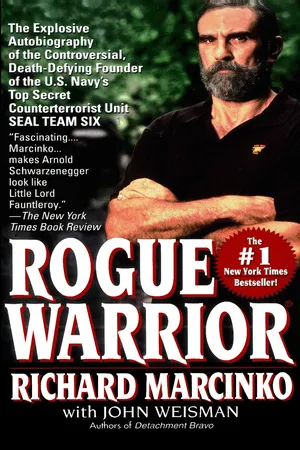
A brilliant virtuoso of violence, Richard Marcinko rose through Navy ranks to create and command one of this country's most elite and classified counterterrorist units, SEAL TEAM SIX. Now this thirty-year veteran recounts the secret missions and Special Warfare madness of his worldwide military career—and the riveting truth about the top-secret Navy SEALs.

Marcinko was almost inhumanly tough, and proved it on hair-raising missions across Vietnam and a war-torn world: blowing up supply junks, charging through minefields, jumping at 19,000 feet with a chute that wouldn't open, fighting hand-to-hand in a hellhole jungle. For the Pentagon, he organized the Navy's first counterterrorist unit: the legendary SEAL TEAM SIX, which went on classified missions from Central America to the Middle East, the North Sea, Africa and beyond.

Then Marcinko was tapped to create Red Cell, a dirty-dozen team of the military's most accomplished and decorated counterterrorists. Their unbelievable job was to test the defenses of the Navy's most secure facilities and installations. The result was predictable: all hell broke loose.

Here is the hero who saw beyond the blood to ultimate justice—and the decorated warrior who became such a maverick that the Navy brass wanted his head on a pole, and for a time, got it. Richard Marcinko—ROGUE WARRIOR.
Frequently asked questions

Yes, you can cancel anytime from the Subscription tab in your account settings on the Perlego website. Your subscription will stay active until the end of your current billing period. Learn how to cancel your subscription.
No, books cannot be downloaded as external files, such as PDFs, for use outside of Perlego. However, you can download books within the Perlego app for offline reading on mobile or tablet. Learn more here.
Perlego offers two plans: Essential and Complete
  • Essential is ideal for learners and professionals who enjoy exploring a wide range of subjects. Access the Essential Library with 800,000+ trusted titles and best-sellers across business, personal growth, and the humanities. Includes unlimited reading time and Standard Read Aloud voice.
  • Complete: Perfect for advanced learners and researchers needing full, unrestricted access. Unlock 1.4M+ books across hundreds of subjects, including academic and specialized titles. The Complete Plan also includes advanced features like Premium Read Aloud and Research Assistant.
Both plans are available with monthly, semester, or annual billing cycles.
We are an online textbook subscription service, where you can get access to an entire online library for less than the price of a single book per month. With over 1 million books across 1000+ topics, we’ve got you covered! Learn more here.
Look out for the read-aloud symbol on your next book to see if you can listen to it. The read-aloud tool reads text aloud for you, highlighting the text as it is being read. You can pause it, speed it up and slow it down. Learn more here.
Yes! You can use the Perlego app on both iOS or Android devices to read anytime, anywhere — even offline. Perfect for commutes or when you’re on the go.
Please note we cannot support devices running on iOS 13 and Android 7 or earlier. Learn more about using the app.
Yes, you can access Rogue Warrior by Richard Marcinko in PDF and/or ePUB format. We have over one million books available in our catalogue for you to explore.

Information

Publisher
Pocket Books
Year
2009
Print ISBN
9780671795931
Part
One
logo
GEEK
Chapter
logo
1
January 1981
IT WAS A BIG FIRST STEP—NINETEEN THOUSAND FEET BETWEEN the soles of my boots and the scrubby jungle—but I didn’t have time to think about that. The green light was on and the jumpmaster was pointing vaguely in my direction, so I blew a polite kiss at him and went out for a walk—took a stroll off the deep end of the C-130’s greasy ramp and dove into the nighttime sky. Just the way I’d done it more than a thousand times before.
The ice-cold slipstream punched at me as the blacked-out plane disappeared overhead. I looked down. Nothing. Almost four miles to the ground—too far to see anything yet, or for anyone down there to have heard the plane.
I looked around me. Zippo. What had I expected? To see my men? That would be impossible, too, of course. We were showing no lights, carried nothing reflective, and were all dressed in dark camouflage tigerstripes, invisible in the blackness above our objective, Vieques Island, in the Caribbean far below.
I clenched my fist and tucked my elbow in silent triumph. Yes! Right on! The first eight seconds of this operation had gone absolutely perfectly. So far, we were ahead of the curve. I checked the altimeter on my wrist then pulled the rip cord. I sensed my chute slip out of the backpack and felt it separate.
I was yanked skyward by the harness in the bungee-cord way you’re always bounced by a chute. Then all of a sudden I veered sharply to my right and began to spiral wildly, uncontrollably, toward the ground.
So much for perfection. I looked up. One of the cells of my sky-blue silk canopy had collapsed in the crosswind. I tugged on the guidelines to shake it out and fill the chute with air, but couldn’t make it happen.
It didn’t help that I was carrying almost a hundred pounds of equipment strapped to a specially built combat vest or attached to my fatigues. The weight was a problem in the thin air during HAHO—high altitude, high opening—jumps. Most of what I carried was lethal. There was my customized Beretta 92-SF in its thigh holster, along with eleven clips of ammo—165 rounds of hollow-point Hydra-Shok, custom-made hot loads that could literally blow a man’s head off. Hanging from a strap attached to my shoulder was a specially modified HK—Heckler & Koch—MP5 submachine gun and 600 rounds of jacketed hollow-point in 30-round magazines.
Then there were the other goodies: flash-bang grenades and thunder-strips to disorient bad guys; strobes and light-sticks for guiding choppers into a drop zone. Wire snips for cutting through fences. And I carried a selection of the miniaturized communications stuff we’d developed—strapped to my waist was a secure Motorola walkie-talkie (it came with lip mikes and earpieces so we could talk and listen to each other while moving. No Secret Service whispering into our shirt cuffs for us).
In the upper right-hand pocket of my combat vest was a satellite transceiver, a SATCOM unit about the same size as a cellular phone. On it I could talk to my boss, Brigadier General Dick Scholtes, who ran the Joint Special Operations Command, back at his Ops Center at Ft. Bragg, North Carolina, as clearly as if I were in the next room instead of almost two thousand miles down the road.
I laughed out loud. Maybe I should punch up Scholtes now. “Hey, General, I’m calling about this little momentary snag that’s developed. Dickie’s about to go squish.”
Another two air cells in the parasail collapsed and the chute folded in half. Okay, so it screwed up. No problem. I’d rehearsed this move maybe eighty, a hundred times during practice jumps. I did a cutaway, jettisoned the faulty canopy, then resumed free-fall. Fifteen thousand feet and cruising.
Five seconds later I yanked the cord on my second chute. It started to open nicely. Then it developed a fissure, folded in half, and collapsed just like number one, and the crazy corkscrewing began all over again.
I didn’t have any more backups.
I tore at the lines with both hands to open the parasail to its full width, screaming profanities into space.
It came to me in the absolutely clear way things come to dying men that I had been the thirteenth jumper to exit the C-130. This was a bad joke on Dickie. This wasn’t the way it was supposed to happen. Down there—where I was about to splatter myself into strawberry-colored goo—were, according to what we’d been told, thirty to forty armed terrorists, a hostage, and a hijacked nuclear weapon.
This clandestine airborne assault was the culmination of five months of bone-wrenching, take-it-to-the-limit training—eighteen hours a day, seven days a week. I was spiraling wildly in the blackness because the U.S. Navy, in its infinite wisdom, had chosen me to design, build, equip, train, and lead what I now believed to be the most effective and highly secret counterterror force in the world—SEAL Team Six.
Admiral Thomas Hayward, the chief of naval operations, gave me the order to create the unit himself, not ninety days after our disastrous April 1980 rescue attempt of the American hostages held in Tehran.
What the CNO had said to me was unequivocal: “Dick, you will not fail.”
I took his words to heart. SEAL Team Six trained harder than any unit had ever trained before, waiting for the opportunity to show the skeptical bureaucrat-sailors and dip-dunk bean-counters prevalent in Washington that it was possible for the U.S. Navy to fight back effectively against terrorists. I had cut more than a few corners and stepped on a shoe store full of toes carrying out Admiral Hayward’s order.
And I hadn’t failed—until now, it seemed. Was it now all going to come to this? Dickie gets slam-dunked and misses all the fun while the rest of the guys get to kick ass and take names?
No way. I was only forty—far too young to die. I yanked on the guides again. No fucking way I was going to buy it. Not like this. Not because my outrageously expensive, personally selected, ingeniously modified, packed-by-my-own-loving-hands, goddamn fucking parachute didn’t work.
I dragged at the lines with as much force as I could muster. Finally, the two far right-hand cells filled with air and I began a controlled descent, spiraling in lazy circles as I hung in the harness, sweating, and tried to figure out where the hell I was.
Where I was, was about three miles out over the ocean, the speed of the C-130 and the free-fall having carried me way off my original flight path. I could see beach below, so I checked my compass and altimeter and changed course, parasailing back toward the prearranged 300-square-yard landing zone, a little airstrip cut into the rough countryside about half a mile from where the terrorists were holed up. We’d chosen it as our assembly point from an ultra-high-resolution NSA satellite photo that had been faxed to us during our flight down from Norfolk.
I was at eleven thousand feet now, and by my best guesstimate I had about ten miles before touchdown. I watched the breakers wash ashore more than two miles beneath my feet, phosphorescent white crescents moving in rippling, parallel lines. Beyond the sea was the jungle. It was, as I knew from the intel pictures, scrubby jungle, the kind common to much of the Caribbean and Latin America. Not rain forest, thank God, with its treacherous high canopy of trees that made parachute landings a bitch. If it’d been rain forest we’d have had to jump way offshore and land on a narrow strip of beach, or come in by sea, swimming from a mother ship, an innocent-looking, apparently civilian vessel that passed far off the coast, or landing in specially modified IBSs—rubberized inflatables that, along with us, were dropped by ships or low-flying planes.
I looked up. No stars. No moon. The chute was now working perfectly, and from the way the wind was blowing, I knew I’d make the landing zone easily. I had a twenty-minute glide ahead of me, and I decided to sit back and enjoy the ride.
I figured I could. Surprise would certainly still be on our side. All the intelligence we’d received during our flight from the States indicated the bad guys wouldn’t be expecting us. Not so soon. That’s what made SEAL Team Six so special. We were unique; a small, highly mobile, quick-reaction team trained to do one job: kill terrorists and rescue hostages, and do it better than anybody in the world. Nobody could move as fast as we could. No other unit could come out of the water, or the sky, with equal ease.
Delta Force, the Army’s hostage-rescue unit originally commanded by my old colleague and sometime rival Colonel Charlie Beckwith, was good. But it was also big—more than two hundred operators—and it was cumbersome as a bloody elephant to move. My entire unit numbered only ninety, and we traveled light. We had to go that way: often, we had to swim to our objective with everything we’d need in tow.
Tonight, fifty-six SEAL Six jumpers parachuted off the ramps of two C-130s that had taken off from Norfolk, Virginia, six and a half hours previously. If my chute was the only one that had screwed up, they’d all be on final approach to the LZ by now, gliding into circular formations of seven, then dropping onto the ground by quickly pulling up, or flaring, just before their feet touched. It kept you from being dragged by your chute and making a furrow with your face.
Normally I’d have been a part of the pattern, but I’d been unavoidably detained and wanted to get onto the ground fast, so I flew a straight approach into the LZ. As I came in, I could hear ambient canopy flutter all around me, and I knew the team was S-turning to eat up ground speed, then corkscrew circling and landing just as we’d trained to do. As for me, I came in fast and high—I didn’t brake as I was supposed to, never flared, and took out a small tree at the end of the overgrown runway. I never even saw it coming. I was at maybe fifteen feet or so and then—blam—took the trunk smack in the face.
It was a good hurt. The kind that made me feel I was alive. I left the canopy up in the foliage, hit the deck, and started to assemble the teams.
We did a fast count. I was ecstatic. Every man had made the LZ with equipment intact. I called JSOC—the Joint Special Operations Command—on the SATCOM and reported we were fifty-six out of fifty-six on the ground and were about to move.
Paul Henley, my XO—Six’s executive officer, who I’d nicknamed PV because of his Prince Valiant haircut—and I formed the teams into four prearranged assault groups.
I punched Paul on the upper arm. “Let’s go hunting.”
Following our NSA maps, we moved off silently into the jungle to the southwest, single file, weapons at the ready. We functioned entirely through hand signals, the way I’d done in Vietnam more than a decade earlier. Our moves were choreographed into a deadly sort of ballet—pas de mort—we’d worked on for months. No one spoke. No one had to. By now, PV and I thought alike. He’d been the first man I’d chosen for Six, a bright, energetic, capable young SEAL officer who could jump and shoot and party with the best of them.
Moreover, unlike me, he was an Academy grad, which gave Six some cachet with the bean counters. The Navy’s caste system has the reputation of being about as rigid as any in the world. The first thing most Navy officers do when they meet you is look at your hands to see whether or not you’re wearing a Naval Academy class ring. If you do, then you’re a part of the club. If you don’t, then you’re an untouchable. I was the original untouchable. The only things I wore on my knuckles were scars. But I loved my work and was uncommonly good at it, and in a few rare cases—mine included—the Navy establishment rewards ability almost as nicely as it does jewelry.
I checked my watch. Twenty-one seventeen. Two minutes behind the schedule I kept in my head.
• • •
We’d gotten the word to move twenty-seven hours beforehand. It came from JSOC. The first info was pretty sketchy: a Puerto Rican terrorist group called the Macheteros, or “machete wielders,” had broken onto the National Guard airfield just outside San Juan and destroyed $40 million worth of planes and equipment. That much of the story would make it into the newspapers.
What wouldn’t be reported, according to JSOC, was that during the attack the Macheteros—we commonly referred to terrorists in the radio phonetic term as Ts, or tangos—took a hostage, and a pallet load of equipment. Including, it was believed, a nuclear weapon. No one was sure. Don’t ask how no one could be sure whether or not an A-bomb was missing. This was the United States Air Force after all—home of $600 toilet seats and $200 pliers.
Anyway, the Macheteros, I was told, had managed to evade police dragnets, roadblocks, and SWAT teams and disappear. Except that U.S. intelligence tracked them to Vieques, a small island due east of Puerto Rico, where they had a clandestine training camp. That was where they were now.
I knew Vieques Island. I’d trained there as a member of Underwater Demolition Team 21 two decades ago. It seemed somehow incongruous that a bunch of tangos would choose for their clandestine base an island that normally crawled with U.S. military personnel.
Moreover, we’d had so many false alarms, I was suspicious that this scramble was just another cry-wolf operational drill, or another training exercise to be done in “real time,” known as a full mission profile. Indeed, we’d been scrambled by Dick Scholtes before, only to find out while we were in the air on the way to the “target” that we were part of some goatfuck war game JSOC had based on a real incident, to make us think we were playing for keeps.
Game or not, I was willing to play along. We had never performed a massed night jump over a hostile target. We’d also never coordinated so many elements at once—clandestine insertion, taking down the target, snatching a hostage and a nuke, and synchronizing an extraction from a hot landing zone was as complicated a series of tasks as SEAL Team Six had been required to perform in its short history.
The call-up had gone right according to schedule. Each man at Six carried a beeper at all times. When it went off, he had four hours to show up at a prearranged location with his equipment.
During the initial hours, while the crews were assembling, PV and I called in my ops boss, Marko, and Six’s master chief petty officer, Big Mac, and we began putting together our basic strategy. That’s the way it worked at Six. Officers, petty officers (Navy noncoms), and enlisted all had a say in what went on, although I made the ultimate aye-or-nay decision on everything.
We realized from the start that a seaborne operation was out of the question because it would have taken too long to land from a mother ship. That meant we’d be launching an air strike. And given the location of the terrorist camp, it would be easier to go straight in than drop us eight or ten miles offshore with our boats.
The first intelligence we received came from a guy I’ll call Pepperman, a former Marine lieutenant colonel who was working special ops assistance at the National Security Agency at Ft. Meade, Maryland, out of a room five or six stories below ground. That basement room was the hub for covert and clandestine operations all over the world, and my old friend Pepperman sat there like a balding Buddha, watching and listening as things went down.
Pepperman—I called him that because he grew his own incredibly hot Thai peppers in the backyard of his suburban Maryland home, a culinary holdover from his special ops days behind the lines in Southeast Asia—was one of those wonderful, ex-military scavengers who could get you anything, anytime. In Vietnam he’d probably been the type who could lay his hands on a bottle of Chivas or a case of beer even though he was six days into a ten-day long-range patrol be...

Table of contents

  1. Cover
  2. Dedication
  3. Foreword
  4. Part One: Geek
  5. Part Two: Unodir
  6. Glossary
  7. Photographs
  8. About Richard Marcinko and John Weisman
  9. Endnotes
  10. Index
  11. Copyright