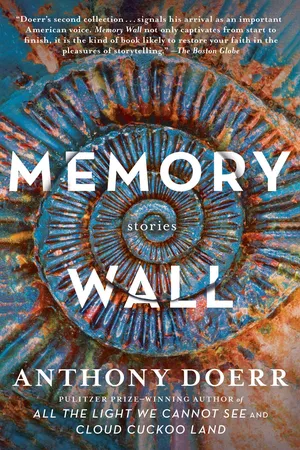
Memory Wall
eBook - ePub

Memory Wall

Stories

  1. 256 pages
  2. English
  3. ePUB (mobile friendly)
  4. Available on iOS & Android
eBook - ePub

Memory Wall

Stories

About this book

In the wise and beautiful second collection from the acclaimed, Pulitzer Prize-winning #1 New York Times bestselling author of All the Light We Cannot See, and Cloud Cuckoo Land, "Doerr writes about the big questions, the imponderables, the major metaphysical dreads, and he does it fearlessly" ( The New York Times Book Review ). Set on four continents, Anthony Doerr's new stories are about memory, the source of meaning and coherence in our lives, the fragile thread that connects us to ourselves and to others. Every hour, says Doerr, all over the globe, an infinite number of memories disappear. Yet at the same time children, surveying territory that is entirely new to them, push back the darkness, form fresh memories, and remake the world.In the luminous and beautiful title story, a young boy in South Africa comes to possess an old woman's secret, a piece of the past with the power to redeem a life. In "The River Nemunas, " a teenage orphan moves from Kansas to Lithuania to live with her grandfather, and discovers a world in which myth becomes real. "Village 113, " winner of an O'Henry Prize, is about the building of the Three Gorges Dam and the seed keeper who guards the history of a village soon to be submerged. And in "Afterworld, " the radiant, cathartic final story, a woman who escaped the Holocaust is haunted by visions of her childhood friends in Germany, yet finds solace in the tender ministrations of her grandson.Every story in Memory Wall is a reminder of the grandeur of life--of the mysterious beauty of seeds, of fossils, of sturgeon, of clouds, of radios, of leaves, of the breathtaking fortune of living in this universe. Doerr's language, his witness, his imagination, and his humanity are unparalleled in fiction today.
Frequently asked questions

Yes, you can cancel anytime from the Subscription tab in your account settings on the Perlego website. Your subscription will stay active until the end of your current billing period. Learn how to cancel your subscription.
No, books cannot be downloaded as external files, such as PDFs, for use outside of Perlego. However, you can download books within the Perlego app for offline reading on mobile or tablet. Learn more here.
Perlego offers two plans: Essential and Complete
  • Essential is ideal for learners and professionals who enjoy exploring a wide range of subjects. Access the Essential Library with 800,000+ trusted titles and best-sellers across business, personal growth, and the humanities. Includes unlimited reading time and Standard Read Aloud voice.
  • Complete: Perfect for advanced learners and researchers needing full, unrestricted access. Unlock 1.4M+ books across hundreds of subjects, including academic and specialized titles. The Complete Plan also includes advanced features like Premium Read Aloud and Research Assistant.
Both plans are available with monthly, semester, or annual billing cycles.
We are an online textbook subscription service, where you can get access to an entire online library for less than the price of a single book per month. With over 1 million books across 1000+ topics, we’ve got you covered! Learn more here.
Look out for the read-aloud symbol on your next book to see if you can listen to it. The read-aloud tool reads text aloud for you, highlighting the text as it is being read. You can pause it, speed it up and slow it down. Learn more here.
Yes! You can use the Perlego app on both iOS or Android devices to read anytime, anywhere — even offline. Perfect for commutes or when you’re on the go.
Please note we cannot support devices running on iOS 13 and Android 7 or earlier. Learn more about using the app.
Yes, you can access Memory Wall by Anthony Doerr in PDF and/or ePUB format, as well as other popular books in Literature & Literature General. We have over one million books available in our catalogue for you to explore.

Information

Publisher
Scribner
Year
2010
Print ISBN
9781439182840
eBook ISBN
9781439182857

Memory Wall

TALL MAN IN THE YARD

Seventy-four-year-old Alma Konachek lives in Vredehoek, a suburb above Cape Town: a place of warm rains, big-windowed lofts, and silent, predatory automobiles. Behind her garden, Table Mountain rises huge, green, and corrugated; beyond her kitchen balcony, a thousand city lights wink and gutter behind sheets of fog like candleflames.
One night in November, at three in the morning, Alma wakes to hear the rape gate across her front door rattle open and someone enter her house. Her arms jerk; she spills a glass of water across the nightstand. A floorboard in the living room shrieks. She hears what might be breathing. Water drips onto the floor.
Alma manages a whisper. ā€œHello?ā€
A shadow flows across the hall. She hears the scrape of a shoe on the staircase, then nothing. Night air blows into the room—it smells of frangipani and charcoal. Alma presses a fist over her heart.
Beyond the balcony windows, moonlit pieces of clouds drift over the city. Spilled water creeps toward her bedroom door.
ā€œWho’s there? Is someone there?ā€
The grandfather clock in the living room pounds through the seconds. Alma’s pulse booms in her ears. Her bedroom seems to be rotating very slowly.
ā€œHarold?ā€ Alma remembers that Harold is dead but she cannot help herself. ā€œHarold?ā€
Another footstep from the second floor, another protest from a floorboard. What might be a minute passes. Maybe she hears someone descend the staircase. It takes her another full minute to summon the courage to shuffle into the living room.
Her front door is wide open. The traffic light at the top of the street flashes yellow, yellow, yellow. The leaves are hushed, the houses dark. She heaves the rape gate shut, slams the door, sets the bolt, and peers out the window lattice. Within twenty seconds she is at the hall table, fumbling with a pen.
A man, she writes. Tall man in the yard.

MEMORY WALL

Alma stands barefoot and wigless in the upstairs bedroom with a flashlight. The clock down in the living room ticks and ticks, winding up the night. A moment ago Alma was, she is certain, doing something very important. Something life-and-death. But now she cannot remember what it was.
The one window is ajar. The guest bed is neatly made, the coverlet smooth. On the nightstand sits a machine the size of a microwave oven, marked Property of Cape Town Memory Research Center. Three cables spiraling off it connect to something that looks vaguely like a bicycle helmet.
The wall in front of Alma is smothered with scraps of paper. Diagrams, maps, ragged sheets swarming with scribbles. Shining among the papers are hundreds of plastic cartridges, each the size of a matchbook, engraved with a four-digit number and pinned to the wall through a single hole.
The beam of Alma’s flashlight settles on a color photograph of a man walking out of the sea. She fingers its edges. The man’s pants are rolled to the knees; his expression is part grimace, part grin. Cold water. Across the photo, in handwriting she knows to be hers, is the name Harold. She knows this man. She can close her eyes and recall the pink flesh of his gums, the folds in his throat, his big-knuckled hands. He was her husband.
Around the photo, the scraps of paper and plastic cartridges build outward in crowded, overlapping layers, anchored with pushpins and chewing gum and penny nails. She sees to-do lists, jottings, drawings of what might be prehistoric beasts or monsters. She reads: You can trust Pheko. And Taking Polly’s Coca-Cola. A flyer says: Porter Properties. There are stranger phrases: dinocephalians, late Permian, massive vertebrate graveyard. Some sheets of paper are blank; others reveal a flurry of cross-outs and erasures. On a half-page ripped from a brochure, one phrase is shakily and repeatedly underlined: Memories are located not inside the cells but in the extracellular space.
Some of the cartridges have her handwriting on them, too, printed below the numbers. Museum. Funeral. Party at Hattie’s.
Alma blinks. She has no memory of writing on little cartridges or tearing out pages of books and tacking things to the wall.
She sits on the floor in her nightgown, legs straight out. A gust rushes through the window and the scraps of paper come alive, dancing, tugging at their pins. Loose pages eddy across the carpet. The cartridges rattle lightly.
Near the center of the wall, her flashlight beam again finds the photograph of a man walking out of the sea. Part grimace, part grin. That’s Harold, she thinks. He was my husband. He died. Years ago. Of course.
Out the window, beyond the crowns of the palms, beyond the city lights, the ocean is washed in moonlight, then shadow. Moonlight, then shadow. A helicopter ticks past. The palms flutter.
Alma looks down. There is slip of paper in her hand. A man, it says. Tall man in the yard.

DR. AMNESTY

Pheko is driving the Mercedes. Apartment towers reflect the morning sun. Sedans purr at stoplights. Six different times Alma squints out at the signs whisking past and asks him where they are going.
ā€œWe’re driving to see the doctor, Mrs. Alma.ā€
The doctor? Alma rubs her eyes, unsure. She tries to fill her lungs. She fidgets with her wig. The tires squeal as the Mercedes climbs the ramps of a parking garage.
Dr. Amnesty’s staircase is stainless steel and bordered with ferns. Here’s the bulletproof door, the street address stenciled in the corner. It’s familiar to Alma in the way a house from childhood would be familiar. As if she has doubled in size in the meantime.
They are buzzed into a waiting room. Pheko drums his fingertips on his knee. Four chairs down, two well-dressed women sit beside a fish tank, one a few decades younger than the other. Both have fat pearls studded through each earlobe. Alma thinks: Pheko is the only black person in the building. For a moment she cannot remember what she is doing here. But this leather on the chair, the blue gravel in the saltwater aquarium—it is the memory clinic. Of course. Dr. Amnesty. In Green Point.
After a few minutes Alma is escorted to a padded chair overlaid with crinkly paper. It’s all familiar now: the cardboard pouch of rubber gloves, the plastic plate for her earrings, two electrodes beneath her blouse. They lift off her wig, rub a cold gel onto her scalp. The television panel shows sand dunes, then dandelions, then bamboo.
Amnesty. A ridiculous surname. What does it mean? A pardon? A reprieve? But more permanent than a reprieve, isn’t it? Amnesty is for wrongdoings. For someone who has done something wrong. She will ask Pheko to look it up when they get home. Or maybe she will remember to look it up herself.
The nurse is talking.
ā€œAnd the remote stimulator is working well? Do you feel any improvements?ā€
ā€œImprovements?ā€ She thinks so. Things do seem to be improving. ā€œThings are sharper,ā€ Alma says. She believes this is the sort of thing she is supposed to say. New pathways are being forged. She is remembering how to remember. This is what they want to hear.
The nurse murmurs. Feet whisper across the floor. Invisible machinery hums. Alma can feel, numbly, the rubber caps being twisted out of the ports in her skull and four screws being threaded simultaneously into place. There is a note in her hand: Pheko is in the waiting room. Pheko will drive Mrs. Alma home after her session. Of course.
A door with a small, circular window in it opens. A pale man in green scrubs sweeps past, smelling of chewing gum. Alma thinks: There are other padded chairs in this place, other rooms like this one, with other machines prying the lids off other addled brains. Ferreting inside them for memories, engraving those memories into little square cartridges. Attempting to fight off oblivion.
Her head is locked into place. Aluminum blinds clack against the window. In the lulls between breaths, she can hear traffic sighing past.
The helmet comes down.

THREE YEARS BEFORE, BRIEFLY

ā€œMemories aren’t stored as changes to molecules inside brain cells,ā€ Dr. Amnesty told Alma during her first appointment, three years ago. She had been on his waiting list for ten months. Dr. Amnesty had straw-colored hair, nearly translucent skin, and invisible eyebrows. He spoke English as if each word were a tiny egg he had to deliver carefully through his teeth.
ā€œThis is what they thought forever but they were wrong. The truth is that the substrate of old memories is located not inside the cells but in the extracellular space. Here at the clinic we target those spaces, stain them, and inscribe them into electronic models. In the hopes of teaching damaged neurons to make proper replacements. Forging new pathways. Re-remembering.
ā€œDo you understand?ā€
Alma didn’t. Not really. For months, ever since Harold’s death, she had been forgetting things: forgetting to pay Pheko, forgetting to eat breakfast, forgetting what the numbers in her checkbook meant. She’d go to the garden with the pruners and arrive there a minute later without them. She’d find her hairdryer in a kitchen cupboard, car keys in the tea tin. She’d rummage through her mind for a noun and come up empty-handed: Casserole? Carpet? Cashmere?
Two doctors had already diagnosed the dementia. Alma would have preferred amnesia: a quicker, less cruel erasure. This was a corrosion, a slow leak. Seven decades of stories, five decades of marriage, four decades of working for Porter Properties, too many houses and buyers and sellers to count—spatulas and salad forks, novels and recipes, nightmares and daydreams, hellos and goodbyes. Could it all really be wiped away?
ā€œWe don’t offer a cure,ā€ Dr. Amnesty was saying, ā€œbut we might be able to slow it down. We might be able to give you some memories back.ā€
He set the tips of his index fingers against his nose and formed a steeple. Alma sensed a pronouncement coming.
ā€œIt tends to unravel very quickly, without these treatments,ā€ he said. ā€œEvery day it will become harder for you to be in the world.ā€
Water in a vase, chewing away at the stems of roses. Rust colonizing the tumblers in a lock. Sugar eating at the dentin of teeth, a river eroding its banks. Alma could think of a thousand metaphors, and all of them were inadequate.
She was a widow. No children, no pets. She had her Mercedes, a million and a half rand in savings, Harold’s pension, and the house in Vredehoek. Dr. Amnesty’s procedure offered a measure of hope. She signed up.
The operation was a fog. When she woke, she had a headache and her hair was gone. With her fingers she probed the four rubber caps secured into her skull.
A week later Pheko drove her back to the clinic. One of Dr. Amnesty’s nurses escorted her to a leather chair that looked something like the ones in dental offices. The helmet was merely a vibration at the top of her scalp. They would be reclaiming memories, they said; they could not predict if the memories would be good ones or bad ones. It was painless. Alma felt as though spiders were stringing webs though her head.
Two hours later Dr. Amnesty sent her home from that first session with a remote memory stimulator and nine little cartridges in a paperboard box. Each cartridge was stamped from the same beige polymer, with a four-digit number engraved into the top. She eyed the remote player for two days before taking it up to the upstairs bedroom one windy noon when Pheko was out buying groceries.
She plugged it in and inserted a cartridge at random. A low shudder rose through the vertebrae of her neck, and then the room fell away in layers. The walls dissolved. Through rifts in the ceiling, the sky rippled like a flag. Then Alma’s vision snuffed out, as if the fabric of her house had been yanked downward through a drain, and a prior world rematerialized.
She was in a museum: high ceiling, poor lighting, a smell like old magazines. The South African Museum. Harold was beside her, leaning over a glass-fronted display, excited, his eyes shining—look at him! So young! His khakis were too short, black socks showed above his shoes. How long had she known him? Maybe six months?
She had worn the wrong shoes: tight, too rigid. The weather had been perfect that day and Alma would have preferred to sit in the Company Gardens under the trees with this tall new boyfriend. But the museum was what Harold wanted and she wanted to be with him. Soon they were in a fossil room, a couple dozen skeletons on podiums, some as big as rhinos, some with yardlong fangs, all with massive, eyeless skulls.
ā€œOne hundred and eighty million years older than the dinosaurs, hey?ā€ Harold whispered.
Nearby, schoolgirls chewed gum. Alma watched the tallest of them spit slowly into a porcelain drinking fountain, then suck the spit back into her mouth. A sign labeled the fountain For Use by White Persons in careful calligraphy. Alma felt as if her feet were being crushed in vises.
ā€œJust another minute,ā€ Harold said.
Seventy-one-year-old Alma watched everything through twenty-four-year-old Alma. She was twenty-four-year-old Alma! Her palms were damp and her feet were aching and she was on a date with a living Harold! A young, skinny Harold! He raved about the skeletons; they looked like animals mixed with animals, he said. Reptile heads on dog bodies. Eagle heads on hippo bodies. ā€œI never get tired of seeing them,ā€ young Harold was telling young Alma, a boyish luster in his face. Two hundred and fifty million years ago, he said, these creatures died in the mud, their bones compressed slowly into stone. Now someone had hacked them out; now they were reassembled in the light.
ā€œThese were our ancestors, too,ā€ Harold whispered. Alma could hardly bear to look at them: They were eyeless, fleshless, murderous; they seemed engineered only to tear one another apart. She wanted to take this tall boy out to the gardens and sit hip-to-hip with him on a bench and take off her shoes. But Harold pulled her along. ā€œHere’s the gorgonopsian. A gorgon. Big as a tiger. Two, three hundred kilograms. From the Permian. That’s only the second complete ...

Table of contents

  1. Cover
  2. Dedication
  3. Memory Wall
  4. Procreate, Generate
  5. The Demilitarized Zone
  6. Village 113
  7. The River Nemunas
  8. Afterworld
  9. Acknowledgments
  10. ā€˜Cloud Cuckoo Land’ Teaser
  11. About Anthony Doerr
  12. Copyright