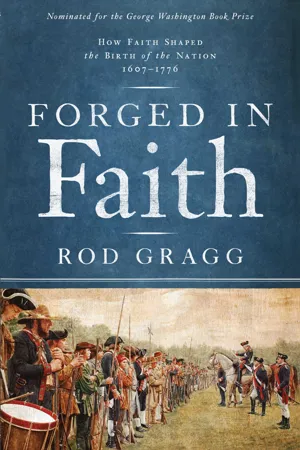
The true drama of how faith motivated America’s Founding Fathers, influenced the Declaration of Independence and inspired the birth of the nation.
This fascinating history, based on meticulous research into the correspondence and documentation of the founding fathers leading up to and encompassing the crafting of the Declaration of Independence, sheds light on how the Judeo-Christian worldview motivated America’s founding fathers, influenced national independence, inspired our foundational documents, and established the American nation. Written with the pacing and drama of an enticing drama, Forged in Faith is crafted for popular appeal with a compelling mix of dramatized story and action-driven narrative, yet with the authenticity and academic verity of historian Rod Gragg.
Frequently asked questions
Yes, you can cancel anytime from the Subscription tab in your account settings on the Perlego website. Your subscription will stay active until the end of your current billing period. Learn how to cancel your subscription.
No, books cannot be downloaded as external files, such as PDFs, for use outside of Perlego. However, you can download books within the Perlego app for offline reading on mobile or tablet. Learn more here.
Perlego offers two plans: Essential and Complete
Essential is ideal for learners and professionals who enjoy exploring a wide range of subjects. Access the Essential Library with 800,000+ trusted titles and best-sellers across business, personal growth, and the humanities. Includes unlimited reading time and Standard Read Aloud voice.
Complete: Perfect for advanced learners and researchers needing full, unrestricted access. Unlock 1.4M+ books across hundreds of subjects, including academic and specialized titles. The Complete Plan also includes advanced features like Premium Read Aloud and Research Assistant.
Both plans are available with monthly, semester, or annual billing cycles.
We are an online textbook subscription service, where you can get access to an entire online library for less than the price of a single book per month. With over 1 million books across 1000+ topics, weâve got you covered! Learn more here.
Look out for the read-aloud symbol on your next book to see if you can listen to it. The read-aloud tool reads text aloud for you, highlighting the text as it is being read. You can pause it, speed it up and slow it down. Learn more here.
Yes! You can use the Perlego app on both iOS or Android devices to read anytime, anywhere â even offline. Perfect for commutes or when youâre on the go. Please note we cannot support devices running on iOS 13 and Android 7 or earlier. Learn more about using the app.
Yes, you can access Forged in Faith by Rod Gragg in PDF and/or ePUB format, as well as other popular books in History & Early American History. We have over one million books available in our catalogue for you to explore.
Already they were bickering. It was day two of the First Continental CongressâTuesday, September 6, 1774. Delegates from twelve of Americaâs thirteen colonies had assembled at Carpentersâ Hall in Philadelphia to officially react to deteriorating relations between Great Britain and its American colonies. Decades of disagreement had led to a tense crisis between the colonies and the Mother Country. In an attempt to resolve the issues, the colonies had dispatched delegations to Philadelphiaâs grand assembly, which was the first of its kind in America. Opening deliberations had been cordial and productive. The delegates had voted to call their assembly the âContinental Congress,â had appointed Virginia delegate Peyton Randolph as its president, and had agreed to meet in Philadelphiaâs Carpentersâ Hall. Then came day twoâand the opening display of cooperation sank into a mire of argument.1
At issue was the question of how to count votes. Large colonies wanted their large populations to count for more. Small colonies wanted equal representation. Amid the debate, Philadelphiaâs church bells began tolling at the news that British forces were bombarding the city of Boston. It was a false alarm, but it added to an atmosphere of anxiety in Congress. The dark mood may have been heightened by the deadly risk each delegate faced by simply being there. The unprecedented assembly was unauthorized by Britainâs King George III or the British Parliament. Among the delegates in attendance were men who believed the British governmentâs treatment of the American colonies amounted to tyranny. Such politics were deemed treasonous by some, and the delegates undoubtedly knew what grisly fate sometimes befell traitors to the Crown.2
If arrested and convicted of high treason, a delegate might find himself in Great Britainâs notorious Tower of London, waiting to be âdrawn and quartered.â If so sentenced, he would first be hanged until almost dead, then cut down and disemboweled. While still alive, he would be forced to watch his intestines burned. Then, one by one, other bodily organs would be torturously removed until death finally occurred. Afterward, his corpse would be beheaded and his torso cut into quarters. Finally, his head would be publicly mounted on a post. âLet us prepare for the worst,â New Jersey delegate Abraham Clark at one point advised a colleague; âwe can Die here but once.â Debate on how to count votes concluded with a consensusâa single vote for each delegationâbut the tension among delegates led some to fear that the Continental Congress might dissolve in disunity.3
Then Massachusetts delegate Thomas Cushing made a motion. Cushing was a forty-nine-year-old Boston lawyer, a Harvard alumnus, and a successful merchant. A member of the Massachusetts Committee of Safety, he was a prominent champion of Colonial political rightsâalways âbusy in the interest of liberty,â according to a colleague. He observed the second dayâs tense deliberations with the savvy of a seasoned statesmanâthen he acted. From now on, Cushing formally proposed, Congress should officially open its day with prayer. The motion reflected Cushingâs personal faithâhe was a deacon at Bostonâs Old South Congregational Churchâand it also reflected the common faith of most delegates. Even so, Cushingâs motion for prayer provoked an immediate challenge.4
Concerns were voiced by John Rutledge of South Carolina and John Jay of New York. A thirty-five-year-old London-educated attorney, Rutledge was renowned for his eloquence and political acumen. The older of two brothers in the South Carolina delegation, he would eventually become his stateâs governor and later the chief justice of the U.S. Supreme Court. He was anything but a critic of Christianity: tutored by clergymen as a child, he was an Anglican who worshipped at Charlestonâs St. Michaelâs Church.5
John Jay was also a believer. At twenty-eight, the New York attorney was a prominent member of New York Cityâs Trinity Church. Descended from French Huguenots who had been driven from Europe for their Protestant faith, he would eventually become president of the American Bible Society. Like Rutledge, he too would someday become a governor and a U.S. chief justice, andâlike Rutledgeâhe made no argument for separation of church and state. They were merely concerned that a congressional prayer might increase disunity because so many Christian denominations were represented in Congress. Could the delegates unite in a congressional act of worship?6
Massachusetts delegate Samuel Adams believed soâand he quickly rose to support Cushingâs prayer motion. By almost any measure, Sam Adams was the most famous advocate of Colonial rights in Americaâand the most controversial. Politics was his passion, and he was a master of the craft. An instrumental leader in the Massachusetts legislature, he was viewed by many as Colonial Americaâs leading defender, but Britainâs leaders called him an âangel of darkness.â He too was devout. Raised in a family of committed Christians, he had considered the ministry in his youth. Now, as a middle-aged Calvinist, he took his faith seriously, and was said to possess âthe dogmatism of a priest.â7
He was âno Bigot,â Sam Adams told his fellow delegates. He âcould hear a Prayer from a Gentleman of Piety and Virtue, who was at the same Time a Friend to his Countryââand he heartily endorsed the call to congressional prayer. Congress agreedâand promptly passed Cushingâs motion. Beginning the next day, the Continental Congress would officially open every dayâs session with prayer. But who would be the first to pray? In an obvious display of congressional unity, Samuel Adams, a Puritan Congregationalist, nominated an Anglican clergyman to offer the first official prayer. Congress approved his nomination and promptly sent an invitation to the selected minister.8
Plead my cause, O LORD, with them that strive with me: fight against them that fight against me. Take hold of shield and buckler, and stand up for mine help. Draw out also the spear, and stop the way against them that persecute me: say unto my soul, I am thy salvation.
Let them be confounded and put to shame that seek after my soul: let them be turned back and brought to confusion that devise my hurt. Let them be as chaff before the wind: and let the angel of the LORD chase them. Let their way be dark and slippery: and let the angel of the lord persecute them.
For without cause have they hid for me their net in a pit, which without cause they have digged for my soul. Let destruction come upon him at unawares; and let his net that he hath hid catch himself: into that very destruction let him fall. And my soul shall be joyful in the LORD: it shall rejoice in his salvation. âŠLet them be ashamed and brought to confusion together that rejoice at mine hurt: let them be clothed with shame and dishonour that magnify themselves against me.
Let them shout for joy, and be glad, that favour my righteous cause: yea, let them say continually, Let the lord be magnified, which hath pleasure in the prosperity of his servant. And my tongue shall speak of thy righteousness and of thy praise all the day long.10
O! Lord, our heavenly father, King of Kings and Lord of lords: who dost from thy throne behold all the dwellers upon earth and reignest with power supreme & uncontrouled over all kingdoms, empires and governments, look down in mercy, we beseech thee, upon these our American states who have fled to thee from the road of the oppressor and thrown themselves upon thy gracious protection, desiring henceforth to be dependent only on thee.
To thee they have appealed for the righteousness of their Cause; to Thee do they look up, for that countenance & support which Thou alone canst give. Take them, therefore, Heavenly Father, under thy nurturing care: give them wisdom in council, valour in the field. Defeat the malicious designs of our cruel adversaries. Convince them of the unrighteousness of their cause. And if they persist in their sanguinary purposes, O! let the voice of thy unerring justice sounding in their hearts constrain them to drop the weapons of war from their enerved hands in the day of battle.
Be thou present, O God of Wisdom and direct the counsels of this honourable Assembly. Enable them to settle things upon the best and surest foundation, that the scene of blood may be speedily closed; that harmony and peace may effectually be restored, and truth and justice, religion and piety prevail and flourish amongst thy people. Preserve the health of their bodies and the vigour of their minds; shower down upon them and the millions they represent such temporal blessings as Thou seest expedient for them in this world, and crown them with everlasting glory in the world to come. All this we ask in the name and through the merits of Jesus Christ thy son, Our Saviour, Amen.11
Their decision to find their way by faith was typical of Colonial America.12 In eighteenth-century America, observed Colonial scholar Patricia Bonomi, âthe idiom of religion penetrated all discourse, underlay all thought, marked all observances [and] gave meaning to every public and private crisis.â The philosophical foundation of Colonial American culture, law, and government was the Judeo-Christian worldview. It was also the flame of inspiration that fired the American quest for freedom. The common people of Colonial America and their leaders would soon establish a new nation, and it would be founded on an old Bookâthe Bible.13
CHAPTER 2
âNew Jerusalemâ
From the overhanging limbs of a riverside tree, Robert Hunt rigged a canopy from an unwanted sail, declared the crude shelter a âchurch,â and called his congregation to worship. It was 1607, and Hunt was the chaplain of what would be the first successful English colony in Americaâthe newly founded Jamestown settlement on the forested coast of Virginia. An Anglican minister who had been educated at Cambridge University, he had answered a call to leave his parish church and accompany three shiploads of English colonists to the foreboding wilds of the New World. No English colony had yet survived in North America, and only males were allowed on the maiden voyage to Jamestown. So taking the post of chaplain or vicar meant assuming grave risks, and saying good-bye to his wife and two children for an unknown period. Even so, Hunt had felt led to accept the call. On December 19, 1606, he and 104 other colonists had left England aboard the Susan Constant, the Discovery, and the Godspeedâbound for the distant, mysterious New World.1
Calamity befell Hunt almost immediately. Stormy weather forced the ships to hug the English coast for two weeks, and the chaplain became seriously ill with an unidentified shipboard malady while still a mere twenty miles from home. The other passengers expected him to die, but Hunt surprised them and recovered. He then set about winning their trust. That was no small achievement: they were a boisterous, bickering lot, and, according to one of their number, a few were âlittle better than Atheists.â By the time they made landfall in Virginiaâs Cape Henry in April 1607, however, they were willing to join Hunt in their first collective action in the New World: they erected a cross at Cape Henry, and thanked God for safe passage. The chaplainâs love for the Lord and his pastorâs heart for the people reportedly won their respect. So too, perhaps, did his pluckâhe was described as âcourageousâ as well as âhonest [and] religious.â2
Whether by patience, pluck, or providenceâor all threeâthe determined chaplain brought light into the âdarknessâ of the New World wilderness. Sobered by an Indian attack that killed two of their number, the settlers moved inland from Cape Henry and established a crude settlement on the James River, which they named Jamestown in honor of the king. Immediately, the Reverend Hunt took an active role. As Jamestownâs chaplain and vicar, he dedicated the selected site âin the name of Godâ and shouldered a share of the physical laborââWe are all laborers in a common vineyard,â he told the colonists. In his ministry, he summoned the settlers to public prayer mornings and evenings, preached two sermons every Sunday, oversaw regular communion, and tended to the colonists like a shepherd to his flock. Eventually, he moved worship services to a church that boasted four walls, even though one worshipper called it a âhomely thing like a barne.â3
Hacking...
Table of contents
Cover Page
Title Page
INTRODUCTION
CHAPTER 1 âPlead Our Cause O Lordâ
CHAPTER 2 âNew Jerusalemâ
CHAPTER 3 âOne Small Candleâ
CHAPTER 4 âFarewell Dear Englandâ
CHAPTER 5 âA City upon a Hillâ
CHAPTER 6 âGodâs Merciful Providenceâ
CHAPTER 7 âThe Holy Experimentâ
CHAPTER 8 âFor Our Saviour and Our Sovereignâ
CHAPTER 9 âThe Great Awakeningâ
CHAPTER 10 âIt Seemâd as if All the World Were Growing Religiousâ
CHAPTER 11 âWhere the Spirit of the Lord is There is Libertyâ
CHAPTER 12 âAn Appeal to God and the Worldâ
CHAPTER 13 âThe Love of Liberty is Interwoven in the Soul of Manâ
CHAPTER 14 âThou Hast Brought a Vine Out of Egyptâ