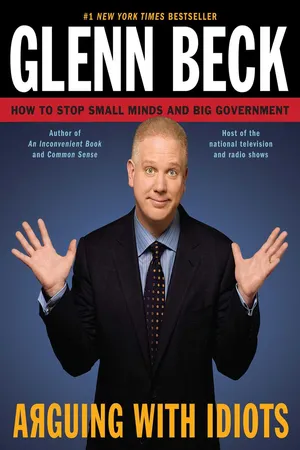
Arguing with Idiots
eBook - ePub

Arguing with Idiots

How to Stop Small Minds and Big Government

  1. 336 pages
  2. English
  3. ePUB (mobile friendly)
  4. Available on iOS & Android
eBook - ePub

Arguing with Idiots

How to Stop Small Minds and Big Government

About this book

Glenn Beck, the New York Times bestselling author of The Great Reset, provides the ultimate handbook for tackling and winning life’s most important arguments.

FUNNY. FRIGHTENING. TRUE.

The #1 New York Times bestseller that gives you the right answers when idiots leave you speechless!

It happens to all of us: You’re minding your own business, when some idiot* informs you that guns are evil, the Prius will save the planet, or the rich have to finally start paying their fair share of taxes.

Just go away! you think to yourself—but they only get more obnoxious. Your heart rate quickens. You start to sweat. But never fear, for Glenn Beck has stumbled upon the secret formula to winning arguments against people with big mouths and small minds: knowing the facts.

And this book is full of them.

The next time your Idiot Friends tell you how gun control prevents gun violence, you’ll tell them all about England’s handgun ban (see page 53). When they insist that we should copy the UK’s health-care system, you’ll recount the horrifying facts you read on page 244. And the next time you hear how produce prices will skyrocket without illegal workers, you’ll have the perfect rebuttal (from page 139). Armed with the ultimate weapon—the truth—you can now tolerate (and who knows, maybe even enjoy?) your encounters with idiots everywhere!

*Idiots can’t be identified through voting records; look instead for people who hide behind stereotypes, embrace partisanship, and believe that bumper sticker slogans are a substitute for common sense.
Frequently asked questions

Yes, you can cancel anytime from the Subscription tab in your account settings on the Perlego website. Your subscription will stay active until the end of your current billing period. Learn how to cancel your subscription.
At the moment all of our mobile-responsive ePub books are available to download via the app. Most of our PDFs are also available to download and we're working on making the final remaining ones downloadable now. Learn more here.
Perlego offers two plans: Essential and Complete
  • Essential is ideal for learners and professionals who enjoy exploring a wide range of subjects. Access the Essential Library with 800,000+ trusted titles and best-sellers across business, personal growth, and the humanities. Includes unlimited reading time and Standard Read Aloud voice.
  • Complete: Perfect for advanced learners and researchers needing full, unrestricted access. Unlock 1.4M+ books across hundreds of subjects, including academic and specialized titles. The Complete Plan also includes advanced features like Premium Read Aloud and Research Assistant.
Both plans are available with monthly, semester, or annual billing cycles.
We are an online textbook subscription service, where you can get access to an entire online library for less than the price of a single book per month. With over 1 million books across 1000+ topics, we’ve got you covered! Learn more here.
Look out for the read-aloud symbol on your next book to see if you can listen to it. The read-aloud tool reads text aloud for you, highlighting the text as it is being read. You can pause it, speed it up and slow it down. Learn more here.
Yes! You can use the Perlego app on both iOS or Android devices to read anytime, anywhere — even offline. Perfect for commutes or when you’re on the go.
Please note we cannot support devices running on iOS 13 and Android 7 or earlier. Learn more about using the app.
Yes, you can access Arguing with Idiots by Glenn Beck,Kevin Balfe in PDF and/or ePUB format, as well as other popular books in Politics & International Relations & North American History. We have over one million books available in our catalogue for you to explore.
Image

In Defense Of Capitalism

Giving the Free Market a Fair Shake
“What I did, when I did it, was honest; now, through changed conditions, what I did may or may not be called honest. Politics demand, therefore, that I be brought to trial; but what is really being brought to trial is the system I represented.”
—Samuel Insull, co-founder of Edison General Electric
IN 1881, a young English clerk named Samuel Insull sailed from England to America and took a low-paying job as a private secretary for a determined inventor named Thomas Edison. Insull worked hard, coming in before his boss in the morning and staying until long after Edison, who wasn’t exactly lazy himself, had gone home at night.
Over time, Insull’s hard work and loyalty did not go unnoticed. He was promoted several times, eventually winding up in charge of Edison’s business affairs.
After twelve years absorbing as much knowledge as he could, Insull finally left to pursue his own American dream. He moved to Chicago, took out a personal loan for $250,000, and built the largest power plant in the world.
At the time, electricity was like private jets are today—grossly expensive and available only to those who don’t spend much time worrying about their bank account. But Insull had a dream that electricity could be produced on a much larger scale and used by the masses. By developing revolutionary ideas, like variable pricing and inexpensive home wiring, he turned electricity from a luxury into a virtual commodity.
Before long, Insull’s new company was servicing over ten million customers in 32 states and had a market value of over $3 billion (somewhere around $66 billion in today’s dollars, which is about the size of Amazon.com and Kraft Foods, combined). Insull also benefited personally. At one point, his net worth was estimated to be $100 million. Time magazine even celebrated his success by putting him on their cover in 1929. He was a true American success story—a foreigner with virtually nothing to his name who had made it big through hard work and innovation.
Then the world changed.
As the Roaring Twenties morphed into the Great Depression, Insull’s business struggled. The debt and equity he’d financed his company’s growth with had become virtually worthless, leaving over a million middle-class Americans who’d invested in his stock in financial straits. The public outrage was palpable.
Image
In the matter of a few short years Insull had gone from hero to villain; from the poster boy for everything great about American capitalism to the poster boy for everything wrong with it.
The government, seizing on the public’s fury over their lost wealth, charged him with fraud, and though he was acquitted at trial, it didn’t matter—the damage was done. Insull was the most hated man in America, the Dick Cheney of the 1930s—and all he’d done to deserve it was to build a remarkable company that, like so many others, suffered during the Depression.
In 1938, Samuel Insull, who’d fled America for France (oh the irony), died of a heart attack in a Paris subway station. He had eight cents in his pocket. It was a sad and lonely ending for a man who exemplified the American dream by bringing affordable electricity to millions.
Image
Like O. J. Simpson, our free-market system seems to be put on trial at regular intervals. People love it until it stops working the way they think it should. Then it becomes the villain.
Wall Street was loved; then it was hated. Alan Greenspan was idolized; then he was demonized. People envied those who flew in private jets; then they despised them. It’s amazing how quickly opinions can change, especially when people are looking to blame someone else for their problems.
The truth is that capitalism is neither good nor evil, it just is. Capitalism can’t get you a job, a bigger house, or a better retirement—you have to do all of those things for yourself. But what capitalism can do is foster an environment where those with the will to succeed have a better chance of achieving their dreams.
Do hardworking people still fall through the cracks? Absolutely. Are there peaks and valleys as excesses in markets are worked out over time? No doubt. But I defy anyone to show me another system that has done as much to quickly raise the standard of living and quality of life of a country as capitalism has for America.
Image
You can’t, because it doesn’t exist.
In 1949, someone who worked minimum wage over the summer would have enough money to buy the following items from that year’s Sears’ catalogue:
A Smith-Corona typewriter; Argus 21 35mm camera; Silvertone AM-FM table radio; and Silvertone 3-speed phonograph.
In 2009, that same person, working the same number of hours at minimum wage, would now be able to purchase:
A Dell laptop computer; HP color ink printer, scanner, copier; Canon 8 megapixel digital camera; portable GPS system; 32” LCD HDTV television; 8GB iPod Nano; GE microwave; Haier refrigerator/freezer; Toshiba DVD/VCR combo; RCA home theater system; Uniden cordless phone; RCA AM/FM radio; Camcorder; Sony PlayStation 2; and about seven other things, but I think you get the point: Capitalism promotes innovation and competition—two ingredients necessary for producing things that get progressively better even as they also get progressively cheaper.
The truth is that a minimum-wage worker in America is still one of the wealthiest people in the world. Does that preclude us from trying to make things even better? Absolutely not—but those who favor throwing away the system that made us the envy of the world are either dangerously naive or they have an agenda. You can probably identify which group they belong to by whether they make idiotic arguments like . . .
Image
Special Note for A cademics and Crazy People :
When I refer to “capitalism” in this chapter, I’m talking about democratic capitalism—the kind America used to have. Yes, you ca n technically still have a capitalist economy under a socialist government—but when everyone is paying 85 percent in taxes, the whole “free-market” concept doesn’t really work very well.

“Your Precious Free-Market Capitalism Has Failed.”

Capitalism hasn’t failed, greed has failed.
Think about it like this: You’re a doctor with 50 sick patients, all of whom have the exact same symptoms: 20 of your patients are women, the rest are men. Ten of your patients are Asian, 5 are Arab, 5 are Mexican, 5 are African-American, and the rest are Caucasian. They have varying hair colors and are all different heights and weights. Some smoke and drink, some do neither.
In other words, these fifty people seem to have nothing in common, yet they all have the same disease.
Look around the world right now—virtually every country is sick. Communists, socialists, capitalists, and everything in between, it doesn’t matter—the global recession infected everyone. Yet we look at all of these countries, with all of their different styles of government and different views on economic freedom, and we come to one nonsensical conclusion: Capitalism has failed.
How can that be possible? The only thing those countries have in common is that they all fell victim to the idea that returns could be had without risk. Or, to put it another way, they all succumbed to greed.
If you could trace the economic crisis back to one seminal event, you’d probably point the finger at the collapse of the U.S. housing market. But was that collapse triggered by a failure of capitalism, or by an abuse of it by the government?
Under true free-market capitalism, the government would have no involvement in homeownership whatsoever. They wouldn’t encourage it through artificially low interest rates, Fannie and Freddie, tax breaks, or a “Community Reinvestment Act,” but they wouldn’t discourage it either. Rates would be set by market participants, based on risk, reward, and a clear understanding that making bad loans would result in bankruptcy.
When Haitian refugees pile into rickety boats to flee their corrupt country, they bypass the glorious communist paradise of Cuba (53 miles away), the Turks & Caicos (110 miles), Jamaica (124 miles), and the Cayman Islands (440 miles). Instead, they head for Florida—523 miles away. Why? Do they love “early bird specials” and BINGO night that much? No—it’s because the greedy, evil capitalists of America still ensure a far better quality of life than any benevolent dictator.
Image
But we’ve done the complete opposite of that. The housing market is manipulated by the government every step of the way. So while some may argue that we need more regulation to prevent these future “excesses,” I would argue that it’s the existing regulations that created those excesses in the first place. In other words, what has failed isn’t the idea of free markets, it’s the idea that a market can be free when it’s run by an increasingly activist government.

“SURE, IT’S ALWAYS THE GOVERNMENT’S FAULT. LET’S PLAY YOUR LITTLE GAME AND GET THE GOVERNMENT OUT OF EVERYTHING—WHO WILL HELP THE POOR? WE HAVE AN OBLIGATION TO TAKE CARE OF OUR WEAKEST, AND ONLY THE GOVERNMENT CAN FILL THAT ROLE.”

Great, we (kind of) agree on something! “We” do have an obligation to help . . . but I think I have a different definition of “we” than you do.
The kind of capitalism that has failed is “soulless capitalism,” because success without compassion results in greed and excess—and we had plenty of both. But that soullessness didn’t come out of nowhere, it was bred by a government that continually tries to step in to do the jobs that individual Americans should be responsible for.
We have never solved problems efficiently from the top down; we solve them from the bottom up. In countries with strong central governments, the people with the money and power are the politicians instead of the businessmen. Are those politicians selfless and charitable? Of course not, they’re greedy and corrupt—and the poor are even worse off than they are here.
My point is that capitalism itself is just a vehicle—we’re the drivers. Any economic system will inevitably fail if individuals stop caring about the welfare of others. But which economic system is more likely to drive people out of poverty, one that cherishes the slogan “from rags to riches” o...

Table of contents

  1. Cover
  2. Title Page
  3. Copyright Page
  4. Acknowledgments
  5. Contents
  6. How to Use This Book
  7. Chapter 1: In Defense Of Capitalism
  8. Chapter 2: The Second Amendment
  9. Chapter 3: Education
  10. Chapter 4: America’s Energy Future
  11. Chapter 5: Unions
  12. Chapter 6: Illegal Immigration
  13. Chapter 7: The Nanny State
  14. Chapter 8: Owning a Home
  15. Chapter 9: Economics 101
  16. Chapter 10: U.S. Presidents
  17. Chapter 11: Universal Health Care
  18. Chapter 12: The U.S. Constitution
  19. Citations