Just Like Us
eBook - ePub

Just Like Us

The True Story of Four Mexican Girls Coming of Age in America

  1. 400 pages
  2. English
  3. ePUB (mobile friendly)
  4. Available on iOS & Android
eBook - ePub

Just Like Us

The True Story of Four Mexican Girls Coming of Age in America

About this book

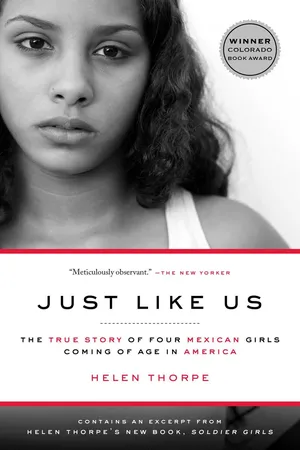
In this eye-opening and poignant true story about the experiences of four young Mexican women coming of age in Denver—two who have legal documentation, two who don’t—Helen Thorpe “puts a human face on a frequently obtuse conversation” (O, The Oprah Magazine), exploring themes of identity and friendship and exposing the reality of life for many undocumented immigrants seeking the American dream.

Just Like Us tells the story of four high school students whose parents entered this country illegally from Mexico. We meet the girls on the eve of their senior prom in Denver, Colorado. All four of the girls have grown up in the United States, and all four want to live the American dream, but only two have documents. As the girls attempt to make it into college, they discover that only the legal pair sees a clear path forward. Their friendships start to divide along lines of immigration status.

Then the political firestorm begins. A Mexican immigrant shoots and kills a police officer. The author happens to be married to the Mayor of Denver, a businessman who made his fortune in the restaurant business. In a bizarre twist, the murderer works at one of the Mayor’s restaurants—under a fake Social Security number. A local Congressman seizes upon the murder as proof of all that is wrong with American society and Colorado becomes the place where national arguments over immigration rage most fiercely. The rest of the girls’ lives play out against this backdrop of intense debate over whether they have any right to live here.

Just Like Us is a coming-of-age story about girlhood and friendship, as well as the resilience required to transcend poverty. It is also a book about identity—what it means to steal an identity, what it means to have a public identity, what it means to inherit an identity from parents. The girls, their families, and the critics who object to their presence allow the reader to watch one of the most complicated social issues of our times unfurl in a major American city. And the perspective of the author gives the reader insight into both the most powerful and the most vulnerable members of American society as they grapple with the same dilemma: Who gets to live in America? And what happens when we don’t agree?
Frequently asked questions

Yes, you can cancel anytime from the Subscription tab in your account settings on the Perlego website. Your subscription will stay active until the end of your current billing period. Learn how to cancel your subscription.
No, books cannot be downloaded as external files, such as PDFs, for use outside of Perlego. However, you can download books within the Perlego app for offline reading on mobile or tablet. Learn more here.
Perlego offers two plans: Essential and Complete
  • Essential is ideal for learners and professionals who enjoy exploring a wide range of subjects. Access the Essential Library with 800,000+ trusted titles and best-sellers across business, personal growth, and the humanities. Includes unlimited reading time and Standard Read Aloud voice.
  • Complete: Perfect for advanced learners and researchers needing full, unrestricted access. Unlock 1.4M+ books across hundreds of subjects, including academic and specialized titles. The Complete Plan also includes advanced features like Premium Read Aloud and Research Assistant.
Both plans are available with monthly, semester, or annual billing cycles.
We are an online textbook subscription service, where you can get access to an entire online library for less than the price of a single book per month. With over 1 million books across 1000+ topics, we’ve got you covered! Learn more here.
Look out for the read-aloud symbol on your next book to see if you can listen to it. The read-aloud tool reads text aloud for you, highlighting the text as it is being read. You can pause it, speed it up and slow it down. Learn more here.
Yes! You can use the Perlego app on both iOS or Android devices to read anytime, anywhere — even offline. Perfect for commutes or when you’re on the go.
Please note we cannot support devices running on iOS 13 and Android 7 or earlier. Learn more about using the app.
Yes, you can access Just Like Us by Helen Thorpe in PDF and/or ePUB format, as well as other popular books in Social Sciences & Emigration & Immigration. We have over one million books available in our catalogue for you to explore.

Information

Image

PART I
Image

INSTANTANEOUS RATE OF CHANGE

Image

1

Image

PROM NIGHT

Three-quarters of the way through her final year of high school, Marisela Benavídez ran into a problem. Her father wanted to attend her senior prom. Marisela went to an inner-city public school in Denver, Colorado, that I will call Theodore Roosevelt High School. On Friday, April 23, 2004, twenty-four hours before the prom, she took a break from arguing with her father to appear in the school’s annual dance recital. Halfway through the performance, Marisela breezed into the auditorium looking like a Vegas showgirl. She wore tight black satin trousers, a see-through white shirt, a revealing black camisole, copious amounts of makeup, and a liberal application of silver body glitter. Her hair was a froth of curls. It was intermission, and Marisela had come in search of her friends, still wearing her dance costume. As soon as she appeared in the audience, a group of peers moved into orbit around her—in their galaxy, she had the gravitational pull of a large star. One of the girls asked about Marisela’s ongoing negotiations with her conservative Mexican father.
“I don’t know what to do!” cried Marisela. “He still says he’s going to come!”
For several years, Marisela and her parents had been warring over the pace at which she was growing up and the extent of her Americanization. Marisela was a straight-A student—AP chemistry, AP calculus, AP literature, Chicano studies, sociology, and dance—who also liked to party. She divided her time equally between boys and books. The question of whether she would be allowed to go to the prom without her father marked the latest in a series of battles over how much freedom she should be allowed. As usual, Marisela was using the conflict to entertain her peers. Her best friend stood beside her. Yadira Vargas and Marisela Benavídez were wearing exactly the same attire but remained a study in opposites. Marisela was dark-skinned and had a round face and a full figure. She wore twice as much makeup as anybody else in her circle, and her shoulder-length hair changed color often. At the moment, it was auburn, but the month before it had been brown with gold streaks, which had highlighted the unusual gold tint of her eyes. This was not their natural color—she wore gold contact lenses to enhance her appearance. And yet, in spite of all this artifice, Marisela’s features constantly betrayed her emotions. In contrast, Yadira was slender, had lighter skin, wore modest amounts of makeup, always kept her long black hair its natural color, and never gave away anything important with her facial expressions. While Marisela was loud and boisterous, Yadira made such a small emotional footprint that, were it not for her striking coltish figure, it might be possible to forget she was present at all. Right now she remained quiet as Marisela announced her woes with abandon.
“I’m getting cramps—right before prom!” Marisela told us.
Despite their differences, the two girls had become close because they both faced the prospect of graduating from high school without legal status or a legitimate Social Security number, their main concern for months until they got distracted with the prom. Now all that mattered was what color dresses to wear, how to fix their hair, and what to say to Marisela’s father. They settled on getting ready at Marisela’s apartment. It would take about five hours, they calculated, and they were going out to dinner before the prom, so they planned to start primping at noon the next day.
Recently Marisela and her family had moved to Lakewood, a suburb west of Denver where rents were cheaper. At twelve on Saturday—the day of the prom—I pulled up at their new apartment complex. It consisted of a vast warren of boxy cinder-block structures, all painted light green. The complex had the air of a place that had seen many tenants come and go, and the dilapidated cars in the parking lot suggested that their owners did not have a lot of money. A concrete walkway led to the ground-floor apartment where Marisela’s family now lived. Outside, I found her father, Fabián, with her mother, Josefa, and their younger daughter, Rosalinda. Fabián worked for a janitorial company called National Maintenance, waxing the floors of commercial properties at night, and Josefa worked for a maid service, cleaning houses. Josefa was a pretty thirty-four-year-old woman with a round face and full figure like Marisela. While Josefa had a warm, jolly manner, Fabián looked more severe. He was forty-two, and had high cheekbones, a long nose framed by grooved lines, and a goatee. At the moment, his face wore a forbidding expression. Fabián was mercurial—he could be gregarious, but he could also fly into a fury without warning. Now he seemed preoccupied with thoughts of what Marisela might be up to this evening, as she had been behaving secretively. Fabián was almost as Mexican as he had been when he first came to the United States, but his daughter was a hybrid—someone he could not fully understand. Fabián explained in Spanish that Marisela wasn’t at home; she had gone to pick up several friends. Then two roly-poly boys emerged from the apartment, and Fabián’s mood lightened. He grabbed one of the boys and began tickling him furiously.
“This is Rafael, my youngest son,” he said proudly in Spanish. “He’s the fattest in our family, too!”
Fabián pointed to the older boy, Nestor. “He is just like Marisela—straight A’s.”
“All of our children are good students,” interjected Josefa, also in Spanish.
“That’s right,” echoed Fabián. “They all get good grades.”
Fabián and Josefa spoke almost no English, and my Spanish was scant, but whenever we failed to understand each other, the boys would translate for us. We expressed wonder at the idea that Marisela and her friends planned to spend five hours getting dressed. What were they going to do for that copious amount of time?
“Dad says that Marisela puts on so much makeup, she looks like a clown!” Nestor hooted.
Josefa called Marisela to check on her progress. “Cinco minutos,” she reported.
“Quieres agua?” Fabián asked.
I accepted a glass of water and Fabián joined me. He had recently stopped drinking alcohol and his body had started aching as a result. He had been much happier when he drank, but admitted that he could not do so in moderation and had sometimes consumed up to thirty beers a day. Drinking helped him sleep during the day, enabling him to work nights. But Fabián could no longer afford to court oblivion so assiduously—not when his older daughter was challenging his authority.
“El carro!” shouted Rafael, announcing the arrival of Marisela’s car. “They’re here!”
We all stared as Marisela, Yadira, and two friends walked up the concrete walkway carrying gowns, shoe boxes, suitcases, and bags filled with makeup. Marisela and Yadira belonged to a close-knit foursome along with two other girls who had similar backgrounds, and one of them, Clara Luz, had opted to dress at Marisela’s house, too. The fourth girl, Elissa Ramírez, was going to meet them later at Cinzetti’s, the Italian restaurant where they were having dinner. Meanwhile, a friend named Annalisa had tagged along to get ready at Marisela’s, even though she was not part of the foursome.
The girls marched into the apartment and through the living room to Marisela’s bedroom. Frilly curtains framed the windows and a shag carpet covered the floor. On the walls were two portraits of Marisela: the first showed her in a vampy pose, wearing a red strapless dress, while the second caught her looking pensive, holding her chin in her hand—the sexpot and the thinker. Her sister Rosalinda pointed to the photographs and said breathlessly, “Everybody thinks she should be a model!”
Eight of us crowded into the bedroom: the four high school seniors, Marisela’s mother, Rosalinda, me, and a teenager wearing a pair of striped flannel pajamas who had shown up unexpectedly. She turned out to live next door. Marisela turned on the TV to a Spanish-language game show, which everyone ignored, and Yadira carefully unpacked her suitcase. It contained silver jewelry, three different curling irons, her gown, which was navy blue with swirly silver lines on it, and a black sweater with a faux fur collar. Yadira carefully hung up her clothes to make sure they didn’t get wrinkled. The other girls unpacked in a more helter-skelter fashion, and within minutes, Marisela’s bed was covered in hair ties, bobby pins, body glitter, cosmetics, bags of cotton balls, shoes, purses, and brand-new costume jewelry still pinned to white cardboard backing.
Yadira’s cell phone rang. “I just wanted to tell you that we got a boutonniere for you,” she said. There was a pause. “It’s like a corsage, but for guys,” she explained. Her boyfriend, Juan, was a junior at a different high school. Juan spent his free time fixing up cars or driving them around. He aspired to become an auto mechanic, although like his girlfriend he did not possess legal status or a legitimate Social Security number. Nor did the boy who Marisela had invited to the prom. A few weeks ago, she had started dating a tall, attractive sophomore at Roosevelt High, but their relationship seemed highly flexible, as she had invited a former boyfriend, Fernando, to be her date instead. She considered Fernando the love of her life, much to the dismay of her parents. Marisela had started dating Fernando two years prior; they had met at a Mexican nightclub in Denver. (Although she was underage, Marisela had no difficulty getting into clubs with a fake Mexican driver’s license that added three years to her age.) Marisela had dated Fernando until he moved to Arizona to work in construction. The major drama of the past few weeks had been the question of whether Fernando and Marisela could achieve their hoped-for reunion, given certain logistical challenges. The first difficulty was the matter of how Fernando would travel from Arizona to Colorado that day. He had to work the day before, and could not fly from Phoenix to Denver, as he lacked the identification needed to board an airplane. Therefore Fernando had set out by car that morning at four A.M. to make the 930-mile journey in time to join them for dinner.
The second difficulty was what to tell Marisela’s parents, who had forbidden her to see Fernando ever again. Both Fabián and Josefa had grown up in small towns in rural Mexico. They disapproved of Marisela’s freewheeling American lifestyle, and Fernando struck them as the type to lead their rebellious daughter further astray. Marisela had lied and told her parents she was going to the prom with a young man named Vicente, who had promised to pose with her for a formal photograph to bolster her story. Her parents were suspicious, however, which was why her father thought she needed a chaperone. For days, Marisela had been trying to convince Fabián that parents didn’t go to proms in America, but Fabián found her claim highly questionable.
As soon as Marisela’s mother left the bedroom, Clara asked for an update on Fernando’s progress. Marisela disclosed the latest drama: Eight hours after he’d left Phoenix, Fernando’s car had broken down, leaving him marooned somewhere on the side of Interstate 25. He had convinced two friends from Denver to pick him up, and the rescue mission was now in progress, but Marisela did not know when he would arrive.
“Maybe he’ll be fat and ugly!” said Clara gleefully.
“I haven’t seen him in six months. Who knows?” replied Marisela with equanimity.
Marisela was waiting for a professional hairdresser, and offered to help the other girls arrange their hair until the stylist, Yolanda, arrived. Clara wanted to leave her hair down, but Marisela pronounced this idea unacceptable. Both Clara and Yadira agreed to let the Benavídez girls put up their hair in twisties, which involved parting their hair in a checkerboard pattern, pulling each square into a small ponytail, and inverting the ponytails. Clara sat cross-legged on the floor before Rosalinda, and Yadira sat before Marisela. Marisela’s big-toothed comb proved unwieldy, however, so she decided to use a pen. “I won’t write on you, I promise,” she told Yadira. “Oh, never mind! I’m writing on you already.”
Then she announced to the room, “We should have bought more hair spray, you guys.”
“I have hair spray,” said Clara.
“I have hair spray, too,” said Yadira.
Yadira wondered out loud if the twisties were going to give her a headache.
“Just sit down and have the boy rub your head,” suggested the girl in pajamas.
Yadira said she was hungry, and Clara said she was, too, but Marisela decided that nobody could eat. Then Yadira said she was bored, and Marisela told her that she was complaining too much. Clara scrunched up her face in pain as Rosalinda began inverting her ponytails. Yadira pronounced that she did not like her twisties, and Marisela began using a skinny curling iron on her hair instead. “Oye! You are burning me!” Yadira protested.
Unconcerned, Marisela applied a cloud of hair spray and unrolled one perfect ringlet, immobilized in a tight coil.
“Look! Todo así,” urged Marisela.
“Do all my hair like that? It’s going to take forever!” objected Yadira, who had slipped into a black mood.
I began to appreciate why this might take some time.
“Okay, I am getting dizzy,” conceded Marisela. “I need food, too.”
Marisela left and returned with a bag of pan dulce—white cake with shockingly bright pink icing.
“Yolanda is making me nervous because she’s not here yet. What can I do? Do you want me to do your makeup, Clara?”
Clara, who almost never wore makeup, seemed alarmed. “Um, you could do my nails,” she said.
“What? You don’t like the way I do my makeup?” cried Marisela. “I wasn’t going to do it like mine!”
Yadira pulled her hair into a ponytail, swathed herself in a furious cloud of hair spray, then took the ponytail down.
“I hate hair,” she pronounced.
“You’re lost, huh?” said Marisela’s little sister sympathetically.
“Yeah,” said Yadira miserably, picking up the pan dulce. “I think I’ll just eat.”
At last Yolanda arrived. She was a large woman in stretchy pants and a striped T-shirt. After Marisela selected an image of a smiling model with straight hair and a wild topknot of curls from one of the magazines that Yolanda had brought, the stylist set to work. Yolanda pulled mousse through Marisela’s hair and cordoned off a section of it. Stiff with mousse, the topknot stuck straight up in the air. The hairdresser plugged in a fat curling iron with bristles that blew hot air from its vents. With this tool, she started curling Marisela’s topknot, but then Yolanda got some of Marisela’s hair stuck in the bristles and spent several minutes yanking it out. The topknot looked worse than ever.
To make conversation, Yolanda asked what Marisela was planning to do after she graduated from high school. The hairdresser must have expected to hear that Marisela was going to work or to marry, as that would have been typical for a student from Roosevelt, but instead Marisela told Yolanda that she was waiting to hear back from the University of Denver, a private institution with a high-caliber faculty.
“Oh, yeah?” Yolanda asked, obviously surprised.
“Yeah,” said Marisela, with pride.
“Waiting to hear—when?”
“Next week. I’m nervous.”
The possibility of going to the University of Denver had just come up, and Marisela viewed it as her only chance to get a college degree. If she had possessed legal status, she would have been able to afford community college, but the state of Colorado classified immigrants who lacked documents as international students, which meant they did not qualify for in-state tuition. Because she did not have a legitimate Social Security number, Marisela also did not qualify for a Pell grant, financial aid, or many private scholarships. The unspoken question hanging over the girls at the moment was whether Marisela was about to be left behind. Clara and Elissa both had legitimate Social Security numbers, and each of them had received substantial offers of financial aid. Meanwhile, in a surprising twist, Yadira had secured a private benefactor. Only Marisela still had no idea how she would pay for higher education—unless she won a private scholarship to the University of Denver. Her only other hope was that some government body might act in time to help her. Members of the state legislature had been debating what to do with undocumented students since the beginning of the calendar year, and members of the U.S. Congress had been discussing the subject, too, but so far neither group of officials had taken any action.
College-bound students were likely to lead stable, middle-class lives, while students who went no further than Roosevelt were likely to live in rental houses and do menial work. Which kind of life was Marisela going to lead? She had one foot in the orderly world of Advanced Placement classes and one foot in the precarious world of her parents. Meanwhile, watching Marisela encounter so many difficulties had unnerved the other girls, who were used to considering her an expert on matters they considered important, such as math, boys, and grooming.
Now Rosalinda handed Clara a mirror to show her the twisties.
“I’m done,” Clara declared.
“Clara, come here,” ordered Marisela. “It’s too simple.”
“I’m simple! Let me be simple!”
“Okay, do your makeup,” Marisela conceded.
Clara began to apply blush, but Marisela said she should apply foundation first. Clara picked up a small black compact.
“Is that powder?” Marisela asked. The compact contained powder in a shade that matched Clara’s fair skin. “Oh, yes,” commented Marisela. “White...

Table of contents

  1. Cover
  2. Dedication
  3. Introduction
  4. Part I—Instantaneous Rate of Change
  5. Part II—Many Dwelling Places
  6. Part III—Lo Que Pasó Pasó (What Happened Happened)
  7. Epilogue
  8. Afterword to The Hardcover Edition
  9. Acknowledgments
  10. ‘The Newcomers’ Excerpt
  11. A Scribner Reading Group Guide
  12. About the Author
  13. Copyright