
- 256 pages
- English
- ePUB (mobile friendly)
- Available on iOS & Android
eBook - ePub
About this book
The monumental statues of Easter Island, both so magisterial and so forlorn, gazing out in their imposing rows over the island’s barren landscape, have been the source of great mystery ever since the island was first discovered by Europeans on Easter Sunday 1722. How could the ancient people who inhabited this tiny speck of land, the most remote in the vast expanse of the Pacific islands, have built such monumental works? No such astonishing numbers of massive statues are found anywhere else in the Pacific. How could the islanders possibly have moved so many multi-ton monoliths from the quarry inland, where they were carved, to their posts along the coastline? And most intriguing and vexing of all, if the island once boasted a culture developed and sophisticated enough to have produced such marvelous edifices, what happened to that culture? Why was the island the Europeans encountered a sparsely populated wasteland?
The prevailing accounts of the island’s history tell a story of self-inflicted devastation: a glaring case of eco-suicide. The island was dominated by a powerful chiefdom that promulgated a cult of statue making, exercising a ruthless hold on the island’s people and rapaciously destroying the environment, cutting down a lush palm forest that once blanketed the island in order to construct contraptions for moving more and more statues, which grew larger and larger. As the population swelled in order to sustain the statue cult, growing well beyond the island’s agricultural capacity, a vicious cycle of warfare broke out between opposing groups, and the culture ultimately suffered a dramatic collapse.
When Terry Hunt and Carl Lipo began carrying out archaeological studies on the island in 2001, they fully expected to find evidence supporting these accounts. Instead, revelation after revelation uncovered a very different truth. In this lively and fascinating account of Hunt and Lipo’s definitive solution to the mystery of what really happened on the island, they introduce the striking series of archaeological discoveries they made, and the path-breaking findings of others, which led them to compelling new answers to the most perplexing questions about the history of the island. Far from irresponsible environmental destroyers, they show, the Easter Islanders were remarkably inventive environmental stewards, devising ingenious methods to enhance the island’s agricultural capacity. They did not devastate the palm forest, and the culture did not descend into brutal violence. Perhaps most surprising of all, the making and moving of their enormous statutes did not require a bloated population or tax their precious resources; their statue building was actually integral to their ability to achieve a delicate balance of sustainability. The Easter Islanders, it turns out, offer us an impressive record of masterful environmental management rich with lessons for confronting the daunting environmental challenges of our own time.
Shattering the conventional wisdom, Hunt and Lipo’s ironclad case for a radically different understanding of the story of this most mysterious place is scientific discovery at its very best.
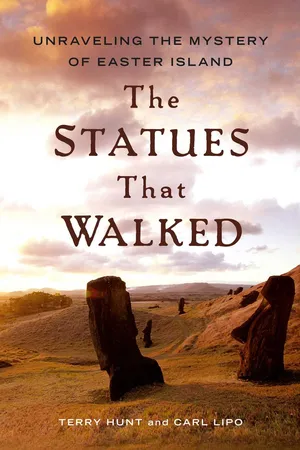
The prevailing accounts of the island’s history tell a story of self-inflicted devastation: a glaring case of eco-suicide. The island was dominated by a powerful chiefdom that promulgated a cult of statue making, exercising a ruthless hold on the island’s people and rapaciously destroying the environment, cutting down a lush palm forest that once blanketed the island in order to construct contraptions for moving more and more statues, which grew larger and larger. As the population swelled in order to sustain the statue cult, growing well beyond the island’s agricultural capacity, a vicious cycle of warfare broke out between opposing groups, and the culture ultimately suffered a dramatic collapse.
When Terry Hunt and Carl Lipo began carrying out archaeological studies on the island in 2001, they fully expected to find evidence supporting these accounts. Instead, revelation after revelation uncovered a very different truth. In this lively and fascinating account of Hunt and Lipo’s definitive solution to the mystery of what really happened on the island, they introduce the striking series of archaeological discoveries they made, and the path-breaking findings of others, which led them to compelling new answers to the most perplexing questions about the history of the island. Far from irresponsible environmental destroyers, they show, the Easter Islanders were remarkably inventive environmental stewards, devising ingenious methods to enhance the island’s agricultural capacity. They did not devastate the palm forest, and the culture did not descend into brutal violence. Perhaps most surprising of all, the making and moving of their enormous statutes did not require a bloated population or tax their precious resources; their statue building was actually integral to their ability to achieve a delicate balance of sustainability. The Easter Islanders, it turns out, offer us an impressive record of masterful environmental management rich with lessons for confronting the daunting environmental challenges of our own time.
Shattering the conventional wisdom, Hunt and Lipo’s ironclad case for a radically different understanding of the story of this most mysterious place is scientific discovery at its very best.
Frequently asked questions
Yes, you can cancel anytime from the Subscription tab in your account settings on the Perlego website. Your subscription will stay active until the end of your current billing period. Learn how to cancel your subscription.
At the moment all of our mobile-responsive ePub books are available to download via the app. Most of our PDFs are also available to download and we're working on making the final remaining ones downloadable now. Learn more here.
Perlego offers two plans: Essential and Complete
- Essential is ideal for learners and professionals who enjoy exploring a wide range of subjects. Access the Essential Library with 800,000+ trusted titles and best-sellers across business, personal growth, and the humanities. Includes unlimited reading time and Standard Read Aloud voice.
- Complete: Perfect for advanced learners and researchers needing full, unrestricted access. Unlock 1.4M+ books across hundreds of subjects, including academic and specialized titles. The Complete Plan also includes advanced features like Premium Read Aloud and Research Assistant.
We are an online textbook subscription service, where you can get access to an entire online library for less than the price of a single book per month. With over 1 million books across 1000+ topics, weâve got you covered! Learn more here.
Look out for the read-aloud symbol on your next book to see if you can listen to it. The read-aloud tool reads text aloud for you, highlighting the text as it is being read. You can pause it, speed it up and slow it down. Learn more here.
Yes! You can use the Perlego app on both iOS or Android devices to read anytime, anywhere â even offline. Perfect for commutes or when youâre on the go.
Please note we cannot support devices running on iOS 13 and Android 7 or earlier. Learn more about using the app.
Yes, you can access The Statues that Walked by Terry Hunt,Carl Lipo in PDF and/or ePUB format, as well as other popular books in History & World History. We have over one million books available in our catalogue for you to explore.
Information
CHAPTER 1
A Most Mysterious Island
The old net is laid aside; a new net goes a-fishing.
âMaori proverb
Mention Easter Island to just about anyone and âmysteryâ immediately comes to mind. The Mystery of Easter Island is the title of untold books and modern film documentaries. The mystery surrounds how so few people on a remote, treeless, and impoverished island could have made and transported hundreds of the eerie, gargantuan statuesâcalled moaiâfor which the island is so famous. The awe-inspiring, multi-ton stone statues, some standing nearly forty feet high and weighing more than seventy-five tons, were carved out of the islandâs quarry of compacted volcanic ash and then somehow transported several miles over the islandâs rugged terrain. Not all of them survived the journey. Many lie scattered across the island, some broken, never to take their intended places on platforms along the shoreline or elsewhere throughout the island. To see these statues, many of them situated upon equally impressive platforms called ahu, is to sense a hidden drama of compelling human proportions calling out for explanation. Facing inward, rather than out to sea, they seem to be gazing back in a vain search for the noble society that created them.
As we were archaeologists who had studied other parts of Polynesia, when we began our work on the island the statues were somewhat familiar. Similar religious statuary are found elsewhere in Polynesia. And on other islands, statues were also moved significant distances. The moai, like the elaborate carved wooden images from the Hawaiian Islands, or the stone tiki of the Marquesas, while much bigger, represented the same deified ancestors so important in Polynesian religion and cosmology. That the moai were religious images explains why the vast majority face inland, watching over their descendants day after day. With their backs to the sea, the moai had not been carved as sentries, warding off potential intruders, as with the Colossus of Rhodes.
Had the islanders carved and transported just one or two of these statues, the accomplishment would have been noteworthy, but not surprising. But our count for Rapa Nui suggests that the islanders carved something well over 950 statues, and of those, more than 500 were transported considerable distances, appearing in every corner of the island. Nowhere else in Polynesia is such a creative and monumental legacy found. Why did it emerge only on this tiny island, whose population should have, by all accounts, been focused solely on where to find the next meal?
Since Easter Sunday 1722, when the first European accidentally sighted this isolated speck in the vast South Pacific, Easter Island has presented a seemingly intractable dilemma for explorers, scientists, and curiosity-driven tourists. By comparison to the cultural and physical richness of such storied Polynesian islands as those of the Tahiti and Hawaii archipelagos, Easter Island seems a poor settingâalmost mockingâfor one of the great achievements of early Polynesian history. The island itself, which today Polynesians call Rapa Nui (the people who live there are called the Rapanui), is almost a moonscape in appearance, little more than a barren lump of lava-covered terrain. Lacking the deep valleys, steep mountains, lush streams, and beautiful waterfalls typical of many of the volcanic islands of Polynesia, Rapa Nui is characterized by a modest landscape of rolling hills. The island was born less than a million years ago when the coalescing eruptions of three seafloor volcanoes reached the surface. One searches in vain here for a refreshing stream, let alone a flowing river. Most of the water is found in lakes formed in the three volcanic cones, though some also trickles out of a number of small springs.
Nor does fruit fall from the trees here, as it does on so many other Polynesian islands. From the mid-eighteenth century onward, seamen, explorers, Christian missionaries, and other visitors remarked consistently on the pitiable and âwretchedâ lives of the islandâs native inhabitants. Swedish botanist Carl Skottsberg, who compiled the first natural history of Rapa Nui, wrote that âthere is in the Pacific Ocean no island of the size, geology and altitude of Easter Island with such an extremely poor flora and with a subtropical climate favorable for plant growth, but nor is there an island as isolated as this, and the conclusion will be that poverty is the result of isolation.â1
Those who settled Rapa Nui had accomplished a remarkable feat of seamanship, perhaps the most daunting of the whole colonization of the Polynesian islands, only to have arrived at a desperately inhospitable new home.
The story of the Polynesian migration is staggering in its sweep.
Seafaring colonists known by their distinctive pottery called Lapita, who had set out from the shores of the western Pacific, reached the islands of Tonga and Samoa by 800 BC. It must have seemed to be the edge of the world. Verdant Samoa is today considered the heart of Polynesia, but at that time, there on the eastern frontier of their rapid dispersal to hundreds of islands, Lapita stopped dead in its tracks. Maybe Samoa was just too luxurious for them to leave. We donât currently know why they stopped, but we do know that no islanders ventured farther into the Pacific for nearly two thousand more years.
It was in the Polynesian homelands of Tonga and Samoa that the earliest forms of Polynesian monumental architecture emerged, by about AD 1000. When the islanders began migrating again, sometime around AD 1100, they brought their ritual architecture with them, including religious courtyards made of stone and upright stones, conceived of as backrests for the gods. In some places these âbackrestsâ were transformed into elaborate carved human figures, like those found in the Marquesas, Hawaii, the Australs, and, ultimately, Rapa Nui.
Those migrating across the eastern Pacific first reached the spectacular islands of the archipelago of Tahiti. Voyaging in large double-hulled canoes soon after AD 1200, in less than a century, the islanders had discovered just about every island in the eastern Pacific, including the far-flung Cooks, Tuamotu atolls, Marquesas, Hawaii, Australs, Gambiers, Rapa Nui, New Zealand, and even the frigid islands of the sub-Antarctic.2 They also reached South America, where they fetched the sweet potato and perhaps introduced the humble chicken.3 Their colonization over this vast region was remarkably fast; they had traversed thousands of miles of turbulent seas, and had done so against prevailing winds and currents.
Discovering Rapa Nui, the most remote of these outposts, was particularly improbable. The territory over which Polynesia spreads is truly vast: about equivalent to the size of the entire North Atlantic Ocean. Roughly 99.5 percent of Polynesia is ocean, and 92 percent of the tiny fraction of land is New Zealandâs whopping 112,355 square miles. Beyond the central archipelagos of the Societies, Tuamotus, and Marquesas lies a wide-open expanse along Polynesiaâs southeastern edge, where the minuscule islands of Rapa Iti, Pitcairn, Henderson, and finally Rapa Nui are found.
Ordinary maps canât convey Rapa Nuiâs true remoteness. One of the old names recorded for the island, Te Pito o te Henua, translates as the ânavel of the world,â or perhaps more aptly, the end of the world. The islandâs geographic isolation is magnified many times over by its extreme windward position. Sailing to Rapa Nui from central Polynesia, as the islanders likely did, meant pushing directly into the prevailing east-southeasterly trade winds and correspondingly strong currents of the South Pacific. Doing so would have required tacking, which would have made the journey approximately four times farther than the straight-line distance. If, for example, the islanders had left from the island of Rarotonga, in the Southern Cook Islands, the tacking distance to Rapa Nui would have been a staggering 12,500 miles.
The trick would be to find enough days of consistent westerly winds. They may well have been aided by El Niño, which reduces the average strength of the east-southeasterly trade winds in the area, bringing westerly wind reversals. Paleoclimatic studies show that about the time the islanders probably set out, El Niño appeared on average about once every four years, so the Rapa Nui settlers may have ridden one of the gusts of regular westerlies that would have been generated.
To have spotted the tiny island was nonetheless quite a long shot. Rapa Nui is tiny, one of the smallest inhabited islands in the Pacific. The total island area measures about sixty-three square miles. The longest east-west axis is just over fourteen miles; the maximum width north-south is less than eight miles. It is possible to walk around the entire island in a day, albeit a long one. This is surely why, as the evidence convincingly shows, the island was colonized only once. Probably traveling in two, or even more, large double-hulled canoes, some thirty to fifty, or perhaps as many as about one hundred men, women, and children embarked on the voyage.
The oral tradition of the island credits the discovery to a chief named Hotu Matuâa. The first signs of land probably came not with actual sighting of the island, but with seabirds returning to their nests flying off to the east at dusk. A lone palm nut or a tree branch floating in the water might have alerted experienced navigators that land was somewhere nearby. They had defied great odds, but their struggle had only begun. The voyagers would have brought with them the critical plants of Polynesian life, including taro, breadfruit, coconut, yams, bananas, sugarcane, turmeric, and kava as well as chickens and small Polynesian rats (Rattus exulans), the latter either invited passengersâit is speculated that they were eatenâor as tenacious stowaways drawn to the provisions. Pigs and dogs may also have been on board, although archaeology reveals they didnât make it to the island. The travelers were to face a challenge, though, in bringing their traditional foods to the island. With such scant water for irrigation, which islanders elsewhere in the Pacific used to cultivate taro, the mainstay of their diets, some of the other crops the settlers brought with them could not be grown on the island. Establishing the way of life the islanders were accustomed to would have been a great challenge. And yet this tiny, relatively impoverished island was to become host to the astonishing population of monoliths so admired still today. Here on Rapa Nui, more than a thousand miles from another Polynesian island, more than two thousand miles from the coast of Chile, apparently without influence from any other culture, a prehistoric society emerged that produced some of the most compelling monuments and feats of engineering in all of Polynesia, and perhaps the world. How could that be?
This has been the question sailors, Christian missionaries, self-styled adventurers, scholars, and a slew of other investigators have been asking since the mid-eighteenth century. Over time a consensus developed around the idea that something dramatic had occurred in the past, long before the island was discovered by Europeans, that would account for the miserable state the society was thought to have been in at the time of European contact. A society that had created such monumental statues, the argument went, must surely once have been more noble. But what was that event? When did it happen? And why? With what seemed increasingly compelling evidence, a theory developed that pointed to horrible conflict and twisted priorities within ancient Rapanui society. Modern writers refer to ecological suicide or âecocideâ in their speculations of what unfolded.
The first Europeans arrived on Easter Sunday 1722, when Dutch explorer Jacob Roggeveen sighted the island. The Dutch encountered a treeless island covered with hundreds of giant statues and a population estimated to be about three thousand, described as healthy. The next European visitors arrived forty-eight years later, in 1770, in the form of a Spanish expedition under the order of the viceroy of Peru, which provided little detail about the state of the island other than that there was very little wood. Then, in 1774, the English arrived under Captain James Cook, probably the best-known explorer to have sailed the Pacific. His fame comes in part from the great details of his observations and those of his crew.
The British mission in the Pacific was colonial, and thus economic. Like the other European nations, Britain had aspirations of finding the great southern continent, and as things unfolded, a northwest passage as well. In Cookâs first voyage, on the Endeavour, he charted much of the Australian and New Zealand coastlines and collected a wealth of information about these southern lands. In July 1772 he set sail from Plymouth, England, for his second expedition, with two ships, the Resolution and the Adventure. This would be a final search for the elusive southern continent, Terra Australis, and indeed, this voyage was to furnish once and for all proof that it did not exist. On board were German-born naturalist Johann Reinhold Forster and his nineteen-year-old son, Georg, as well as artist and engraver William Hodges.
Searching the frigid waters of the far southern Pacific for about two months, Cook crossed the Antarctic Circle, and as he expected, no great continent awaited their discovery. By March of 1774, the crew, badly in need of provisions, headed north to Easter Island. His men were exhausted and suffering the debilitating effects of scurvy. Cook knew of the voyage of English buccaneer Edward Davis in the 1680s with mention of an island in the vicinity, he had read Carl Behrensâs report of the Dutch visit in 1722, and he had learned of the Spanish expedition. On March 11, he and his crew finally sighted Rapa Nui.
Cook and his men described the island as barren, lacking wood and fresh water, and noted, âNature has been exceedingly sparing of her favours to this spot.â4 On this visit, the expeditionâs naturalist, Forster, recorded that
the most diligent enquiries on our part have not been sufficient to throw a clear light on the surprising objects which struck our eyes on this island. We may however attempt to account for those gigantic monuments, of which great numbers exist in every part; for as they are so disproportionate to the present strength of the nation, it is most reasonable to look upon them as the remains of better times. The nicest calculations ⊠never brought the number of inhabitants in this island beyond 700, who, destitute of tools, of shelter, and clothing, are obliged to spend all their time in providing food to support their precarious existence. ⊠Accordingly we did not see a single instrument among them on all our excursions, which could have been of the least use in masonry or sculpture: We neither met with any quarries, where they had recently dug the materials, nor with unfinished statues which we might have considered as the work of the present race. It is therefore probable that these people were formerly more numerous, more opulent and happy, when they could spare sufficient time to flatter the vanity of their princes. ⊠It is not in our power to determine by what various accidents a nation so flourishing, could be reduced in and degraded to its present indigence.
This concept of flourishing times on the island followed by indigence took a new twist with French explorer La PĂ©rouse. Visiting for a just single day in April 1786, he speculated that at some very distant time Easterâs inhabitants unwisely cut down all of the islandâs trees. La PĂ©rouse observed that the loss of the forest
exposed their soil to the burning ardor of the sun, and has deprived them of ravines, brooks, and springs. They were ignorant that in these small islands, in the midst of an immense ocean, the coolness of the earth covered with trees can alone detain and condense the clouds, and by that means keep up an almost continual rain upon the mountains, which descends in springs and brooks to the different quarters. The islands[,] which are deprived of this advantage, are reduced to the most dreadful aridity, which, gradually destroying the plants and scrubs, renders them almost uninhabitable. Mr. de Langle [naval commander, explorer, and second in command of the La Pérouse expedition] as well as myself had no doubt that these people were indebted to the imprudence of their ancestors for their present unfortunate situation.5
In this manner, the notion of the imprudence of the islandersâ ancestors entered the Western discourse of Rapa Nuiâs sorry fate, a theme that would be revived in the twentieth century with the beginnings of scientific expeditions to the island.
Best known for his Kon-Tiki adventures, Norwegian explorer Thor Heyerdahl brought contemporary archaeological research to Rapa Nui. Born in 1914 in Larvik, Norway, Heyerdahl began his studies as a zoologist and traveled to the Marquesas as part of a school project to learn how animals arrived on these remote Pacific islands. This interest in colonization led him to an interest in human migrations, specifically those of the Polynesians and, ultimately, the Rapanui. Heyerdahl believed that ancient Americans first populated the Pacific islands, and he set out to prove his theory in adventurous fashion.
In 1947 Heyerdahl led the Kon-Tiki expedition, a daring experiment, drifting on a balsa wood raft from South America into the Pacific, as some Spanish accounts had asserted the Inca had done. The expedition succeeded in making land, washing ashore on the reef off the coast of the island of Raroia in the Tuamotu Archipelago, and generated a storm of media attention. In 1955 Heyerdahl and an international team of scientists began extensive field research on Rapa Nui. William Mulloy, an American archaeologist, was part of the team. Based on his analysis of the evolution in style of the islandâs monumental architecture and the islandâs first radiocarbon dates, Mulloy proposed three periods for Rapa Nui prehistory: the Early Period, AD 400â1100; t...
Table of contents
- Cover
- Description
- Title Page
- Copyright
- Dedication
- Contents
- Chapter 1: A Most Mysterious Island
- Chapter 2: Millions of Palms
- Chapter 3: Resilience
- Chapter 4: The Ancient Paths of Stone Giants
- Chapter 5: The Statues That Walked
- Chapter 6: A Peaceable Island
- Chapter 7: Ahu and Houses
- Chapter 8: The Benefits of Making Moai
- Chapter 9: The Collapse
- Chapter 10: Conclusion
- Appendix 1: Environmental Constraints
- Appendix 2: Lithic Mulching and Manavai
- Notes
- Bibliography
- Acknowledgments
- Index
- About the Author
- Back Cover