Black Dawn, Bright Day
eBook - ePub

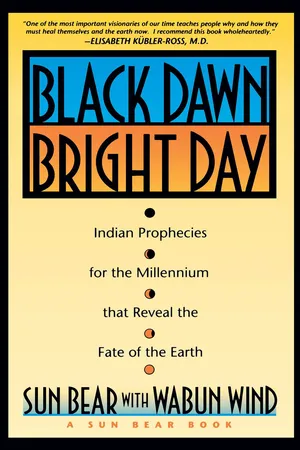
Black Dawn, Bright Day

Indian Prophecies for the Millennium that Reveal the Fate of the Earth

  1. 256 pages
  2. English
  3. ePUB (mobile friendly)
  4. Available on iOS & Android
eBook - ePub

Black Dawn, Bright Day

Indian Prophecies for the Millennium that Reveal the Fate of the Earth

About this book

A compelling and prophetic work that details the environmental future of every major landmass in the world. The sacred teacher and author of The Medicine Wheel offers a compelling and prophetic work that details the environmental future of every major landmass in the world. Through his own visions and dreams, and the visions of other Native American peoples, Sun Bear has seen the future of our Earth, and here he explicitly details which parts of the world will be most affected.
Frequently asked questions

Yes, you can cancel anytime from the Subscription tab in your account settings on the Perlego website. Your subscription will stay active until the end of your current billing period. Learn how to cancel your subscription.
No, books cannot be downloaded as external files, such as PDFs, for use outside of Perlego. However, you can download books within the Perlego app for offline reading on mobile or tablet. Learn more here.
Perlego offers two plans: Essential and Complete
  • Essential is ideal for learners and professionals who enjoy exploring a wide range of subjects. Access the Essential Library with 800,000+ trusted titles and best-sellers across business, personal growth, and the humanities. Includes unlimited reading time and Standard Read Aloud voice.
  • Complete: Perfect for advanced learners and researchers needing full, unrestricted access. Unlock 1.4M+ books across hundreds of subjects, including academic and specialized titles. The Complete Plan also includes advanced features like Premium Read Aloud and Research Assistant.
Both plans are available with monthly, semester, or annual billing cycles.
We are an online textbook subscription service, where you can get access to an entire online library for less than the price of a single book per month. With over 1 million books across 1000+ topics, we’ve got you covered! Learn more here.
Look out for the read-aloud symbol on your next book to see if you can listen to it. The read-aloud tool reads text aloud for you, highlighting the text as it is being read. You can pause it, speed it up and slow it down. Learn more here.
Yes! You can use the Perlego app on both iOS or Android devices to read anytime, anywhere — even offline. Perfect for commutes or when you’re on the go.
Please note we cannot support devices running on iOS 13 and Android 7 or earlier. Learn more about using the app.
Yes, you can access Black Dawn, Bright Day by Sun Bear,Wabun Wind in PDF and/or ePUB format, as well as other popular books in History & Cultural & Social Anthropology. We have over one million books available in our catalogue for you to explore.

Information

Black Dawn

Chapter One

The Natural World

To understand the nature of the things that are happening now upon the Earth Mother, we first have to understand different concepts of relating to the Earth. The Native people of Turtle Island, the North American Indians, relate to the Earth as the mother of all living creation. Native people also believe all creatures — minerals, plants, animals, spirits — have the same right to life as humans do.
Native people try to blend with nature, rather than conquer it. The Native philosophy teaches that you never take anything from the Earth without first making your prayers. Before you go out on a hunt you always make prayers and ceremonies of thanksgiving. Before you take the life of an animal you say, “I have to take your life, little brother, little sister, so that I may continue my own. Even as I take your life this time, the time will come when I will give my life back to the Earth. I too will become part of the cycle of life. My body will give new life for the plants, animals and insects to feed on. From my sacred sacrifice a new life will come up again.”
Whenever we take a plant, we never take the first one we come to. We regard that one as a grandfather plant. We make an offering there. We say, “Grandfather, we come to your plant people in order to have food or to have medicine for our healing. We make a gift to you and we pray that your species will always be on the Earth.” Then we take from the other plants of that species nearby the grandfather. But we take only what we need.
This is our sacred way. It insures there will always be plenty of every thing for generations to come. It is a Native philosophy found across the Earth that you never kill anything you don’t eat; you don’t waste anything. This is part of our religion, part of living in balance and harmony upon the Earth.
This is what the ghostdancers sing in their dance songs — all giving, all receiving, all part of the sacred way. And the healing of the Earth happens in this way. If you watch nature, you see how each part of creation feeds on the other. When the leaves go back to the soil, they provide food for the Earth and for the other plants that are there. The rabbits eat from the grasses and the plants, and in turn, some of the larger four-leggeds come and eat the rabbits. It’s all a covenant, an agreement among all living things. There’s a balance and harmony this way.
For thousands of years, Native people have said, “This is our Earth Mother. You can’t take from her all the time, you have to give back to her.” You can’t just take, take, take. You have to say your prayers and only take what you need. You must keep in harmony and balance with the Earth.
We feel that all living creation around us is intelligent and that every thing has a right to be here as much as people do. We think of the Earth Mother as being an intelligent, living being.
Today, we need to think that way again; we need to learn from the Native traditions. For perhaps as long as twenty thousand years, the Native people lived so harmoniously on Turtle Island that the first Europeans who arrived here were able to describe it as a beautiful, unspoiled wilderness, a virtual paradise. But in the short period of four hundred and fifty years since the Europeans arrived, this continent has become riddled with ecological disasters and pollution from sea to shining sea. Look hard at what has happened in that very short time span, then ask yourself “Why?”
When the Europeans first came to this land, we Natives went out and showed them how to plant crops. We would plant corn, beans and squash and put the remains of a fish in the dirt with the seeds. We kept telling the Europeans, “You have to feed the Earth.” But they said, “Well, that’s just a savage custom.” They didn’t understand what we were saying.
It wasn’t until the New England States had eroded away that the Europeans became even a little bit aware of what we had been trying to tell them. Yet when the great Dust Bowl of the 1930’s occurred, the one that wiped out thousands of acres of land, the dominant society still called the Indians the savages. But we Indians disagreed. We called those who had destroyed the land the “wheat savages” because, year after year, they had planted wheat until they had destroyed the Earth in certain areas to the point where the land wasn’t capable of producing anything.
The same pattern has gone on and on. We have to learn to love and respect the Earth as a living being in the sacred manner now!

“Indian Givers”

Different concepts about land caused conflict between the Native people and the European people. The Native people accepted the Europeans at first and treated them royally. The Native philosophy is that you treat the stranger as the Great Spirit in disguise. This is the standard way of hospitality which is sacred to the Native people. When they sat down with the European strangers, they would bring gifts. When they offered these gifts, the people from across the Great Water said, “Oh, these primitive savages, they think we’re gods.” Their arrogance got away with them because they didn’t understand the sacred ways.
The root of the problem is a different way of thinking. It is a basic difference in life philosophy that has brought about all this destruction. When the Europeans came to Turtle Island, they looked at it as land that was there for the taking. They had to kill a few Indians to get it, but history shows that was no problem for them.
At the time the first Europeans came to the continental United States, there were at least three million Native people living here. By the time that the Europeans had finished their slaughter in 1900, there were only 300,000 Natives left. Since then we’ve regenerated. There are about 1,400,000 Native people in the United States at this time.
At first, however, the Europeans — few in number — asked the Native people if they would share with them. They asked the Indians if they would give them a little land. The Native people had a great sense of generosity. They said, “Well yes, you are our brothers. You share the same mother with us, so here is some land for you.” After a while the Europeans weren’t happy with that. They kept saying to the Natives, “Move over a little, we need more land.” Then the immigrants over-strained the Indians’ generosity and started forcibly driving the Indians out of their homelands. They began to take more and more land, often at the point of a gun.
The Natives couldn’t understand the concept of the settlers owning the land. They thought the Europeans were using the land as they did. That meant that other people also had the right to go there. Pretty soon there were conflicts because of these different concepts, and the Europeans began killing Native people. To avoid conflict many Natives simply retreated to more remote areas, hoping to avoid the new settlers.
Originally the Native chiefs had brought gifts to honor the European men. They asked for their gifts back after they saw the killing that was happening. “You haven’t honored the gift,” they said. “You haven’t shown friendship.” This is where the expression “Indian-giver” comes from. It was the Indian answer to the European practice of not keeping a treaty or agreement. To the Indian people this showed that the gift of friendship or land had no value to the recipient anymore.
Every bit of the land is sacred to the Native people. When the European settlers came across this land, they didn’t understand this sacredness. They didn’t respect the land, so the Natives resisted them. I have read that it cost the government eight federal soldiers for every Indian they killed. The Spaniards eventually called the Indians the bronze race that knew how to die, because many Indians preferred dying to yielding.
As the Europeans moved across the American continent, history shows that the average man, in his lifetime, used up three farms. He would cut down the timber and leave it lying on the Earth, or set fires and burn beautiful virgin forest so he could have land to plant crops. This is what happened in the New England States. You can still see old stone fences going up through brush and small timber in places there. These stone fences marked the boundaries of the farms that were used and then abandoned.
These people just wore out the soil. They never bothered to take care of it or to use proper crop practices. As a result, they had to keep moving westward in order to have productive farmland. And as they went, they continued to cut down trees and kill Indians. Almost all of the beautiful forests that had been here for thousands of years were destroyed at that time. Massive deforestation and genocide were part of the famous, “glorious” movement westward.
When the settlers reached the Great Plains, they discovered the buffalo and stopped farming for a time. In a period of about forty years these “American Heroes” slaughtered 50 million or more buffalo. Think of it. They killed at least 50,000,000 buffalo. Why? Because it was easier and more profitable than farming. They killed them primarily for just their hides and tongues, both of which were highly valued in the East and in Europe.
During the time that the railroads were being built, people would ride on the railroad and shoot buffalo for sport. They would often kill up to a thousand buffalo on one of these sporting expeditions. They used these beautiful animals for target practice. They shot them and just let the meat and hides lay and rot.
The immigrants who came to the Northwest didn’t even bother to cut down the trees to prepare land for farming; they just bored holes in the bottom of beautiful pines and firs, some of which were 125 feet tall. The sap, which is the life-blood of these trees, flowed down into these holes. Then these “Conquering Heroes” would set fire to them. The trees became living torches, dying from their own burning pitch.
In this way the settlers burned down thousands of acres of forests just so they could farm the land. These European immigrants destroyed beautiful trees without any concern for what was happening. They would also cut the trees off the tops of the mountains and never bother to replant them. Even today, when you fly over the western part of the United States, you see whole mountaintops that look bare of trees. They’ve been clear-cut and replaced with seedlings that will take a century to become a forest again.
By the time the European immigrants got to the west coast of the United States, they had “refined” not only their treatment of the trees, but also of the Indians. They didn’t just go and shoot Indians on sight, like they had done in the East. Instead, they would invite them to a feast. They’d say, “Well come on and have a big feast with us.” And then they would poison the food. The Indians would eat it, fall ill and die. If any tried to escape, their “hosts” would slaughter them. That was one way they solved the “Indian problem.”
All of these practices show the ways in which the European immigrants dealt with the land, the animals and the people. They were all part of the movement westward across America, even though these stories have been omitted in the famous, romanticized versions recorded in the history books.

All Of Creation

Before we Native American people look at adding anything to our life, we pray over it. We ask, “How does this affect our life? How does it affect all the rest of creation upon the Earth? How does it affect our relationship to our Creator, and all the generations to come?” That’s what we ask ourselves before we bring something new into our life path. We know that we are not here just for ourselves. We’re responsible for everything on the planet, everything that we come into contact with. That has to be acknowledged. In our life, when we’re just little children, that’s put into our minds.
When we go into the sweat lodge, we’re reminded of that. We say, “All my relations” or “Thank you, all my relations.” By this we mean all other parts of creation on the Earth; all things are our relatives. We are acknowledging them. When we fill the pipe, we also acknowledge all of creation because we know everything has to live the same as we do. That’s what we Natives have come to, this sense of interconnection. That is what we strive to always be aware of. Many humans are not willing to wake up to this interconnection and the responsibility that comes with it. We Native teachers try to reach out to those humans who are ready to listen. That’s our responsibility. It can get kind of lonely. That’s why I’d like to have many more people on the planet aware of what is happening. I’m trying to bring you a message and an understanding so you’ll know both how to wake up and how to stay alive.
I’m a Native American talking to you through the pages of this book. But I drink the same water and breathe the same air as you do, so I am truly your brother. We all share many of the same things. Nobody can get away from the condition the Earth is in now. Nobody can say, “Hey, I can get away from it.” We have to look at the planetary condition. That’s why I’m sharing with people. I have to get your attention. We all need to become more aware and to understand why the Earth changes are occurring.
To understand the reality of what is happening, we have to look at the contrast of the two different ideologies that move through the world. One is the Native philosophy, the sacred way of walking on the planet by blending with nature and being part of nature. The other ideology demands conquest of nature.
The people who came from across the Great Water had what I call the “ladder” approach. The ladder approach has God at the top, then man, then woman, and then the kids, then the cat and dog, then the rest of the creation according to how useful it is to man. The European concept was that they had the supreme right to do anything they wanted to with anything under them on this ladder. They had no sense of respect, no sense of the totality of things.
In the Native philosophy, we think of life as a circle. All things are part of the circle. All parts of the creation have the same right to life as we do. The animal, the plant, the mineral, the elemental kingdoms — all creation belongs to that circle. Nothing is above and nothing is below. We think of things in terms of roundness. All things have a roundness to them: the Earth, the Sun, the Moon, the stars. The trees and rocks have roundness, and humans have roundness as well. The lodges we build — our sweatlodge, our tepee — are also round because we want to acknowledge the wholeness of creation.

Sharp Edges

Then the Europeans came along and built square things. Squareness has a hardness to it — it’s those sharp edges coming out all the time. Squareness was also a way that people thought. As the Europeans cut the land up into squares so that everybody had their own little block, they even began to think in terms of squareness.
People in such societies have come to think that’s the way it should be. Their thinking reflects these sharp edges, and their sense of territory. In these societies people talk about “my house, my car, my wife, my dog, my land.” There is no longer the sense of oneness with all of creation. The value of land is measured only by how much it is worth to someone else in terms of dollars. This is a totally different way of looking at things.
When we look at these ideas, we see how they have created what we have today. They separated us from each other, blocked us off from one another so completely we can no longer reach out and embrace as brothers and sisters. We no longer have a sense of responsibility for one another; we lost that with the ladder view of life.
We need to consider here what we have done to each other and, consequently, what we have done to the planet, since the two are deeply connected. We need to look at the beginnings of how we relate. In doing so, I will push some people’s buttons because some of you have some little leftover concepts from your conditioning that might bother you as we explore this area.

Sacred Circles

At one time, all people upon the Earth worshipped in a sacred manner. They acknowledged the forces and the powers of creation all around them. All over the world, they worshipped in sacred ceremonial circles. In the United States there were some 20,000 medicine wheels, sacred circles where people would come to do their ceremonies and their praying and to seek and share knowledge with each other. A medicine man or medicine woman would come to such a circle, empty out their medicine pouch and say, “We can use this particular herb for healing this, and use this one for healing that.” This was one way the knowledge was shared at the sacred circle.
We find sacred circles in Europe too. Along with Stonehenge, great stone circles can be found all over England. In Germany I saw a stone circle and a turtle’s head was marked on one of the stones, and I said, “Oh yes, I know you folks, I recognize all this.” I saw pictographs there of the bear shaman and the deer shaman — ancient acknowledgements of t...

Table of contents

  1. Cover
  2. Dedication
  3. Acknowledgements
  4. Part I: — Black Dawn
  5. Part II: — Bright Day
  6. About the Authors
  7. Bibliography
  8. Copyright