Monster Under The Bed
eBook - ePub

Monster Under The Bed

  1. 192 pages
  2. English
  3. ePUB (mobile friendly)
  4. Available on iOS & Android
eBook - ePub

Monster Under The Bed

About this book

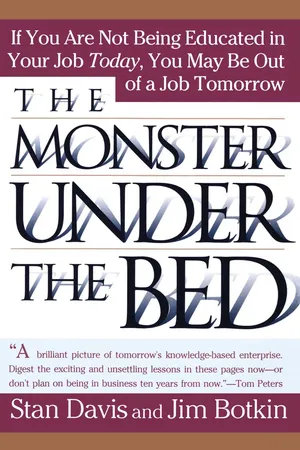
Companies in the business of providing knowledge -- for profit -- will dominate the 21st-century global marketplace. Can your business compete?In today's fast-paced world, knowledge is doubling nearly every seven years, while the life cycle of a business grows increasingly shorter. The best way -- and perhaps the only way -- to succeed is to become a "knowledge-based" business. In The Monster Under the Bed, Stan Davis and Jim Botkin show how: * Every business can become a knowledge business* Every employee can become a knowledge worker* Every customer can become a lifelong learner The Monster Under the Bed explains why it's necessary for businesses to educate employees and consumers. Consider the fact that the vast majority of 60 million PC owners, for example, learned to use their computers not at school but at work or at home. Davis and Botkin explain how any high-tech, low-tech, or no-tech company can discover new markets and create new sources of income by building future business on a knowledge-for-profit basis -- and how, once it does, its competitors must follow or fail.Filled with examples of high-profile companies that are riding the crest of this powerful wave, The Monster Under the Bed is an insightful exploration of the many ways that the knowledge-for-profit revolution will profoundly affect our businesses, our educational processes, and our everyday lives.
Frequently asked questions

Yes, you can cancel anytime from the Subscription tab in your account settings on the Perlego website. Your subscription will stay active until the end of your current billing period. Learn how to cancel your subscription.
No, books cannot be downloaded as external files, such as PDFs, for use outside of Perlego. However, you can download books within the Perlego app for offline reading on mobile or tablet. Learn more here.
Perlego offers two plans: Essential and Complete
  • Essential is ideal for learners and professionals who enjoy exploring a wide range of subjects. Access the Essential Library with 800,000+ trusted titles and best-sellers across business, personal growth, and the humanities. Includes unlimited reading time and Standard Read Aloud voice.
  • Complete: Perfect for advanced learners and researchers needing full, unrestricted access. Unlock 1.4M+ books across hundreds of subjects, including academic and specialized titles. The Complete Plan also includes advanced features like Premium Read Aloud and Research Assistant.
Both plans are available with monthly, semester, or annual billing cycles.
We are an online textbook subscription service, where you can get access to an entire online library for less than the price of a single book per month. With over 1 million books across 1000+ topics, we’ve got you covered! Learn more here.
Look out for the read-aloud symbol on your next book to see if you can listen to it. The read-aloud tool reads text aloud for you, highlighting the text as it is being read. You can pause it, speed it up and slow it down. Learn more here.
Yes! You can use the Perlego app on both iOS or Android devices to read anytime, anywhere — even offline. Perfect for commutes or when you’re on the go.
Please note we cannot support devices running on iOS 13 and Android 7 or earlier. Learn more about using the app.
Yes, you can access Monster Under The Bed by Stan Davis in PDF and/or ePUB format, as well as other popular books in Business & Business General. We have over one million books available in our catalogue for you to explore.

Information

Publisher
Touchstone
Year
2011
Print ISBN
9780684804385
eBook ISBN
9781439143773

CHAPTER 1

THE RELUCTANT HEIR

Most of the learning in use is of no great use.
—BENJAMIN FRANKLIN

FROM CHURCH TO STATE TO BUSINESS

Through successive periods of history, different institutions have borne the major responsibility for education. Changes in education take a very long time to evolve. They are a consequence of greater transformations, often social, political, economic, or religious, and therefore are always a few steps behind the demands of the society they are designed to serve. But today schools are more than a few steps behind, and many feel they are on the wrong path altogether.
Ben Franklin, James Madison, and Patrick Henry were all taught at home rather than in school. In colonial America, the kitchen was the schoolhouse, mother was the teacher, and church was the overseer. As the agrarian economy expanded, children were educated in one-room schoolhouses. With the move from an agrarian to an industrial economy, the small rural schoolhouse was supplanted by the big brick urban schoolhouse. Four decades ago, in the early 1950s, we began the move to another economy, but we have yet to develop a new educational paradigm, let alone create the “schoolhouse” of the future, which may be neither school nor house.
The coming shift from civil to commercial leadership in education has been evolving for decades, and it will take several decades more before it is complete. The first great educational shift, from church to state dominance, followed a similar progression. How and why it happened helps explain the current and coming change.

THE FIRST TIME ’ROUND

Education in America was dominated by church and family from the earliest European settlements until the end of the colonial period in the 1780s.1 Family, church, school, and civic authority were intermingled during this early period, although the family had the greatest influence. The Family Instructor, by Daniel Defoe (1715), was as popular in pre-Revolutionary America as Dr. Spock was in the post-World War II United States. Most family education, however, was on religious matters. The guiding books were John Foxe’s The Book of Martyrs (1563) and Lewis Bayly’s The Practice of Piety (1612). Christianity, like Judaism from which it emanated, has always been an educational system, with Christ as the divine teacher. Harvard’s stated purpose, for example, was instruction to “know God and Jesus Christ.”
Church control of education was exercised by the Puritans in New England, the Dutch Reformed Church and Quakers in the mid-Atlantic region, and powerful Protestant and Catholic plantation families in the South, especially Virginia. There were also many other churches, sects, and religions, and competition among them led to the expansion of education.
The debate about whether church or state should be responsible for education went on for over a hundred years before the Revolutionary War. It started in 1655, when a Harvard president was forced to resign over the issue of infant baptism. Another challenge to the church was repeated almost a century later when the Independent Whig, distributed from Boston to Savannah, declared: “The ancients were instructed by philosophers, and the moderns by priests. The first thought it their duty to make the students as useful as possible to their country; the latter as subservient to their order.” Twelve decades later, with the Revolutionary War and the Constitution, which clearly delineated a separation between church and state, the responsibility for public education was assumed primarily by the state.
The changing of the guard from church to state was propelled chiefly by political rather than economic motives. In New England it took five decades after the Revolutionary War until the Puritans and the Congregational Church relinquished their domination of schools. It occurred first in 1827, when, by taxation, Massachusetts made the support of public schools compulsory. Public support of schools in the South did not occur until after the Civil War, nearly nine decades after ratification of the United States Constitution in 1789 and the Ordinance of 1787, which established “education as necessary to good government.”
Only after independence from England did education begin to move from parent and pastor to schoolmaster and governmental authorities. The motivating factor was the need to build a free and independent government. The chief educators of the time, Benjamin Franklin and Thomas Jefferson, were first and foremost political figures. As early as 1749, Franklin, in his Proposals Relating to the Education of Youth in Pennsylvania, announced a plan to establish a grammar school in Philadelphia that would use English, the vernacular of trade and daily life, rather than Latin, the language of the church.
Fifty years later, in 1779, Jefferson introduced a “Bill for the More General Diffusion of Knowledge” in the Virginia Legislature, mandating that all children be educated at public expense, which made education a political rather than a religious function. The law was enacted twenty years later, although until the 1880s it met with substantial resistance, including armed clashes between the citizenry and enforcing militia.
Alexis de Tocqueville wrote in 1830 that “Americans are infinitely better educated than any other place in the world.” Part of the evidence for this was the success of the school textbooks and dictionaries written by Noah Webster. The American Speller and the Elementary Spelling Book sold fifteen million copies by 1837. The purpose of his American spellers and dictionaries was again political, to create a national language, distinct from British, that would unify the new nation.
Yet at the same time that the political shift was occurring between England and America, both countries were also evolving from an agricultural to an industrial economy. The emphasis on a utilitarian education taught in a common language suited, and was reinforced by, America’s emerging industrial economy. The common or public school, which taught reading, arithmetic, and citizenship, was an instrument first of Americanization and second of industrialization. Utilitarian goals took their place alongside civil and patriotic aims as the changes from colony to fledgling republic to industrial nation gradually occurred.
Industrialization also produced social changes that weakened the educative role of the family and posed further threats to older forms of religious schooling. Sunday schools, for example, were created because of extensive child labor. Since most children had to work twelve hours a day, their only time for schooling was on Sundays, when factories, mines, and mills were idle. Early Sunday schools taught reading, writing, and religion. When child labor laws were enacted, Sunday schools left the reading and writing to public schools and concentrated exclusively on religious teaching.
By the late nineteenth century, in their attempt to limit the spread of Catholicism from large waves of new immigrants, state control of education was supported actively by mainstream Protestant churches that had once opposed it. Methodists, Baptists, Presbyterians, and Congregationalists hoped to instill generalized Protestant values of hard work, frugality, and respect for both private and public property into secular schools that would be attended by children of Catholic immigrants.
In sum, the changing responsibility for education was largely a reflection of a changing society. When society’s needs shifted, responsibility for education likewise shifted. It lay with family and church in colonial times and moved to civil authorities after independence from Britain. In agrarian America education was not thought of as a discrete segment of society. Nor was it truly a part of the monetary economy or a matter of political concern and public consciousness until the emergence of the industrial era, when it was supported by tax dollars that were measured and accounted for. The one-room schoolhouse had been displaced by the statehouse, and public education grew like crazy.

“IT’S DÉJÀ VU ALL OVER AGAIN”

Boston opened the nation’s first publicly supported high school in 1821, and in 1852 Massachusetts passed the first compulsory school-attendance law in the United States. Many people believed that the use of taxes to support secondary schools was unlawful. The disagreement was settled in 1874, when the Michigan Supreme Court ruled that publicly supported high schools were legal. State after state then passed laws mandating that taxes be used to support a public school system of elementary, secondary, and even postsecondary schools. Every state had such a law by 1918, thus consolidating a process that had begun a hundred years before and ensuring government’s control and responsibility for education.
The most significant education act of the nineteenth century was the federal Morrill Act of 1862, which established land-grant colleges and universities to “teach such branches of learning as are related to agriculture and the mechanic arts.” In the middle of the Civil War, Congress granted the states huge tracts of land to sell, in order to finance the building of agricultural and technical colleges and universities. Proceeds from the sale of over 17.4 million acres of land went to finance developments in public education.
The Morrill Act fused the interests of government, education, and the farming community into a national policy, and it led to the establishment of agricultural extension programs, the mechanization of agriculture, and the birth of modern farming in the United States. Between 1855 and 1895, for example, the hourly labor required to produce one bushel of corn declined from four hours and thirty-four minutes to forty-one minutes, and, between 1830 and 1894 the equivalent wheat production time declined from over three hours to only ten minutes. Perhaps the most impressive legacy born of the Morrill Act was the understanding that education, open to all and focused on learning applicable to real economic needs, could not be divorced from economic growth and national strategy. It is a lesson we need to relearn today.
By contrast, a lesson that we know all too well is that government is often very late meeting market needs, and once it has met a need, it does not step aside. Ironically, the land-grant act established the highly successful agricultural extension program just as America’s agricultural economy was drawing to a close. Public spending on agricultural extension programs today is $1.4 billion compared to the about $80 million spent on industrial extension programs, even though agricultural producers contribute about 2 percent to the GNP compared to manufacturers’ 18 percent. Worse still, there are no educational extension programs at all to support the remaining 80 percent in services or information jobs, except for some extension studies in nursing and education.
However nobly we may interpret the land-grant act today, its main purpose originally was political. With the country in the middle of the Civil War, education reform was not exactly a topic on the front burner. The act may have bribed western and border states to stay in the Union, and after the Civil War it assuaged and enticed the South to accept rejoining the Union. The major incentives for educational change were thus political rather than economic.
Nevertheless, when the politics of national unity coincided with the politics of economic development in America, significant advances occurred in education. Today the politics of unity focus on racial equality and elimination of class distinction. The politics of economic development, on the other hand, focus on international trade, global competition, and jobs. The two are not aligned, and that is why political action is not moving education into the twenty-first century.
Why is education one of the few remaining institutions that is national, rather than international, in scope? The reason, again, is that educational institutions are generally shaped by social and political forces rather than economic concerns. Every country has used education to promote national unity. Bismarck, in particular, developed the Prussian education system because of the need to unify German principalities. Colonial powers used it to override ethnic and tribal loyalties. Education is now governed by just the opposite logic—to revive these loyalties and often instill social and political rivalries. Had the motive force of educational development been economic, schools would have evolved globally along with the current shift to a global economy.
The most significant governmental education act of the twentieth century was the GI Bill of Rights. Like the Morrill Act, it came in response to war, stimulated more by social and political change than by economic and technological conditions. The federal government has often justified changes in educational policy on the basis of military needs. Since its inception in 1944, the GI Bill has either paid or lent money to veterans of World War II, the Korean War, and the Vietnam War. It has been the single largest educational initiative in the United States, with over $140 billion in grants or loans and a total of seventeen million college-bound recipients.
The GI Bill, however, benefited veterans’ personal lives after they left the service more than it affected our military preparedness. It was intended to repay our debt to those who defended the country, not to direct their study into areas that would secure our national defense. The GI of the forties became the “man in the gray flannel suit” of the fifties. And the education that veterans received, again ironically, was designed largely to meet the needs of an industrial economy that was even then on the wane.
The launching of Sputnik in 1957 marked the end of the industrial era and the beginning of the information economy. The country instantly became gripped by the Soviet threat to our national security and saw education in science, math, and engineering as an important way to counter it. Relying on past political rallying calls, the government responded with the National Defense Education Act of 1958. The military-industrial complex powered the economy, and education was more captive to government defense initiatives than it was responsive to larger market needs.
The next sign that government-run education was faltering and continuing to ignore market needs came in 1983, when a blue-ribbon government panel known as the National Commission on Excellence in Education issued the widely quoted report, A Nation at Risk. Again pushing political hot buttons, the report cited national defense, not the economy and technology, as reasons to act. “If an unfriendly foreign power had attempted to impose on America the mediocre educational performance that exists today,” it said, “we might well have viewed it as an act of war.”2
Thus, political forces have dominated American education reform for more than two centuries, sometimes mandating reform to address issues of national unity, sometimes responding to concerns about national defense. In either event, education initiatives served the needs of the state. Historically economic growth and productivity were never the major cause of systemic change in education.
Today the civil servants in the education establishment are on the defensive, trying to hold on to their dominant role, but they are no longer able to couch educational reform and the mission of schools in terms of national defense and responsible citizenship and ignore the needs of individuals concerned about their jobs and of companies concerned about global competition. With the demise of the Soviet Union, education’s mission is hardly preparation for war.

THIS TIME THE MOTIVATION IS ECONOMIC

“History doesn’t repeat itself,” said Mark Twain. “At best it sometimes rhymes.” The last shift in the forces driving education was from religious to political; this time it is from political to economic.
The values missing from the government-dominated educational system that the business-led replacement will more likely institute are not related to greater social or political equality. The missing values are fundamentally economic. They are about our pocketbooks and how to restore our intergenerational rise in living standards. They are about keeping the American dream from becoming a nightmare.
The establishment of business values in our educational systems addresses the need to revive our economic leadership. The free market brought down communist and socialist governments around the world and is likely to bring down the hegemony of government-directed education. Maintaining any developed country’s high standard of living will mean an emphasis on economic values over social and political ones. Future business dominance of the educating function, therefore, will emphasize values such as competition, service, and standards.
When all the universities in Texas combined graduate two people qualified to teach calculus but more than five hundred trained to coach football, it is an indication that values of social consumption have crushed values of economic production. The calculus/coach ratio can be taken as a measure of market demand. If government presses for a new ratio, and all that it implies, it is interpreted as an attempt to regulate education and not allow the free market to operate. If business presses for a new ratio, however, it is interpreted as an attempt to protect our economic future.
The effort to redirect education toward math, science, and technology is guiding the educational marketplace, whether it is made by government or by business. Its goal is to redefine basic values and recapture a high standard of living, irrespective of the difference between free versus regulated educational markets.
The private sector doesn’t want to take over the public schools. It wants an education system that supplies the necessary human skills to keep the economy and society healthy. The current system does not do that. It was built to serve an economy and society that no longer exist. The new ways of learning and educating for the future are evolving right now. There are roles for everyone to play—executives, educators, government, and the public—and they are very different from previous roles. The pace of technological change is transforming everyone, not just students, into learners, and it is pushing our economic institutions to become educators.
Since personal computers hit the market in 1981, for example, a third of U.S. households have at least one,3 and more than sixty million people have learned to operate them. Al...

Table of contents

  1. Cover
  2. Title Page
  3. Copyright Page
  4. Contents
  5. Introduction: The Seven Ways
  6. Chapter 1: The Reluctant Heir
  7. Chapter 2: Four Steps to Wisdom
  8. Chapter 3: The Chatter, the String, and the Can
  9. Chapter 4: L’earning Power
  10. Chapter 5: The Last Thing you want is a Learning Organization
  11. Chapter 6: The Six R’s
  12. Chapter 7: For Better and for Worse
  13. The Seven Ways
  14. Notes
  15. Acknowledgments
  16. Index