
- 208 pages
- English
- ePUB (mobile friendly)
- Available on iOS & Android
eBook - ePub
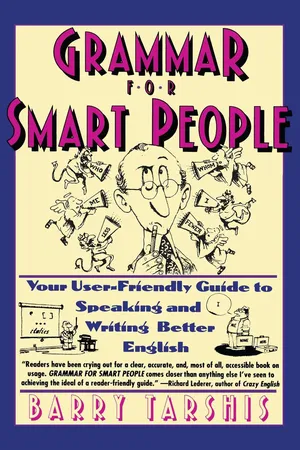
Grammar for Smart People
About this book
Good grammar is essential for effective communication. Yet many of us are plagued by the same nagging question: If I'm so smart why does grammar make me feel so dumb? Grammar For Smart People can help. Here at last, is a lively, user-friendly guide that zeroes in on the areas that give everyone the most trouble, and it does it with an advantage most grammar books lack - a light touch. You won't feel as though you're back in the fifth grade, diagramming sentences and struggling with a grammar textbook filled with dull, unbreakable rules.
Frequently asked questions
Yes, you can cancel anytime from the Subscription tab in your account settings on the Perlego website. Your subscription will stay active until the end of your current billing period. Learn how to cancel your subscription.
At the moment all of our mobile-responsive ePub books are available to download via the app. Most of our PDFs are also available to download and we're working on making the final remaining ones downloadable now. Learn more here.
Perlego offers two plans: Essential and Complete
- Essential is ideal for learners and professionals who enjoy exploring a wide range of subjects. Access the Essential Library with 800,000+ trusted titles and best-sellers across business, personal growth, and the humanities. Includes unlimited reading time and Standard Read Aloud voice.
- Complete: Perfect for advanced learners and researchers needing full, unrestricted access. Unlock 1.4M+ books across hundreds of subjects, including academic and specialized titles. The Complete Plan also includes advanced features like Premium Read Aloud and Research Assistant.
We are an online textbook subscription service, where you can get access to an entire online library for less than the price of a single book per month. With over 1 million books across 1000+ topics, we’ve got you covered! Learn more here.
Look out for the read-aloud symbol on your next book to see if you can listen to it. The read-aloud tool reads text aloud for you, highlighting the text as it is being read. You can pause it, speed it up and slow it down. Learn more here.
Yes! You can use the Perlego app on both iOS or Android devices to read anytime, anywhere — even offline. Perfect for commutes or when you’re on the go.
Please note we cannot support devices running on iOS 13 and Android 7 or earlier. Learn more about using the app.
Yes, you can access Grammar for Smart People by Barry Tarshis in PDF and/or ePUB format, as well as other popular books in Education & Education General. We have over one million books available in our catalogue for you to explore.
Information
Topic
EducationSubtopic
Education GeneralCHAPTER 1
Word Wise
How to put the proper word in its proper place

This chapter deals with verbal abuse. More precisely, it deals with those words and expressions in English that in the view of most usage authorities are common sources of confusion and misuse.
As it happens, the number of words and expressions in English that fall into this dubious category is substantial. But that is to be expected, given the nature of the language. Forget for the moment that English has more words per se than any other of the major languages of the world, or that it is more densely populated than other languages with words that have foreign origins. Focus instead on the fact that English, as William Safire has pointed out, is a “stretch language”—a language, in other words, that gives its users an enormous amount of elbow room when the time comes to express ideas. No other language, on the one hand, has as many words that mean the same or nearly the same thing, and, on the other hand, has as many words that take on different meanings in different situations.
All this elbow room, of course, is terrific news if you are one of those persons who loves words and would just as soon go to bed with a good dictionary as with a Robert Ludlum thriller; but it is not terrific news if you are concerned about using what Jonathan Swift liked to call “the proper word in its proper place.” For how do you know, given all the choices you have in any given situation, which word is, in fact, the “proper” word: the long word, the short word, the more formal word, the idiomatic word, the word Shakespeare used, the word your boss uses, ad infinitum?
The purpose of this chapter is to help you answer that question when you are dealing with those words and expressions (and most of them, not surprisingly, come in pairs) that, for a variety of reasons, have become troublesome to most people. In many of the listings that follow, the choice is clear-cut: Similar though the words may look or sound, they mean different things. More often than not, however, the words in each listing are close enough in meaning that a case could be made for either choice; and in a few instances the only difference between the two words or expressions is that one of the choices grew up in a bad neighborhood and hasn’t yet achieved enough respectability to be considered standard English.
With these considerations in mind, I have based the guideline in each listing on how the majority of today’s better writers, editors, and usage authorities would handle the choice in each pairing, and I have relied, in particular, on two sources: The American Heritage Dictionary and Webster’s Dictionary of English Usage. I have also divided the word pairings into several categories, based not only on why the words are confused, but on how significantly they differ in their basic meanings. (Note: All the words listed appear alphabetically in the Index.)
The listings themselves consist of a usage guideline and a sentence or two that illustrate the distinction at the heart of the guideline. Some of the listings include a sentence or two that further clarify the distinction; and where I thought it might help, I have included a memory key—an easy-to-remember sentence or phrase designed to help you keep in mind the distinction between the two words.
A final word about the mechanics of this chapter—and, for that matter, the book itself. You will notice as you read through this chapter that in some cases parenthetical information is enclosed within brackets [ ] while in other cases it is enclosed within parentheses ( ). I have used brackets primarily for definitions inserted in the examples to help reinforce the distinction between the two words. I have used parentheses for everything else.
Sore Thumbs
A random sampling of those words and sets of words that deserve special attention, given how frequently they are misused
ADVERSE & AVERSE: Up against it
Guideline. Use adverse (never followed by to) to describe reactions that are unfavorable, hostile, and unfortunate. Use averse (generally followed by to) to suggest the idea of being against something.
Even though I had an adverse [unfavorable] reaction the first time I tasted the guacamole-raisin-crunch ice cream, I have changed my mind and am no longer averse to [against] the idea of introducing the flavor next summer.
Memory key. Never ADd to an ADVERSE reaction.
AFFECT & EFFECT: Influence game
Guideline. Use affect (almost always a VERB) when expressing the action that means “to influence” or “have an impact upon.” Don’t confuse it with either the NOUN form of effect, which means “result,” or with the verb form of effect, which means to “produce a result.”
The speech Dimitri gave after dinner last night had a strong effect [impact] on all of us, especially Inga.
Inga’s tearful reply to Dimitri’s speech affected [had an influence on] us even more.
And:
Thanks to the conversation we had with Dimitri, we were able to effect [bring about] a major change in the plan in a matter of hours.
A closer look. Affect can operate as a noun, but only as a psychological term. It is used to differentiate a feeling or an emotion from a thought or action.
Memory key. To keep in mind that effect is usually a noun, remember the phrase NOW IN [noun] EFFECT.
AMONG & BETWEEN: Beyond the numbers
Guideline. Use between when you are drawing a connection involving only two persons or things. Use among when three or more persons or things are involved.
Jesse and Frank were hoping to divide the money between the two of them [only two involved], but Billy and Cole wanted the money to be distributed among all the people [more than two involved] who took part in...
Table of contents
- Cover
- Acknowledgments
- Introduction
- 1. Word Wise
- 2. Avoiding Pronoun Paranoia
- 3. Coming to Agreement
- 4. End Games
- 5. Points Well Taken
- 6. Spellbound
- 7. Changing Times
- 8. Finishing Touches
- Appendix
- Bibliography
- Index
- Copyright