One Shot One Kill
eBook - ePub

One Shot One Kill

One Shot One Kill

  1. 288 pages
  2. English
  3. ePUB (mobile friendly)
  4. Available on iOS & Android
eBook - ePub

One Shot One Kill

One Shot One Kill

About this book

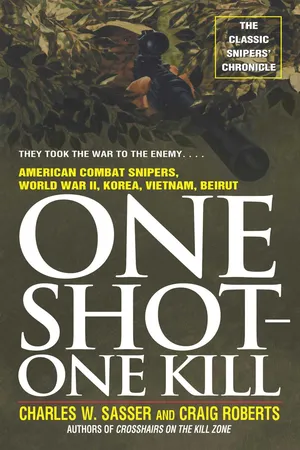
They are the lone wolves of the battlefield. Tracking the enemy, lying in wait for the target to appear—then they shoot to kill. Armed with an unerring eye, infinite patience and a mastery of camouflage, combat snipers stalk the enemy with only one goal... In World War II, Korea, Vietnam, and Beirut, American snipers honed the art of delivering a single deadly shot from nowhere—and devastating enemy morale. They met the enemy on his own turf, picking off officers, unwary soldiers, and even other snipers from extraordinary distances of up to 1 ½ miles. Now, these uncommon men tell their stories: of the emotions felt when a man's face came into their crosshairs and they pulled the trigger, of the nerve-wracking hours and days of waiting, motionless, for the enemy, of the primal savagery of a sniper duel. Often trained haphazardly in wartime, and forgotten in times of peace, combat snipers were officially recognized after the Vietnam War, when the Marine Corps became the first military branch to start a full-time sniper school. One Shot-One Kill is their powerful record of desperate trials and proud victories.
Frequently asked questions

Yes, you can cancel anytime from the Subscription tab in your account settings on the Perlego website. Your subscription will stay active until the end of your current billing period. Learn how to cancel your subscription.
At the moment all of our mobile-responsive ePub books are available to download via the app. Most of our PDFs are also available to download and we're working on making the final remaining ones downloadable now. Learn more here.
Perlego offers two plans: Essential and Complete
  • Essential is ideal for learners and professionals who enjoy exploring a wide range of subjects. Access the Essential Library with 800,000+ trusted titles and best-sellers across business, personal growth, and the humanities. Includes unlimited reading time and Standard Read Aloud voice.
  • Complete: Perfect for advanced learners and researchers needing full, unrestricted access. Unlock 1.4M+ books across hundreds of subjects, including academic and specialized titles. The Complete Plan also includes advanced features like Premium Read Aloud and Research Assistant.
Both plans are available with monthly, semester, or annual billing cycles.
We are an online textbook subscription service, where you can get access to an entire online library for less than the price of a single book per month. With over 1 million books across 1000+ topics, we’ve got you covered! Learn more here.
Look out for the read-aloud symbol on your next book to see if you can listen to it. The read-aloud tool reads text aloud for you, highlighting the text as it is being read. You can pause it, speed it up and slow it down. Learn more here.
Yes! You can use the Perlego app on both iOS or Android devices to read anytime, anywhere — even offline. Perfect for commutes or when you’re on the go.
Please note we cannot support devices running on iOS 13 and Android 7 or earlier. Learn more about using the app.
Yes, you can access One Shot One Kill by Charles W. Sasser,Craig Roberts in PDF and/or ePUB format, as well as other popular books in History & Military & Maritime History. We have over one million books available in our catalogue for you to explore.

Information

FOREWORD

The information in this book came from sources ranging from official U.S. Government documents and publications to actual taped interviews with the men whose stories appear on these pages. Brief quotes from knowledgeable individuals came from other sources where their statements were relevant to a given topic. These are: Lones Wigger, quoted from an article in American Rifleman magazine (ā€œGood to the Very Last Shot,ā€ by Rupp Scott, May 1987); Sergeant Paul Herman and Captain Tim Hunter, quoted from an article in Leatherneck magazine (ā€œScout Sniper School,ā€ by E L. Thompson, March 1984); and Major D. L. Wright in an article in Marine Corps Gazette (ā€œTraining the Scout Sniper,ā€ by Major D. L. Wright, October 1985).
The chapters in this book dealing with one person and his experiences are based on taped, personal interviews conducted with, and letters written by, the people who volunteered their stories. The vast majority of dialogue appearing in the book was taken from these interviews and letters. In a few instances, dialogue has been recreated based on the interviews to match the situation, action, and personalities, while maintaining factual context as it was presented to the authors.

FOREWORD

If you look at just the statistics, it is damned hard to kill an enemy soldier on the battlefield. During World War II, the Allies fired an average of 25,000 bullets for each enemy soldier they killed. The ratio of bullets to KIAs kept climbing. United Nations troops in Korea expended 50,000 rounds for each dead enemy. In Vietnam, American GIs armed with M-14s at the beginning of the war and, later, with rapid-firing M-16s burned up in excess of 200,000 bullets to get a single body count.
The statistics become even more astonishing if you consider that certain skilled warriors, armed with an unerring eye, infinite patience, and a mastery of concealment and woodcraft, have proved repeatedly that the most deadly weapon on any battlefield is the single, well-aimed shot. In stalking the enemy like big game hunters, these marksmen live out the philosophy that one accurate shot, one bullet costing a few cents, fired with deliberate surgical precision is more deadly and more effective against an enemy than a onethousand-pound bomb dropped indiscriminately.
Statistically, it takes 1.3 bullets for a trained sniper to kill an enemy.
ā€œThere survives one lone wolf of the battlefield,ā€ wrote U.S. Marine Corps General George O. Van Orden in a 1940 paper extolling the use of snipers in war. ā€œHe hunts not with the pack. Single-handed, or accompanied by one companion, he seeks cover near the fighting. Sometimes he holes-in behind the tottering walls of a shell-ridden hut, far from the shelter of his lines. Again, at dead of night, he rolls out across the shell-torn fields, burrowing deep into the sodden ground…. His game is not to send a hail of rapid fire into a squad or company; it is to pick off with one well-directed, rapidly delivered shot a single enemy….
ā€œHe is the gadfly of a great war. He must harass the foe…. He must hammer relentlessly upon the nerves of the rank and file of the opposing forces, until his rifle crack, joining with others of his kind, becomes a menace more to be feared than the shrieking shells from cannon, or the explosive hail from the mortars. His bullets must come from nowhere.ā€
The art and science of sniping is not a product solely of modern warfare. Its roots reach into prehistoric times when man at war saw the advantage of being able to kill his enemy at the farthest possible range with the least danger to himself. Stones launched by slingshots were replaced by spears launched by throwing sticks. The bow and arrow replaced these and was in turn replaced by the crossbow and then by gunpowder. Each technological advancement in weaponry increased the range from which a marksman could hit a target and the accuracy with which he could hit it.
Leonardo da Vinci picked off enemy soldiers from the walls of besieged Florence with a rifle of his own design at ranges of 300 yards. A sniper hiding in the woods with a crossbow felled Britain’s Richard the Lion-Hearted. Lord Admiral Horatio Nelson also became victim of the sniper’s simple philosophy of one shot—one kill. Early in America’s War of Independence, a single bullet could have changed the course of history had a British sniper, Captain Patrick Ferguson, chosen to shoot General George Washington in the back when the general turned and rode away from him at the beginning of the Battle of Brandywine Creek.
To the average western man, who has an aversion to what he considers unsportsmanlike conduct, merely the mention of the word sniper evokes an image of an evil little foreign man sneaking through the jungles of Okinawa picking off the good guys, or of a merciless Viet Cong hiding in a tree waiting for the opportunity to kill a 19-year-old GI from Des Moines or Wichita as he walks patrol at Nha Trang. Americans, especially, believe in Gary Cooper or John Wayne who walked down the middle of a dusty street to shoot it out face to face with the bad guys. To bushwhack an enemy, even in war, is considered unfair and underhanded. It is wrong to kill, says western man, but if we do kill we must kill in a fair fight.
Although each war of this century produced a need for snipers, a need that was temporarily filled at places like Salerno and Normandy and Pork Chop Hill and Chu Lai and Beirut, the standard reaction after the need ended was to cork the snipers back into their bottles, as though they never really existed. It was as though we were ashamed of them and what they had done, as though sniping was morally wrong and unfit for a role in the United States armed forces.
If you want to look at it from that point of view, war is immoral. And there is no Gary Cooper or John Wayne in war; if there were, they would be lying dead in the dust of Main Street. In combat, the aim is to survive and to kill before you are killed. The weapon most dreaded on any battlefield is the lone sharpshooter whose single rifle crack almost invariably means death for the enemy. Hundreds of American GIs and Marines survived because, as General Van Orden put it, ā€œ(the sniper’s) rifle crack, joining with others of his kind, becomes a menace more to be feared than the shrieking shells from cannon….ā€ American snipers saved American lives by killing before the enemy could kill.
Studies show that not every soldier can kill, even in the heat of battle. Even fewer are able to kill calculatedly, coldly, deliberately, one man at a time, one shot at a time.
ā€œWhen you look through that rifle scope, the first thing you see is the eyes,ā€ said U.S. Marine Captain James Land, a sniper instructor in Vietnam. ā€œThere is a lot of difference between shooting at a shadow, shooting at an outline, shooting at a mass, and shooting at a pair of eyes. The first thing that pops out at you through the scope is the eyes. Many men can’t do it at that point. It takes a special kind of courage.ā€
Men like U.S. Army Sergeant John Fulcher possessed that rare quality.
Fulcher was a Cherokee Indian from Texas whose sniper platoon dogged the Nazis up the boot of Italy, taking German scalps and striking terror into the hearts of Hitler’s troops.
Also, men like:
U.S. Army Sergeant Bill Jones, who hit Utah Beach at Normandy on D-day and rooted out German snipers during the bitter hedgerow fighting that followed;
U.S. Army Sergeant Chet Hamilton, who, at one setting on Pork Chop Hill in Korea, methodically wiped out forty Chicom soldiers;
U.S. Marine Captain James Land, who helped initiate the sniper program in Vietnam and later worked to launch what is now the best sniper school in the world;
U.S. Marine Sergeant Carlos Hathcock, the most successful sniper in history, whose feats of daring and courage and marksmanship at such places as Elephant Valley and in the General’s Camp became legend;
And U.S. Marine Corporal Tom Rutter, who engaged Shiite militiamen in Beirut’s ā€œHooterville.ā€
It was the courage of these men and others like them that has turned the lone wolf of the battlefield into a formidable weapon of romance and controversy. Nowhere is the enemy safe from the sniper’s eye. The enemy’s life is cheap. It takes only one bullet to kill him.
One shot—one kill.

CHAPTER ONE
U.S. Marine Sergeant
Carlos Hathcock
Vietnam, 1967

For all I know, it might have been a chicken feather, but it earned me a name among the Vietnamese. It was an impulse when I picked it up. I saw a flight of big beautiful white birds flying over against the cloudstreaked red of a setting Asian sun. Somehow, the sight touched me—the beauty of it, the sheer freedom of flight. I picked up a white feather off the ground and stuck it into my bush hat. Everybody carried something for good luck. A coin, a religious medal, even a rabbit’s foot. You needed luck if you were a sniper. The hamburgers—the Viet Cong and NVA—started calling me Long Tr’ang. White Feather. North Vietnam offered a bounty of three years’ pay to the soldier who plucked that feather from my hat and my head from my shoulders.
Being a sniper was a good job for me. I didn’t like killing people—I never liked that—but I liked the job. I was able to detach myself from everything and do it. I did it to keep our people from getting hurt. I was saving Marine lives. Every hamburger I killed out in Indian Country meant one more Marine or GI would be going back to the World alive. That was how I looked at it.
But I didn’t want some hamburger collecting my head to save his buddies’ lives.
I felt a lot safer in the bush than behind the wire on Hill 55. Behind the wire made me uneasy, like a duck must feel on opening day setting on a pond surrounded by hunters. I stood on one of the fingers of the hill and gazed past the concertina and minefields toward the river and the clumps of jungle and bamboo separating the rice paddies. I felt eyes watching me. I couldn’t control conditions inside the wire; the hamburgers called the shots. Rockets and mortars had your name written all over themā€”ā€œTo Whom It May Concern.ā€ But out there, I had control.
I hadn’t realized how much impact my hunting had had on the hamburgers until the intel section came up with a wounded Vietnamese woman. The company gunny called me to his hootch to let me know that the mamasan was saying the North Vietnamese had detailed an entire sniper platoon to Hill 55 with one primary mission.
ā€œAll she could talk about was how they had taken a blood oath not to return home without Long Tr’ang’s feather,ā€ the gunny said.
That kind of stuff could psych you out, if you let it. I had already seen the circulars passed around in the villages with my picture on them.
ā€œI don’t care how hard them hamburgers think they are,ā€ I replied, ā€œthere ain’t none of them hard enough to get me.ā€
ā€œYou ain’t Superman, Hathcock.ā€
ā€œI never said I was. They’d kill me in a heartbeat if I let down my guard. But the harder they hunt me, the harder I get.ā€
A wrinkle showed between the gunny’s eyes. He rubbed a calloused hand across his short-cropped gray hair.
ā€œHathcock?ā€ He cleared his throat. ā€œFrom what she says, they may have an ol’ boy out there that’s even better than you.ā€
I didn’t say anything.
ā€œAll this guy does is live in the bush,ā€ the gunny said. ā€œHe lives off rats and snakes and worms—shit like that. He claims it’ll give him an edge. The woman said this guy catches cobras with his bare hands and eats ’em raw.ā€
ā€œI’ve spent a lot of time crawling around in the woods too.ā€
The gunny stood up. He still looked sober.
ā€œI know your reputation, Hathcock, but take this for what it’s worth. Keep your head down, lad.ā€
I liked being behind the wire even less after that. The NVA sniper platoon started causing damage on the hill. At least one of them did. This hamburger sneaked in to a cluster of low knolls across the valley from Hill 55 and picked off a Marine every chance he got. His shots came at different hours of the day and night, sometimes at dawn, sometimes at dusk, or at noon. He never fired more than one shot a day and never from the same location twice. He was good. It was seven hundred meters across the valley, and he was hitting what he shot at. He killed a sergeant walking past in front of my hootch. My spotter, Corporal Johnny Burke, who accompanied me on most missions to help spot targets and direct fire, wondered if the round had been intended for me—if he knew which was my hootch.
It had to be the Cobra sniper. None other would have been so bold.
I studied the terrain. You never knew when he would come. He waited a day between shots, or he waited a week. Some of our snipers tried to get a stand on him, pick him off as he came in and out, but they never saw him. I decided he must have a secret route that brought him into the knolls. He delivered his shot. Then he vanished. He was good. He was making me uneasy. I knew he had to go.
ā€œThe next time that hamburger plinks at us,ā€ I told Burke, ā€œwe’re going after his ears.ā€
A few days later, as the shadows were starting to lengthen across the valley, a Marine collapsed as he was scurrying between his sandbagged position on the edge of the hill and one of the hootches farther back. He was already on the ground kicking and groaning by the time the distant report of the gunshot reached the hill.
I always kept my gear ready. ā€œLet’s go,ā€ I said to Burke. I grabbed my war belt laden with canteen, ammo belt, and knife, and plucked my Winchester Model 70 from just inside the door of my hootch.
It took us an hour to cut the hamburger’s trail. It was faint: some flattened grass, a broken weed, an indentation in the soil. I kept glancing at the failing sun as we slowly dogged the trail. Not much time. The spoor led us low beyond the grassy knolls directly to the water of a narrow canal filled with scummy water and leeches and overgrown like a watery tunnel with knife grass and cattails. The trail ended there.
I glanced at Burke. His gaunt face filled with a kind of reluctant admiration for the Cobra’s stealth. This was how he was slipping in and out to do his work—float in, float out.
It would be getting dark. Shadows were already thickening in the watery tunnel. I glanced at Burke again. There was no turning back.
I waded into the warm water. The weak current sucked at my waist as we cautiously slid downstream, our eyes adjusting to the shadows. We stopped often to listen. I didn’t think the hamburger would be watching his back trail this near his hide, but you learned never to underestimate your foes. We listened, slipped through the water soundlessly, listened some more.
It wasn’t long before broken grass and weeds told us where something large had slithered out of the canal. I felt relieved. We picked up the trail and followed it up a wooded ridge. I looked back. Since we had taken to the canal, a thick clot of black clouds had risen to mask the setting sun. The monsoon clouds were moving; you could see the demarcation between night and the last of day as the clouds swiftly escorted in darkness. In no time the first big drops began to fall.
Talking was not necessary. Burke and I had been together in the bush too much to need words. We just looked at each other and burrowed like rats into a thicket where we rolled into our ponchos to wait for daybreak. The rain drummed on the forest leaves and closed in our world to the size of what you could feel within arm’s reach.
Dawn painted a clear sky orange. We stirred. Morning toiletries consisted of taking a leak, adding some fresh camouflage paint to our faces. It was all done in complete silence. Then we picked up the sniper’s trail again. Rain filtered by jungle canopies falls softly and gently on the forest floor, no matter how it savages the upper levels. It had not destroyed the spoor we followed.
In no time we came upon a small clearing in the jungle. We lay on our bellies concealed in the bush, watching. The sniper’s trail led to a small hand-dug cave in the center of the clearing. The opening faced us. The cave contained a sleeping bed of dried grass. As far as I could determine there was only one way in and out of the cave. It made me suspect a trap. The trail was too clearly marked going in for it to be anything else.
The clearing was in the shape of a big circle less than one hundred meters across. A ridge beyond jutted out of the forest. It overlooked the clearing. If the Cobra was keeping an eye on his back trail—and I felt sure he was—then that was where he would be. Although I studied the ridge foot by foot through field glasses, I detected nothing suspicious. There was just the lush green of the jungle dripping water from last night’s rain.
We proceeded more cautiously. Hunting men, you develop a kind of sixth sense. My sixth sense told me the Cobra was near. He was cunning and clever—and he wanted the white feather in my hat.
Crawling on our bellies, we circled the clearing and made for the ridge. Soon, we approached a narrow draw at its base. The draw was filled with birds all busily feeding on the ground. The sniper had sprinkled rice to attract birds as an early warning signal in case his trap in the clearing didn’t work.
I had a feeling tha...

Table of contents

  1. Cover Page
  2. Title Page
  3. Dedication
  4. Acknowledgment
  5. Foreword 1
  6. Foreword 2
  7. Chapter One
  8. Chapter Two
  9. Chapter Three
  10. Chapter Four
  11. Chapter Five
  12. Chapter Six
  13. Chapter Seven
  14. Chapter Eight
  15. Chapter Nine
  16. Chapter Ten
  17. Chapter Eleven
  18. Chapter Twelve
  19. Chapter Thirteen
  20. Chapter Fourteen
  21. Chapter Fifteen
  22. Chapter Sixteen
  23. Chapter Seventeen
  24. Chapter Eighteen
  25. Chapter Nineteen
  26. Chapter Twenty
  27. Chapter Twenty-One
  28. Chapter Twenty-Two
  29. Chapter Twenty-Three
  30. Chapter Twenty-Four
  31. Afterword
  32. About The Author