
- 216 pages
- English
- ePUB (mobile friendly)
- Available on iOS & Android
eBook - ePub
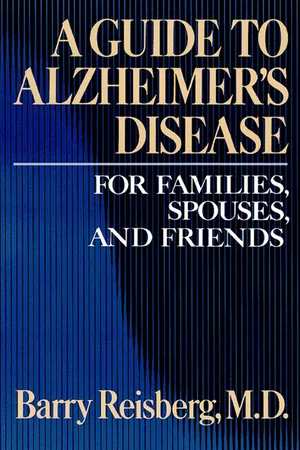
Guide to Alzheimer's Disease
About this book
An excellent and intelligent book for the families of patients with Alzheimer's disease. Written by long-time researcher Dr. Barry Reisberg, this guide is filled with information for the families, loved ones, spouses, and friends of people living with Alzheimer's disease.
Frequently asked questions
Yes, you can cancel anytime from the Subscription tab in your account settings on the Perlego website. Your subscription will stay active until the end of your current billing period. Learn how to cancel your subscription.
At the moment all of our mobile-responsive ePub books are available to download via the app. Most of our PDFs are also available to download and we're working on making the final remaining ones downloadable now. Learn more here.
Perlego offers two plans: Essential and Complete
- Essential is ideal for learners and professionals who enjoy exploring a wide range of subjects. Access the Essential Library with 800,000+ trusted titles and best-sellers across business, personal growth, and the humanities. Includes unlimited reading time and Standard Read Aloud voice.
- Complete: Perfect for advanced learners and researchers needing full, unrestricted access. Unlock 1.4M+ books across hundreds of subjects, including academic and specialized titles. The Complete Plan also includes advanced features like Premium Read Aloud and Research Assistant.
We are an online textbook subscription service, where you can get access to an entire online library for less than the price of a single book per month. With over 1 million books across 1000+ topics, we’ve got you covered! Learn more here.
Look out for the read-aloud symbol on your next book to see if you can listen to it. The read-aloud tool reads text aloud for you, highlighting the text as it is being read. You can pause it, speed it up and slow it down. Learn more here.
Yes! You can use the Perlego app on both iOS or Android devices to read anytime, anywhere — even offline. Perfect for commutes or when you’re on the go.
Please note we cannot support devices running on iOS 13 and Android 7 or earlier. Learn more about using the app.
Yes, you can access Guide to Alzheimer's Disease by Barry Reisberg in PDF and/or ePUB format, as well as other popular books in Medicine & Medical Theory, Practice & Reference. We have over one million books available in our catalogue for you to explore.
Information
Chapter 1
The Rediscovery of Senile Brain Failure
BRAIN FAILURE, LIKE OLD AGE, is a condition which mankind has always reluctantly recognized and always accepted—with resignation. So closely have people associated the loss of intellectual functioning with normal aging that they have not always found it necessary to have different words for the two conditions. Indeed one word is currently used to refer to the two states of aging and loss of intellect; “senility.”’ The 1975 unabridged second edition of Webster’s New Twentieth Century Dictionary defines senility as:
“old age”
“weakness”
“the characteristics of old age”1
“infirmity of mind and body”’
Old age is certainly not synonymous with loss of intellectual functioning. Indeed, we now know that many people enter their seventh, eighth, and ninth decades with no measurable decline in their intellectual functioning from that in their youth or their middle age.2 Conversely, some persons undergo intellectual decline in their fifth or sixth decade. When this early intellectual decline does occur, it is not accompanied by the other changes which all of us associate with aging. The skin retains the firmness and resilience of middle age. Arthritis, with its characteristic effects on posture and on facility of movement, is no more likely to occur. Nor are the sensory changes which we know to be increasingly frequent as people age more likely to become manifest at an earlier age if brain failure occurs unusually early in life. Persons with early onset of brain failure, or “presenile dementia,” as it is called, are no more likely to develop cataracts or loss of auditory acuity than other persons their own age. Indeed, changes in many bodily functions are more closely related to chronological aging than the intellectual changes which we associate with being senile.3
In one sense the intellectual decline, or “dementia,” which we associate with senility is related to old age. The incidence of the intellectual deterioration does appear to increase steadily with age from the fifth decade to the ninth decade, and perhaps even beyond the ninth decade of life.2 However, progressively increasing incidence with age is also associated with many other “normal” physical processes as well as with certain other pathological processes. For example, in men the prostate gland surrounding the urethra enlarges progressively with aging.4 Analogously, the incidence of cancer of the large intestine increases with each decade of life in American men.5 For men, we are less justified in declaring intellectual decline synonymous with old age than we are in making benign prostatic hypertrophy synonymous with old age.
Associating intellectual decline with “weakness” also obscures the true nature of senile and presenile dementia. There is no occurrence of physical weakness or debility in the sense of a loss of physical strength associated with the condition. Nonetheless, there is a form of weakness which occurs in brain failure, in that increased fatigue occurs in some persons with the condition. Even more important is the intellectual weakness which occurs in persons with severe brain failure. This intellectual weakness is best described by coining a new phrase to identify the symptoms, “cognitive abulia.” “Abulia” is psychiatric terminology for “a loss or marked diminution of the will power.”6Cognitive abulia is a form of intellectual weakness which commonly occurs in severe brain failure. Essentially, sufferers from it are incapable of maintaining a new thought or idea long enough to act upon it effectively. Hence they can’t carry out or follow through on their decisions. This results in a form of intellectual weakness which is distinct from physical debility or loss of strength.
Brain failure, or age-associated loss of intellect, also needs to be distinguished from “infirmity of mind and body,” Numerous mental disorders entirely unrelated to senility can be called, with equal justification, “infirmities of the mind.” Schizophrenia, mania, depression, and alcohol intoxication are but a few examples of other “infirmities of the mind.” Furthermore, neither brain failure nor any of the preceding examples are truly “infirmities of the mind and body.” That phrase would more appropriately be applied to conditions that, like syphilis, truly affect both the brain and other organs.
The definition of senility found in Webster’s would clearly appear to be inadequate to describe the condition which is the concern of this volume. The moment people identify a condition or a concept which they consider in any way significant, they give that concept a name. The condition which we shall be discussing in this book afflicts more than 1 million Americans (the very lowest estimate), and has been described as the fourth or fifth leading cause of death in the United States.2, 3 Yet among the several hundred thousand entries in the new Webster’s there is no word which adequately describes this condition.
It is difficult to discuss a condition for which no word exists. Indeed, it is very easy for people to completely ignore or deny a condition which they do not even have a word for. Nevertheless, the illness we shall be discussing is not only widespread, it is increasing at a genuinely epidemic rate as the average longevity of peoples throughout the world increases. For convenience, throughout this book when we use the term “senility,” we shall be using it in the very narrow sense of “an infirmity of the mind,” and more precisely, “a specific type of infirmity of the mind which is frequently associated with aging.” Using the word in this sense, the United States government recently released statistics which showed that senility afflicts 58 percent of the more than 1 million Americans in nursing homes, making it, according to the government health survey, the most common chronic illness to strike them.*4 Of course, removing sufferers from the community and confining them to institutions makes it much easier for the community to ignore that condition. Indeed, not only are senile persons an absolute majority among residents of nursing homes, but vast numbers are confined within other chronic institutions such as mental hospitals. State mental hospitals and veterans hospitals in particular often have a large proportion of senile patients. One source states that of the patients in state and county mental hospitals over the age of 65, more than half have the diagnosis of “senile dementia.”5 Despite these dramatic statistics, it is thought that at least half of moderately to severely impaired senile individuals remain within the community and either care for themselves as best they can or, more frequently, are assisted by their spouses, siblings, children, or other relatives. But man’s capacity for denial of that which he would prefer not to face is such that one of the few books written for the general reader dealing specifically with this condition gainsays the threat, the magnitude, and even the present existence of senility. “… for the first time since man appeared on this planet, the terrifying shadow of the madness that man has learned to call senility has been lifted. At long last we can truly speak of the end of senility, and of the obsolescence, as well of ’old age’ as we have always known it.”6
How then do we explain all those people in the nursing homes and other institutions?
In the past two decades, medical scientists have ceased to ignore this area and have begun to make some progress in learning about and treating senility. It is this progress—the realistic achievements and the hope and future directions—which will be the major concern of this book.
Historically physicians have most frequently classified the syndrome of brain failure, which they frequently observed in their middle-aged and particularly in their elderly patients, as a “dementia,” that is, a kind of “general mental ’deterioration.’ “7 Specifically, it has been referred to as “senile type dementia” when it has occurred in people over a certain age, generally 65 or older. This condition was described by Esquirol in 1838 in a French textbook of psychiatry in terms with which modern psychiatrists would not quarrel.8 Esquirol described “démence senile” as an illness in which there occurs a weakening of the memory for recent experiences and a loss of drive and willpower. The condition appears gradually and may be accompanied by emotional disturbances, he stated accurately. In 1906 Alois Alzheimer described a similar condition with the same symptoms developing in persons under the age of 65, a condition which has been named for him as “Alzheimer’s disease.” Another form of dementia generally occurring before the age of 65 and also with very similar symptoms was described by Arnold Pick in 1892 and came to be known as “Pick’s disease.” Together, Alzheimer’s disease and the much less frequent disease described by Pick have come to be recognized as the “presenile dementias.”
Much of medical science and practice is an arcane and scholarly discipline. Consequently, it is common for exceedingly rare and unusual conditions to receive as much attention in the medical literature and in medical research as much more frequently observed maladies. Fortunately, this approach, although certainly not the most sensible, often eventually yields dividends when the unusual conditions are found to tell us something useful about the more mundane illnesses. Nowhere is this process more evident than in the area of dementia. As we shall see later, one of the greatest breakthroughs in this field was made in a disease area which was so rare that cases had to be collected from all over the world, and the researchers, who eventually received a Nobel Prize in recognition of their discovery, published a public acknowledgment of every physician around the world who was kind enough to contribute a case.9
A similar process has occurred with regard to scientific interest in and investigation of what doctors called the senile and the presenile dementias. Dementia, occurring in the “senium,” that is, the period after age 65, is of course very common. Although physicians have not been as negligent as laymen in that at least physicians have always had a word for this disorder, they have until very recently done very little more than name it. Once the diagnosis of senile dementia was made, neither clinicians nor researchers devoted much more time, effort, or thought to the condition. No doubt this lack of interest was merely one aspect of physicians’ historic relative lack of knowledge of, interest in, and hope in the treatment of aging-related illness in general, which in turn was a product of societal prejudices against aged people in general.10 The conditions of the “presenium,” on the other hand, although uncommon, received at least as much interest and attention as the much more frequent later-onset condition. Because of this lack of proportion, a large amount of information has accumulated on Alzheimer’s disease, which fortunately, as we shall see, tells us a great deal about senility.
A measure of the scientific neglect which senility has received until very recently can be obtained by reference to the standard medical texts. Among the medical disciplines, senile dementia has fallen primarily within the province of the specialties of psychiatry and neurology.
The standard American psychiatric text of the late 60s and early 70s is a huge tome comprising 1,666 pages. Only one-half of one of these pages is devoted to senile dementia, Alzheimer’s disease, and Pick’s disease combined.11 The standard American neurology textbook from a later period, published in 1973, finds no space at all in its 841 pages for senile dementia, other than to mention its existence.12 Indicative of the trend described above, however, we here find fully four pages of text and references on the presenile dementias. Between 1973 and 1975 a very fortuitous and important change occurred in medical thought. The 1975 edition of the standard psychiatric textbook (an even more massive compilation, this time comprising two volumes and 2,609 pages) finds two pages for senile dementia, which, however, are put under the heading “Senile Dementia (Alzheimer’s Disease). ”13 What good fortune for physicians and scientists studying senility. Suddenly the relatively rare Alzheimer’s disease, about which relatively so much information has accumulated, is being identified as the same entity as senile dementia.
Of course textbooks necessarily lag somewhat behind the vanguard of current research and thought. It has recently been proposed that the term “brain failure” replace “senile dementia” and “senility.” “Progressive idiopathic dementia” and “primary degenerative dementia” are more descriptive terms. The latter has become the official terminology in the American diagnostic nomenclature.14 Currently the various terms are used synonymously by scientists and medical researchers. In the remainder of this book we will follow this procedure and use the various terms interchangeably. Alzheimer’s disease is not synonymous with senility as implied in that recent psychiatric text. It is, however, now thought to be the most important contributor to the syndrome*in a majority of senile people.
What finally got scientists and medical researchers to pay serious attention to senility? We have already mentioned the serendipitous finding that it had something to do with Alzheimer’s disease, so that scientists were provided with a ready-made, previously painstakingly acquired body of knowledge regarding the condition. However, as is always true in scientific endeavor, social, economic, political, historical, and technological forces have contributed importantly to our newfound insight.
Although scientific and technological progress has not altered the human “lifespan,” that is, the maximum age to which people can aspire to live, it has reduced many of the maladies which formerly struck down people in their youth or in middle age. The result has been that an increasingly greater proportion of the population is reaching old age.
This trend is of relatively recent origin. The human population has increased with increasing rapidity since about 1750. National registries of vital statistics provide concordant information from Sweden beginning in 1749, from France beginning in 1800, from England and Wales beginning in 1838, and from Ireland beginning in 1871. Birth rates have fallen fairly steadily, and, allowing for net migrations, the populations of Wester...
Table of contents
- Cover Page
- Title Page
- copyright Page
- Dedication
- Contents
- Foreword
- Acknowledgements
- Chapter 1 The Rediscovery of Senile Brain Failure
- Chapter 2 Plaques and Tangles: Understanding Alzheimer’s Disease
- Chapter 3 Origins of Alzheimer’s Disease
- Chapter 4 Late Life Dementia: The Other Causes of Senility
- Chapter 5 The Evolution of Senility
- Chapter 6 Joe: A Case of Senility
- Chapter 7 Treating Alzheimer’s Disease: Medical and Pharmacological Approaches
- Chapter 8 Treating Senility: Psychotherapy and Counseling
- Chapter 9 Future Directions
- Selected A nnotated Bibliography
- Index
- Footnote