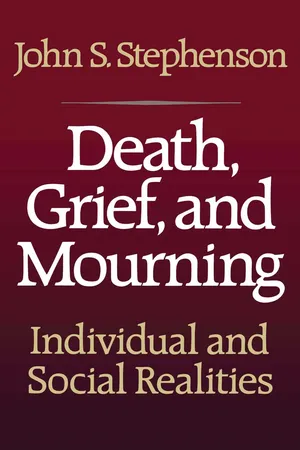
Death, Grief, and Mourning
eBook - ePub

Death, Grief, and Mourning

  1. 292 pages
  2. English
  3. ePUB (mobile friendly)
  4. Available on iOS & Android
eBook - ePub

Death, Grief, and Mourning

About this book

How do Americans cope with death? Do our feelings about dying influence the way we live? How are our ideas of death different from those of our ancestors?

These questions and others are addressed in this innovative new book -- a comprehensive, interdisciplinary approach to the processes, practices, and experiences concerning death and dying in the United States. Drawing on sociology and psychology as well as history and literature, John S. Stephenson surveys the range of individual and social responses to death -- from our very conception of its meaning to the complex ethical dilemmas surrounding suicide and euthanasia.

Stephenson synthesizes a theoretical perspective of death from the contributions of such important thinkers as Freud, Jung, Ernest Becker, and Robert Jay Lifton. He reviews the evolution of American attitudes and behaviors toward death -- from the Puritan era to the present, and charts the significance of such organizations for the dying as hospitals, hospices, and nursing homes. Bereavement as both personal reaction (grief) and social convention (mourning) is also discussed, as is the denial of death as a coping mechanism for individuals and institutions alike.

In his final chapters, Stephenson analyzes the ceremonies of death (including gravestones as social indicators) and provides a psychosocial overview of suicide as a final, desperate attempt to assert control. He concludes by exploring the implications of euthanasia at a time when technology can extend life dramatically but is not always capable of assuring its quality.

Throughout, authentic case examples -- many drawn from Stephenson's own clinical work -- illustrate the multi-faceted imagery and experiences that comprise the American way of death.

Stephenson's book will be welcomed by sociologists, psychologists, social workers, religious leaders, nurses, and others concerned with caring for the dying and the bereaved. It is a brilliant and elegantly written work that crosses disciplinary boundaries to provide a valuable synthesis of existing knowledge and offer educators and professionals a firm foundation for teaching, practice, and research.
Frequently asked questions

Yes, you can cancel anytime from the Subscription tab in your account settings on the Perlego website. Your subscription will stay active until the end of your current billing period. Learn how to cancel your subscription.
No, books cannot be downloaded as external files, such as PDFs, for use outside of Perlego. However, you can download books within the Perlego app for offline reading on mobile or tablet. Learn more here.
Perlego offers two plans: Essential and Complete
  • Essential is ideal for learners and professionals who enjoy exploring a wide range of subjects. Access the Essential Library with 800,000+ trusted titles and best-sellers across business, personal growth, and the humanities. Includes unlimited reading time and Standard Read Aloud voice.
  • Complete: Perfect for advanced learners and researchers needing full, unrestricted access. Unlock 1.4M+ books across hundreds of subjects, including academic and specialized titles. The Complete Plan also includes advanced features like Premium Read Aloud and Research Assistant.
Both plans are available with monthly, semester, or annual billing cycles.
We are an online textbook subscription service, where you can get access to an entire online library for less than the price of a single book per month. With over 1 million books across 1000+ topics, we’ve got you covered! Learn more here.
Look out for the read-aloud symbol on your next book to see if you can listen to it. The read-aloud tool reads text aloud for you, highlighting the text as it is being read. You can pause it, speed it up and slow it down. Learn more here.
Yes! You can use the Perlego app on both iOS or Android devices to read anytime, anywhere — even offline. Perfect for commutes or when you’re on the go.
Please note we cannot support devices running on iOS 13 and Android 7 or earlier. Learn more about using the app.
Yes, you can access Death, Grief, and Mourning by John S. Stephenson in PDF and/or ePUB format, as well as other popular books in Psychology & Abnormal Psychology. We have over one million books available in our catalogue for you to explore.

Information

CHAPTER ONE
Death:
A Theoretical Perspective

THROUGHOUT THE HISTORY of humanity, and even in prehistoric times, people have sought to give meaning to death. The evidence of this surrounds us, whether it be an army of statues created to protect a Chinese emperor, the pyramids of Egypt, or the Tomb of the Unknown Soldier. All of these are statements about death, and the meaning that it has for people. Death is an event that everyone knows about, but about which little is known. We do know that at one point life as we know it ceases to be. Beyond that, we know little except what is told to us by seers, mystics, prophets, and those who claim to have returned from the dead. From the time that humanity first became aware, people have had to grapple with the question of their mortality. They have answered that question in many different ways, usually in response to many different experiences and reasonings. But the quest has always been there—the search for an answer to the question, ā€œWhy was I born, if just to die?ā€
To live and then die meaninglessly is a terrible fate. And so humanity struggles to find an answer which will make sense of existence. ā€œWhy death?ā€ is and has been a fundamental question for all people. Answers to this question become infused in cultures and are passed on to succeeding generations. Most cultures are blendings of many different rationales and explanations of death, which means that the value and meaning of death within a particular culture may be many-faceted.
In American society, which will be the focus of this book, death has many meanings. It may mean that one is to dwell in heaven or hell. To some, death is a state of nothingness. To others, death is a transitory state until one returns in another life or life form. These are some of the various explanations for the state of being dead. Being dead is very different from dying, which is a process of living.
The way in which one dies is an important part of death, and so it has its own meanings. For example in America, altruistic suicide—where one gives his or her life for another—is highly valued. Taking your life in the face of a painful and lingering fatal illness is not seen as a good act. Thousands of dollars will be spent by the state to keep a suicidal prison inmate alive, so that the state can then carry out the capital punishment verdict and kill him or her. The federal government will devote great energies to save the lone sailor and his foundering boat caught in a storm at sea; and at the same time support the toxic tobacco industry through large subsidies. In American society, a high number of automobile deaths is acceptable; a high number of crib deaths is not.
The dying process involves individuals who behave in ways contingent upon the situation in which they find themselves. Their behavior, in other words, is influenced by their understanding of the situation. ā€œUnderstandingā€ is a subjective process. It involves the individual’s internal symbolic constructs, which we will call images. Images are internal recreations of our unique experiences, which are combined with and influenced by our emotions and past experiences. However, images are not simply static, emotionally-tinged visual impressions. The human mind is such that we can internally influence the images that we hold. We can both act on and react to our internalized images.
We are assuming that the individual is born with some elementary drives toward biological survival, which Boulding calls a biological value system.1 Lifton posits the existence of what he calls an inchoate image: ā€œa vital or controlling image, which determines the direction of the organism’s activity.ā€2 The society into which we are born teaches us through the socialization process the commonly held values of the larger social organization. These acquired images, which come to dominate the inchoate biological image, are what Boulding calls the ā€œpublic image.ā€ Every public or collective image begins in the mind of some single individual, and only becomes public as it is shared and incorporated within the images held by others. Society is involved in the process of transmitting, legitimizing, and enforcing images. Cassirer states that ā€œa glance at the development of the various symbolic forms shows us that their essential achievement is not that they copy the outward world in the inward world or that they simply project a finished inner world outward, but rather that the two factors of ā€˜inside’ and ā€˜outside,’ of ā€˜I’ and ā€˜reality’ are determined and delimited from one another only in these symbolic forms and through their mediation.ā€3
The images held by individuals are strongly influenced by the social environment. Where the individual exists in a state of reduced awareness, public images can come to dominate his or her thinking to the point of determining the individual’s behavior. Because consciousness (awareness of self) develops out of socialization, the influences of the external environment can be profound.
These two assumptions—that human beings are unique, internally-imaging animals, and that the environment strongly affects this process—form the basis for our discussion of thanatology, the study of death. The nature and function of imagery is such that to disregard either its psychological or social aspects would render our examination of the subject incomplete.
An example of the importance of internal imagery is its explanatory value in understanding the individual’s reaction to the death of a loved person. Small children, not yet having a complete and accurate image of death, often will not grieve as adults might expect. This is because of the child’s inability fully to ā€œimagine,ā€ or comprehend, what has taken place. The importance of considering the social environment’s effect on our image and hence our behavior is seen in understanding mourning behavior. In mourning behavior, which is the social aspect of the grief process, the inchoate feelings of the griever are channeled into socially appropriate ways of behaving on the basis of social custom. Social custom is another term for normative behavior—the valued ways of acting which represent in action the person’s internalized image of the world.
Because images serve as inner schema upon which behavior is based, we have to understand the internalized image—the frame of reference—which precedes and determines behavior if we are to understand human behavior itself. This internal representation of the world and the self’s relationship to the world will determine behavior; external stimuli which impinge upon the individual will not. Herbert Blumer speaks to this point when he argues that human beings act toward things on the basis of the meanings that things have for them.4 For example, the message, ā€œThe medical tests show that you have cancerā€ will produce very different reactions among people. Those who have seen others die painfully and whose images of cancer include such things as fear, hopelessness, and pain might react differently from those whose images contain a belief in medicine, a determination to survive, or a strong religious belief system.
Sheehan describes the functioning of the image as providing a basis for action in this manner:
It structures and creates some order that is meaningful and relevant to our physical and to our psychological needs out of the terrifying chaos that is the world of sight, sound, smell, taste, touch and movement. Through the image we sift, select and render down to a manageable scale both the world of the objects and our own human experience. Furthermore, with the help of images we learn to span time and so relate the objects and experiences in the present; this then assists abstraction and classification. Again, by using images of the past as a bridge to the present, man is better able to tolerate discomforts and frustrations in the present for the sake of a future satisfaction. Thus, when an infant manages to survive the mother’s temporary absence without panic he is probably enabled to do this because images of the mother’s face and body have begun to form themselves and thus he can comfort himself while she is not actually present. The image also ā€œfixesā€ an experience and so helps to preserve this experience for future use and reference. In the form of an image, experience retains some of the original vivacity and effect.
How do these images develop? Blumer believes that the images we hold (he uses the term ā€œmeanings that things haveā€) are derived from the messages in social interaction.6 In other words, our images are the products of our social interactions. Blumer does not deny the internal dynamics of symbol formulations—the psychoformative process—for he acknowledges the importance of interpretation as a formative process in which meanings are used and revised as instruments for the production of action. Symbolic interactionism is, according to Blumer, grounded in the root, or basic images which all of us have of the self and the world. The process of social interaction is the development of a shared image of the world. People agree to interpret the world and themselves in certain shared ways. These regularities allow for the smooth functioning of social groups. Examples of our shared, or collective, images are such concepts as ā€œfair play,ā€ our belief in the importance of progress, and in the goodness of the democratic political system.
Parsons likewise acknowledges the importance of the image in understanding human behavior when he writes that ā€œthe major structure of the ego is a precipitate of the object-relations which the individual has experienced in his life historyā€ and that the internalization of the social environment provides the core of human personality.7 Parsons acknowledges the ability of the human being to act upon his or her own images, and states, ā€œWhile the main content of the structure of the personality is derived from social systems and culture through socialization, the personality becomes an independent system through its relations to its own organism and the uniqueness of its life experience; it is not a mere epiphenomenon of the structure of society.ā€8 Parsons, like a great many other sociologists, opted for an investigation of social life—focusing on the structure and functioning of the larger social system—and paid comparatively little attention to the individual.
According to the social psychological paradigm that I have just described, both the individual and the social organization are necessary parts of any explanation of human behavior. The individual learns to symbolize from the social environment. The social environment retains and passes on to the individual shared meanings about the world. Some of these meanings (images) concern death and dying, and are central to all other images that are held by individuals and the larger social group (society or culture). In our approach to thanatology, we will take a social psychological perspective which allows us to examine images of mortality from the perspective of both the individual and the larger society.

Individual Meanings of Death

Each of us holds an image of death. That image is the sum of all our thoughts, feelings, and experiences concerning death. For example, someone may have had a traumatic encounter with death as a child, which resulted in an overwhelming sense of vulnerability. This becomes an important part of that person’s image of death. Our image may include fears of the unknown, or a theologically based conviction that death leads to a better life. Many of us retain as a part of our image of death the belief that to die a hero’s death battling for one’s country is a good death. Some people’s image of death has been influenced through reading popular books on death and dying. Common experiences can have a long-lasting effect upon a society’s image of death; an example is the impact of nuclear bombing upon the Japanese psyche. Our individual images of death, while having some content similar to the collective image, are also the products of our own unique experiences and thoughts. But what about personal death? Can we really know of it, and fully accept our mortality? Sigmund Freud believed not, for he saw death in a unique way.

The Drive Toward Death

Freud built his theory of human behavior upon the premise that the actions of individuals were influenced by the pleasure principle. The basic drive possessed by all human beings, according to Freud, is a drive toward physical pleasure. As a child, the pleasure is found in various parts of the body, but successful maturing finds the individual receiving the greatest physical pleasure from heterosexual intercourse.9
This theory, for the most part, served Freud well. But there were some human behaviors that he was unable to explain in terms of his theory. One of these behaviors was what Freud termed the repetition compulsion. This is the urge to repeat painful and sometimes traumatic experiences in such forms as dreams and children’s games. The repetition compulsion is also seen in the behaviors of individuals who act in ways that lead them into repeated unpleasurable experiences, thus appearing to be cursed by tragedy. Clearly these experiences which are repeated over time ā€œinclude no possibility of pleasure.ā€10 How, then, to account for such actions?
In order to explain these behaviors, as well ...

Table of contents

  1. Cover Page
  2. Title Page
  3. Contents
  4. CHAPTER ONE Death A Theoretical Perspective
  5. CHAPTER TWO Death in America
  6. CHAPTER THREE Institutions for Dying
  7. CHAPTER FOUR The Dying Process
  8. CHAPTER FIVE Grief and Mourning
  9. CHAPTER SIX Survivors of Death
  10. CHAPTER SEVEN Ceremonies of Death The Funeral
  11. CHAPTER EIGHT Suicide Deciding to Die
  12. CHAPTER NINE Euthanasia
  13. Index