
- 256 pages
- English
- ePUB (mobile friendly)
- Available on iOS & Android
eBook - ePub
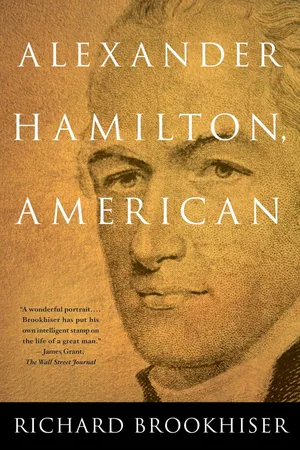
ALEXANDER HAMILTON, American
About this book
Alexander Hamilton is one of the least understood, most important, and most impassioned and inspiring of the founding fathers. At last Hamilton has found a modern biographer who can bring him to full-blooded life; Richard Brookhiser. In these pages, Alexander Hamilton sheds his skewed image as the "bastard brat of a Scotch peddler, " sex scandal survivor, and notoriously doomed dueling partner of Aaron Burr. Examined up close, throughout his meteoric and ever-fascinating (if tragically brief) life, Hamilton can at last be seen as one of the most crucial of the founders. Here, thanks to Brookhiser's accustomed wit and grace, this quintessential American lives again.
Frequently asked questions
Yes, you can cancel anytime from the Subscription tab in your account settings on the Perlego website. Your subscription will stay active until the end of your current billing period. Learn how to cancel your subscription.
No, books cannot be downloaded as external files, such as PDFs, for use outside of Perlego. However, you can download books within the Perlego app for offline reading on mobile or tablet. Learn more here.
Perlego offers two plans: Essential and Complete
- Essential is ideal for learners and professionals who enjoy exploring a wide range of subjects. Access the Essential Library with 800,000+ trusted titles and best-sellers across business, personal growth, and the humanities. Includes unlimited reading time and Standard Read Aloud voice.
- Complete: Perfect for advanced learners and researchers needing full, unrestricted access. Unlock 1.4M+ books across hundreds of subjects, including academic and specialized titles. The Complete Plan also includes advanced features like Premium Read Aloud and Research Assistant.
We are an online textbook subscription service, where you can get access to an entire online library for less than the price of a single book per month. With over 1 million books across 1000+ topics, weâve got you covered! Learn more here.
Look out for the read-aloud symbol on your next book to see if you can listen to it. The read-aloud tool reads text aloud for you, highlighting the text as it is being read. You can pause it, speed it up and slow it down. Learn more here.
Yes! You can use the Perlego app on both iOS or Android devices to read anytime, anywhere â even offline. Perfect for commutes or when youâre on the go.
Please note we cannot support devices running on iOS 13 and Android 7 or earlier. Learn more about using the app.
Yes, you can access ALEXANDER HAMILTON, American by Richard Brookhiser in PDF and/or ePUB format, as well as other popular books in Politics & International Relations & Historical Biographies. We have over one million books available in our catalogue for you to explore.
Information
Chapter One
St. Croix/Manhattan
IN THE LATE eighteenth century, Bryan Edwards, a Jamaican author, inserted this description into a reference work on the West Indies. âThe nightsâ in summer âare transcendantally beautiful. The clearness of the heavens, the serenity of the air, and the soft tranquility in which Nature reposes contribute to harmonize the mind, and produce the most calm and delightful sensations. The moon too in these climates displays far greater radiance than in Europe: the smallest print is legible by her light; and in the moonâs absence her function is not ill-supplied by the brightness of the milky-way, and that glorious planet Venus, which appears here like a little moon⌠cast[ing] a shade from trees.â1
When Alexander Hamilton was born, the Caribbean was as enchanting as it is now. It was also richer, thanks to sugar. At the end of the Seven Yearsâ War in 1763, when the British victors considered restoring some of their conquests to France, they seriously debated whether to return Canada, or the island of Guadeloupe. One sugar island weighed evenly in the balance with half of North America. Some West Indian planters made fortunes. They lived high in the islands, and when they returned to the old country. âSuch eating and drinking I never saw,â wrote a visitor to Jamaica. âSuch loads of all sorts of high, rich and seasoned things and really gallons of wine and mixed liquors. They eat a late breakfast as if they had never eaten before. It is as disgusting as it is astonishing.â âThere was no such thing as a [seat in Parliament] to be had now,â an English lord wrote in 1767; rich West Indians âhad secured them all at the rate of 3,000 pounds at least, but many at four thousand pounds, and two or three that he knew at five thousand pounds.â2
If war, disease, and hurricanes spared them, sugar planters could do well indeed. But there was little else to do in the West Indies. The sugar islands were floating agricultural factories, with few small farms, and small service populations in their ports. When young George Washington of Virginia (hardly an egalitarian society) took a trip to Barbados in 1751, he was struck by the material disparity he saw there. âThere are few who may be called middling people. They are either very rich or very poor.â3
Beneath the poor whites were the slaves. Sugar farming was labor intensive; on plantations, slaves outnumbered their white masters by twenty to one. Their life was harsh. In 1755, Denmark decreed that masters in the Danish Virgin Islands could not punish their slaves by mutilating them, or putting them on the rack, though they might shackle and flog them. In spite of this lenience, the slaves of St. Croix planned a revolt in 1759. The free black man who revealed the plot ahead of time committed suicide, after which his body was hung, then burned at the stake. Slaves found riding or walking the streets of Christiansted, the main town, after eight oâclock at night were given 150 lashes at the fort, âat no expense to the owner.â Edwards, describing the British island of Nevis as a âbeautiful little spot,â added that the population was 600 whites and 10,000 blacks: âa disproportion which necessarily converts all such white men as are not exempted by age and decrepitude into a well-regulated militia.â4 In the Second Amendment to the United States Constitution, the âwell-regulated militiaâ would be a force for freedom. In the West Indies, it was a force for keeping the labor force in line.
Hamilton, who grew up in Nevis and St. Croix, never wrote a fond word about the Caribbean, and never made the slightest effort to return for a visit as an adult. The prosperity of the West Indies existed chiefly in its balance sheets, and made little use of human capital apart from muscle. With its barren riches and its lack of opportunity, it was a place to leave behind, and a model for what a happy country should avoid.
Hamiltonâs early life and the lives of his family were set in the small islandsâthe Leeward and the Virgin Islandsâthat rim the northeast corner of the Caribbean. Hamiltonâs mother, Rachel Faucett, was born on Nevis, but went to St. Croix, a twenty-hour sail with the trade winds, as a teenager. She followed one of her sisters, who had married a St. Croix planter named James Lytton. About 1745, Rachel married another planter, John Lavien, and a year later she bore him a son. Like many whites in the Caribbean, the families were a mix of nationalities, who had settled without regard to the islandsâ formal owners: the Faucetts were Huguenots and the Lyttons English; Lavien was probably German.
Hamilton family tradition held that Rachel had âwitnessed⌠family quarrelsâ5 as a girl. If so, she found a new set of them in her marriage to Lavien. They settled on a cotton plantation he owned, ironically named Contentment, but in 1750, he had her jailed in the town fort in Christianstedâthe same place where curfew-breaking slaves were lashedâfor refusing to live with him. When she got out, she returned to the British West Indies, where she met James Hamilton.
James Hamilton, the fourth son of a Scottish laird, had come to the Caribbean to make his fortune as a merchant. Fifty years later, Alexander Hamilton wrote a friend that âI have better pretensions than most of those who in this Country plume themselves on Ancestry.â This was an unusually defensive tone for him: Hamilton characteristically expected people to endorse his ideas and his actions because he had shown how right they were, not because he had a good pedigree. He went on to admit that his birth was ânot free from blemish,â6 for Rachel had two sons with James HamiltonâJames Junior and Alexanderâwithout getting a divorce from John Lavien.
Illegitimacy may not have had quite the stigma in that century that it acquired under the Victorians in the next, but it was still shameful. A dozen years later, when Benjamin Franklin arranged for his illegitimate son William to be named royal governor of New Jersey, John Adams called it an âInsult to the Morals of America.â Rachel and James Senior seem to have tried to avoid the stigma: Alexander believed that his mother had gotten a second marriage, and the records of a christening on the Dutch island of St. Eustatius mention the presence of James Hamilton and âRachel Hamilton his wife.â In the Danish Virgin Islands, however, Rachel was still Rachel Lavienâuntil 1759, when John Lavien divorced her for her âungodly mode of life.â7 Since Rachel was the party at fault, Danish law did not allow her to remarry. Presumably, James Senior discovered this state of affairs when he moved with his family to St. Croix in 1765. A year later, he left them, never to return.
To support herself, Rachel opened a provision store in Christiansted. Alexander went to work as a clerk in a merchant house; his older brother worked for a carpenter. In 1768, Alexander and Rachel came down with a fever. The son recovered; the mother died.
These, and a few other dry details, reflected in scattered church and legal documents, are virtually all we know of Hamiltonâs earliest childhood. They leave several puzzles. One is the year of his birth. Hamilton indicated, and descendants of his who wrote biographies of him stated flatly, that he was born in 1757, which would mean that he began working in a merchant house at the age of nine. But in settling Rachelâs estate in 1768, the probate court listed her illegitimate sonsâ ages as fifteen and thirteen, which would mean that Alexander had been born in 1755. Biographers in thrall to documents tend to accept 1755; defenders of the later date point out that the clerk was not perfect, for he misspelled the name Lavien. The desire to add two years to Alexanderâs age may also reflect an impulse, encouraged by the practice of assigning schoolchildren to grades, to discount the abilities of the gifted. Without being a Mozart, Alexander Hamilton was a very bright boyâand he was hardly unique. Benjamin Franklin was apprenticed to a printer at the age of twelve, and published his first journalism when he was sixteen. The future theologian Jonathan Edwards wrote an eloquent and observant essay on flying spiders when he was twelve, and entered Yale College a year later. One of the supporters of an âolderâ Hamilton inconsistently argues that his responsibilities as a clerk were not that great.8 If they were not, then it is all the more likely that a younger boy could have fulfilled them. Recognizing that even a younger Hamilton would not have been miraculous, and believing that a man is more likely to know his own birthday than a clerk in a probate court, I will accept 1757.
A more important question is the character of his parents. Since Hamiltonâs relations with women played an important role in his public career, it would be interesting to know more about his mother. Hamilton described her to his children as a woman of âsuperior intellect,â âelevated and generous sentiments,â and âunusual elegance of person and manner.â John Lavien accused her in his divorce papers of âwhoring with everyone.â9 Neither man was an objective witness. What is clear is that Rachel was a good businesswoman; when she died, the accounts of her store were in order, and she had only a few short-term debts.
It is also clear that James Hamilton, Sr., was a bum. He had other qualitiesâhis surviving letter shows charm, and his decision to move from Scotland to the Caribbean suggests that he had a stock of youthful enterprise, or at least hopeâbut he was a bum nevertheless, and this would have been clear to his sons. When he left his family, he did not disappear, but went back to the Leeward Islands, where he lived a long and uneventful life. He and his famous son made sporadic efforts to keep in touch. In 1783, Alexander wrote to his older brother, who had asked him for money: âBut what has become of our dear father?⌠Perhaps, alas! he is no more, and I shall not have the pleasing opportunity of contributing to render the close of his life more happy than the progress of it.â Ten years later, James wrote the secretary of the treasury from St. Vincent that he would take âthe first ship that sails for Philadelphia.â But two years after that, Alexander wrote a friend that though he had âpressedâ his father to come, James had decided not to, on account of his health. Perhaps he was reluctant to be so directly helped by the son he had abandoned. In 1799, the old man died. Afterward, Alexander wrote that his father had âtoo much pride and too large a portion of indolenceâbut his character was otherwise beyond reproach.â10 This was more generous than accurate. Pride and indolence are faults (Alexander inherited the first, though not the second). But they were not Jamesâs only faults. If he had vanished, his lover and his children could have consoled themselves with romantic, even tragic, speculations about his character and his fate. But he simply moved over a few islands. James Hamilton walked away from a complicated situation, and made it plain that that was what he had done. When Alexander Hamilton became a husband and father, he dedicated himself (sometimes with very mixed results) to behaving differently.
Rachel left a modest estateânine slaves, thirteen silver spoons, and thirty-four books. James Junior and Alexander received none of it. John Lavien appeared before the probate court and claimed everything for his and Rachelâs legitimate son. The Lytton family, into which Rachelâs sister had married, gave the Hamilton boys some help, buying back the thirty-four books at an auction. But the Lyttons were coming to grief too. Two of Alexanderâs Lytton cousins had left the island as bankrupts; a third killed himself. James Lytton, their father, died a month later. Alexander was practically alone in a small world.
A year later, age twelve, he wrote his first letter that survives, to Edward Stevens, an older boy who had been sent to New York to attend Kingâs College, now Columbia University. â[T]o confess my weakness, Ned, my Ambition is so prevalent that I contemn the grovâling and condition of a Clerk or the like, to which my Fortune &c. condemns me and would willingly risk my life thoâ not my Character to exalt my StationâŚ. Im no Philosopher, you see, and may be justly said to Build Castles in the AirâŚ. yet Neddy we have seen such Schemes successfull when the Projector is Constant I shall Conclude saying I wish there was a War.â11 St. Croix was a bigger island than Nevis, with more than twice the populationâ24,000, of which 2,000 were whiteâand as a merchantâs clerk, Alexander could observe its traffic with a wider world. But in the normal course of things, a local boy without a family could not expect to see the world, still less to exalt his station. Neddy Stevens might get away; not him.
Three factors altered the course of things. In 1771, the Reverend Hugh Knox, a Scotch-Irish Presbyterian minister, moved to Christiansted and noticed the ambitious boy. Knox was interested in education, and he had plans to teach the local slaves. He himself had been educated at the College of New Jersey in Princeton, at that time the finest school in the Thirteen Colonies. Jonathan Edwards had served briefly as president; Knox had studied with Edwardsâs son-in-law, Aaron Burr. Knox could introduce Alexander to two new worldsâlearning, and North America.
Hamiltonâs employer, Nicholas Cruger, had even more extensive connections on the mainland, which would propel Alexander in that direction. The Crugers, originally a German family, had been New York merchants for three generations. Nicholasâs uncle had been the first president of the New York Chamber of Commerce. Nicholas and his three brothers were dispatched by the family to different centers of business: St. Croix, Jamaica, Curaçao, and Bristol, England. (The brother who went to Bristol ultimately became mayor, and a member of Parliament.) In Christiansted, Nicholas Cruger owned ships, warehouses, a general store, and a counting house, where Hamilton worked, on Kongensgade, or King Street. Cruger and other New Yorkers began trading in St. Croix at mid-century for its sugar, delivering it to the refineries of old New York families like the Roosevelts. In return, they brought the islanders the staples that were not produced locally. One of Crugerâs handbills advertised Albany white pine, pork, codfish, Madeira, and mules from Puerto Rico. Cruger was not a regular slave-trader, though in 1771 he did auction three hundred âfirst class slaves⌠just in from Africa.â In Virgin Islands dialect today, the phrase âthe City,â when used without qualification, means New York, or America (the two are assumed to be interchangeable).12 There was no United States when Hamilton was Crugerâs clerk, but Crugerâs hometown had already become a pivot for the Virgin Islandsâ dealings with North America, and the world.
The third factor in Hamiltonâs change of fortune was the impression his abilities made on these men. In the fall of 1771, Cruger left St. Croix for four months on account of bad health, leaving his fourteen-year-old clerk to mind the store. In the letters he sent out during this period, Hamilton passed judgment on loads of flour (ârealy very badâ), apples (âin every respect very indifferentâ), and the captain of a ship the Crugers had hired (âI think he seems rather to want experience in such Voyagesâ). He suggested that Nicholasâs brother in Curaçao mount guns on the ship to protect it from the Spanish coast guard, and fretted when this was not done. âI begd Mr. Teleman Cruger to put some force upon her. How he came to neglect it I donât know.â13
In 1772 Hamilton got to read himself in print. On the last day of August, a hurricane raked the island, killing thirty people and sweeping ships a hundred yards inland. Alexander wrote to his father describing the disaster; some local adult saw the letter, and in early October it appeared (âby a Youth of this Islandâ) in the Royal Danish-American Gazette. It opened with staccato description: âThe roaring of the sea and windâfiery meteors flying about it in the airâthe prodigious glare of almost perpetual lightningâthe crash of the falling houses.â Pious reflections followed, perhaps inspired by the Reverend Mr. Knox: âThat which, in a calm and unruffled temper, we call a natural cause, seemed then like the correction of the DeityâŚ. The father and benefactor were forgot [while] a consciousness of our guilt filled us with despair.â These were interesting thoughts to be addressed to a father, no benefactor, who had forgotten to return home. The last sentence, like a flash, prefigured the mature Hamilton: âOur General,â he wrote, of the Danish governor of the island, âhas issued several very salutary and humane regulations, and both in his publick and private measures, has shewn himself the Man.â14 All his adult life, he would make confident judgments of the performance of superiors and subordinates. He was doing it at the age of fifteen.
His authority for doing so sprang from his own passion to perform wellâhe never criticized from the role of a detached analyst or a kibbitzer. Years later, Hamilton told one of his sons that clerking for Cruger had taught him âmethodâ and âfacility,â and that his years in the King Street counting house had been âthe most useful of his education.â15 But method and facility would have been of little account without his will to see the job done right, by himself if necessary.
Later that month, the young author was put on a ship and sent to the mainland. Other foreigners who would come to America during the Revolutionary period, like Thomas Paine and the Marquis de Lafayette, were citizens of superpowers, who saw the new country as a haven of virtuous simplicity. Hamiltonâs trajectory was different: he was coming from the fringes to the center.
⢠⢠â˘
Hamiltonâs move to the mainland was a joint project of Cruger and Knox. The plan was to send him to the College of New Jersey at Princeton, after he had done the necessary academic catching up. Hamilton studied at a grammar school in Elizabethtown, New Jersey, reading in his room until midnight, and in the morning before school began, in a nearby cemetery.
Dr. John Witherspoon, the Scottish minister who had succeeded Aaron Burr as president at Princeton, made the college a republican seminary. But Hamilton was not destined to be one of his disciples....
Table of contents
- Cover
- Title Page
- Copyright Page
- Dedication
- Acknowledgments
- Contents
- Introduction
- Chapter 1: St. Croix/Manhattan
- Chapter 2: War
- Chapter 3: Laws
- Chapter 4: Treasury Secretary
- Chapter 5: Fighting
- Chapter 6: Losing
- Chapter 7: Words
- Chapter 8: Rights
- Chapter 9: Passions
- Chapter 10: Death
- Notes
- Index
- Photo Insert
- Back Cover