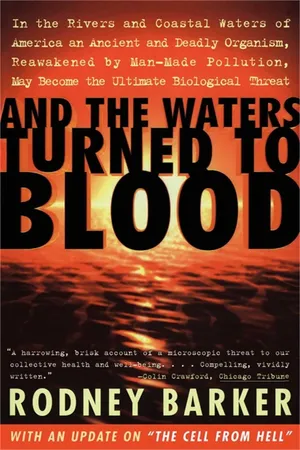
And the Waters Turned to Blood
eBook - ePub

And the Waters Turned to Blood

  1. 352 pages
  2. English
  3. ePUB (mobile friendly)
  4. Available on iOS & Android
eBook - ePub

And the Waters Turned to Blood

About this book

In this account, Rodney Barker tells the full and terrifying story of a microorganism popping up along the Eastern seaboard—far closer to home than the Ebola virus and equally frightening. In the coastal waters of North Carolina—and now extending as far north as the Chesapeake Bay area—a mysterious and deadly aquatic organism named Pfiesteria piscicida threatens to unleash an environmental nightmare and human tragedy of catastrophic proportions. At the very center of this narrative is the heroic effort of Dr. JoAnn Burkholder and her colleagues, embattled and dedicated scientists confronting medical, political, and corporate powers to understand and conquer this new scourge before it claims more victims.

Frequently asked questions

Yes, you can cancel anytime from the Subscription tab in your account settings on the Perlego website. Your subscription will stay active until the end of your current billing period. Learn how to cancel your subscription.
No, books cannot be downloaded as external files, such as PDFs, for use outside of Perlego. However, you can download books within the Perlego app for offline reading on mobile or tablet. Learn more here.
Perlego offers two plans: Essential and Complete
  • Essential is ideal for learners and professionals who enjoy exploring a wide range of subjects. Access the Essential Library with 800,000+ trusted titles and best-sellers across business, personal growth, and the humanities. Includes unlimited reading time and Standard Read Aloud voice.
  • Complete: Perfect for advanced learners and researchers needing full, unrestricted access. Unlock 1.4M+ books across hundreds of subjects, including academic and specialized titles. The Complete Plan also includes advanced features like Premium Read Aloud and Research Assistant.
Both plans are available with monthly, semester, or annual billing cycles.
We are an online textbook subscription service, where you can get access to an entire online library for less than the price of a single book per month. With over 1 million books across 1000+ topics, we’ve got you covered! Learn more here.
Look out for the read-aloud symbol on your next book to see if you can listen to it. The read-aloud tool reads text aloud for you, highlighting the text as it is being read. You can pause it, speed it up and slow it down. Learn more here.
Yes! You can use the Perlego app on both iOS or Android devices to read anytime, anywhere — even offline. Perfect for commutes or when you’re on the go.
Please note we cannot support devices running on iOS 13 and Android 7 or earlier. Learn more about using the app.
Yes, you can access And the Waters Turned to Blood by Rodney Barker in PDF and/or ePUB format, as well as other popular books in Biological Sciences & Environmental Science. We have over one million books available in our catalogue for you to explore.

PART ONE

logo
“I’ve been waiting to meet you for a long time.”

1

The circumstances that brought Dr. JoAnn Burkholder to North Carolina in 1986 were so sudden and surprising that it almost seemed as if the Tar Heel State dialed her number, rather than the other way around.
She was thirty-three and close to completing her doctorate in botanical limnology—the scientific study of plants that thrive in freshwater lakes and streams—at Michigan State, and for months she had devoted her Saturdays to filling out job applications. The effort had produced several offers, but none she could bring herself to accept. A faculty position at Fordham University came with a low salary, and the thought of living in New York City made her writhe as if from physical confinement. Michigan State had asked her to apply for a postdoctoral fellowship, and it would have been a comfortable position—a house in the woods and a year of writing papers—but she knew part of the reason it had been offered to her was that her great-grandmother was a full-blooded Cherokee. While it would have helped the administration to satisfy its minority quota, she didn’t feel right about accepting it under those conditions. Not only would she be taking away an opportunity meant for people who were struggling, it was also important to her that wherever she went, her appointment be based on her merits as a scientist.
Then a professor from her undergraduate days at Iowa State University phoned, saying he had received a call from the head of a faculty search committee at North Carolina State University: they were having difficulty attracting qualified applicants for an aquatic botanist position. It was May, she had been sending out applications for months. In her field most job prospects came through in January or February, so even though she said she would look into it, she thought it was too late to apply. But then the professor called back to say he had recommended her for the position and they were personally requesting an application. Hearing that, she remembers, she was so taken aback she looked at the telephone receiver as if it were something with a will of its own.
She had never been to North Carolina, and when she flew in for an interview she had very few preconceptions. She didn’t even know what the landscape would look like. So she took a window seat on the flight to Raleigh, and looking out the window, she noticed the thick pine forests that began at the mountains and seemed to cover the northwest part of the state like a wilderness. They made her smile, because she loved the woods. Raised in Rockford, Illinois, she had been especially close to her father, who had all but grown up in the woods, hunting, fishing, and trapping during the Depression to help his family put food on the table. When he married, he had badly wanted a son who would share his interest in the outdoors, but there’d been no such luck. His first daughter, Norma, would have been Norman, and John turned out to be JoAnn. To his delight, however, so naturally did JoAnn take to the open air that she almost made him forget she wasn’t a boy. Her happiest memories were of their hunting trips together, when he taught her how to track animals and flush game, and would tease her that she was his rabbit-and-squirrel retriever. Years later, she would credit those early experiences in the woods as inaugurating her scientific curiosity about nature: at the age of nine, she was keeping notes on how many bird species she could identify, and whenever she found a nest with eggs, she would count and measure them, and record color differences.
Also in view from the air were North Carolina’s lakes, and they were very different from what she was used to in Michigan. Not only were most of them river impoundments, as opposed to natural bodies of water, they also shone bright orange and brown—indicating a lot of turbidity. Her specialty being the study of freshwater plants—where and why and how they grow, with a particular emphasis on the way nutrients influence botanical communities—she knew just from looking that agricultural runoff and urban development were the likely culprits. She felt there was interesting work to be done here.
Not everyone can look back and point to a single experience or something read that gave his or her life direction and meaning, but JoAnn Burkholder could. When she was a junior in high school, she picked up a copy of Life magazine that featured a special report on “The Blighted Great Lakes: The Shocking Case of Our Inland Seas Dying from Man-Made Filth.” Accompanying a text that recalled the deep, clear waters that inspired Longfellow to write “By the shore of Gitche Gumee” were sickening photographs of dead fish floating on currents that carried soapsuds, sewage, and chemicals, and of shorelines littered with abandoned cars and oil drums. While it was apparent from the article that the errors and negligence of we the people were responsible for fouling the lakes, it was beyond the scope of a sixteen-year-old conservation-minded girl to know how to approach the human aspect of the problem. But what did capture her interest was the concept that every lake had its own natural life cycle, beginning as a cold, clean body of water that supported a variety of healthy plant and animal life, and moving through stages toward becoming a shallow, warm marsh that hosted only the lowest forms of life. And while under normal conditions that process was supposed to take place over thousands of years, man-made pollution accomplished it in a fraction of the time by introducing nutrients that fed forms of plant life, particularly algae, that could, literally, choke a lake to death. After that article, there was never any question of what JoAnn Burkholder was going to do with her life. She was going to be involved in “water science” of some sort.
The people on the interview committee at North Carolina State were candid about their need: they were replacing a retiring professor and wanted someone forward-looking. Her former professor had told them that she filled the bill. She had a reputation for using advanced techniques in her research work because she was willing to go out on her own and learn what was necessary to accomplish a specific task. If she was involved in research that would benefit from electron microscopy, she took a course. If she needed to learn how to do autoradiography, she sought the people who could teach it to her—even if it meant going beyond the skill level of her professors.
When she asked the interviewers what would be expected of her, she found the position allowed for enormous flexibility. She could do almost anything she was interested in doing that pertained to the basic science of her field, they told her.
It was the first position she had interviewed for that she really wanted, and the feeling was mutual. Within three months, she was moving to Raleigh as an assistant professor of aquatic botany.
At that point it seemed as if fortune was working on JoAnne Burkholder’s behalf. It didn’t even faze her that in her haste to get settled she took a lease on a one-room flat in north Raleigh that she would come to think of as the Apartment from Hell. It was tiny and ugly, a single cell in an enormous honeycomb, with a prime view of rush-hour traffic. Making matters worse, on the other side of her wall lived someone who snored like a troll. She had to run a fan at high speed in order to get to sleep, and there were times when her apartment seemed to shake from the rumble of his snoring. She tried leaving notes, but they went unanswered, and one especially bad night she stormed into the hallway and pounded on his door. For ten minutes. It took her that long to realize he couldn’t hear her over the din he was creating. By morning she was feeling homicidal. She’d taken the apartment because it had been the only place she could find near campus that did not allow pets and was within her budget. “I’m being held hostage to my allergy to cats,” she would explain to those who asked her why she didn’t just move.
Nevertheless it was home, and she succeeded in making it comfortable with pictures—an oil painting of a cabin in the woods, another of Brigadoon, and one from the tales of King Arthur. She was striving for a magical and timeless ambience, a place whose doorway was a moat that, once crossed, gave onto a fantasy world where she could forget everything unpleasant on the outside. It was an escape she needed, because as she was quickly discovering, an assistant professor at the university level was a lot like a pledge in a fraternity: a period of hazing preceded acceptance as an equal.
Although technically she was on a tenure track, she knew she had only five years to make good—which meant that she had to hurry up and write grant proposals and get them funded. The time had passed when tenure for newly hired professors was based on getting papers accepted in reputable scientific journals. Now you were expected to do that and go out and raise money to support your research. Plus set up a research laboratory and develop courses from scratch. On top of which you were also presented with, and had no choice but to accept, the junky jobs that were tossed your way by your department head—such as giving the guest lecture he’d been invited to deliver on botany appreciation at a community college a day’s drive from Raleigh.
But JoAnn Burkholder was no stranger to adversity when it came to educational advancement. Indeed, she’d had to vault a lot of hurdles to get to this stage of her career.
Although she had been a precociously bright and quick-witted child, she was brought up in a working-class community where girls were discouraged from having ambitions beyond motherhood. In the second grade, after outscoring every other student on a test, she was told by her teacher that boys were endowed with native smarts girls did not possess, and as soon as their interests shifted from the playground to the classroom, they would surpass her. Her response had been, No they won’t!
Even though she graduated from high school with straight A’s, her mother had refused to sign college financial aid papers. As a result, JoAnn had worked as a drugstore clerk and scraped dishes in the school cafeteria to pay for her higher education.
When, as an undergraduate, she was hired as an assistant in a limnology research lab at Iowa State, she was the only female on staff. She was forced to put up with the good-old-boy chauvinism that came with an academic discipline traditionally considered the province of males because so much of what went on took place outdoors. But she showed that she could hike in the woods, ford streams, and camp with the best of them. In the end, it had been her limnology professor who recommended her to N.C. State.
For the first four months in North Carolina, she did not even have her own office. A space was cleared for a small desk in the corner of a storeroom. The conditions were so cramped that, at her own expense, she flew back to Michigan State to use the computer there in writing her grant proposals. And whereas in some institutions department members would take new people under their wing, offering them recommendations and leads, she was given very little mentoring—other than the understanding, in no uncertain terms, that she’d better get something funded fast.
All she did that first year was work. On a typical day, she arrived at the office at seven in the morning and was still there at midnight. She wrote proposals for stream and reservoir research, because she knew fresh waters best. She also went to the library and ferreted out the nearby professors in her field and their publications, so she could talk intelligently to them. She started making telephone calls: Hello, my name is JoAnn Burkholder. I’m new in the area. I understand you’re a fishery ecologist. Your work sounds interesting—would you like to get together and talk about the aquatic ecology in the state? I’ll buy lunch.
Other than making the rounds and visiting people related to her work—and leaving herself time to jog and to swim at the university gym, which she did religiously—she got out very little. She felt extremely isolated, but whenever she tried to think about activities she could engage in that would introduce her to new people, there was either a time conflict or a reason not to. She would have liked to join an organization, for example, but the only groups that interested her were environmentally oriented, and she feared affiliating herself with them might compromise her scientific integrity in the eyes of her colleagues.
As for a social life, it too was nonexistent. That had nothing to do with her ability to attract men. An athletic and shapely five feet five, with curly brown hair and electric-blue eyes, JoAnn had never been lacking in male admirers. It was more that at this point in her life she wasn’t especially interested in getting involved with someone; in fact, her romantic history had left her slightly wary of the opposite sex.
There were men who became obsessed with her. David Mangold was the first name that came to mind, though it was a name she wished she could forget. She had been fifteen, he was two or three years older, and for some reason he fixated on her. For three and a half long years he pursued her, as what today would be called a stalker. He called her on the phone and wrote her letters, professing his love. And when she tried to tell him, reasonably, that she didn’t share his feelings, he threatened to commit suicide, to kill her, to kill her parents. Once, reading a book in her room, she looked up and saw him staring at her through the window. An ACE radio operator, he would tap into her phone calls and interrupt angrily if the call was from another boy. When she came home from dates, he would be sitting on the front porch, waiting for her. Her parents tried everything they could to get rid of the boy, and his own family tried too. There was even an attempt to get a restraining order against him. But nothing worked until she moved to another state to go to college.
Still, years later, it wasn’t fear of a relationship that prevented JoAnn Burkholder from going out socially, so much as priorities: she had a hard time relaxing and enjoying herself while her professional life was out of sorts. And to be completely honest, it seemed that whenever she tried to mix the two, she ended up miscalculating. A prime example was the suggestion she took from a professor. “Why don’t you teach my aquatic ecology seminar. That way you’ll get to meet new people, and gain experience in the process.” She fell for it and taught the course. And while he was paid for the credit hours, she got a lesson learned.
And so it went for almost two years. She was awarded several small grants and even a couple of sizable ones, but it was still a struggle. Which goes a long way to explaining why she reacted as she did when she received a phone call from Dr. Edward Noga, a fish pathologist at the North Carolina State veterinary school, asking for her help in solving a mass murder.

2

The modern three-story building that is North Carolina State’s College of Veterinary Medicine sprawls across a bucolic sweep of rolling green fields several miles west of the main campus. Its offices, classrooms, and research laboratories are approached by a redbrick walkway that leads from a parking lot to the front entrance. First-time visitors often stop on their way into the vet school to read from a row of bricks etched with names: donors to the college, and pets to whom contributions to the building fund were dedicated. In Memory of Pepper—Don and Nancy. In Memory of Slugger and Ted—The Biggs Family. Perhaps it is because they think of the inscribed bricks as little gravestones, but most people make a point of stepping over that row rather than on it.
In back of the main building are four towering grain silos and the laboratory-animal houses, which are referred to as finger barns because they are long and narrow and there are five of them. Horses and pigs and cattle, dogs and cats, are kept there, and the last one down—Building 311—is used for poultry and fish. This is where Dr. Edward Noga conducted studies into the causes of fish diseases and developed treatments, though it was actually his Ph.D. student Stephen Smith who was the first to arrive at the present crime scene and who took the early lead as chief investigator.
Smith, who had earned his bachelor’s, master’s, and D.V.M. from Ohio State, was teaching several classes in parasitology and assisting in Dr. Noga’s lab, where, for his dissertation, he had been working on an experiment that looked at the immune response of fish to a parasitic marine dinoflagellate. Dinoflagellates are a group of microscopic, mostly single-cell organisms that belong in a “twilight zone” between the plant and animal kingdoms. Claimed by botanists as microscopic plants because some members obtain their sustenance through photosynthesis, they are also claimed by zoologists, because other members consume protozoans. A primitive group that has been traced by the fossil record back at least 500 million years, dinoflagellates form the base of the food chain in both fresh and salt water, being consumed by small organisms that in turn are eaten by...

Table of contents

  1. Cover
  2. Dedication
  3. Foreword: “What’s wrong with me, Mommy?”
  4. Part One: “I’ve been waiting to meet you for a long time.”
  5. Part Two: “Oh, science took it awfully well.”
  6. Part Three: “Watch out for Howard Glasgow. He’s turned this place into a Little Shop of Horrors.”
  7. Part Four: “Hey, there’s something out there. There has to be.”
  8. Epilogue: “I ain’t never seen a dead man spend no money.”
  9. Afterword
  10. Glossary
  11. Acknowledgments
  12. About Rodney Barker
  13. Index
  14. Copyright