Big Trouble
eBook - ePub

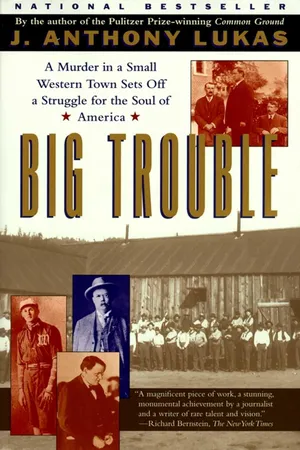
Big Trouble

A Murder in a Small Western Town Sets Off a Strugg

  1. 880 pages
  2. English
  3. ePUB (mobile friendly)
  4. Available on iOS & Android
eBook - ePub

Big Trouble

A Murder in a Small Western Town Sets Off a Strugg

About this book

Hailed as "toweringly important" (Baltimore Sun ), "a work of scrupulous and significant reportage" (E. L. Doctorow), and "an unforgettable historical drama" (Chicago Sun-Times), Big Trouble brings to life the astonishing case that ultimately engaged President Theodore Roosevelt, Supreme Court justice Oliver Wendell Holmes, and the politics and passions of an entire nation at century's turn.After Idaho's former governor is blown up by a bomb at his garden gate at Christmastime 1905, America's most celebrated detective, Pinkerton James McParland, takes over the investigation. His daringly executed plan to kidnap the radical union leader "Big Bill" Haywood from Colorado to stand trial in Idaho sets the stage for a memorable courtroom confrontation between the flamboyant prosecutor, progressive senator William Borah, and the young defender of the dispossessed, Clarence Darrow. Big Trouble captures the tumultuous first decade of the twentieth century, when capital and labor, particularly in the raw, acquisitive West, were pitted against each other in something close to class war.Lukas paints a vivid portrait of a time and place in which actress Ethel Barrymore, baseball phenom Walter Johnson, and editor William Allen White jostled with railroad magnate E. H. Harriman, socialist Eugene V. Debs, gunslinger Charlie Siringo, and Operative 21, the intrepid Pinkerton agent who infiltrated Darrow's defense team. This is a grand narrative of the United States as it charged, full of hope and trepidation, into the twentieth century.
Frequently asked questions

Yes, you can cancel anytime from the Subscription tab in your account settings on the Perlego website. Your subscription will stay active until the end of your current billing period. Learn how to cancel your subscription.
No, books cannot be downloaded as external files, such as PDFs, for use outside of Perlego. However, you can download books within the Perlego app for offline reading on mobile or tablet. Learn more here.
Perlego offers two plans: Essential and Complete
  • Essential is ideal for learners and professionals who enjoy exploring a wide range of subjects. Access the Essential Library with 800,000+ trusted titles and best-sellers across business, personal growth, and the humanities. Includes unlimited reading time and Standard Read Aloud voice.
  • Complete: Perfect for advanced learners and researchers needing full, unrestricted access. Unlock 1.4M+ books across hundreds of subjects, including academic and specialized titles. The Complete Plan also includes advanced features like Premium Read Aloud and Research Assistant.
Both plans are available with monthly, semester, or annual billing cycles.
We are an online textbook subscription service, where you can get access to an entire online library for less than the price of a single book per month. With over 1 million books across 1000+ topics, we’ve got you covered! Learn more here.
Look out for the read-aloud symbol on your next book to see if you can listen to it. The read-aloud tool reads text aloud for you, highlighting the text as it is being read. You can pause it, speed it up and slow it down. Learn more here.
Yes! You can use the Perlego app on both iOS or Android devices to read anytime, anywhere — even offline. Perfect for commutes or when you’re on the go.
Please note we cannot support devices running on iOS 13 and Android 7 or earlier. Learn more about using the app.
Yes, you can access Big Trouble by J. Anthony Lukas in PDF and/or ePUB format, as well as other popular books in History & North American History. We have over one million books available in our catalogue for you to explore.

Information

1
Images
THE MAGIC CITY
Images
IT BEGAN to snow just before dawn, chalky flakes tumbling through the hush of the sleeping town, quilting the pastures, tracing fence rails and porch posts along the dusky lanes. In the livery stables that lined Indian Creek, dray horses and fancy pacers, shifting in their stalls, nickered into the pale light. A chill north wind muttered down Kimball Avenue, rattling the windows of feed stores and dry goods emporia, still festooned for the holidays with boughs of holly, chains of popcorn and cranberries. Off to the east, behind the whitening knob of Squaw Butte, rose the wail of the Union Pacific’s morning train from Boise, due into the Caldwell depot at 6:35 with its load of drowsy ranch hands and bowler-hatted drummers.
Sounding up the slope of Dearborn Street into Caldwell’s jaunty new subdivision of Washington Heights, the whistle brought an unwelcome summons to the former governor of Idaho, Frank Steunenberg, as he lay abed that final Saturday of 1905. The governor—as he was still known, five years out of office—had spent a bad night, thrashing for hours in sleepless foreboding.1 Now while the snow piled up beneath his cottonwoods, he burrowed deeper under the bedclothes.
One of his favorite boyhood songs had evoked just such a moment: ā€œOh, it’s nice to get up in the morning, when the sun begins to shine / At four, or five, or six o’clock in the good old summertime / But when the snow is a-snowing and it’s murky overhead / Oh, it’s nice to get up in the morning, but it’s nicer to lie in bed!ā€ The Steunenbergs, though, were sturdy Hollanders imbued with a Protestant work ethic, and it offended the governor’s temperament to idle away even a weekend morning.2 So he hauled himself out of bed and put on his favorite six-dollar shirt with its flowered design. When it had shrunk so much he couldn’t fasten the collar, his sister Jo, in her motherly fashion, had cut a chunk out of the tail to expand the chest. She was still looking for matching material to repair the back, but the governor liked the cheerful old shirt so well he donned it that morning anyway, short tail and all.3 Then he went down to the kitchen and built a coal fire in the great iron stove.
When his wife, Belle, joined him, she remarked that he seemed ill at ease.
ā€œThe good and evil spirits were calling me all night long,ā€ said the governor, who sat for a time with his face buried in his hands.4
ā€œPlease do not resist the good spirits, Papa,ā€ his wife admonished.5 A devout Seventh-Day Adventist, Belle persuaded her husband, who generally eschewed such rituals, to kneel on the kitchen floor and join her in reading several passages from Scripture. Then they sang Annie Hawks’s fervent hymn:
I need thee, O, I need thee!
Every hour I need Thee;
O, bless me now, My Saviour!
I come to Thee.
When their devotionals were done, Frank set out across the barnyard—joined by his white English bulldog, Jumbo—to milk his cows and feed his chickens, goats, and hogs.6
The family’s eccentric gray-and-white edifice, a hybrid of Queen Anne and American Colonial styles, bristled with gables, porches, columns, and chimneys. It was barely seven-eighths of a mile from Caldwell’s center, but the governor, with one young hand to help him, maintained a working farm on the two and a half acres, replete with barn, windmill, well, pasture, livestock pens, and apple and pear trees mixed among the sheltering cotton-woods.
After feeding his stock, he turned toward the house for breakfast with Belle and the children—Julian, nineteen, on Christmas vacation from the Adventists’ Walla Walla College in Washington State; Frances, thirteen; Frank Junior, five; and eight-month-old Edna, an orphan the Steunenbergs had adopted that year—as well as Will Keppel, Belle’s brother, who was staying with them for a time while working at the family bank. Their hired girl, Rose Flora, served up the austere breakfast prescribed by Adventists: wheat cereal, stewed fruit, perhaps an unbuttered slice of oatmeal bread (the sect believed that butter—like eggs, bacon, other meats, coffee, and tea—stimulated the ā€œanimal passionsā€).7
Had the governor allowed his melancholy to infect the breakfast table that morning, it would have been out of character. With his children—on whom he doted—he generally affected a puckish humor, spiced with sly doggerel, such as the verse he’d composed a year earlier for his daughter: ā€œFrances had a little watch / She swallowed it one day / Her mother gave her castor oil / To help her pass the time away.8ā€
After breakfast came a phone call from his younger brother Albert—universally known as A.K.—the most entrepreneurial of the six Steunenberg brothers and cashier of the Caldwell Banking and Trust Company, of which Frank was president. An important matter awaited the governor’s attention, A.K. said: Edward J. Dockery, a Boise lawyer, a former Democratic state chairman, and now a business associate of the Steunenbergs, would be arriving in Caldwell later that day and expected to meet them at the bank.9 No, Frank said, he wasn’t in the right frame of mind for such a meeting. He asked A.K. to tell Dockery he’d see him in Boise next week.
In days to come, the governor’s disinclination to do business that day was much remarked. Some said it was the weather, which by late morning had turned nasty, four inches of snow driven by blustery winds drifting along the roadways, temperatures plummeting toward zero. But Frank Steunenberg was still young (forty-four years old), husky (six foot two, 235 pounds), and healthy (an avid hiker and camper who scorned the big eastern cities, with their creature comforts, their smoke, noise, and dirt)—in short, not a man likely to be intimidated by a little Idaho snowstorm.
Others said his reclusiveness that day was merely a bow toward Belle’s Sabbath, which lasted from sundown Friday to sundown Saturday. Although Frank was by no means an Adventist, some believed that he was gradually accommodating himself to his wife’s recent conversion. Others who knew him well insisted he was profoundly skeptical of Belle’s piety and would never have canceled a meeting on religious grounds.10 He might well have been weary. For only the day before he’d returned from a strenuous trip—by train, buggy, and horseback—to his sheep ranch near Bliss, a hundred miles to the southeast. With his business associate, James H. ā€œHarryā€ Lowell, he’d also inspected an irrigation project along the Wood River. A. K. Steunenberg—his brother’s confidant—believed there was a quite different explanation for Frank’s behavior that day. Later he told reporters the governor must have received a warning late in the week, which would account for his ā€œunusualā€ manner. On Friday afternoon at the bank, he’d walked the floor with a ā€œmeditative and troubled expressionā€ on his face.11
Whatever the reason, Frank clearly didn’t wish to engage with the world that snowy Saturday. Toward noon, a young man called at the house, introducing himself as Theodore Bird of Boise, representing the New York Life Insurance Company. He’d come down from the state capital, he said, to renew the governor’s $4,500 life insurance policy, which expired at year’s end, barely thirty-six hours away.12 With some reluctance—and only because the deadline was so close—Frank agreed to meet Bird at the bank in late afternoon.
Most of the day, as wind-driven snow hissed at the windowpanes, the governor read and wrote in his study. At four o’clock he put on his overcoat, a slouch hat and galoshes, but no necktie: he was known throughout the state for his stubborn refusal to throttle himself with those slippery eastern doohickeys. Some said the habit began in the governor’s youth when he was too indigent to afford a tie.13 In any case, for the rest of his life he’d button the shirt around his neck, leaving the uncovered brass collar button to glint like a gold coin at his throat.
People loved to speculate on this eccentricity. ā€œHis friends have exhausted all their persuasive powers on him,ā€ said the Populist James Sovereign.14 ā€œNewspapers have raked him fore and aft with editorial batteries, theatrical companies have held him up to laughter and ridicule, he has become the basis of standing jokes in bar-room gossip and sewing circles, orators have plead [sic] with him, doctors have prescribed for him and politicians have lied for him, but all of no avail.ā€ Indeed, a fashionable Washington, D.C., hotel had once refused to serve him because he wore no tie, an exclusion that he bore with ā€œmagnanimous mien.15ā€ A bemused Wall Streeter remembered him, on one of his excursions East, as ā€œa rugged giant who wore a bearskin coat flapping over a collarless shirt.ā€16
Some Idahoans thought he carried sartorial informality a bit too far. On the day he was nominated for governor, he was said to have appeared at the Democratic convention lacking not only a necktie but a collar, with trousers so short they showed off his ā€œcheap socksā€ and a sack coat so skimpy ā€œas not to exclude from view the seat of his pants.ā€17
As usual, the governor didn’t spend much time that morning stewing about his appearance. Bundled a bit awkwardly against the storm, he set off down Cleveland Boulevard toward the business district of his thriving little country town. Each time he strode that spacious avenue, he wondered at the transformation wrought on this wasteland in scarcely two decades. When first he’d set foot there in 1887, fresh from the black loam of his native Iowa, he’d been dismayed by the barren reach of alkali desert. Writing to his father, he called it ā€œthe worst land that can be found. . . .18 It is full of potash and the sun draws it out in a white crust on top. It is ā€˜death’ on shoe leather and where it drys and mixes with the dust and a ā€˜dust wind’ starts up, the best thing you can do is to close your eyes, stand still and take it.ā€
It was that choking, biting dust, the ā€œwhite desolate glareā€ broken only by sagebrush and greasewood, that had dismayed Caldwell’s founders, Bob and Adell Strahorn, making them feel at times as if it were ā€œa place deserted by God himself, and not intended for man to meddle with.ā€19 When Bob Strahorn was a newspaper correspondent covering Indian wars along the Powder River, he’d joined so lustily in the cavalry’s battle cries that he permanently damaged his vocal cords.20 Bringing that same zeal to his new job as publicist for the Union Pacific Railroad, he clothed raw data—as his wife put itā€”ā€œin an attractive garb that it might coquette with restless spirits in the East who were waiting for an enchantress to lure them to the great mysterious West.ā€21 Over the next few years, Strahorn produced a gaggle of guidebooks championing Western settlement—and generating passenger revenue and freight tonnage—without disclosing that they emanated from the railroad. His Resources and Attractions of Idaho Territory—published in 1881 by Idaho’s legislature but secretly underwritten by the railroad—bubbled with braggadocio: ā€œthe healthiest climate in America, if not in the world ... the richest ores known in the history of mining ... the peer of any mining region in the universe ... luxuriant crops, emerald or golden, trees blossom- and perfume-laden, or bending to earth with their lavish fruitage.ā€
He didn’t hesitate to promise glittering rewards, as in his flat assertion that cattle raising in Idaho was ā€œa sure and short road to fortune.ā€22 Only rarely did he suffer twinges of conscience for misleading wide-eyed eastern settlers: ā€œI could not but feel that, for a time at least, many of them would be grievously disappointed in what we could already visualize and enthusiastically paint as a potential land of plenty.ā€23
In 1883, the lanky Strahorn, with his aquiline nose and lofty airs, graduated from publicity to the lucrative role of town building along the railroad’s sprawling rights-of-way. As general manager of the Idaho and Oregon Land Improvement Company—an independent enterprise in which both railroad officials and local nabobs enjoyed juicy financial interests—he colonized land along the Oregon Short Line, a Union Pacific subsidiary, so named because, by skirting San Francisco, it provided a shortcut from Omaha to Portland, linking the parent road directly to the rich resources of the burgeoning Northwest. In this capacity, Strahorn had a major voice in determining where the tracks would go. Infant communities throughout the West desperately sought access to the railroad, for it often spelled the difference between bleak isolation and bustling prosperity.
In 1883, Boise was waging a fierce campaign for a rail connection. All that spring, the territorial capital seethed with rumors about where the Short Line would ford the Boise River on its way west, a crossing that speculators were sure would mark the site of Idaho’s future metropolis. One June morning, the Strahorns set forth by buckboard from Boise, ostensibly to visit a northern mining camp. But ...

Table of contents

  1. Cover
  2. Title Page
  3. Copyright Page
  4. Dedication
  5. Cast of Characters
  6. Author’s Note
  7. Chapter 1: The Magic City
  8. Chapter 2: The Sweatbox
  9. Chapter 3: Imps of Darkness
  10. Chapter 4: The Great Detective
  11. Chapter 5: Big Bill
  12. Chapter 6: Viper, Copperhead, and Rattler
  13. Chapter 7: The Great Defender
  14. Chapter 8: The Friends of Mr. Fillius
  15. Chapter 9: Operative 21
  16. Chapter 10: Undesirable Citizens
  17. Chapter 11: Only a Murder Trial
  18. Chapter 12: Quartet
  19. Chapter 13: Gentlemen of the Press
  20. Chapter 14: A Good Hanging Spoiled
  21. Epilogue
  22. Photographs
  23. Notes
  24. Bibliography
  25. Acknowledgments
  26. Index
  27. Photo Credits
  28. About the Author
  29. Endnotes