The Book of Immortality
eBook - ePub

The Book of Immortality

The Science, Belief, and Magic Behind Living Forever

  1. 416 pages
  2. English
  3. ePUB (mobile friendly)
  4. Available on iOS & Android
eBook - ePub

The Book of Immortality

The Science, Belief, and Magic Behind Living Forever

About this book

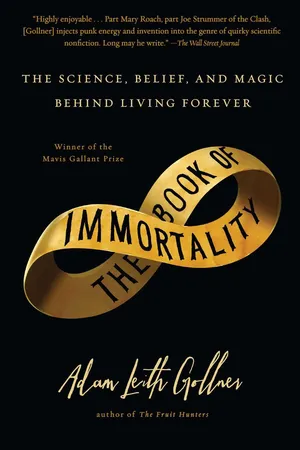
A "wonderful" ( Harper's ), "engrossing" ( Parade ) exploration of the most universal of human obsessions: immortality—from an author who is "part Mary Roach, part Joe Strummer of The Clash" ( The Wall Street Journal ). What have we not done to live forever? Adam Leith Gollner, the critically acclaimed author of The Fruit Hunters, weaves together religion, science, and mythology in a gripping exploration of the most universal of human obsessions: immortality. Raised without religion, Adam Leith Gollner was struck by mankind's tireless efforts to cheat aging and death. In a narrative that pivots between profundity and hilarity, he brings us into the world of those whose lives are shaped by a belief in immortality. From a Jesuit priest on his deathbed to antiaging researchers at Harvard, Gollner— sorting truth from absurdity—canvasses religion and science for insight, along with an array of cults, myths, and fringe figures.He journeys to David Copperfield's archipelago in the Bahamas, where the magician claims to have found "a liquid that reverses genes." He explores a cryonics facility, attends a costume party set in the year 2068 with a group of radical life-extensionists, and soaks in the transformative mineral waters at the Esalen Institute. Looking to history, Gollner visits St. Augustine, Florida, where Ponce de León is thought to have sought the Fountain of Youth.Combining immersive reporting, rigorous research, and lyrical prose, Gollner charts the rise of longevity science from its alchemical beginnings to modern-day genetic interventions. He delves into the symbolic representation of eternal life and its connection to water. Interlaced throughout is a compelling meditation on the nature of belief, showing how every story we tell about immortality is a story about the meaning of death."Part journalist, part detective, part scientist." ( New York Post). Adam Leith Gollner has written a rollicking and revelatory examination of our age-old notion of living forever.
Frequently asked questions

Yes, you can cancel anytime from the Subscription tab in your account settings on the Perlego website. Your subscription will stay active until the end of your current billing period. Learn how to cancel your subscription.
No, books cannot be downloaded as external files, such as PDFs, for use outside of Perlego. However, you can download books within the Perlego app for offline reading on mobile or tablet. Learn more here.
Perlego offers two plans: Essential and Complete
  • Essential is ideal for learners and professionals who enjoy exploring a wide range of subjects. Access the Essential Library with 800,000+ trusted titles and best-sellers across business, personal growth, and the humanities. Includes unlimited reading time and Standard Read Aloud voice.
  • Complete: Perfect for advanced learners and researchers needing full, unrestricted access. Unlock 1.4M+ books across hundreds of subjects, including academic and specialized titles. The Complete Plan also includes advanced features like Premium Read Aloud and Research Assistant.
Both plans are available with monthly, semester, or annual billing cycles.
We are an online textbook subscription service, where you can get access to an entire online library for less than the price of a single book per month. With over 1 million books across 1000+ topics, we’ve got you covered! Learn more here.
Look out for the read-aloud symbol on your next book to see if you can listen to it. The read-aloud tool reads text aloud for you, highlighting the text as it is being read. You can pause it, speed it up and slow it down. Learn more here.
Yes! You can use the Perlego app on both iOS or Android devices to read anytime, anywhere — even offline. Perfect for commutes or when you’re on the go.
Please note we cannot support devices running on iOS 13 and Android 7 or earlier. Learn more about using the app.
Yes, you can access The Book of Immortality by Adam Leith Gollner in PDF and/or ePUB format, as well as other popular books in Social Sciences & World History. We have over one million books available in our catalogue for you to explore.

Information

Part 1

Belief

Images
There is only one supreme idea on earth—the idea of the immortality of the human soul.
—Dostoyevsky, Diary of a Writer

1

We Bereave, We Believe

Images
Can I learn to suffer
Without saying something ironic or funny
On suffering? I never suspected the way of truth
Was a way of silence
—W. H. Auden, The Sea and the Mirror
We have to die, we have to leave life presently. Injustice and greed would be the real thing if we lived for ever. As it is, we must hold to other things, because Death is coming. I love death—not morbidly, but because He explains. . . . Behind the coffins and the skeletons that stay the vulgar mind lies something so immense that all that is great in us responds to it.
—E. M. Forster, Howards End
EVERYONE IN the family called her Auntie Tiny. She’d always been minuscule—“of stature elegantly wee,” as our Hungarian relatives put it. She spoke in a helium-pitched, young-girl voice, even when discussing serious matters. We kids considered her one of us. She was an emissary from the grown-up realms, a benevolent Old World pixie who kept shrinking into her dotage. We worried she’d get smaller and smaller, so teensy she’d eventually vanish.
I first heard Auntie Tiny’s real name when the funeral notice appeared:
With deep sorrow, but in acquiescence to Divine will, we inform those who knew and loved Ilona Köver Göllner that, in the 96th year of her life, she returned home to her Lord and Saviour.
Childless and widowed, our childlike Auntie Tiny had been closer to a grandmother than a great-aunt. My father’s mother died when I was very young. And the last time I tried to visit my maternal grandmother, a British antiquarian with hoarding tendencies, she asked me not to come. “I’m in an absolute muddle,” she sighed, engulfed by four stories of belongings.
Auntie Tiny loved visitors. Her one-room apartment was on the third floor of a sooty, bullet-ridden building in Budapest. She’d creak open the door, greeting my brothers and me with that witchy falsetto. Kissing her powdered cheeks felt like kissing marshmallows. “Entrez, entrez,” she’d trill. The noble bearing wasn’t affected: when she was born, the dual monarchy still reigned and her family belonged to Austria-Hungary’s landowning gentry. Following communism, all that remained was this somber tenement overlooking the Danube.
Inside it smelled of dust and paprika. Her dĂ©cor was strictly Habsburg Empire: embroidered lace, illuminated vellum, ikons, dried flowers. We’d sit at a table next to the doll-size bed and eat bowls of chilled sour-cherry soup. She baked little cylindrical biscuits called pogĂĄcsa, telling us how one should never set off on a journey without a knapsack full of them.
She herself embarked on a mini-pilgrimage every morning. After lifting her hair into an onionlike beehive and lacing up her booties, she headed out to various crosses around town, beaming thoughts of eternity. Then, without fail, she attended church service.
The last time we saw each other, I’d become an adult. Her milky eyes had clouded into near blindness. A vein cluster near her right iris was tangled in the distinct shape of a heart. She could no longer read her beloved books, but she seemed capable of seeing into the next world. Despite suffering more than I could imagine, she said it was all a blessing. She loved life, but was not afraid of death.
What about those who don’t know what they believe in? I wondered. As though sensing my thoughts, she gave me a small cross and said she prayed for me.
Her funeral invitation included a biblical passage: “Whoever believes in me will live, even though they die; whoever lives and believes in me shall never die. Do you believe this?”
Not able to answer, but unwilling to lose her forever, I located the quote in the Gospel of John, where God is defined as love and faith as living water: “Whoever drinks of the water that I shall give him will never thirst; the water that I shall give him will become in him a spring of water welling up to eternal life.”

We imagine ourselves impervious, but at some point in every life, grief overpowers us. When it descends, we feel physically ill. We drift asleep and fall awake with it. We catch ourselves asking unanswerables. We call that person’s name. We repeatedly anticipate being reunited and then have to re-remember reality, painfully. The depth of our reaction can come as a shock, but the slow grind of mourning work is how we accept an absence where a presence had been. Bereavement brings with it a sense of having embarked upon a lengthy search for something that can’t be found. Gnawing reminders. Wringing rearrangements. Memory folders on our mental desktop get filed away in forlorn subcompartments. Eventually, what’s gone becomes a part of us.
The modern attitude toward death has been described as “a hedonistic avoidance of the issue.” In the past, we dealt with it socially. Wakes, cremation ceremonies, and other burial rites entailed community participation. Today, being bereaved is often seen as interfering with productivity, a sign of weakness, an unpleasantry best done in private. Should we tweet about it? Do we press like when someone else does? Doctors dole out dolorifuging pills. Even in death we pump ourselves full of chemicals to fit in, with morticians embalming bodies to give them a waxy semblance of life. But no matter how much a cadaver appears like a napping person, the irrevocable can’t be airbrushed away. Everyone ends up sleeping the same sleep.

My friend Elena was in the hospital with her comatose mother. In the middle of the night, her mother started shaking violently. She appeared to be trying to pull her clothes off. Elena, realizing she couldn’t calm her unconscious mother, decided to help her undress. Once naked, she quieted down. The following day, she passed on in peaceful repose. Elena felt sure her mother wanted to exit life the way she had entered it. “There was something greater than us in the hospital room that night,” she concluded.
When someone close to us dies, we escape into beliefs. It’s not unusual to find religion in loss. At the age of twenty-five, another friend of mine lost her best friend and her cousin within a few weeks of each other. The grief was so all-consuming, she told me, that “the only way I could stay alive was by starting to believe in the afterlife.”
Our mind ceaselessly churns out plausible interpretations of unexplainables in attempting to reconcile itself to death’s implications. The idea of “person permanence”—that our dead relatives, or parts of them, such as a soul, are still floating around somewhere—is a venerable way of negotiating the question. The recovering brain prefers to imagine them continuing to exist in some undetermined afterlife. Social psychologists involved in a discipline called terror-management theory explain that envisaging others’ postmortem continuance has an added benefit: if their spirits are kicking around the starry skies, it follows that we’ll join them out there, too, when our time comes. In this ostensibly mythless age, person permanence remains the mind’s preferred means of handling the destabilizing possibility of its own demise. Such illusions can be survival mechanisms. At least until we die.
If dealing with the deaths of others is so hard, then mustn’t actually dying be brutal agony? Not necessarily, it turns out. Elisabeth KĂŒbler-Ross, who famously developed the theory that grief passes through five distinct stages, from denial to acceptance, found that those on the brink of dying often experience feelings of peaceful contentment. Peter Pan was right: “To die will be an awfully big adventure.” It’ll also be different from what anyone supposes—and luckier—wrote Walt Whitman. As survivors of life-threatening injuries attest, the anticipatory worry is far worse than the actuality. Gallup polls of patients who’ve experienced clinical death and were then revived show that “confronting and undergoing death frequently seems more pleasant than life itself.”
Our neuroprocessors may prevent consciousness from actually experiencing its own annihilation. On death’s doorstep, the mind produces narcotic tranquilizers to protect itself. In his 1892 study of mountain-climbing accidents, Remarks on Fatal Falls, Albert von St. Gallen Heim interviewed people who’d fallen from Alpine heights (and lived to tell the tale). Many reported feeling a calm lucidity as they drifted through the sky. They plummeted not in stabbing terror, but rather like lemon pips sinking into tea.
Of course, death can also be painful or violent, but for the most part, we’re pretty out of the loop as far as the whole “dying experience” is concerned. Because the brain naturally suppresses thoughts of its eventual extinction, much of our thinking about death takes place on an inaccessible, subconscious level. Modern neuroscience has demonstrated that the mind consists of multiple layers of cerebral functioning. Within the vast interlocking choreography of transmitters, axons, peptides, circuits, and spanned gaps, many processes that resemble conscious activity are actually performed entirely without our rational mind realizing it. We can be totally unaware of our feelings about death—until we lose someone, triggering a realization of our own mortality.
A part of us accepts that we will eventually disintegrate; other neural subdivisions harbor furtive aspirations. Rationally, we know the end will come. Irrationally, we hope to get around it somehow. As we face finality, complicated feelings arise, as do hopes of evading the unavoidable. Inexorable though the situation may appear, we are infinitely creative when it comes to concocting alternative scenarios. We convince ourselves that if we search long enough, we just might stumble upon a loophole, a VIP pass, a get-out-of-jail-free card. Imagination is an essential existential consolation.
Ernest Becker’s 1973 book, The Denial of Death, argued that undertaking heroic acts is a way of challenging the loamy unknowability of death. We use our imaginative powers to concoct “immortality projects” that will allow our name to outlive our mortal transience. Many creative types are fueled by this instinct, but so are people in every other walk of life. Donors to public institutions receive commemorative plaques in their honor. “Achieve Immortality! (We’re not kidding)” is the tagline for advertisements by the New York Community Trust that encourage benefactors “to leave a charitable legacy that will make gifts in your name forever.” Scientists hope that their life’s work, while it may not ever explain the mystery of mysteries, will grant them a kind of immortality after their passing. Einstein, after all, is remembered as much as van Gogh. Our pursuit of impressive acts or deeds is known as “achievement immortality.”
During an 1841 breakdown, Abraham Lincoln confided to a friend that he had “done nothing to make any human being remember that he had lived.” He found the idea of dying intolerable, yet started seriously considering killing himself. His only solace, he explained to his friend, was the idea of surviving in others’ memories. What kept him alive was the ambition that, by accomplishing deeds that would link his name to monumental exploits, he would attain immortality. And, in a way, he did.
The phenomenon of occupying memories after we die is called social or vicarious immortality. Even though we may lose people, they exist in our minds when we imagine them. A person’s sense of identity depends on the knowledge that he or she is in others’ thoughts. This is a normal strangeness that can become warped under duress. Suicide cases may start to reason (unconsciously) that by becoming dead, they, too, will posthumously inhabit others’ minds, therefore becoming immortal. And those who’ve been kidnapped, or imprisoned in solitary confinement, or who’ve faced an extended period of almost-certain death, can find themselves starting to write down the names of every person who loved them, everyone who will remember them. It’s a curious thing to do, and it’s a form of consolatory immortality. Nobody wants to be forgotten.
After we die, our corporeal remains can be cremated, carried off by carrion eaters, or chewed upon by worms and microorganisms. My friend Melanie, vice president of horticulture at the Brooklyn Botanic Garden, doesn’t believe in linear religions. Based on her work with plants, she prefers the idea of the nutrient cycle. “When I’m buried, my corpse will gradually be dismantled and embodied by millions of bacteria, roots, bugs, amoebae, fungi. There’s a massive congregation of life-forms in the soil. Whenever something dies, countless lives are enriched. Why would it be any different for us? If you’re buried properly—not in some impenetrable coffin that prevents nature from its due—you’ll get to escape your body, to go out there into all those new organisms.” As right as she is, Mel is also talking about continuity, about escaping the body, about parts of us becoming something else. We all have semantic approaches to death’s incommensurability. Mel’s version fits into a category called cosmic immortality, the nontheistic notion of a person coming from the elements and returning back to them.
Intimations of immortality surround us. Molecules in the dead animal we eat become part of our cellular makeup. When a pollinated flower wilts, it becomes a fruit that dies into ripeness, containing within its spent flesh a seed that becomes a tree. Quantum Immortality (or QI, for those who frequent speculative-physics chat rooms) holds that there are many universes in which each of us lives parallel lives, and even if we die in this world, we’ll survive in faraway galaxies forever. This is about as verifiable as the precise geographical coordinates of nirvana, but it’s an interesting, if excessively technical, example of scientific religiosity.
Heredity, that stream of acquired traits, is a more generally accepted form of immortality. Linking eons, DNA is a means of encoding and preserving information that is transferred from generation to generation. Posterity immortality is the phenomenon of genes living on through one’s children. “What is mortal tries, to the best of its ability, to be everlasting and immortal,” wrote Plato. The most obvious way of doing this, he added, is by making babies—by leaving behind replicas. The notion of trumping death through having progeny also got the biblical stamp of approval. The Old Testament isn’t concerned with the afterlife as much as it is obsessed with generations of descendants. Having kids who then have their own children is the path. Parents may die, but parts of them persist. The selfish-gene theory suggests that we value our offspring because we’re in them. They are made from us, just as we consist of those who came earlier. We all wear the ...

Table of contents

  1. Cover
  2. Dedication
  3. Epigraph
  4. Prologue: On Finitude and Infinity
  5. Introduction: The Nature of Immortality
  6. Part 1: Belief
  7. Part 2: Magic
  8. Part 3: Science
  9. Conclusion: If ________ Is Possible
  10. Epilogue: Springs Eternal
  11. Acknowledgments
  12. About Adam Leith Gollner
  13. Sources
  14. Index
  15. Copyright