
- 464 pages
- English
- ePUB (mobile friendly)
- Available on iOS & Android
eBook - ePub
About this book
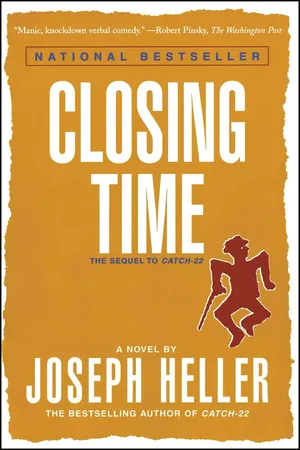
A darkly comic and ambitious sequel to the American classic Catch-22.
Joseph Heller revisits the unforgettable characters of Catch-22, now facing the twilight of their lives and the end of the century. The generation that fought in World War II—Yossarian, Milo Minderbinder, the chaplain, along with newcomers little Sammy Singer and giant Lew—are bound together in uneasy peace and old age, fighting not the Germans this time, but the inevitability of The End. Closing Time deftly satirizes the realities and the myths of postwar America with the same ferocious humor as his masterpiece, Catch-22, exploring the absurdity of our politics, the decline of our society and great cities, and the greed and hypocrisy at the heart of our business and culture.
Outrageously funny yet deadly serious, and as brilliant as Catch-22 itself, Closing Time is a fun-house mirror reflecting, at once grotesquely and accurately, who we truly are.
Joseph Heller revisits the unforgettable characters of Catch-22, now facing the twilight of their lives and the end of the century. The generation that fought in World War II—Yossarian, Milo Minderbinder, the chaplain, along with newcomers little Sammy Singer and giant Lew—are bound together in uneasy peace and old age, fighting not the Germans this time, but the inevitability of The End. Closing Time deftly satirizes the realities and the myths of postwar America with the same ferocious humor as his masterpiece, Catch-22, exploring the absurdity of our politics, the decline of our society and great cities, and the greed and hypocrisy at the heart of our business and culture.
Outrageously funny yet deadly serious, and as brilliant as Catch-22 itself, Closing Time is a fun-house mirror reflecting, at once grotesquely and accurately, who we truly are.
Frequently asked questions
Yes, you can cancel anytime from the Subscription tab in your account settings on the Perlego website. Your subscription will stay active until the end of your current billing period. Learn how to cancel your subscription.
No, books cannot be downloaded as external files, such as PDFs, for use outside of Perlego. However, you can download books within the Perlego app for offline reading on mobile or tablet. Learn more here.
Perlego offers two plans: Essential and Complete
- Essential is ideal for learners and professionals who enjoy exploring a wide range of subjects. Access the Essential Library with 800,000+ trusted titles and best-sellers across business, personal growth, and the humanities. Includes unlimited reading time and Standard Read Aloud voice.
- Complete: Perfect for advanced learners and researchers needing full, unrestricted access. Unlock 1.4M+ books across hundreds of subjects, including academic and specialized titles. The Complete Plan also includes advanced features like Premium Read Aloud and Research Assistant.
We are an online textbook subscription service, where you can get access to an entire online library for less than the price of a single book per month. With over 1 million books across 1000+ topics, weāve got you covered! Learn more here.
Look out for the read-aloud symbol on your next book to see if you can listen to it. The read-aloud tool reads text aloud for you, highlighting the text as it is being read. You can pause it, speed it up and slow it down. Learn more here.
Yes! You can use the Perlego app on both iOS or Android devices to read anytime, anywhere ā even offline. Perfect for commutes or when youāre on the go.
Please note we cannot support devices running on iOS 13 and Android 7 or earlier. Learn more about using the app.
Yes, you can access Closing Time by Joseph Heller in PDF and/or ePUB format, as well as other popular books in Literature & Literature General. We have over one million books available in our catalogue for you to explore.
Information
FOUR
11
Lew
Sammy and I enlisted the same day. Four of us set out together. All of us went overseas. All four of us came back, although I was captured and Sammy was shot down into the water and crash-landed another time with a forgetful pilot called Hungry Joe, who forgot to try the emergency handle for lowering the landing gear. No one was hurt, Sammy tells me, and that pilot Hungry Joe got a medal. Itās a name that sticks. Milo Minderbinder was his mess officer then and not the big war hero he tries to pass himself off as now. Sammy had a squadron commander named Major Major, who was never around when anyone wanted to see him, and a bombardier he thought I would have liked named Yossarian, who took off his uniform after a guy in their plane bled to death, and he even went to the funeral naked, sitting in a tree, Sammy says.
We went up by subway to volunteer at the big army induction center at Grand Central Station in Manhattan. That was a part of the city most of us hardly ever went to. There was the physical examination weād heard about from the older guys who were already gone. We turned our heads and coughed, we milked down our joints, we bent over and spread the cheeks of our buttocks, and kept wondering what they were looking for. Weād heard of piles from our uncles and aunts, but we didnāt really know what they were. A psychiatrist interviewed me alone and asked if I liked girls. I liked them so much I fucked them, I answered.
He looked envious.
Sammy liked them too but didnāt know how.
We were past eighteen, and if weād waited until nineteen, we would have been drafted, said FDR, and that was the reason we gave to our parents, who were not so happy to see us go. We read about the war in the newspapers, heard about it on the radio, saw it done gorgeously in the Hollywood movies, and it looked and sounded better to us than being home in my fatherās junkshop, like I was, or in a file cage like Sammy in the insurance company he worked for, or, like Winkler, in a cigar store that was a front for the bookmaking operation his father ran in back. And in the long run it was better, for me and for most of the rest of us.
When we got back to Coney Island after enlisting, we ate some hot dogs to celebrate and went on the roller-coasters awhile, the Tornado, the Cyclone, and the Thunderbolt. We rode up on the big Wonder Wheel eating caramel popcorn and looked out over the ocean in one direction and out over Gravesend Bay in the other. We sank submarines and shot down planes on the game machines in the penny arcades and dashed into Steeplechase for a while and rolled around in the barrels and spun around on the Whirlpool and the Human Pool Table and caught rings on the big carousel, the biggest carousel in the island. We rode in a flat-bottomed boat in the Tunnel of Love and made loud dirty noises to give laughs to the other people there.
We knew there was anti-Semitism in Germany, but we didnāt know what that was. We knew they were doing things to people, but we didnāt know what they were.
We didnāt know much of Manhattan then. When we went up into the city at all, it was mainly to the Paramount or Roxy theater, to hear the big bands and see the big new movies before they came into the neighborhood six months later, to the Loewās Coney Island or the RKO Tilyou. The big movie houses in Coney Island then were safe and profitable and comfortable. Now theyāre bankrupt and out of business. Some of the older fellows would sometimes take us along into Manhattan in their cars on Saturday night to the jazz clubs on Fifty-second Street or up into Harlem for the music at the colored ballroom or theater there or to buy marijuana, eat ribs cheap, and get sucked and fucked for a buck if they wanted to, but I didnāt go in much for any of that, not even the music. Once the war came, a lot of people started making money, and we did too. Soon after the war you could get that same sucking and the rest right there in the Coney Island neighborhood from Jewish white girls hooked on heroin and married to other local junkies who had no money either, but the price was two bucks now, and they did their biggest business mostly with housepainters and plasterers and other laborers from outside the neighborhood, who hadnāt gone to school with those girls and didnāt care. Some in my own crowd, like Sammy and Marvelous Marvin Winkler, the bookieās little boy, began smoking marijuana even before the war, and you could find that country smell of pot in the smoking sections of the Coney Island movie houses once you got to recognize what the stuff smelled like. I didnāt go for any of that either, and the guys who were my friends never lit up their reefers when I was around, even though I told them they could, if they wanted to.
āWhatās the use?ā Winkler liked to groan, with his eyes red and half closed. āYou bring me down.ā
A guy named Tilyou, who maybe was already dead, became a sort of guy to look up to once I found out about him. When everyone else was poor, he owned a movie house and he owned a big Steeplechase amusement park and a private house across the street from his Steeplechase Park, and I never even connected them all with the same name until Sammy pointed it out to me not long ago on one of his mercy visits up to my house, when all of them were already gone, and George C. Tilyou too. Sammy began coming up a lot to see us after his wife died of cancer of the ovary and he did not know what to do with himself weekends, and especially when I was out of the hospital again and had nothing much to do with myself either but hang around getting my strength back after another session of radiation or more chemotherapy. Between these hospitalizations I could feel like a million and be strong as an ox again. When things got bad here, Iād go into the city to a hospital in Manhattan and an oncologist named Dennis Teemer for treatments they had there. When I felt good, I was terrific.
By now itās out of the bag. And everyone knows Iāve been sick with something that sometimes puts other people away. We never speak of it by name, or even as something big enough to even have a name. Even with the doctors, Claire and I donāt talk about it by name. I donāt want to ask Sammy, but Iām not sure we fooled him for a minute in all of the years of my lying about it like I didāas I did, as he would want to correct me, like he does, when I let him. Sometimes I remember, but I talk to him like I want to anyway just to heckle him.
āTiger, I know it,ā I will tell him with a laugh. āYou still think Iām a greenhorn? Iām putting you on, like I like to do, and hopefully, someday youāll get it.ā
Sammy is smart and picks up on small things, like the name Tilyou, and the scar on my mouth before I grew my big brush mustache to hide it or let what hair I had left grow long in back to cover the incisions there and the blue burn marks on the glands in the back of my neck. I missed a lot maybe in my lifetime by not going to college, but I never wanted to go, and I donāt think I missed anything that would have mattered to me. Except maybe college girls. But I always had girls. Theyād never scared me, and I knew how to get them and talk to them and enjoy them, older ones too. I was always priapic, Sammy told me.
āYouāve got it, tiger,ā I answered him. āNow tell me what it means.ā
āYou were all prick,ā he said, like he enjoyed insulting me, āand no conflicts.ā
āConflicts?ā
āYou never had problems.ā
āI never had problems.ā
I never had doubt. My first was an older one on the next block named Blossom. My second was an older one we called Squeezy. Another one was a girl I picked up in the insurance office when Sammy was working there, and she was older too, and she knew I was younger, but she wanted more of me anyway and bought me two shirts for Christmas. Back then I think I made it with every girl I really wanted to. With girls, like everywhere else, even in the army, I found out that if you let people know what you want to do and seem sure of yourself about doing it, theyāre likely to let you. When I was still a corporal, my sergeant overseas was soon letting me do all the deciding for both of us. But I never had college girls, the kind you used to see in the movies. Before the war, nobody we knew went to college or thought about it. After the war, everybody began going. The girls I met through Sammy from his Time magazine before he was married, and after too, didnāt always find me as popular as I thought they should, so I cut down on the personality with them instead of embarrassing him, and even his wife, Glenda, wasnāt really as crazy about me and Claire at first as the people we were used to in Brooklyn and Orange Valley. Claire had the idea Glenda felt like a snob because she wasnāt Jewish and was not from Brooklyn, but it turned out it wasnāt that. When we began to get sick, first me, then her, we all got close, and even before that, when their boy, Michael, killed himself. We were the married couple they could turn to easiest and Claire was the girl she could confide in most.
In Coney Island, Brighton Beach, and everywhere else, I always had girls, as often as I wanted, and even could get them for others, even for Sammy. Especially in the army, in Georgia, Kansas, and Oklahoma, and married ones too, with husbands away. And that sort of always turned me off a little afterward, but it never stopped me from having the good time when I could. āDonāt put it in,ā they would sometimes try to make me promise before I made us both happier by putting it in. In England before I was shipped into Europe there were lots. In England in the war every American could get laid, even Eisenhower, and sometimes in France in a village or farm, where we were busy moving forward with the fighting, until we had to move back and I was taken prisoner with a whole bunch of others in what I later found out was the Battle of the Bulge. Except in Germany, but even almost in Dresden as a POW working in that liquid vitamin factory making syrups for pregnant women in Germany who needed nourishment and didnāt have what to eat. That was late in the war, and I hated the Germans more than ever before, but couldnāt show it. Even there I came close to getting laid with my joshing around with the guards and the Polish and other slave-labor women working there, and maybe could really have talked my favorite guardsāthey were all old men or soldiers whoād been wounded badly on the Russian frontāinto looking the other way while I slipped off into a room or closet with one or another of them for a while. The women werenāt eager but didnāt seem to mind meāup until the night of that big firebombing when everything around us came to an end in one day, and all of the women were gone too. The other guys thought I was out of my mind for horsing around that way, but it gave us a little something more to do until the war ended and we could go back home. The Englishmen in the prison detail could make no sense of me. The guards were tired too, and they began to get a kick out of me also. They knew I was Jewish. I made sure of that everywhere.
āHerr Reichsmarschall,ā I called each one of the German privates as a standing joke whenever I had to speak to them to translate or ask for something. āFucking Fritzā was what I called each one of them to myself, without joking. Or āNazi kraut bastard.ā
āHerr Rabinowitz,ā they answered with mock respect.
āMein Name ist Lew,ā I always kidded back with them heartily. āPlease call me that.ā
āRabinowitz, youāre crazy,ā said my assistant Vonnegut, from Indiana. āYouāre going to get yourself killed.ā
āDonāt you want to have fun?ā I kept trying to cheer us all up. āHow can you stand all this boredom? I bet I can get a dance going here if we can talk them into some music.ā
āNot me,ā said the old guy named Schweik. āIām a good soldier.ā
Both these guys knew more German than I did, but Vonnegut was modest and shy, and Schweik, who kept complaining he had piles and aching feet, never wanted to get involved.
Then one week we saw the circus was coming to town. We had seen the posters on our march to the food factory from our billets in the reinforced basement that had been the underground room of the slaughterhouse when they still had animals to slaughter. By then the guards were more afraid than we were. At night we could hear the planes from England pass overhead on their way to military targets in the region. And we would sometimes hear with pleasure the bombs exploding in the hundreds not far away. From the east we knew the Russians were coming.
I had a big idea when I saw those carnival posters. āLetās talk to the headman and see if we canāt get to go. The women too. We need a break. Iāll do the talking.ā The chance excited me. āLetās go have a try.ā
āNot me,ā said that good soldier Schweik. āI can get myself in enough trouble just doing what Iām told.ā
The women working with us were wan and bedraggled and as dirty as we were, and I donāt think there was a sex gland alive in any of us. And I was underweight and had diarrhea most of the time too, but that would have been one screw to tease Claire about later and to boast about now. I could have lied, but I donāt like to lie.
Claire and I got married even before I was out of the army, just after my double hernia operation at Fort Dix when I got back from Europe and the prisons in Germany, and I almost went wild with a pair of German POWs there in New Jersey for leering and saying something in German when they saw her waiting for me while we were still engaged.
I saw them first in Oklahoma, those German prisoners of war over here, and I couldnāt believe what I was looking at. They were outdoors with shovels and looked better than we did, and happier too on that big army base. This was war? Not in my book. I thought prisoners of war were supposed to be in prison and not outdoors having a good time with each other and making jokes about us. I got angry looking at them. They were guarded by a couple of slouching GIs who looked bored and lazy and carried rifles that looked too heavy. The krauts were supposed to be working at something, but they werenāt working hard. There were American stockade prisoners all around whoād gone AWOL and been put to work digging holes in the ground just for punishment and then filling them up, and they were always working harder than any of these. I got even angrier just watching them, and one day, without even knowing what I was doing, I decided to practice my German on them and just walked right up.
āHey, youāre not allowed to do that, soldier,ā said the guard nearest the two I went to, jumping toward me nervously and speaking in one of those foreign southern accents I was just beginning to get used to. He even started to level his rifle.
āPal, Iāve got family in Europe,ā I told him, āand itās perfectly all right. Just listen, youāll hear.ā And before he could answer me I began right in with my German, trying it out, but he didnāt know that. āBitte. Wie ist Ihr Name? Danke sehƶn. Wie alt sind Sie? Danke vielmals. Wo Du kommst hier? Danke.ā By now a few of the others had drawn close, and even a couple of the other guards had come up to listen and were smiling too, like having a good time at one of our USO shows. I didnāt like that either. What the hell, I thought, was this war or peace? I kept right on talking. When they couldnāt understand me, I kept changing the way I said something until they did, and then there were nods and laughs from all of them, and I made believe I was grinning with happiness when I saw they were giving me good marks. āBitte schƶn, bitte schƶn,ā they told me when I said āDanke, dankeā to them in a gush for telling me I was āGut, gut.ā But before it was over, I made sure I let them know there was one person there who wasnāt having such a good time, and that person was me. āSo, wie geht jetzt?ā I asked them, and pointed my arm around the base. āDu, gefƤllt es hier? Schƶn, ja?ā When they said they did like it there, like we were all practicing our German, I put this question to them. āGefƤllt hier besser wie zuhause mit Krieg? Ja?ā I would have bet they did like it there better than they would have liked being back in Germany at war. āSure,ā I said to them in English, and by then theyād stopped smiling and were looking confused. I stared hard into the face of the one I had s...
Table of contents
- Cover
- Title Page
- Copyright Page
- Book One
- Book Two
- Book Three
- Book Four
- Book Five
- Book Six
- Book Seven
- Book Eight
- Book Nine
- Book Ten
- Book Eleven
- Book Twelve
- Book Thirteen
- Acknowledgments