At the beginning of the twentieth century, H. G. Wells predicted that statistical thinking would be as necessary for citizenship in a technological world as the ability to read and write. But in the twenty-first century, we are often overwhelmed by a baffling array of percentages and probabilities as we try to navigate in a world dominated by statistics.
Cognitive scientist Gerd Gigerenzer says that because we haven't learned statistical thinking, we don't understand risk and uncertainty. In order to assess risk -- everything from the risk of an automobile accident to the certainty or uncertainty of some common medical screening tests -- we need a basic understanding of statistics.
Astonishingly, doctors and lawyers don't understand risk any better than anyone else. Gigerenzer reports a study in which doctors were told the results of breast cancer screenings and then were asked to explain the risks of contracting breast cancer to a woman who received a positive result from a screening. The actual risk was small because the test gives many false positives. But nearly every physician in the study overstated the risk. Yet many people will have to make important health decisions based on such information and the interpretation of that information by their doctors.
Gigerenzer explains that a major obstacle to our understanding of numbers is that we live with an illusion of certainty. Many of us believe that HIV tests, DNA fingerprinting, and the growing number of genetic tests are absolutely certain. But even DNA evidence can produce spurious matches. We cling to our illusion of certainty because the medical industry, insurance companies, investment advisers, and election campaigns have become purveyors of certainty, marketing it like a commodity.
To avoid confusion, says Gigerenzer, we should rely on more understandable representations of risk, such as absolute risks. For example, it is said that a mammography screening reduces the risk of breast cancer by 25 percent. But in absolute risks, that means that out of every 1,000 women who do not participate in screening, 4 will die; while out of 1,000 women who do, 3 will die. A 25 percent risk reduction sounds much more significant than a benefit that 1 out of 1,000 women will reap.
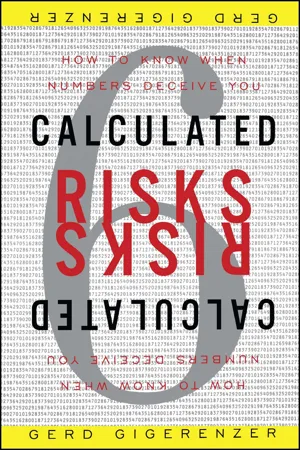
This eye-opening book explains how we can overcome our ignorance of numbers and better understand the risks we may be taking with our money, our health, and our lives.
- 288 pages
- English
- ePUB (mobile friendly)
- Available on iOS & Android
eBook - ePub
About this book
Information
Subtopic
Education Theory & PracticeIndex
Social SciencesTable of contents
- Cover
- Dedication
- Acknowledgments
- Part I: Dare to Know
- Part II: Understanding Uncertainties in the Real World
- Part III: From Innumeracy to Insight
- Glossary
- References
- Notes
- Index
- Copyright
Trusted by 375,005 students
Access to over 1.5 million titles for a fair monthly price.
Study more efficiently using our study tools.
Frequently asked questions
Yes, you can cancel anytime from the Subscription tab in your account settings on the Perlego website. Your subscription will stay active until the end of your current billing period. Learn how to cancel your subscription
No, books cannot be downloaded as external files, such as PDFs, for use outside of Perlego. However, you can download books within the Perlego app for offline reading on mobile or tablet. Learn how to download books offline
Perlego offers two plans: Essential and Complete
- Essential is ideal for learners and professionals who enjoy exploring a wide range of subjects. Access the Essential Library with 800,000+ trusted titles and best-sellers across business, personal growth, and the humanities. Includes unlimited reading time and Standard Read Aloud voice.
- Complete: Perfect for advanced learners and researchers needing full, unrestricted access. Unlock 1.5M+ books across hundreds of subjects, including academic and specialized titles. The Complete Plan also includes advanced features like Premium Read Aloud and Research Assistant.
We are an online textbook subscription service, where you can get access to an entire online library for less than the price of a single book per month. With over 1.5 million books across 990+ topics, we’ve got you covered! Learn about our mission
Look out for the read-aloud symbol on your next book to see if you can listen to it. The read-aloud tool reads text aloud for you, highlighting the text as it is being read. You can pause it, speed it up and slow it down. Learn more about Read Aloud
Yes! You can use the Perlego app on both iOS and Android devices to read anytime, anywhere — even offline. Perfect for commutes or when you’re on the go.
Please note we cannot support devices running on iOS 13 and Android 7 or earlier. Learn more about using the app
Please note we cannot support devices running on iOS 13 and Android 7 or earlier. Learn more about using the app
Yes, you can access Calculated Risks by Gerd Gigerenzer in PDF and/or ePUB format, as well as other popular books in Social Sciences & Education Theory & Practice. We have over 1.5 million books available in our catalogue for you to explore.