Overlord
eBook - ePub

Overlord

General Pete Quesada and the Triumph of Tactical A

  1. 416 pages
  2. English
  3. ePUB (mobile friendly)
  4. Available on iOS & Android
eBook - ePub

Overlord

General Pete Quesada and the Triumph of Tactical A

About this book

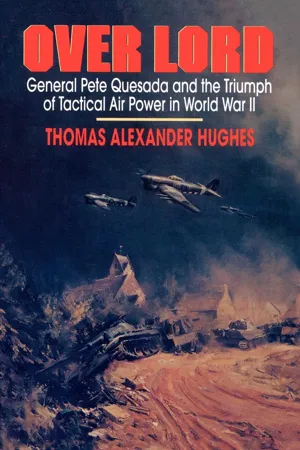
Over Lord is the fascinating story of how American tactical air power was developed by General Elwood "Pete" Quesada during World War II, including its decisive role in Operation OVERLORD and the liberation of Europe.
Pete Quesada is one of World War II's unsung yet crucial heroes. With his famous "Ninth Tactical Air Command, " Quesada established the best air-ground team in the European theater. he pioneered the use of radar in close air support operations, introducing weapons systems specifically geared to tactical operations. He nurtured new flying methods designed for the kind of precision bombing the battlefields of Europe demanded. And more than anything else, Pete Quesada championed efforts to model air and ground officers into a single fighting unit. His relationships with ground leaders like Generals Omar Bradley and "Lightning Joe" Collins were a model for the kind of interservice harmony that was essential for dislodging the entrenched German Army.
At war's end everybody from General of the Army Dwight Eisenhower to ordinary infantrymen recognized Pete Quesada as the premier expert and dogged patron of close air support. Allied airplanes over the battlefields of Europe had undoubtedly shortened the war and saved many thousands of lives, and Pete Quesada came home to a hero's welcome in 1945. By then he was the personification of tactical air power. Indeed, he was its over lord.
Unfortunately, Quesada's groundbreaking methods were all but forgotten after the war. As the Cold War deepened, Air Force leaders stressed the role of big bombers flying deep into enemy territory and renounced the importance of close air support missions. Quesada himself was shunted into jobs that were both illsuited to his fiery temperament and divorced from his wartime expertise in tactical aviation. Frustrated, he retired from the Air Force in 1951 at forty-seven years of age.
Fortunately, the story of Quesada's innovative tactics did not end there for the American military. In Korea in the 1950s and Vietnam in the 1960s, U.S. servicemen struggled -- and died -- relearning and recreating the kinds of tactics that Quesada had made commonplace in 1944-45. Had the U.S. Air Force nurtured its capacity for close air support, those two conflicts may have unfolded differently. Since then, the Air Force has struggled for a better balance between its bombardment missions and its support functions.
This is the definitive story of an extraordinary man, whose remarkable efforts to aid foot soldiers in World War II contributed significantly to the Allies' success. America's belated rediscovery of Quesada's precepts some forty years later in conflicts like Operation DESERT STORM only underscores the importance of Quesada's story.
Frequently asked questions

Yes, you can cancel anytime from the Subscription tab in your account settings on the Perlego website. Your subscription will stay active until the end of your current billing period. Learn how to cancel your subscription.
No, books cannot be downloaded as external files, such as PDFs, for use outside of Perlego. However, you can download books within the Perlego app for offline reading on mobile or tablet. Learn more here.
Perlego offers two plans: Essential and Complete
  • Essential is ideal for learners and professionals who enjoy exploring a wide range of subjects. Access the Essential Library with 800,000+ trusted titles and best-sellers across business, personal growth, and the humanities. Includes unlimited reading time and Standard Read Aloud voice.
  • Complete: Perfect for advanced learners and researchers needing full, unrestricted access. Unlock 1.4M+ books across hundreds of subjects, including academic and specialized titles. The Complete Plan also includes advanced features like Premium Read Aloud and Research Assistant.
Both plans are available with monthly, semester, or annual billing cycles.
We are an online textbook subscription service, where you can get access to an entire online library for less than the price of a single book per month. With over 1 million books across 1000+ topics, we’ve got you covered! Learn more here.
Look out for the read-aloud symbol on your next book to see if you can listen to it. The read-aloud tool reads text aloud for you, highlighting the text as it is being read. You can pause it, speed it up and slow it down. Learn more here.
Yes! You can use the Perlego app on both iOS or Android devices to read anytime, anywhere — even offline. Perfect for commutes or when you’re on the go.
Please note we cannot support devices running on iOS 13 and Android 7 or earlier. Learn more about using the app.
Yes, you can access Overlord by Thomas Alexander Hughes in PDF and/or ePUB format, as well as other popular books in History & Military & Maritime History. We have over one million books available in our catalogue for you to explore.

Information

Chapter One
Unusual, Offbeat Assignments

Image
WASHINGTON, D.C. 11 JUNE 1924. AFTERNOON. Twenty-year old Elwood R. Quesada gently rowed a small boat across the Tidal Basin. The little estuary of the Potomac was a popular swimming hole in Washington, and Quesada had snared a summer job as a lifeguard. It paid poorly, but the work was easy and the sights were good. The roaring twenties were at high tide, and the capital was awash with speakeasies, movie houses, dance halls, and flappers. With each passing year the Great War had faded ever more from memory, and now the days drifted by to the age-old beat of summer. All in all, it was a good time to be young.
The rowboat rocked when a swimmer climbed aboard without warning. “What the hell are you doing?” Quesada demanded, “I’m working.”1
The stranger only smiled and whipped the water from his face. “What are you going to do next year?” he asked.
The man and his question perplexed Quesada. “I’ll be a sophomore at Maryland,” he replied at last.
“I know, but how about joining the Air Service instead?”
Millard “Tiny” Harmon then pitched his proposal. He was a full-time Army pilot stationed at Washington’s Bolling Air Field and a part-time football referee. The previous fall he had worked a game between perennial power Penn State and a hapless Maryland team quarterbacked by Quesada. Maryland squeezed out an upset win that autumn day, Quesada became a brief hero, and Harmon remembered. To grab attention and attract stout recruits, the Air Service had for a few years sponsored its own team at Brooks Field, the Army’s primary flight school in San Antonio. The military had chafed under tight budgets since World War I, and approving publicity and reliable enlistees were two ways to weather the lean years. Harmon figured Quesada could not only help the team but also pass the flight course. “Why don’t you come over to Bolling tomorrow?” Harmon concluded. “We’ll go for a fly and see what you think.”
It was an odd way to entice enlistment, but the proposition intrigued Quesada. The idea buzzed about in his head for the rest of the day and into the evening. Until then, he and an older brother and sister had enjoyed a mildly affluent youth at the dawn of America’s century. The only rough period came in 1914 when his parents, a Spanish banker and a naturalized Irish immigrant, divorced. Theirs was an amicable rift, and Lope Lopez Quesada continued to provide for Helen Quesada and his children. Still, such events bred trauma, and after the split Quesada rarely saw his father and did not even know when he died, remembering only that it was in the 1930s.
Save that, the years had sped by in Washington public schools and at Wyoming Seminary Preparatory in Pennsylvania. The quiet life of study held little interest for him, and sports, fishing, and swimming filled school afternoons and the glorious days of vacation. John Sirica, who later gained fame as the “Watergate” trial judge, was a steadfast chum. Together, they passed through the glory of youth not predisposed to reflection or introspection. Yet, by 1924 the morrow called. “I had,” Quesada remembered in the twilight of his life, “grown apprehensive about the future.”
It was now night, and the idea of flight absorbed Quesada as he lay in bed. He recalled running into the streets as a kid to watch novel flying contraptions cross the sky. Although he did not know it then, those planes were the Army’s first aircraft, operating from a makeshift field in College Park, Maryland, and piloted by the Signal Corps’s first flight instructors, Tommy Milling and Hap Arnold. Later as a teenager Quesada had been enthralled by the tales of Eddie Rickenbacker and the Red Baron, but so had tens and perhaps hundreds of thousands of other boys. As he tossed and turned in the darkness, Quesada knew he had never harbored deep dreams of being a pilot. Besides, his mother would surely be against such shenanigans. Why, then, did Harmon’s invitation captivate him into the dawn?2
Morning saved him at last. With curiosity as his guide, he went to Bolling Field, telling his mother he was going to the beach and would return by dinner. It was a great day to fly the fragile canvas contraptions of the era. A little before noon, Harmon and Quesada hopped into a plane, faced into a mild breeze, and climbed into the sky. Piloting the ship straight and level, Harmon offered few words and let the experience of flight speak its own language. The simple trip charmed Quesada and delighted his youthful sense of adventure. When Harmon rolled the plane to a stop, Quesada walked to the base hangar and signed enlistment papers. In another forty-eight hours he left for Texas.
As the train moved down through the Carolinas and across the deep South toward San Antonio, Quesada must have reflected on the strange turn of events. Little in his early years had foreshadowed his recruitment into the military. His family had scant history as Americans and even less tradition of military service. He had never thought to attend a service academy. He did not share that sense of destiny and mission which, from a young age, drove so many other military leaders. Mostly, a confluence of time and circumstance made for his enlistment. It was an accident. Like others attracted to the nation’s air arm in the 1920s, Quesada was exhilarated by flying; that became reason enough to join the Army. Like them, he was a breed apart from the conservative line and staff officers who dominated the old military. Yet, in a way, the very unorthodoxy of his enlistment presaged his later military accomplishments.
While his passenger car rolled over the Sabine River and into Texas, Quesada’s thoughts were interrupted only by intermittent conversations with three other recruits. When he introduced himself as Elwood Richard Quesada, one of them declared: “The hell with that, you’re Pete!” Quesada carried the nickname until the day he died. Silent again as the train rumbled through Houston, the four boys wondered what lay ahead.
To a degree, Quesada was right: the Air Service did offer a brand of heroic adventure. But for its pilots the 1920s were a far cry from the exotic life promised by the Great War. Existence was austere, and the air arm was locked in a struggle for its very being in an age of neglect and interservice rivalry.
Less than a decade before, World War I had hinted of great things for military aviation. In a period of only three years the Army’s air arm had grown from 1,200 men and a couple of hundred planes to over 190,000 men and some 11,000 aircraft. Young air pioneers, usually in their twenties or thirties, moved up through the ranks with meteoric speed. Benjamin Foulois and Billy Mitchell were mere captains in 1916; both wore stars by 1918. Hap Arnold was embarrassed when promoted to colonel at twenty-eight. The commander of the Ninety-first Aero Squadron rose from private to major in a year.3
These dramatic increases in size and rises in seniority reflected a new place for air power in both the panoply of weaponry and the organization of war. Early in World War I, planes were used mainly for observation and air-to-air combat. Three years of weary trench fighting encouraged a bolder role for aircraft by 1917, however, and some began advocating aerial bombardment to break the stalemate. In the summer of 1918, Brigadier General Billy Mitchell led bomber strikes in the Saint-Mihiel and Meuse-Argonne offensives. Although the results were ambiguous, the experiments worked well enough to foster optimism among flyers.
On top of that, pilots won a small measure of autonomy from the broader Army with the creation of the Air Service, which freed them from Signal Corps control. Quasi-independence for pilots proved a bit unorthodox, highly problematic, and absolutely necessary—for if no one knew how best to employ air power, everyone agreed that it had ceased to be a pure auxiliary service. With growth, promotions, new roles, and their own organization, pilots had every reason for confidence in the fall of 1918.4
Then the trouble began. Abruptly and without warning, Germany capitulated in November 1918 before bombardment could be adequately evaluated as a war tool. Flyers nonetheless believed that bombs were the key to their future, and they insisted that peacetime doctrine reflect this new dimension of air power. Ground officers begged to differ. Most of them urged a more traditional employment of planes, some even supporting a move to return the Air Service to the Signal Corps now that the national emergency had passed. Flyers vigorously opposed such a move, fighting to maintain some freedom to advance their notions of air power. To buttress their arguments, they pointed to the British, who had granted the Royal Air Force full autonomy from the British Army, and to Italian air theorist Giulio Douchet, who had maintained that air power alone could bring an adversary to its knees. In the years before Quesada enlisted, these opposing viewpoints fostered a great debate in the Army over air-power doctrine and military organization.
Demobilization only exacerbated the feud. Slogans like “Bring the Boys Home” reflected a strong national desire to shrink the military, and the Army experienced spectacular reductions in expenditures and manpower. In the proud American tradition of citizen-soldiers, most of those discharged happily returned to civilian life. But not the pilots. The Air Service had attracted a different type of man, certainly patriotic but also addicted to flight. Pioneers by disposition, innovators by mentality, and adventurers by temperament, they disliked the quiet life and had created an unusually strong esprit de corps within the Air Service. With little chance of an aviation career outside the military, they wanted to remain in uniform. Instead, they were discharged by the tens of thousands. The few that did manage to stay in the Army soon found their pay returned to prewar levels and in line with that of ground officers. When peacetime flying proved only marginally safer than wartime service, pilots declared that the General Staff did not fathom life in the air. “They wouldn’t admit there was even such a thing as air power,” one World War II air general bitterly remembered.5
Increasingly frustrated, flyers in the early 1920s circumvented the chain of command and carried their doctrine of bombardment and their case for a separate service to Congress and the American public. Brigadier General Billy Mitchell led this campaign, becoming an increasingly vocal critic of the General Staff and its attitudes toward air power. By mid-decade he had become overtly insubordinate, and the Army leadership court-martialed him in a very public and divisive proceeding.
Like most enduring debates, both sides had legitimate grounds for argument. On one hand, infantry, artillery, and cavalry officers were justly skeptical of bold claims that air power could win wars alone, without ground action. On the other hand, flyers rightly disdained the Army’s narrow and conservative view in the face of the new technology of flight. Pilots held the General Staff in particular contempt, for the Army leadership had allowed the air arm to fall to a pathetic force level of just 396 modern, serviceable aircraft by 1924. Whatever else was true in this complicated dispute, this much was undeniable: the Air Service, being almost entirely a child of the Great War, suffered more than other Army branches in the postwar years.6
It had been quite a fall since the glory days of the Saint-Mihiel and Meuse-Argonne offensives. By the mid-1920s, the feud over doctrine and organization was inexorably entrenched in the institutions and culture of the Army. Men on the ground and in the air refused to subordinate or even accommodate their differing views on the future of war. In time, the dispute influenced everything about the military. For Pete Quesada, the fracas would affect his entire life.7
Quesada was, of course, oblivious to all that as his train rolled to a stop in San Antonio. He had only seen the novel winged machines as a boy and read of the wartime exploits of colorful aces as a teenager. He arrived at Brooks Field that summer, at the front end of his twentieth year, anxious to play some football and looking forward to flight instruction. If all went well, he would spend five months in the preliminary flight training course at Brooks and then move on to any number of fields for advanced training in pursuit, attack, or bombardment aviation.
Its status as the air arm’s primary flight school had spared Brooks Field the decay that befell most military installations after the war. In fact, the post had even managed to grow. There was ample housing, sixteen hangars, and numerous equipment and sports facilities. Together, the buildings bordered a huge grass pasture where the wheels of planes had etched dirt runways into the earth. In the middle of the field a huge barn stood empty, a homestead relic from a bygone era. But Brooks was no frontier outpost. Although it was a world away from cosmopolitan Washington, the base’s proximity to San Antonio supplied adequate social diversions.8
The dilapidated Curtiss “Jennies” that served as aircraft trainers punctured the illusion of a modern base. Cadets disparaged the slight biplanes. The cockpit was sparse; the fuselage was merely a canvas tarp tacked tautly to a wooden frame. Even under ideal conditions the birds barely reached 80 miles per hour. They were relics from the last war, and they looked like it.9
Quesada and his classmates began their educational program after three days of physicals and paperwork. Those recruits with no military experience—the bulk of the class—underwent an abbreviated basic training and spent the early weeks in drill. Luckily for some, football practice was an excused absence and players spent as much time on the gridiron as possible, managing to “march around damn little.” But if the football workouts were numerous, they were not very effective. That fall, the team won just one game and Harmon’s brainchild attempt to draw favorable attention to the Air Service ended in almost comic anticlimax.10
Almost. Quesada broke a leg playing against the University of Texas. With ground instruction nearing completion and actual flying slated to begin in days, the accident could not have come at a worse time. He watched helplessly as his classmates took their initial instruction in the Jennies. In the following weeks his spirits fell, and even the ground-school work became a struggle. He soon appeared to be one of the early washouts of the class. When at last the cast came off seven weeks later, Quesada’s fellow cadets had completed nearly half their instruction in the air.
A flight instructor rescued Quesada from his predicament. First Lieutenant Nathan Twining, a former football star at West Point, liked Quesada and offered to help the cadet make up lost time. Together, the two remained at Brooks over the Christmas holiday for a crash course in flying. Day One was exciting. “After we drew helmets, goggles, and leather flight coats from the quartermaster,” Quesada recalled, “Nate headed straight to the fastest Jenny. He got in the front seat and explained all the instruments to me and then told the ground crew to swing the propeller.” Sputtering, the engine quickly came alive. Twining taxied to the end of the field. As they turned into a stout Texas breeze, Quesada’s heartbeat quickened.11
For all cadets, the first lesson marked a significant rite of passage and was always a challenge. Quesada was no different. As soon as he grasped the controls, the plane banked violently to the left and pitched steeply downward. But within ten minutes Quesada managed straight and level flight, and in another twenty minutes he was executing constant-altitude turns. Sixty minutes after taking off, Quesada made his first assisted landing.
He learned quickly in the fourteen days he and Nate Twining flew above San Antonio. He became proficient in takeoffs, landings, figure eights, spirals, and other maneuvers. He soloed after six hours of instruction. His performance steadily impressed Twining, who years later became the Air Force Chief of Staff. In time, the two forged a friendship, foretelling Quesada’s uncanny knack for forming important associations. When his classmates reconvened after the New Year, Quesada had made good the time lost after his fall and was on schedule to finish with the rest of the group. It had been a productive holiday break.12
In February of 1925 Quesada graduated from primary flight school and received orders to attend the half-year pursuit course at Kelly Field, just across town. The planes there were sleek and quick compared to the Jenny. To the cadets, the Sopwith SE-5 and Boeing VE-9 seemed to gallop across the sky with their large engines. Like most performance planes, however, these birds were temperamental. Limited visibility, high wing loading, and finicky flight characteristics all made for poor handling. They were not as forgiving as the Jen...

Table of contents

  1. Cover Page
  2. Title Page
  3. Contents
  4. Chapter One
  5. Chapter Two
  6. Chapter Three
  7. Chapter Four
  8. Chapter Five
  9. Chapter Six
  10. Chapter Seven
  11. Chapter Eight
  12. Chapter Nine
  13. Chapter Ten
  14. Chapter Eleven
  15. Notes
  16. INDEX