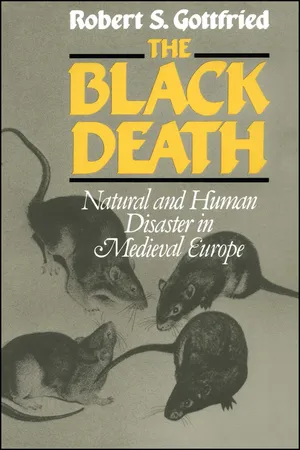
A fascinating work of detective history, The Black Death traces the causes and far-reaching consequences of this infamous outbreak of plague that spread across the continent of Europe from 1347 to 1351. Drawing on sources as diverse as monastic manuscripts and dendrochronological studies (which measure growth rings in trees), historian Robert S. Gottfried demonstrates how a bacillus transmitted by rat fleas brought on an ecological reign of terror -- killing one European in three, wiping out entire villages and towns, and rocking the foundation of medieval society and civilization.
Frequently asked questions
Yes, you can cancel anytime from the Subscription tab in your account settings on the Perlego website. Your subscription will stay active until the end of your current billing period. Learn how to cancel your subscription.
No, books cannot be downloaded as external files, such as PDFs, for use outside of Perlego. However, you can download books within the Perlego app for offline reading on mobile or tablet. Learn more here.
Perlego offers two plans: Essential and Complete
Essential is ideal for learners and professionals who enjoy exploring a wide range of subjects. Access the Essential Library with 800,000+ trusted titles and best-sellers across business, personal growth, and the humanities. Includes unlimited reading time and Standard Read Aloud voice.
Complete: Perfect for advanced learners and researchers needing full, unrestricted access. Unlock 1.4M+ books across hundreds of subjects, including academic and specialized titles. The Complete Plan also includes advanced features like Premium Read Aloud and Research Assistant.
Both plans are available with monthly, semester, or annual billing cycles.
We are an online textbook subscription service, where you can get access to an entire online library for less than the price of a single book per month. With over 1 million books across 1000+ topics, weāve got you covered! Learn more here.
Look out for the read-aloud symbol on your next book to see if you can listen to it. The read-aloud tool reads text aloud for you, highlighting the text as it is being read. You can pause it, speed it up and slow it down. Learn more here.
Yes! You can use the Perlego app on both iOS or Android devices to read anytime, anywhere ā even offline. Perfect for commutes or when youāre on the go. Please note we cannot support devices running on iOS 13 and Android 7 or earlier. Learn more about using the app.
Yes, you can access Black Death by Robert S. Gottfried in PDF and/or ePUB format, as well as other popular books in History & African American History. We have over one million books available in our catalogue for you to explore.
LIKE ALL INFECTIOUS DISEASES, the Black Death has a natural history and can be properly understood only in that context. First, there is environment.1 Anyone traveling through Europe today would find it hard to imagine what the continent looked like a thousand years ago. There were no sprawling urban and industrial complexes, the outstanding characteristic of the last century, and surprisingly few towns of any size. Towns were usually far apart, located next to the sea or astride great rivers. By the middle of the twelfth century, a few urban centers in Italy and the Netherlands, and perhaps Paris, had fifty thousand or more people, but most claimed a thousand or so inhabitants. Nine out of ten Europeans lived in still smaller settlements, nucleated villages or hamlets of a few hundred people, fifteen to twenty miles apart. Both town and village were small and cramped, with woefully inadequate sanitation and transportation facilities. Ironically, in the confines of their small but isolated settlements, most people lived close together and had little privacy.
Surrounding the villages were the fields, pastures, and woodlands from which most people squeezed their subsistence. By 1250 or so, field and pasture had come to dominate Europeās landscape, but, until at least the mid-twelfth century, the extent and density of the woodlands characterized the European environment. In the far northāmost of Scandinavia and Russiaāthe forests were coniferous, consisting primarily of fir trees, with a smattering of birch and, where the land was poorly drained and the elevation low, moors, marshes, and tundra. The rest of Europe had deciduous forests. The generally cold, wet, acidic-soil areas around the Baltic and North Seas and throughout much of eastern Europe had beech trees surrounded by holly and other aquifoliacs. Central Europe was mostly oak forest. Where the soil was alkaline, especially on both sides of the Alps and the Carpathians, the oaks were mixed with alders. Where the climate was wetter and the soil was more acidic, as in most of central and northern France and central Germany, the oaks were surrounded by birch and aspen. South of the Alps, in most of the Mediterranean Basin, the sunlight was brighter, the temperatures were higher, the rainfall was less frequent and less well-distributed throughout the year, and the soil was sandy and acidic. The Mediterranean Basin had also been settled longer than northern Europe and had a higher population density. Hence, it was less densely forested than the North; but, even in the twelfth century, much woodland remained, particularly stands of conifers, such as pines and junipers, which can tolerate sandy soils.
A second consideration in studying disease is causation.2 All epidemics, plague included, are caused by parasites that have relations with other, usually larger organisms. This process is a natural part of human and animal ecology. A third factor, and one of paramount concern to man, is toxicity. Epidemiologists generally distinguish between lethal and nonlethal diseases. Nonlethal infections are usually āoldā and well-established. Often, they are only mildly deleterious to their hosts, thus ensuring a steady supply of victims. By contrast, those spectacular diseases that periodically burst onto the historical stage, killing large numbers of people, are caused by newer parasites that have yet to establish an equilibrium with their hosts. An example of an older disease is malaria; the plasmodium that causes it is debilitating, but generally not fatal. An example of a newer disease is pneumonic plague, which is 95% to 100% fatal. Both diseases have been significant in the past, but because of the plagueās enormous mortality, it has had far greater impact.
A fourth concern regarding infectious diseasesāand, indeed, an important way of distinguishing one from anotherāis their means of transmission. One such mechanism is direct contact between people, usually via the respiratory system. Diseases so disseminated include influenza, diphtheria, measles, and pneumonic plague. Respiratory diseases are highly communicable, virtually impossible to prevent, and closely related to human population density. Consequently, they were common in the cities and towns of medieval Europe. A second mechanism of dissemination comprises enteric diseases, those spread through the digestive system; among them are dysentery, diarrhea, typhoid, and cholera. Like respiratory afflictions, enteric ailments were very common throughout the Middle Ages. They often reflected social conditions, especially poor sanitation. Because of this, and in contrast to respiratory diseases, enteric diseases can be eliminated rather easily through basic improvements in public health.
Diseases are spread in at least two other fashions. One is through venereal contact, the prime example being the treponema infections, especially syphilis, and gonorrhea. The causative organisms of venereal ailments are highly vulnerable when exposed, even in temperate environments, and were less frequent in the Middle Ages than were either respiratory or enteric diseases. A fourth group, however, was very commonādiseases transferred to humans from animal hosts, with animals acting either as intermediaries, as with malaria or typhus, or as primary or secondary epizoƶtic victims, as with bubonic plague. The role of animals in the spread of diseases can be crucial: humans share 65 different diseases with dogs; 50 with cattle; 46 with sheep and goats; 42 with pigs; 35 with horses; 32 with rats and mice; and 26 with poultry.3 While not as common as respiratory or enteric diseases, those transmitted by animals are usually more lethal, since most viruses and bacteria, the organisms that actually cause infection, gain in virulence as they pass through the chain of hosts.
In addition to their virulence, diseases facilitated by animal intermediaries are important for other reasons. They represent still another disease classification and interpretation in that their dissemination and frequency are based primarily on the animal hosts rather than on humans. Bubonic plague provides a good example. When a rodent population in which plague is enzoƶtic, that is, indigenous, begins to multiply and reaches a certain population density, there is a concentrated transfer among the rodents of parasitesāfleas, in this caseāand bacteria. The result is usually an epizoƶtic among the rodents, which sometimes leads to an epidemic of bubonic plague. Some scholars have suggested that communicable diseases are a basic part of the human environment and a function of the population density, and that civilization and disease travel hand in hand.4 Accordingly, the incidence of a given epidemic would hinge on patterns of human settlement. This is indeed the case with respiratory, enteric, and venereal diseases, but it is not so with those diseases spread by animal intermediaries. The latter are primarily dependent on factors exogenous to civilization, such as climate and rodent and insect population density and ecology. There is great danger when studying the history of infectious diseases in being too anthropocentric and overemphasizing the human element. In many epidemic diseases, humans are most effective as carriers when entering new ecospheres, such as the Americas in the sixteenth century, where they brought smallpox and measles, rather than in areas of older inhabitation, such as Europe in the Middle Ages.
Another key characteristic in the development of infectious diseases is immunity. Humans have complex mechanisms for defending themselves against pathogens, the microorganisms that cause disease. Individual resistance varies with many factors, such as number of protective antibodiesāthe proteins generated in reaction to the disease toxins introduced into the bloodstream. Immunity is either innate or acquired; if acquired, it is either active or passive. Active immunity comes when the host generates his own defenses, passive when generated defenses are introduced. Passive immunity is often only temporary. In the Middle Ages, active immunity was particularly important in determining the extent and intensity of an epidemic. Some infections, especially respiratory types such as smallpox and measles, do not change a great deal in their etiology. Hence, survival from an initial attack confers a degree of immunity, limiting recurrence to those members of society born after the last epidemic. Diseases for which there was immunity had less of an impact on medieval Europe than did more complex, multiple infections such as dysentery, influenza, and plague, for which immunity is quite limited, if it exists at all.
Medieval infectious diseases were an inheritance from the classical world. Between about 500 B.C. and A.D. 550 there were extensive contacts between the animal populations and the civilizations of China, Central Asia, India, the Upper Nile, and the Mediterranean Basin. As a result, as William McNeill has argued, there was a general confluence of Eurasian and African disease pools which, by the sixth century A.D., brought to the Mediterranean Basin most of the important diseases that can survive in temperate climates.5 To be sure, this proliferation of diseases took a long time. With a few exceptions, such as the Athenian Plague of the fifth century B.C., the classical world was remarkably free from major, deadly epidemics. This was fundamental to its steady population growth, which continued almost unabated until the second century A.D. But this biological peace was deceptive; in fact, the peripatetic character of ancient empires acted as a conduit and incubator for future disease patterns. An example was the reticulum of commerce and communications established by the Romans late in the first century B.C. This included their famed road system and, even more important, network of commercial sea routes. The sea routes converged on the Levantine Coast, then branched east across the northern Arabian Peninsula to the Arabian Sea, the Indian Ocean, and South Asia; and west to Italy, southern Gaul, and Iberia, whence goods proceeded inland via major river valleys such as the Rhone. Sea travel was relatively quick and, with good weather, all Mediterranean ports were just a few days apart. Thus, a person who seemed well on embarkation could fall sick en route, infect fellow passengers, and then spread the disease hundreds of miles from its point of origin. Further, cargoes were often bulky enough to conceal potential insect and rodent intermediaries. This, coupled with the linking of south and central Asia, the Middle East, the Nile Delta, and the European coast along the Mediterranean, brought about the fruition of disease pools.
From the second through the sixth centuries A.D., three new and lethal infections emerged from this disease pool, bringing an end to the ecological stability of the ancient world. The first began in 165 and persisted until 180, striking Italy and the western part of the Roman Empire. It seems to have been brought west by Roman legionnaires and probably marks the introduction into Mediterranean Europe of smallpox. Some authorities believe that smallpox was concomitantly present among the Germanic tribes beyond the Rhine-Danube frontier, but, even if this were so, the barbarians apparently did not transmit it to the peoples within the Empire, at least not before the third century.6 Smallpox is one of manās most communicable diseases and can be very deadly to a population with no innate immunity. This was the case in the Roman Empire. The physician Galen estimated that between a quarter and a third of Italyās population died during the 15 years after it appeared.7 But because the smallpox virus changes little and survival of an attack generally confers immunity, its role in the Middle Ages was limited to areas it had yet to visit and to those who never had had itāprimarily children. Thus, it was as a killer of children that smallpox made its biggest mark in the medieval world.
Smallpox was joined in 251 by the second of the great epidemic diseases, marking the classical/medieval disease watershed. This disease was the āAntonine Plague,ā probably measles. It was described by St. Cyprian, bishop of the North African town of Carthage:
Now that the bowels loosened into a flux exhaust the strength of the body, that a fever contracted in the very marrow of the bones breaks out into ulcers of the throat, that the intestines are shaken by the continual vomiting, that the blood-shot eyes burn, that the feet of some or certain parts of their members are cut away by the infection of diseased putrefaction that, by a weakness developing through the losses and injuries of the body, either the gait is enfeebled, or the hearing impaired, or the sight blinded.8
At its height, measles allegedly killed 5000 people a day in Rome, and it remained a major menace until about 260. Measles is like smallpox in many ways and the two diseases were not distinguished by European doctors until the sixteenth century. It is caused by a virus, transmitted via the respiratory system, and highly lethal to a population with little or no immunity. As is the case with smallpox, however, survival of a measles attack confers immunity from future visitations. Thus, it, too, was primarily a childhood affliction in the Middle Ages. Nevertheless, it is important not to diminish the effects of either disease, especially in their initial appearances. Measles depleted the population, hastened the desertion of many rural areas (particularly in the grain-producing regions of Sicily and North Africa), and cut the rolls of the Roman army and taxpayers. It caused at least a temporary reduction in East-West trade and, with smallpox, has formed the cornerstone of a major theory of the decline of the Roman Empire.9
Important as smallpox and measles were in the natural history of infectious disease, their combined role was dwarfed by the arrival in 541 of a third disease. This was plague, caused by a complex series of bacterial strains called Yersinia pestis.10 Plagueās etiology helps to explain its historical importance; Y. pestisās toxicity varies, but the disease is always highly lethal. Under normal circumstances, it lives in the digestive tract of fleas, particularly the rat fleas Xenopsylla cheopis and Cortophylus fasciatus, but it can also live in the human flea, Pulex irritans. Periodically and for reasons that epidemiologists still do not fully understand, the bacilli multiply in the fleaās stomach in numbers large enough to cause a blockage, thus threatening the flea with starvation. The āblocked flea,ā while feeding, regurgitates into its victims large numbers of Y. pestis bacilli. This process is crucial to plagueās progress; furthermore, Y. pestis cannot pass through healthy skin, but only through a break in the surface.
Dozens of rodents carry plague. Among them are tarbagons, marmots, and susliks in Asia, prairie dogs and ground squirrels in America, and gerbels and mice in Africa. Generally living in networks of tunnels just beneath the earthās surface, these rodents can be very numerous. In the Volga steppe in south Russia, an average of 325,000 susliks per four square miles has been estimated. In Europe, rats, especially the black rat, Rattus rattus, have been most important carriers. Black rats are quite sedentary and rarely move more than 200 meters from their nests. Because they live so close to humans, they are most dangerous to them. An excellent climber, R. rattus was well-suited to both the thatched roofs of peasant dwellings and the high roof beams and dark corners of urban houses. But, important as black rats were in the dissemination of plague, it is essential to emphasize that they were not the only secondary carriers. Along with the other rodents already mentioned, additional secondary vector hosts included virtually all household and barnyard animals save the horse, whose odor apparently repels even starving blocked fleas.
When Y. pestis is enzoƶtic, that is, endemic to a rodent population, it is called silvatic plague. Silvatic plague is crucial to human epidemics because its presence in a rodent population provides a reservoir, or focus, in which the disease can survive for extended periods of time. Reservoirs may help explain the cyclic occurrence of plague, which ultimately made it so important in the Middle Ages. Y. pestis is able to live in the dark, moist environment of rodent burrows even after the rodents have been killed by an epizoƶtic, or epidemic. Thus, if a new rodent community replaces the old one, the plague chain can be revived.
The fleas carrying Y. pestis turn to humans only after their supply of secondary hosts has diminished. Most secondary hosts can tolerate a modest proportion of Y. pestis in their bloodstreams, but when the bacilli multiply and invade the pulmonary or nervous systems, the secondary hosts succumb. The fleas then seek a new hostāand sometimes that host is a human being. Humans, then, are not a preferred host for Y. pestis, but rather, the victims of an animal epizoƶtic. In effect, humans are victims of changes in insect and rodent ecology.
There are three principal varieties of plagueābubonic, pneumonic, and septicaemic. Bubonic is by far the most common and therefore the most important of the three. Its incubation period from the time of infection to the appearance of the first symptoms is generally about six days. The initial symptom, a blackish, often gangrenous pustule at the point of the bite, is followed by an enlargement of the lymph nodes in the armpits, groin, or neck, depending on the place of the flea bite. Next, subcutaneous hemorrhaging occurs. causing purplish blotches and swelling in the lymphatic glands, from which bubonic plague takes its name. The hemorrhaging produces cell necrosis and intoxication of the nervous system, ultimately leading to neurological and psychological disorders, which may explain the danse macabre rituals that accompanied the Black Death. Bubonic plague is the least toxic of all plague types, but it is still highly lethal, killing 50% to 60% of its victims.
Pneumonic plague is unique in that it can be transmitted directly from person to person. This is in part the result of pneumonic plagueās peculiar etiology, for it seems to occur only when there is a sharp temperature drop and the infection moves into the lungs. After the two-to-three-day incubation period, there is a rapid fall in body temperature, followed by a severe cough and consolidation in the lungs, rapid cyanosis, and the discharge of bloody sputum. The sputum contains Y. pestis, making transmission airborne and thus direct from human to human. Neurological difficulties and coma follow infection, with death coming in 95% to 100% of the cases. Therefore, while pneumonic plague is less frequent than bubonic, it is far more virulent.
Like bubonic plague, septicaemic plague is insect-borne, but its precise etiology and occasional appearance in selected epidemics have not...
Table of contents
Cover Page
Halftitle
Contents
Acknowledgments
Introduction
CHAPTER 1 A Natural History ofPlague
CHAPTER 2 The EuropeanEnvironment 1050-1347
CHAPTER 3 The Plagueās Beginnings
CHAPTER 4 The Plagueās Progress
CHAPTER 5 The ImmediateConsequences
CHAPTER 6 The Stirrings ofModern Medicine
CHAPTER 7 Disease and theTransformation ofMedieval Europe
Epilogue EuropeāsEnvironmental Crisis
Notes
A Bibliographical EssayGeneral Literature and Sources