
- 256 pages
- English
- ePUB (mobile friendly)
- Available on iOS & Android
eBook - ePub
About this book
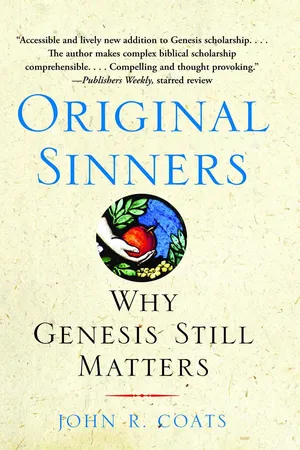
In this vivid, original interpretation of Genesis, former Episcopal priest John R. Coats takes readers on a journey through the ancient text, inviting them to see its characters in a new light, not as religious icons, but as people whose day-to-day concerns, triumphs, and failures are like our own.
In Coats’s telling, the relationships of Cain and Abel, Jacob and Esau, Rachel and Leah, and Joseph and his brothers take on stunning contemporary relevance as these characters find themselves confronted with extraordinary situations and circumstances that they’d neither asked for nor had anything to say about. Using stories from his life as well as the lives of people he’s known, Coats creates a rubric you can use to examine your own life and to discover aspects of yourself in the characters whose lives unfold in these primordial stories. How has Eve’s story shaped yours? Is your life reflected in Jacob’s evolution to wisdom? In Joseph’s youthful arrogance? Coats explores the strengths and weaknesses of the men and women in Genesis, pulling back the wrappings that have hidden their humanity to reveal the vibrant drama of these foundational narratives. "Different clothing, yes, and language, and customs, yet at the human level," he writes, "they were just as greedy and generous as we are, as gullible and crafty, as moronic and brilliant, as cowardly and brave. They are us, their stories, our stories, mirrors in which to see our best and worst selves."
Frequently asked questions
Yes, you can cancel anytime from the Subscription tab in your account settings on the Perlego website. Your subscription will stay active until the end of your current billing period. Learn how to cancel your subscription.
At the moment all of our mobile-responsive ePub books are available to download via the app. Most of our PDFs are also available to download and we're working on making the final remaining ones downloadable now. Learn more here.
Perlego offers two plans: Essential and Complete
- Essential is ideal for learners and professionals who enjoy exploring a wide range of subjects. Access the Essential Library with 800,000+ trusted titles and best-sellers across business, personal growth, and the humanities. Includes unlimited reading time and Standard Read Aloud voice.
- Complete: Perfect for advanced learners and researchers needing full, unrestricted access. Unlock 1.4M+ books across hundreds of subjects, including academic and specialized titles. The Complete Plan also includes advanced features like Premium Read Aloud and Research Assistant.
We are an online textbook subscription service, where you can get access to an entire online library for less than the price of a single book per month. With over 1 million books across 1000+ topics, weāve got you covered! Learn more here.
Look out for the read-aloud symbol on your next book to see if you can listen to it. The read-aloud tool reads text aloud for you, highlighting the text as it is being read. You can pause it, speed it up and slow it down. Learn more here.
Yes! You can use the Perlego app on both iOS or Android devices to read anytime, anywhere ā even offline. Perfect for commutes or when youāre on the go.
Please note we cannot support devices running on iOS 13 and Android 7 or earlier. Learn more about using the app.
Yes, you can access Original Sinners by John R. Coats in PDF and/or ePUB format, as well as other popular books in Theology & Religion & Biblical Commentary. We have over one million books available in our catalogue for you to explore.
Information
Topic
Theology & ReligionSubtopic
Biblical CommentaryPART I
THE BEGINNING
ACT ONE
Adam and Eve, but Mostly Eve
1
AS LINE LEADER, YOU MAKE
A RATHER STARTLING ENTRY
Imagine yourself as the first human being. Youāve popped into the world inside the body of a full-grown adult. Youāve gone from nonbeing to being and become fully conscious, although you have no memories, no parents, no siblings, friends, or enemies. No clothes and no language, though it seems reasonable that from thy bowels, as our Elizabethan ancestors were wont to say, would arise some expression of, What thā ā¦? as you stood, lay, or sat, blank-brained, absorbing those first bursts of fivefold sensory input. This wordless sense of being and identity is just the sort of abstraction that your big Homo sapiens brain is designed to ponder and dissect. Advanced queries such as Who am I? and What am I? will follow, in time.
But all those thoughts require context, and at present you donāt have any. So your brain, with its capacity for objectification, starts building some. Perhaps you begin by noticing that you and a tree, say, are not the same thing. You have feet, for instance, and trees donāt. You can move from here to there; they canāt. Hmm. Then, suddenly, all about you, as if appearing from nowhereāwhich they didāare hopping things, jumping things, soaring, crawling, running, buzzing, growling, chirping things. Your second What thā⦠Your first adrenaline buzz and an inner voice screams, Run! Then a louder inner voice shouts, No! Wait! Look! So you do and you see that those tiny creatures hovering around the flowers, and that big, stripey one with the huge teeth, and the ones in the trees all have feet; they can move from here to there. As for the How and the Why of them, well, the same All-Powerful Being who made you lets you know that he also made them, just so you wouldnāt be aloneāand how nice was that? Now, as you go about naming everythingābird, bee, tiger, horse, platypusāyou notice that there are at least two of each of them, but only one of you. Hmm!
The facility takes care of your basic physical needsāfood, water, shelter, climate controlāso thereās little for you to do but eat, sleep, hang out with the birds, bugs, plants, and animals, ponder it all, and build those contexts. No hassles. No worries. Except for that one tiny wrinkle that came up during the tour when the All-Powerful Being pointed to that one tree and said, Donāt eat the fruit of that one! He was pretty emphatic, going on about Good, Bad, and Die. Your software being quite adept at sniffing out danger, even in the subtleties of mood and tone, from the sudden shift in voice inflection, and the look, and the finger-pointing, and the finger-wagging, youād picked up on the bit about Donāt eat. (But, Die? Whatās that?) If, however, heād meant that you were not even to think about it, well, too bad, because that tree you might never have noticed is now the most interesting thing in the Garden.
2
ANOTHER CREATUREāONE LIKE
YOU, SORT OFāSHOWS UP
That is, until that one day when, on waking from a nap, you find a new creature in the garden. It makes you feel all funny. You forget about the tree. Then, sometime later, when the two of you come up for air, you remember to mention it. So now your partner is curious, too, and when you two arenāt, um, involved, you both can be found at the tree, your curiosity now infatuation, now compulsion, moving you closer each day until, finally, there you are, the two of you, beneath it, contemplating the heavy, hanging fruit of it, dangerously, flirtatiously, close to the forbidden touch. Day after day it hovers there, silent, juicy, whispering. Yum.
3
ITāS ENTIRELY POSSIBLE THAT NONE OF
THIS IS WHAT YOUāVE ASSUMED IT TO BE
The above two sections have bits and pieces of both creation stories. Yes, both. The Bibleās opening line, the familiar āIn the beginningā¦,ā is the creation of P,* as is the story of the man and the woman who just popped into being. The tree is from the second creation story, Jās version, which recounts that the woman was created after the man. (Yes, Genesis can get a little confusing.) Thereās more. For instance, you probably grew up with the idea that, in Genesis, the first man was named Adam. Nope. While P writes that āGod created man in His imageā¦male and female He created them,ā he never mentions anyone actually named Adamāor Eve, for that matter, or a Garden of Eden. In fact, weāre well into Jās story (which begins at Genesis 2:4b) before the man is referred to as āthe man,ā which makes sense from a linguistic point of view, given that adam is the Hebrew word for āhuman.ā Yes, human: male and female. So, adam is a common gender noun rather than a proper name, a āHey, you!,ā and Eve is as much an adam as Adam. While Eve is given her name by the man, Eve means āmother of all that livesāāwhich is interesting, since she has not yet given birthāand though J does refer to him as āAdam,ā at least in translation, the first man is never officially named. I suppose that, were one to send a formal announcement or invitation, say, the proper inscription would read, Eve and friend.
The text that is actually there in Genesis, and what readers assume is there, are often quite different. Indeed, among its other functions, Genesis challenges assumptions, a role made necessary by thousands of years of attempts at interpreting its contents, itself a role to which any interpreter, being human, will bring a point of view. Moreover, people tend to defend their assumptions regarding Genesisāor, for that matter, any part of the Bibleāwith the tenacity of a lioness guarding her cubs. While proponents of this or that assumption, however outrageous, might truly believe theirs to be the product of divine inspiration, some, for their own reasons, likely made it up. Or someone else did, and they believed it. Take Eve, for example.
4
ABOUT THE WOMAN
In the JPS translation, Pās account of the creation of the humans reads: āGod said, āLet us make man in our image, after our likenessā¦ā And God created man in His image, in the image of God He created him; male and female he created them.ā The URJ translation of the same Hebrew text reads: āGod now said, āLet us create human beings in our image, after our likenessā¦ā So God created the human beings in [the divine] image, creating [them] in the image of God, creating them male and female.ā Note that the latter translates the Hebrew adam as āhuman beings,ā not āman,ā as in the JPS and most English translations. Note also the use of the plural, āhuman beings.ā About that, Bible scholar Tamara Cohn Eskenazi writes,
This translation resorts to the plural to avoid using misleading masculine pronouns later in the verse. Literally, the Hebrew has: āAnd God created the adam. In the image of God he created him/it; male and female he created themā (shifting the object pronoun from singular to plural). By referring to adam, the text is not describing an individual but a new class of beings that comprises female and male from the start, both of them in Godās imageā¦The shift from singular to plural does not convey that man was created before womanā¦Rather, it seems to say that our humanity, as adam, precedes our division into sexual categories. Our humanity comes first; our sexual identity next.1
Jās account of the creation of the humans is earthy, intimate, and hands-on. In chapter 2, verse 7, Yahweh fashions the man from the soil (earth, adama) then breathes into him āthe breath of life,ā which, breath and spirit being the same word in Hebrew (nephesh), is an act of infusing the human with life and the divine spiritāa significant act. Then, to provide the man with companions, Yahweh fashions, again from the soil, the birds and animals. Still, since the man has no proper mate, at verse 21, Yahweh puts him to sleep, takes one of the manās ribs, and creates one.
But, one what, exactly?
In Hebrew, the phrase is āezer kenegdo, which, for centuries, has been translated into English as āhelperā or āhelpmate,ā and taken to mean something akin to āthe little woman.ā āThe Hebrew,ā writes Robert Alter, in his commentary on Genesis, āis notoriously difficult to translate. The second term means āalongside,ā āopposite him,ā a counter-part to him. āHelpā is too weak because it suggests a merely auxiliary function, whereas āezer elsewhere connotes active intervention on behalf of someone, especially in military contexts, as often in the Psalms.ā2 Alter translates the phrase as āsustainer beside him [the man],ā3 Richard Elliott Friedman as āa strength corresponding to him.ā4 In other words, the woman was created in order to provide the man with a partnerāan equal partner. This leaves us with nothing in either creation narrative that places the woman in an inferior position to the manānot her sex, not her place in the order of creation, and not the reason she was created. Yet thousands of years of inventive speculation and creative writing about the book of Genesis, efforts that would yield āproofā of Eveās (and her sexās) inferiority to Adam (and his sex), have given us most of what we assume to be true about Eveāeven though no validation of those assumptions exists in the original text.
How that came about is its own story.
5
WHO ARE WE?
THE RISE OF THE INTERPRETERS
If you build your house on the southeastern shore of one of the Florida Keys, you must expect that, one day, a hurricane will take it away. Likewise, if you establish your homeland on a piece of geography that, for centuries, has been a principal invasion corridor (think interstate highway), then you will, in time, be invaded. If you do either on the premise that you are under divine protection from such consequences, only to have your house blown away, or an invader roll over your land, youāll likely arrive at one of two conclusions: your premise for choosing that location was faulty, or your premise was correct, but something you did, or failed to do, really annoyed the divine protector.
In his masterwork, Traditions of the Bible: A Guide to the Bible as It Was at the Start of the Common Era, James Kugel reveals that, over the centuries, passages from the Bible were interpreted this way, then that way, then another; each interpretation, in the context of place and time of its origin, seemed to be correct. Therefore, what we might assume to be the interpretation of the Bible might well be but the product of the latest interpreters. āWho nowadays, for example,ā writes Kugel, ādoes not automatically think of the story of Adam and Eve as telling about some fundamental change that took place in the human condition, or what is commonly called the Fall of Man.ā5 Yet the early Israelites made no such assumption, until after the Babylonian invasion. Known in Jewish history as āthe great divide,ā the year 586 B.C.E. witnessed the fall of Jerusalem, the destruction of the first Temple, and the beginning of nearly fifty years of exile from the promised land, a national trauma expressed with affecting poignancy in Psalm 137:
By the rivers of Babylon
there we sat,
and we wept
as we thought of Zion.
There on the poplars
we hung up our lyres,
for our captors asked us there for songs,
our tormentors, for amusement:
āSing us one of the songs of Zion.ā
How can we sing a song of the Lord
on alien soil?
there we sat,
and we wept
as we thought of Zion.
There on the poplars
we hung up our lyres,
for our captors asked us there for songs,
our tormentors, for amusement:
āSing us one of the songs of Zion.ā
How can we sing a song of the Lord
on alien soil?
Then, in 532 B.C.E., soon after the Babylonians fell to the Persians, Cyrus the Great, king of Persia, granted the Israelites the option to return. Some remainedāwhat had been a foreign land to their grandparents was the only home theyād known. Those who chose to go back to Zion were haunted by the idea that, somehow, their ancestors had tweaked the divine nose and lost the protective shield. As for what their ancestors had done, nobody had a clue. The Israelite elders who might have remembered were dead, along with their knowledge of the sacred texts and their meanings. Besides, even if theyād found a key to that old knowledge, they no longer spoke the old language. Fifty years of immersion in Babylonian culture had created new words and given old words new meaning. Too much of the past was out of reach. Still, with no place else to look but their holy books, when answers werenāt forthcoming with sufficient clarity, the role of the interpreter was born.
None was a woman.
6
THE FRUIT OF THE TREE OF THE
KNOWLEDGE OF ⦠EXACTLY WHAT?
The first clue about free will and human nature shows up in Yahwehās warning to Adam about the consequences of eating the fruit of that tree: Eat it, you die. Donāt eat it, you live. Your call. While most English translations read, āthe tree of the knowledge of good and evil,ā the JPS reads, āthe tree of knowledge of good and bad.ā Why the change? In his Commentary on the Torah, Richard Elliott Friedman also translates the Hebrew word as ābad,ā because
āevilā suggests that this is strictly moral knowledge. But the Hebrew word (raā) has a much wider range of meaning than that. This may mean knowledge of what is morally good and bad, or it may mean qualities of good and bad in all realms: morality, aesthetics, utility, pleasure and pain, and so on. It may also mean that things are good and bad in themselves and that when one eats from the tree one acquires the ability to see these qualities; or it may mean that when one eats from the tree one acquires the ability to make judgments of good and bad. Perhaps the meaning was clear to the ancient reader who knew the immediate connotation of the words. It is not clear to us in the text of the story as it has survived. The only immediate consequence of eating from the tree that the story names is that before eating from the tree the humans are not embarrassed over their nudity and after eating from it they are. This is not sufficient information to tell us what limits of āgood and badā are meant, nor does it tell us if absolute good and bad are implied or if it is the more relative concept of making judgments of good and bad.6
So, as much as we might want to know, and think we know, about what J meant by his use of āgood and bad,ā we canāt know. We can study the writings of the interpreters, but even the earliest of these, those closest to Jās own time, began writing because they didnāt know, either.
7
ENTER THE SERPENT, CHOICES,
AND CONSEQUENCES
The word serpent is from Latin and means ācreeping,ā an activity we associate with legs of some sort, as opposed to slitheringāa fate the serpent might have avoided had he kept the conversation to a light banter. Ironically, the conversation the serpent did initiate with Eve, one of the more familiar fragments in Western literature, begins with what appears to be no more than an innocent request for clarification:
āDid God really say: You shall not eat of any tree of the gardenā?
āWe may eat of the fruit of the other trees in the garden.ā
āIt is only about the fruit of the tree in the middle of the garden that God said: āYou shall not eat of it or touch* it lest you die.āā
āYou are not going to die, but God knows that as soon as you eat of it your eyes will be opened and you will be like divine beings who know good and bad.ā
The serpent knew the answer before he asked the qu...
Table of contents
- Cover Page
- Title Page
- Copyright Page
- CONTENTS
- INTRODUCTION
- PART I THE BEGINNING
- PART II THE WANDERERS
- PART III THE BLESSING THIEF: A STORY IN THREE ACTS
- PART IV THE DREAM READER
- EPILOGUE
- NOTES
- ACKNOWLEDGMENTS
- INDEX
- ABOUT THE AUTHOR
- Footnote