
- 320 pages
- English
- ePUB (mobile friendly)
- Available on iOS & Android
eBook - ePub
About this book
New York Times bestselling author T.D. Jakes explains the tools that we need to know—whether we’re single and looking to have a committed relationship or already married—before taking the next big step.
The star of BET’s Mind, Body & Soul, and featured guest speaker on Oprah’s Lifeclass, Potter’s House pastor, T.D. Jakes turns his attention to the topic of relationships, guiding you on the right track to making decisions you will benefit from for the rest of your life. In the vein of Joel Osteen’s Become a Better You and Dr. Phil’s Life Strategies, the New York Times bestselling Making Great Decisions gives you the psychological and practical tools you need to reflect, discern, and decide the next step toward strong relationships in your life. “Remember,” writes T.D. Jakes, “your tomorrow is no better than the decisions you make today.”
“My promise is that if you read this book, you will be equipped, you will know all you need to know about making foolproof relational decisions,” writes T.D. Jakes. Choosing the right partner, at home or at work, is one of the most consequential decisions we’ll ever make. How can we be sure that we’re choosing wisely? How do we know if we’re doing the right thing when we change careers? By breaking our decisions down into their five crucial components:
-Research: gathering information
-Roadwork: removing obstacles
-Rewards: listing choices and visualizing consequences
-Revelation: narrowing your options and making your selection
-Rearview: looking back and adjusting as necessary to stay on course
Clear-sighted, realistic, and spiritually uplifting, Making Great Decisions is one of those rare books that can change lives.
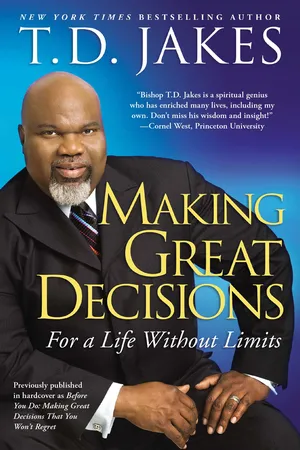
The star of BET’s Mind, Body & Soul, and featured guest speaker on Oprah’s Lifeclass, Potter’s House pastor, T.D. Jakes turns his attention to the topic of relationships, guiding you on the right track to making decisions you will benefit from for the rest of your life. In the vein of Joel Osteen’s Become a Better You and Dr. Phil’s Life Strategies, the New York Times bestselling Making Great Decisions gives you the psychological and practical tools you need to reflect, discern, and decide the next step toward strong relationships in your life. “Remember,” writes T.D. Jakes, “your tomorrow is no better than the decisions you make today.”
“My promise is that if you read this book, you will be equipped, you will know all you need to know about making foolproof relational decisions,” writes T.D. Jakes. Choosing the right partner, at home or at work, is one of the most consequential decisions we’ll ever make. How can we be sure that we’re choosing wisely? How do we know if we’re doing the right thing when we change careers? By breaking our decisions down into their five crucial components:
-Research: gathering information
-Roadwork: removing obstacles
-Rewards: listing choices and visualizing consequences
-Revelation: narrowing your options and making your selection
-Rearview: looking back and adjusting as necessary to stay on course
Clear-sighted, realistic, and spiritually uplifting, Making Great Decisions is one of those rare books that can change lives.
Frequently asked questions
Yes, you can cancel anytime from the Subscription tab in your account settings on the Perlego website. Your subscription will stay active until the end of your current billing period. Learn how to cancel your subscription.
At the moment all of our mobile-responsive ePub books are available to download via the app. Most of our PDFs are also available to download and we're working on making the final remaining ones downloadable now. Learn more here.
Perlego offers two plans: Essential and Complete
- Essential is ideal for learners and professionals who enjoy exploring a wide range of subjects. Access the Essential Library with 800,000+ trusted titles and best-sellers across business, personal growth, and the humanities. Includes unlimited reading time and Standard Read Aloud voice.
- Complete: Perfect for advanced learners and researchers needing full, unrestricted access. Unlock 1.4M+ books across hundreds of subjects, including academic and specialized titles. The Complete Plan also includes advanced features like Premium Read Aloud and Research Assistant.
We are an online textbook subscription service, where you can get access to an entire online library for less than the price of a single book per month. With over 1 million books across 1000+ topics, weâve got you covered! Learn more here.
Look out for the read-aloud symbol on your next book to see if you can listen to it. The read-aloud tool reads text aloud for you, highlighting the text as it is being read. You can pause it, speed it up and slow it down. Learn more here.
Yes! You can use the Perlego app on both iOS or Android devices to read anytime, anywhere â even offline. Perfect for commutes or when youâre on the go.
Please note we cannot support devices running on iOS 13 and Android 7 or earlier. Learn more about using the app.
Yes, you can access Making Great Decisions by T.D. Jakes in PDF and/or ePUB format, as well as other popular books in Theology & Religion & Literature & the Arts in Christianity. We have over one million books available in our catalogue for you to explore.
Information
four
Before You LeadâDecide on Your Team
âIf your actions inspire others to dream more, learn more, do more and become more, you are a leader.â
âJohn Quincy Adams
When confronted with important choices, we gather the information that is important to our decision-making process. We assume responsibility for what we are deciding, the life we are constructing. We get rid of the junk in our trunk, the negative thinking, unwillingness to forgive, bitterness, or any other deep emotional issues that weigh us down. Then we must also consider the team we bring to the task of making the decision.
Professional sports teams send out scouts to identify a playerâs talent, current level of skill, and potential to fit their pro team, years in advance of his or her eligibility. NFL teams send their scouts to colleges to spot not just seniors soon to be eligible for signing, but the freshmen who have just made the team. Major league baseball coaches have been known to send their scouts to Little League games in hopes of identifying their future pitching prodigies.
The best scouts see beyond where the player may be positioned currently and take an eyeball X-ray into that youthâs ability to play several positions on the team envisioned for the future. They realize that every player scouted will not make the team, but that the team will not flourish without a vision of who will play key roles into the future. This is the only way to produce a winning team.
To the coach, the team is a collection of athletes, defined by the positions they hold, assembled by league rules within the salary cap and team budget. Some positions are more valuable than others to the well-being of the team. Itâs hard to imagine a successful football team without a talented running back, or a winning baseball team that didnât invest in its pitchers.
Personnel considerations must be a fundamental priority, no matter what kind of team it is. To the CEO of an industrial giant, his team is determined by the organizational charts he has in place and by the Human Resources department he has established for recruiting, training, and retaining the people he hires. He knows that a strong HR team is the heartbeat of a strong organization. His talented employees will build a strong infrastructure that operates, produces, markets, and sells the companyâs products. They are the lifeblood of the corporation; the shareholders and investors count on them for a return on their investment.
A motherâs team that she uses to run the house will likely be her children. As her children grow, she recognizes their abilities and talents and matches them accordingly with chores and responsibilities around the home. She matches them by the age level, skill set, and individual temperamentâone washes dishes while another empties the trash. As they get older, their responsibilities increaseâcleaning their rooms, cutting the grass, preparing meals, and taking care of pets. The savvy mother realizes that as her team succeeds, she is keeping the household running smoothly as she teaches her children about responsibility and teamwork.
CEO of Your Life
Begin to think of yourself as a CEO, as a leader, the one who makes decisions about your life. You are the Donald Trump of your own life. (You may not like his methodologies or mannerisms, but no one has ever wondered whoâs in charge when heâs in the boardroom.) Your team members are those whose contributions affect the quality of your life.
Remember, my friends, that God is the owner of your team but gave you authority to run it. Like Adam in the garden, you have power to subdue and have dominion, and you must know that the earth is the Lordâs but God has given you the task to run it. I like this understanding of ownership and stewardship. God owns your life, but you care for it. This gives you the power to make the necessary decisions in your life and moves you from victimhood to being a victor. The next great decision is yours to make.
Now you may not feel like you are the CEO of your own life, or if you do, you may wonder why you always feel on the verge of emotional bankruptcy or a hostile takeover by those around you. But you alone have the responsibility to make the choices that will affect your own performance, productivity, profitability. You have stakeholders and shareholders, those who support you and those who compete with you. In the corporate world, at the end of the day, it is the CEO sitting in her corner office who is held responsible for the bottom line. Similarly, you are the one sitting in the executiveâs chair in your life and if you donât guide your personal corporation, then you will miss the chance to reap the dividends for which you were created.
Understanding that you are the leader of your life, you must move away from being a peacemaker to being a policy maker. Your goal is not to keep peace but to develop policies.
In the process of being a great CEO of your life, you can expect to be controversial, face conflict, commit fully, and exercise character. Each of these four qualitiesâcontroversy, conflict, commitment, and characterâemerge from your willingness to exercise strength, wisdom, and determination. You must be willing to examine whatâs inside yourself and to choose the kind of leader you want to be. Without the deliberate choice to lead, the preparation necessary to inform your decisions, and the will to follow through, your team will flounder searching for someone to direct them.
I have never seen leaders who didnât have these four characteristics. Letâs briefly examine each of these four:
They tend to be controversial.
Their decisions create conflict.
They are persons of commitment.
They are guided by their character.
IF YOU DONâT CONSIDER YOURSELF A LEADER
If you consider yourself a leader, then you understand that it is rarely an easy job or one that necessarily makes you very popular. If you donât consider yourself a leader, perhaps you are not taking responsibility for the decisions you make in your life and are relying too much on others to lead the way. You can be a leader at home and/or at work. Leadership at home is the mother who encourages her kids to donate their toys to the local shelter when they no longer play with them or the father who teaches his son the value of honesty when he walks with him to tell the next door neighbor that he damaged his tree while riding his new minibike.
Leadership at home is the couple who, rather than engaging in screaming, yelling, and name calling when they disagree, calmly talk to each other, state their perspective, and respectively listen to the otherâs point of view. So, by their example, they teach their children how to disagree with another person but at the same time let their needs be known.
Leadership does not only apply to people in positions of power such as presidents, pastors, or corporate CEOs. You show leadership in the way you choose to live your life, the way you interact with others no matter what their social status, and the example you set for your family, friends, and others you come into contact with.
Accept Being Controversial
Exercising leadership requires that you accept being controversial. Many people will not accept where youâre going until after you get there. They donât understand the mind-set of a leader, because their opinions are based on where they are in life, not where you see your life going. Necessary members of your team may have myopic visions; they are unable or unwilling to see the forest for the trees. They are not the global thinkers you are. Leaders are not limited to one dimension but see the entire panoramic view of the team, their goals, and life itself. The difference in perspective between their myopic views and your panoramic view usually creates controversy, and a good leader has to be strong enough to live with the turmoil that comes from being misunderstood.
The controversies will hit you from many different directions. Some will be small and inconsequential and should be swatted away like flies at a picnic. Some people on the periphery of a relationship with youâcasual acquaintances at church, business associates in other departmentsâmay gossip about and second-guess what they perceive you are up to. Their rumors and concerns should roll off your back unless you see them influencing primary relationships or other parts of your life.
Other controversies will emerge from those closest to you. It may be someone who overtly disagrees with you, which is actually not as bad as it may sound. Far worse, are the controversies hiding like a riptide beneath the calm surface. People who disagree with you or have competing agendas but who pretend to be in agreement with you can be the most dangerous of all. These may be coworkers, family members, your kids, your spouse, your pastor, or your close friends. They want you to do and to be who they want and need, not necessarily who you must become according to your own personal sense of mission. Communication is the best way to confront these controversies, and I would encourage you to keep short accounts and lean into them as soon as you sense their presence.
Accomplish Amid Conflict
Great leaders are generally tolerant of conflict, able to perform in the eye of the storm that may rage around them. If you have to wait until every conflict is resolved in order to proceed, you will never go forward. Instead, great leaders achieve their accomplishments as they venture through the middle of conflict. Their goal is to balance the extremes, for the betterment of all.
In spite of what we see today in the political and business arenas, where our leaders often rise to power by playing on the polarities of our world, scaring people into voting for them or hiring them, great leaders strategize rather than polarize. Talented leaders balance themselves within the conflict, between the polarities, without yielding to either extreme. They know that the truth is usually in the middle.
Many individuals focus on being recognized for their own talents rather than the team or corporate goals. Others want to be ârightâ and recognized as smarter, quicker, or more savvy than those around them. They tend to pick fights in order to strut their stuff and gain recognition. Real leaders know how to sidestep these ego-driven obstacle builders and maneuver like a sports car along a mountain road. Leaders keep the big picture and the bottom line in view when others attempt to obscure the view with personal agendas and petty conflicts.
Be Committed
Third, a great leader is a person of commitment. If sheâs the CEO, sheâs not off at five. If heâs the captain, then heâs not the first one off the ship. If heâs a manager, then heâs closing up after others leave the building. A leader must be committed or she will never achieve her goal.
There are simply too many other demands, distractions, and divisions interfering with your perseverance unless your commitment is firmly in place. Life circumstances will often thwart the schedules and methodologies that we set in place to fulfill our goals. Leaders know they must remain flexible, nimble, and adept at spontaneous course changes. They are not surprised when the laptop crashes, the international plant closes, or the deadline gets moved again. They are not deterred when critics go public and gain press coverage for their negativity. They are not diverted from their real goals when new opportunities present themselvesâthe good ones versus the great ones.
When family members no longer support their dreams, when a spouse doesnât encourage their passion, when their kids require more of them, these leaders forge onward and refuse to enter a spiral of discouragement, depression, or diversion. They keep their goals in the bullâs-eye and refuse to allow naysayers, critics, and detractors to poison their determination.
You may need to maintain firm boundaries when these people attempt to derail your dream. Know when to say no. Know that itâs okay to walk away alone with your head held high rather than to conform to someone elseâs standard of who you should be. Know that no one, even those who love you most, can pursue your goals the way you can.
Be of Good Character
But commitment without character leads to chaos. Character sets boundaries; it may not determine what you will do but will always determine what you wonât do. Character letâs you know how much youâre willing to pay to go up the ladder.
Anyone in power who has no character is dangerous. They become ruthless tyrants. These are the leaders who produce gas chambers, devise weapons of mass destruction, enslave hundreds of thousands of people, lynch anyone who does not agree with them, and terrorize the hearts of all within their grasp. Tyranny, totalitarianism, and terrorism never contribute the kind of leadership that enriches lives and enhances the team.
But good character does not have to be in the spotlight, overtly running the show and screaming for recognition. When your character is forged by determination and your ego is strengthened by enduring past defeats, you do not need to resort to shortcuts to get your goals. If you think you can fast-track success by cheating, lying, or sleeping your way to the top, then youâre sadly mistaken.
You carry who you are with you everywhere you go. If you do not build a solid character, then you will not be able to survive for long once youâre at the top. Real leadership requires integrity, someone who displays the same character in the boardroom and in the bedroom. Someone who plays by the rules and works hard. Someone who gives others credit when itâs due. Someone who lives by faith. Someone who trusts their Creator to help them accomplish all that they were made and called to do.
The Bible tells us that the wicked may prosper for a season but they will not endure and most certainly will not ultimately triumph. Treat others the way you want to be treated. Give as much or more than you take. Remember where you came from. Never lose sight of where youâre going.
HANDLING CONFLICT
As a leader you will never be far from conflict and controversy. While not everyone will be willing to step up and take responsibility as the leader, you can be sure there will be plenty of people who are more than willing to sit back and critique everything you are doing. At work, you might take on leadership for a task force or assume the lead on a new product launch, for example. As part of the task force, you must assign coworkers certain jobs. You try to choose roles that coincide with everyoneâs wishes and strengths wherever possible, but of course, not everyone will be completely satisfied. Further, some of your coworkers are jealous and upset that you were offered the position rather than them and, in response, criticize everything you do, saying, âIf I were in charge, I would do it differently.â You may hear whispering in the break room or notice employees huddling in the hallways as you walk by.
This is one of the unfortunate but expected by-products of leadership. Not everyone will be happy with your decisions or even happy that you are taking the lead. You canât let these people deter you from your success. Certainly you want to treat everyone with the courtesy and respect they deserve, but as long as you make your decisions based on what is best for the project, you canât worry about individuals who wish to focus on petty, negative issues.
This is also true in family relationships. Not everyone is going to be happy with the decis...
Table of contents
- Cover
- Dedication
- Introduction: Before You Decide
- One: Before You Take the First StepâReflect, Discern
- Two: Before You BlameâAccept Responsibility
- Three: Before You Leave Junk in Your TrunkâClean Up Emotionally
- Four: Before You LeadâDecide on Your Team
- Five: Before You Join
- Six: Before You Decide to Love
- Seven: Before You Place Your Love Order
- Eight: Before You CommitâResearch
- Nine: Before You CommitâDevelopment
- Ten: Before You Get EngagedâTwenty Final Exam Questions You Must Ask
- Eleven: Before You Marry
- Twelve: Before You Decide to Take a Risk for Your Marriage
- Thirteen: Before You Buy a House
- Fourteen: Before You Have Children
- Fifteen: Before You Divorce
- Sixteen: Before You Settle for Less
- Seventeenv Before You Fight
- Eighteen: Before You Take Flight
- Nineteen: Before You Gamble
- Conclusion: Now Youâve Done It
- Acknowledgments
- Copyright