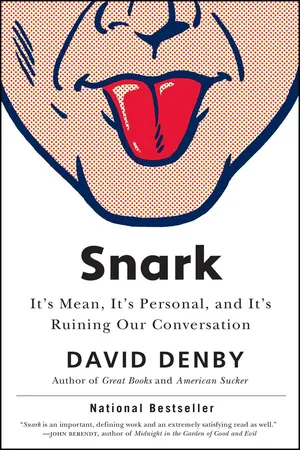
This is an essay about a strain of nasty, knowing abuse spreading like pinkeye through the national conversationâa tone of snarking insult provoked and encouraged by the new hybrid world of print, television, radio, and the Internet. Itâs an essay about style and also, I suppose, grace. Anyone who speaks of graceâso spiritual a wordâin connection with our raucous culture risks sounding like a genteel idiot, so I had better say right away that Iâm all in favor of nasty comedy, incessant profanity, trash talk, any kind of satire, and certain kinds of invective. Itâs the bad kind of invectiveâlow, teasing, snide, condescending, knowing; in brief, snarkâthat I hate.
Perhaps a few contrasts will make the difference clear. Jon Stewart and Stephen Colbert can be rough. Like all entertainers, they trust laughs more than anything else, and they wait for some public person to slip a stirrup and fall. âWeâre carrion birds,â says Stewart, a man capable of describing Karl Rove as having a head like a lump of unbaked bread dough. But the Stewart/Colbert claws are sharpened in a special way. Even when pecking at a victimâs tender spots, they also manage to defend civic virtue four times a week. When Stephen Colbert, a liberal, wraps himself in the flag and bullies his guests in the manner of right-wing TV host Bill OâReilly, he is practicing irony, the most powerful of all satiric weapons. Attacking the Bush administration, Colbert and Stewart were always trying to say, This is not the way a national government should behave. Snark, by contrast, has zero interest in civic virtue or anything else except the power to ridicule. When the comic Penn Jillette said on MSNBC in May 2008, that âObama did great in February, and thatâs because that was Black History Month. And now Hillaryâs doing much better âcause itâs White Bitch Month, right?â he was not, putting it mildly, practicing irony or satire. The remark was bonehead insult, but insult of a special sort. It spoke to a knowing audienceâto white people irritated by black history as a celebration, and to men who assume an ambitious woman can safely be called a bitch. The layer of knowingness, in this case, was an appeal to cranky ill will and prejudice. Jilletteâs joke was snark. A question I found as a comment on a right-wing blogââIs Obama a fat-lipped niggerâor what?ââis simple racist junk. But a student named Adam LaDuca, formerly president of the Pennsylvania Federation of College Republicans, wrote on his Facebook page that Obama was ânothing more than a dumbass with a pair of lips so large he could float half of Cuba to the shores of Miami (and probably would).â That remark, in its excruciating âhumorâ and its layer of knowing reference, is tin-plated snark (and also racist junk).
Snark is not the same as hate speech, which is abuse directed at groups. Hate speech slashes and burns, and hopes to incite, but without much attempt at humor. Some legal scholarsâmost notably, Jeremy Waldron, of New York Universityâhave argued that the United States, a tumultuous, multiethnic country with many vulnerable minorities, should consider banning hate speech by law, as some countries in Europe have done. But that is not my concern here; the legal issues lie far beyond the range of this essay, and, in any case, I am against censorship in any form, on the usual ground that it will choke legitimate critical speech as well as vicious rant. I will hunt the snark but leave hate speech alone. I will also ignore the legions of anguished, lost people on Web sites and the social networking site Facebook who are convinced that, say, Barack Obama is the Antichrist (âBuraq was the name of Muhammadâs horse!â), and who fly about wildly, like bats trapped in a country living room, looking for a way to release fear. Madness and paranoia are not the same as snark.
Nor am I talking about the elaborately sadistic young sports known on the Internet as âtrolls.â These are technically enabled young men, part hackers, part stalkers, who pull such pranks as teasing the parents of a child who has committed suicide or sending flashing lights onto a Web site for epileptics. The lights may cause seizures. Fun! The trolls have a merry time screwing people up. What they do violates existing statutes, and if federal and state authorities had the energy and resources to pursue them, the trolls could probably be prosecuted for harassment. So far they have gone largely unpunished, but I leave them to the cops and prosecutors. Finally, I will bypass the issue of political correctness, which, rightly or wrongly, is a way of protecting groups against calumny and lesser slights. Political correctness actually shares one leading characteristic with snarkâit refuses true political engagement, the job of getting at the truth of things. All too often, PC tries to rein in humor that might brush against a truth. What Iâm doing hereâhunting the snarkâis a way of preserving humor. Those of us who are against snark want to humble the lame, the snide, and the lazyâand promote the true wits.
Snark attacks individuals, not groups, though it may appeal to a group mentality, depositing a little bit more toxin into already poisoned waters. Snark is a teasing, rug-pulling form of insult that attempts to steal someoneâs mojo, erase her cool, annihilate her effectiveness, and it appeals to a knowing audience that shares the contempt of the snarker and therefore understands whatever references he makes. Itâs all jeer and josh, a form of bullying that, except at its highest levels, beggars the soul of humor. In the 2000 presidential campaign, Maureen Dowd of the New York Times had Al Gore âso feminized and diversified and ecologically correct, heâs practically lactatingâ in one column and buffing his pecs and ridging his abs in another column. Which was it? Effeminate or macho? Snark will get you any way it can, fore and aft, and to hell with consistency. In a media society, snark is an easy way of seeming smart. When Harvard professor Samantha Power resigned from Obamaâs campaign on March 7, 2008, after calling Hillary Clinton âa monster,â Michael Goldfarbâs comment, on the blog of the conservative magazine the Weekly Standard, was âTell us something we donât know.â Powerâs remark is a plain insult; Goldfarbâs, with its cozy âwe,â which adds a twist of in-group knowingness, is snark. Snark doesnât create a new image, a new idea. Itâs parasitic, referential, insinuating.
Of course, snark is just words, and if you look at it one piece at a time, it seems of piddling importance. But itâs annoying as hell, the most dreadful style going, and ultimately debilitating. A future America in which too many people sound mean and silly, like small yapping dogs tied to a post; in which we insult one another merrily in a kind of endless zany brouhaha; in which the lowest, most insinuating and insulting side threatens to win national political campaignsâthis America will leave everyone, including the snarkers, in a foul mood once the laughs die out. At the moment, there are snarky vice presidential campaigns (Sarah Palinâs mean-girl assault on Barack Obama as âsomeone who sees America as imperfect enough to pal around with terrorists who targeted their own countryâŠThis is not a man who sees America like you and I see America.â); snark-influenced crafts (advertising); an enormous, commercially flourishing snark industry (celebrity culture); snarky news-and-commentary cable TV shows, left and right; and snark words, such as whiny and whiner, which are often used to cut the ground under anyone with a legitimate complaint. Senator John McCain, displaying some creative flair in his attacks on Barack Obama on October 15, 2008, added a snarky visual effect (perhaps a first in a presidential debate) to ordinary sarcasm, by holding up his fingers for air quotes around the word health in a discussion on abortion: âHere again is the eloquence of Senator Obamaâthe âhealthâ of the mother. You know, thatâs been stretched by the pro-abortion movement in America to mean almost anything.â By using air quotes (was he channeling the late Chris Farley?), McCain was sending a sportive signal to pro-lifersâthatâs the snarky partâbut also suggesting, perhaps unconsciously, that the heath of the mother was somehow irrelevant to the matter of abortion. At the end of the first decade of the twenty-first century, snark sounds like the seethe and snarl of an unhappy and ferociously divided country, a country releasing its resentment in rancid jokes. Itâs a verbal bridge to nowhere. Iâve been accused of writing some myself.
The practice has often been mislabeled. Snark is not the same thing, for instance, as irreverence or spoof. Iâve heard the morally outraged satirist Lenny Bruce described as a pioneer of snark, which is absurd. Bruce, in his way, was as serious as the prophet Jeremiah. David Letterman the ironist is snarky; Jay Leno, a straight joke teller, is not. Don Rickles takes on hecklers and insults his audience, but his act is a formal structure whose unvarying rules are known in advance. If he werenât vicious, people wouldnât go to hear him. What he does isnât snark; itâs a harmless, self-contained ritual performed by a cobra with a ribbon tied around its head.
The platonic ideal of snark is something like this: Two girls are sitting in a high school cafeteria putting down a third, whoâs sitting on the other side of the room. Whatâs peculiar about this event is that the girl on the other side of the room is their best friend. In that scenario, snark is abusive or sarcastic speech that operates like poisoned arrows within a closed space. Its intention is to offer solidarity between two or more parties and to exclude someone from the same group. On Gossip Girl, this is juicily entertaining, but in real life itâs as hostile as spit. The crab that tries to escape the barrelâthe girl who dresses differently or studies harderâgets pulled back into the barrel. Who does she think she is? A young writer who creates an ambitious work of fiction gets snarked by journalists of lesser ambition. What a pretentious phony! Snark often functions as an enforcer of mediocrity and conformity. In its cozy knowingness, snark flatters you by assuming that you get the contemptuous joke. Youâve been admitted, or readmitted, to a club, though it may be the club of the second-rate.
Letâs not fall into a misunderstanding. Life would be intolerable without any snark at all. There are public events like Dick Cheneyâs shooting his close friend in the puss, or Eliot Spitzerâs encounters with a $4,300 hooker after prosecuting vice for several yearsâevents that no human being could fail to relish, rehash, retell. These misadventures inspired snarky comments by the hundreds, and all one can say about the comments is that malice is as natural as kindness, and that someone completely without snarky impulses would have little humor of any sort. One canât, without hypocrisy, be against all snark all the time. The practice exists at different levels of ambition and skill, and at the top levels snark crosses into wit. In a 1976 essay (âSome Memories of the Glorious Bird and an Earlier Selfâ), Gore Vidal, a master of high snark, recounts the early days of his friendship with Tennessee Williams. Eventually, the narrative turns to Truman Capote:
This is funny no matter how you read it. But the last line achieves its full snarky glory only if you know that in 1976, when Vidal wrote these sentences, Capote was a sodden mess. Vidalâs insult is perfectly phrased. How could one be against it? A writer like the Roman poet Juvenal (discussed in the Second Fit), who deploys a virulent, sometimes obscene witâan early case of snark, I thinkâcan make proper writers seem timid and slow.
Another, more complicated example of contemporary high snarkâor, rather, attempted high snark: The literary editor and critic Leon Wieseltier reviewed The Second Plane, a collection of essays about Islamic extremism by the English writer Martin Amis, in the New York Times of April 27, 2008, and, at great length, Wieseltier deplored Amisâs lack of seriousness. Amis, he wrote, used the catastrophe of 9/11 to show off his brilliant phrasemaking; instead, he should have triedâmore soberly and with better informationâto understand the nature of radical Islam. Wieseltierâs clinching judgment goes like this: âPity the writer who wants to be Bellow but is only Mailer.â Now, this is a knowing signal to readers who believe that Saul Bellow was a greater writer than Norman Mailer. Yet itâs an odd insult, since most of us would hardly turn scarlet with shame if Mailerâs The Armies of the Night or The Executionerâs Song suddenly turned up on our rĂ©sumĂ©. What is there to âpityâ? In that respect, Wieseltierâs remark is a misfire. In another respect, itâs a stealth dart aimed directly at Martin Amisâs heart. An even smaller group of readers would know that Amis adores Bellowâs work and dislikes Mailerâs. The snark is unspoken: You write like someone you despise, not like your hero.
At the more popular level, there is a fine piece of wickedness perfected by the British humor magazine Private Eye. In the sixties, a British woman journalist, disappearing from a London party, had a pleasing encounter with a former cabinet minister in the government of Ugandan dictator Milton Obote; afterward, reappearing, she said that the two were âupstairs discussing Uganda.â Thereafter, and for decades, whenever any public figure was taunted by the magazine for illicit sex, he or she was described as having âUgandan discussions.â The British libel laws are tougher than ours; the Uganda euphemism (and there were others) began as a way of avoiding libel, but it became a snazzy repeated joke, an insult that gathered laughter around it every time it was applied to a new victim. The two hundred thousand or so readers of Private Eye gloried in a gag that united them within the walls of an exclusively knowing club. âUgandan discussions,â a terrific piece of mid-snark, is much funnier than anything appearing in America today.
At what point do we write snark out of the book of lifeâor at least out of the book of style? When it lacks imagination, freshness, fantasy, verbal invention and adroitnessâall the elements of wit. When itâs just mean, low, ragging insult with a little curlicue of knowingness. Much of what passes for humor in American public discourse strikes me this way, and, in the Fourth Fit, I will set out the way snark is written todayâa kind of stylebook of snarkâand give examples. If you crave immediate proof, turn to the discussion threads that follow a routine post on so many Web sites. For every bright and easy conversation, thereâs another one that turns into a free-fire zone of bilious, snarling, resentful, other-annihilating rage, complete with such savories as racist taunt, nationalist war whoops (âFuck those towel-headsâ), misogynist rant, gay-baiting witticisms. In these effusions, snark is the preferred mode of attack. Everyone, it seems, wants to be a comic. I would bet that half the words written as instant messages or Twitter are snark of one sort or another. As for commenters, they donât just address the famous and powerful; they light into one another. You canât miss them if you look, and even a man as generous as Walt Whitman would be hard-pressed to hear in these flares the barbaric yawp of a free people. Then there are the college men writing on such sites as Juicy Campus who have slept with a woman and then refer to her as âa whoreâ by name while hidin...