Why is America so rich and powerful? The answer lies in our genes, according to psychologist John Gartner.
Hypomania, a genetically based mild form of mania, endows many of us with unusual energy, creativity, enthusiasm, and a propensity for taking risks. America has an extraordinarily high number of hypomanics—grandiose types who leap on every wacky idea that occurs to them, utterly convinced it will change the world. Market bubbles and ill-considered messianic crusades can be the downside. But there is an enormous upside in terms of spectacular entrepreneurial zeal, drive for innovation, and material success. Americans may have a lot of crazy ideas, but some of them lead to brilliant inventions.
Why is America so hypomanic? It is populated primarily by immigrants. This self-selection process is the boldest natural experiment ever conducted. Those who had the will, optimism, and daring to take the leap into the unknown have passed those traits on to their descendants.
Bringing his audacious and persuasive thesis to life, Gartner offers case histories of some famous Americans who represent this phenomenon of hypomania. These are the real stories you never learned in school about some of those men who made America: Columbus, who discovered the continent, thought he was the messiah. John Winthrop, who settled and defined it, believed Americans were God’s new chosen people. Alexander Hamilton, the indispensable founder who envisioned America’s economic future, self-destructed because of pride and impulsive behavior. Andrew Carnegie, who began America's industrial revolution, was sure that he was destined personally to speed up human evolution and bring world peace. The Mayer and Selznick families helped create the peculiarly American art form of the Hollywood film, but familial bipolar disorders led to the fall of their empires. Craig Venter decoded the human genome, yet his arrogance made him despised by most of his scientific colleagues, even as he spurred them on to make great discoveries.
While these men are extraordinary examples, Gartner argues that many Americans have inherited the genes that have made them the most successful citizens in the world.
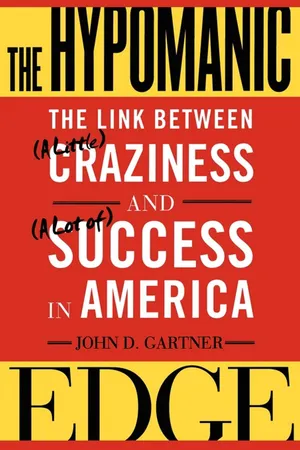
eBook - ePub
The Hypomanic Edge
The Link Between (A Little) Craziness and (A Lot of) Success in America
- 368 pages
- English
- ePUB (mobile friendly)
- Available on iOS & Android
eBook - ePub
The Hypomanic Edge
The Link Between (A Little) Craziness and (A Lot of) Success in America
About this book
Information
Table of contents
- Cover Page
- Title Page
- Copyright Page
- Dedication
- Contents
- Introduction: The Hypomanic American
- I Christopher Columbus: Messianic Entrepreneur
- II Winthrop, Williams, and Penn: Prophets Prosper in the Land of Promised Lands
- III Alexander Hamilton: Father of Our Economy
- IV Andrew Carnegie: Industrial Revolutionary
- V The Selznicks and the Mayers: A Hollywood Family
- VI Craig Venter: Playing God
- Conclusion: Hypomania’s Past and Future
- Appendix
- Notes
- Bibliography
- Acknowledgments
- Index
- Illustration Credits
Trusted by 375,005 students
Access to over 1.5 million titles for a fair monthly price.
Study more efficiently using our study tools.
Frequently asked questions
Yes, you can cancel anytime from the Subscription tab in your account settings on the Perlego website. Your subscription will stay active until the end of your current billing period. Learn how to cancel your subscription
No, books cannot be downloaded as external files, such as PDFs, for use outside of Perlego. However, you can download books within the Perlego app for offline reading on mobile or tablet. Learn how to download books offline
Perlego offers two plans: Essential and Complete
- Essential is ideal for learners and professionals who enjoy exploring a wide range of subjects. Access the Essential Library with 800,000+ trusted titles and best-sellers across business, personal growth, and the humanities. Includes unlimited reading time and Standard Read Aloud voice.
- Complete: Perfect for advanced learners and researchers needing full, unrestricted access. Unlock 1.5M+ books across hundreds of subjects, including academic and specialized titles. The Complete Plan also includes advanced features like Premium Read Aloud and Research Assistant.
We are an online textbook subscription service, where you can get access to an entire online library for less than the price of a single book per month. With over 1.5 million books across 990+ topics, we’ve got you covered! Learn about our mission
Look out for the read-aloud symbol on your next book to see if you can listen to it. The read-aloud tool reads text aloud for you, highlighting the text as it is being read. You can pause it, speed it up and slow it down. Learn more about Read Aloud
Yes! You can use the Perlego app on both iOS and Android devices to read anytime, anywhere — even offline. Perfect for commutes or when you’re on the go.
Please note we cannot support devices running on iOS 13 and Android 7 or earlier. Learn more about using the app
Please note we cannot support devices running on iOS 13 and Android 7 or earlier. Learn more about using the app
Yes, you can access The Hypomanic Edge by John D. Gartner in PDF and/or ePUB format, as well as other popular books in Business & Business Biographies. We have over 1.5 million books available in our catalogue for you to explore.