
- 356 pages
- English
- ePUB (mobile friendly)
- Available on iOS & Android
eBook - ePub
Calculations
About this book
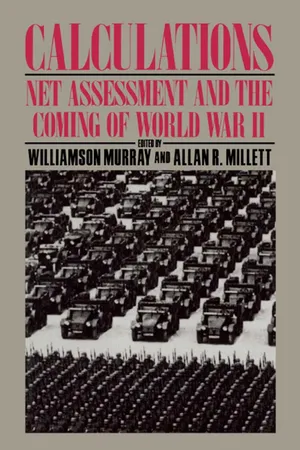
Eight scholars - Alan R. Millett, Paul Kennedy, Earl F. Ziemke, Alvin D. Coox, Williamson Murray, Brian Sullivan, Steven Ross and Calvin L. Christman - examine the methods used by the major powers of World War II to evaluate their own and their enemies' military capacity.
Frequently asked questions
Yes, you can cancel anytime from the Subscription tab in your account settings on the Perlego website. Your subscription will stay active until the end of your current billing period. Learn how to cancel your subscription.
No, books cannot be downloaded as external files, such as PDFs, for use outside of Perlego. However, you can download books within the Perlego app for offline reading on mobile or tablet. Learn more here.
Perlego offers two plans: Essential and Complete
- Essential is ideal for learners and professionals who enjoy exploring a wide range of subjects. Access the Essential Library with 800,000+ trusted titles and best-sellers across business, personal growth, and the humanities. Includes unlimited reading time and Standard Read Aloud voice.
- Complete: Perfect for advanced learners and researchers needing full, unrestricted access. Unlock 1.4M+ books across hundreds of subjects, including academic and specialized titles. The Complete Plan also includes advanced features like Premium Read Aloud and Research Assistant.
We are an online textbook subscription service, where you can get access to an entire online library for less than the price of a single book per month. With over 1 million books across 1000+ topics, we’ve got you covered! Learn more here.
Look out for the read-aloud symbol on your next book to see if you can listen to it. The read-aloud tool reads text aloud for you, highlighting the text as it is being read. You can pause it, speed it up and slow it down. Learn more here.
Yes! You can use the Perlego app on both iOS or Android devices to read anytime, anywhere — even offline. Perfect for commutes or when you’re on the go.
Please note we cannot support devices running on iOS 13 and Android 7 or earlier. Learn more about using the app.
Yes, you can access Calculations by Allan R. Millett, Williamson Murray in PDF and/or ePUB format, as well as other popular books in History & 20th Century History. We have over one million books available in our catalogue for you to explore.
Information
Notes
1. Net Assessment on the Eve of World War II
1. Sun Tzu, The Art of War, trans. Samuel B. Griffith II, rev. ed. (New York and London, 1963), p. 71.
2. The implications of “chaos theory” for the social sciences are beginning to emerge. It is interesting to note that economists have initially proved receptive to this line of mathematical inquiry, while political scientists have largely ignored its implications, perhaps because most economists have solid mathematical training. The same cannot be said for most political scientists.
3. Astonishingly, with all the ink spilt over the Munich crisis, only one author in English has attempted to calculate the actual correlation of forces. See Williamson Murray, The Change in the European Balance of Power, 1938-1939 (Princeton, NJ; 1984).
4. For an egregious example of the confusion that can result from reading too many documents on one side of the balance, see Robert J. Young, In Command of France: French Foreign Policy and Military Planning, 1933-1940 (Cambridge, MA, 1978). Young attempts to rehabilitate the reputations of General Maurice Gamelin and the French high command by placing most of the blame for the 1940 disaster on the shoulders of civilian leaders.
5. Again the Munich crisis provides examples. On the side of those who have argued that Britain and France could easily have won a war against Germany in 1938, see the analysis in Telford Taylor, Sword and Swastika (Chicago, 1969), p. 223. For an analysis of how Chamberlain “saved” Britain at Munich that posits a chain of events running in a pattern similar to those of the 1939 conflict and then argues that Fighter Command could not have defended the British Isles against the Luftwaffe in summer 1939, see Keith Eubank, Munich (Norman, OK, 1963).
6. With the exceptions of MacGregor Knox, Paul Kennedy, Holger Herwig, and John Erickson, the essays in Ernest R. May (ed.), Knowing One’s Enemies: Intelligence Assessment Before the Two World Wars (Princeton, NJ, 1984), rarely move beyond national intelligence organizations to the process of national net assessment.
7. In terms of the present-day analysis of intelligence organizations it is worth noting that the Defense Intelligence Agency by law cannot study “blue” forces but instead only calculates “red” strength. Consequently it is incapable of estimating the Soviet “correlation of forces”; obviously it cannot engage in any coherent effort at net assessment.
8. Paul M. Kennedy, “Great Britain Before 1914,” in May, Knowing One’s Enemies, p. 194.
9. Williamson Murray and Barry Watts, “Net Assessment,” a memorandum for Dr. Andrew Marshall, Director of Net Assessment, Office of the Secretary of Defense, 1987.
10. Kenneth Macksey, Tank Warfare (New York, 1981), pp. 70-107; Field Marshal Lord Carver, The Apostles of Mobility: The Theory and Practice of Armoured Warfare (New York, 1979), pp. 31-54.
11. Ernest R. May, “Capabilities and Proclivities,” in May, Knowing One’s Enemies, pp. 503-42.
12. For our analysis of net assessment in the 1930s, we have relied principally on the essays in this study but also upon our earlier edited work: Allan R. Millett and Williamson Murray (eds.), Military Effectiveness, 3 vols. (London and Boston, 1988). The observations on current organization theory are drawn from Paul S. Goodman, Johannes M. Pennings, and associates, New Perspectives on Organizational Effectiveness (San Francisco and London, 1977), and Jay M. Shafritz and Philip H. Whitbeck (eds. and comps.), Classics of Organization Theory (Oak Park, IL, 1978).
13. In addition to our own judgments, we have profited by a memorandum, “Conclusions and Reflections,” drafted by one of our authors, Professor Paul Kennedy of Yale University, in 1988.
2. British “Net Assessment” and the Coming of the Second World War
1. For details of the British system, see John Ehrman, Cabinet Government and War, 1890-1940 (Cambridge, UK, 1958); N. H. Gibbs, Grand Strategy, vol. 1, Rearmament Policy (London, 1976), ch. 20; Franklyn A. Johnson, Defense by Committee: The British Committee of Imperial Defence, 1885-1959 (London, 1960).
2. Ronald Robinson and John Gallagher, with Alice Denny, Africa and the Victorians: The Official Mind of Imperialism (London, 1961), pp. 19-20 and passim.
3. This refers to my critique in Paul Kennedy, The Realities Behind Diplomacy: Background Influences on British External Policy, 1865-1980 (London, 1981), pp. 59-65, 236-57.
4. Apart from Ehrman, Cabinet Government, see Donald C. Gordon, The Dominion Partnership in Imperial Defence, 1870-1914 (Baltimore, 1965).
5. The literature on this point is summarized in Kennedy, Realities Behind Diplomacy, chs. 1 and 2, and Aaron Friedberg, The Weary Titan (Princeton, NJ, 1989).
6. Ehrman, Cabinet Government and War, traces these developments, as does Gibbs, Grand Strategy, vol. 1, ch. 20.
7. Correlli Barnett, The Collapse of British Power (London and New York, 1972), provides a good account of these procedures. There is also a useful summary in Williamson Murray, The Change in the European Balance of Power, 1938-1939 (Princeton, NJ, 1984), ch. 2.
8. The Secret Intelligence Service’s flow of information, by contrast, was much more uneven. See Francis H. Hinsley et al., British Intelligence in the Second World War, vol. 1 (London, 1979), chs. 1 and 2.
9. See Public Record Office, London (hereafter, PRO), War Office (hereafter, WO) 106/5422, “Visit to German Tank Corps by Military Attaché Berlin” (1938); note by Captain Vivian, “Difficulties Encountered by the Naval Attaché in Tokyo in Visits to Naval and Industrial Establishments,” 1936, cited in Wesley K. Wark, “In Search of a Suitable Japan: British Naval Intelligence in the Pacific Before the Second World War,” Intelligence and National Security, 1, no. 2 (May 1986): 189-211.
10. Wesley K. Wark, “Three Military Attachés at...
Table of contents
- Cover Page
- Title Page
- Contents
- Net Assessment on the Eve of World War II
- British “Net Assessment” and the Coming of the Second World War
- Net Assessment in Nazi Germany in the 1930s
- The Impatient Cat Assessments of Military Power in Fascist Italy 1936 1940
- French Net Assessment
- Soviet Net Assessment in the 1930s
- Franklin D Roosevelt and the Craft of Strategic Assessment
- Japanese Net Assessment in the Era Before Pearl Harbor
- Notes
- About the Contributors
- Index