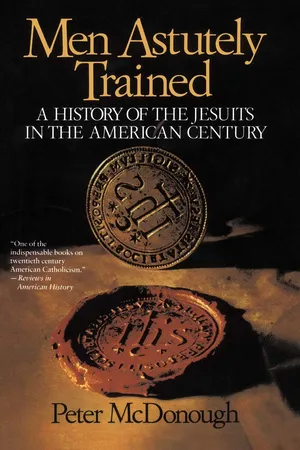
Men Astutely Trained
eBook - ePub

Men Astutely Trained

A History of the Jesuits in the American Century

  1. 656 pages
  2. English
  3. ePUB (mobile friendly)
  4. Available on iOS & Android
eBook - ePub

Men Astutely Trained

A History of the Jesuits in the American Century

About this book

A perceptive & provocative analysis of the transformation that swept through American Catholicism in the decades leading up to Vatican II. The Jesuits have been the carriers of a culture borne along by a fruitful & often frustrating tension between their dual commitment to ancient virtues & to the pursuit of the free play of ideas. This book explains developments among the Jesuits and sets them in the larger context of the sea-changes that shook the world and the Catholic Church in the world during the mid-20th century.
Frequently asked questions

Yes, you can cancel anytime from the Subscription tab in your account settings on the Perlego website. Your subscription will stay active until the end of your current billing period. Learn how to cancel your subscription.
No, books cannot be downloaded as external files, such as PDFs, for use outside of Perlego. However, you can download books within the Perlego app for offline reading on mobile or tablet. Learn more here.
Perlego offers two plans: Essential and Complete
  • Essential is ideal for learners and professionals who enjoy exploring a wide range of subjects. Access the Essential Library with 800,000+ trusted titles and best-sellers across business, personal growth, and the humanities. Includes unlimited reading time and Standard Read Aloud voice.
  • Complete: Perfect for advanced learners and researchers needing full, unrestricted access. Unlock 1.4M+ books across hundreds of subjects, including academic and specialized titles. The Complete Plan also includes advanced features like Premium Read Aloud and Research Assistant.
Both plans are available with monthly, semester, or annual billing cycles.
We are an online textbook subscription service, where you can get access to an entire online library for less than the price of a single book per month. With over 1 million books across 1000+ topics, we’ve got you covered! Learn more here.
Look out for the read-aloud symbol on your next book to see if you can listen to it. The read-aloud tool reads text aloud for you, highlighting the text as it is being read. You can pause it, speed it up and slow it down. Learn more here.
Yes! You can use the Perlego app on both iOS or Android devices to read anytime, anywhere — even offline. Perfect for commutes or when you’re on the go.
Please note we cannot support devices running on iOS 13 and Android 7 or earlier. Learn more about using the app.
Yes, you can access Men Astutely Trained by Peter Mcdonough in PDF and/or ePUB format, as well as other popular books in History & World History. We have over one million books available in our catalogue for you to explore.

Information

Publisher
Free Press
Year
2008
eBook ISBN
9781439106082
Topic
History
Index
History

PART ONE

Ordina quest’amore, O tu che m’ami.
—Jacopone da T’odi
The towns of French Lick and West Baden nestle together in the Cumberland foothills on the Indiana side of the border with Kentucky, sixty miles northwest of Louisville. Toward the end of the eighteenth century, while chasing Indians in the area, the explorer George Rogers Clark came across bison trails that led to salt traces and mineral springs. By the middle of the nineteenth century a local entrepreneur was bottling “Pluto Water” in homage to the god of the underworld. Nowadays the street that runs south from the grounds of the French Lick Springs Golf and Tennis Resort bears the name Larry Bird Boulevard, in honor of the town’s favorite son. There is an ice cream and soda shop across the way.
About a mile up Broadway Boulevard, just off Highway ISO, stands a colossal round building that was once the West Baden Springs Hotel. From the turn of the century until the Great Depression, the structure was touted as the eighth wonder of the world. It was “the Mecca for fun and pleasure in the Midwest.” Al Capone and his entourage frequented the casino. The Monon Railway had summer runs from Chicago, Indianapolis, St. Louis, Cincinnati, and other towns and cities in the region to cater to the vacation crowds. The Cubs and the White Sox used the resort area for spring training.
“The principal feature of the hotel,” reads a local history, “is the Grand Rotunda, with the largest and finest promenade in the world. This immense Rotunda is covered by a glass and steel dome 200 feet in diameter, having an inner circumference of 600 feet, the center of the dome being 130 feet from the ground. This dome has the distinction of being positively the largest ever constructed in the world.”1 The rotunda, fitted with statuary, fountains, and tropical plants, was flooded during the day with a northern glow, and at twilight the building took on the aspect of Xanadu, set in the heartland of America.
Over Labor Day weekend in 1943 more that two hundred Jesuits from across the United States convened under the dome at West Baden. By that time the old hotel had been the property of the Society of Jesus, in use as a seminary, for nine years. Although a good many resolutions were passed, the Indiana meeting itself did not produce great changes in the Society of Jesus. The significance of the West Baden gathering was that it lay at the watershed of seminal events and social changes that ultimately transformed the order. The social and intellectual aftermath of World War II pushed the Jesuits into unexplored territory—in the direction, as it happened, of the Second Vatican Council.2
For more than a decade a scattering of Jesuits had been engaged in “the social apostolate.” Their efforts had been improvisational, the results uneven. The objective now was to pull ideas and resources together. The times were pivotal, yet the leadership of the society was unsettled. Wlodimir Ledochowski, the Polish aristocrat who had governed the society since World War I, had died in 1942, and the war prevented the calling of a congregation of Jesuits to select a new leader. During the interim, until 1946, the American Jesuits were managed by the “American assistant,” the Very Reverend Zacheus Macher, a dour Californian who had directed the growth of the University of Santa Clara.3
As recently as 1941 nearly nine million Americans had been out of work. By 1943 full employment was attained. The desolation depicted in The Grapes of Wrath, published in 1941, was replaced by the expansive optimism of the musical Oklahoma!4 Economic depression was vanishing with the war effort, yet the boom in consumption and mobility was still some years away. A few Jesuit colleges and universities, their cash-flow problems aggravated by the draft, feared that with so many men in uniform they would not be able to survive the drop in enrollments if hostilities lasted much longer. This led them to reconsider their prohibition against admitting women.
For the most part, however, the massive institutional and demographic changes that came to be identified with the postwar boom remained pent up. Anticipation ran high. Immigration to the United States had crested just prior to World War I. By World War II many immigrants and their children had weathered the depression and were approaching prosperity. Almost imperceptibly the social bases of enclave Catholicism and with it the subculture of the ethnic ghettos were beginning to slip away.5
Nineteen forty-three was also the year of Divino afflante Spiritu. An encyclical drafted by the German Jesuit Augustin Bea, this document opened the way to Catholics for critical and historical study of biblical texts, an enterprise in which Protestants had been engaged for nearly a century.6 It prepared the intellectual ground for the aggiornamento that was to take place twenty years later. The next year, in Pius XII’s Christmas address, a pope for the first time extolled the virtues of democracy.7
Except for the likelihood of a surge in enrollments once the war was over, it was scarcely possible to foresee what was to come. Memories of economic hardship were vivid, and Jesuits lived in a conceptual universe bounded by the categories of scholastic philosophy. Like every “house of formation,” the seminary at West Baden was set in the countryside, a refuge from the lures of the city. Frugality reigned. Only rarely were the men allowed to listen to the radio. Debating tournaments, athletic competitions, and the occasional screening of films brought in from the outside after being vetted by the patres graviores, the senior fathers, served for recreation. The regimen was largely monastic.
Austerity was associated with success. By the standards of the time the Jesuits had done well by their immigrant and postimmigrant clientele. A few of their schools had been hurt by the depression, but almost all of them stayed open. Enrollments held steady or showed modest increases. Except for a downturn attributable to the draft, the number of Jesuits had grown, not spectacularly but with comforting regularity. At the time of the West Baden meeting there were approximately 4,500 Jesuits in the United States, slightly more than half the number which the American branch of the order would reach at its peak in 1965. The scale of operations was small. The pace of change was slow, or so it would come to seem.
A system of high schools, colleges, and universities, spread through the United States, overshadowed the lesser activities of the American Jesuits. Social ministry made up a miniscule portion of their work. The marginality of this line of activity was not without advantages. Precedent came in isolated fragments rather than as a seamless tradition. One strand of experimentation was made up of a miscellany of initiatives—the Jesuit schools of social work in Manhattan and on the North Shore of Chicago, and later in Boston and St. Louis, parish work among immigrants in East Coast and Midwest cities, chaplaincies in prisons and hospitals—some dating back to the turn and the early decades of the century, and a few to the century before.
Professional schools like those at Fordham were quickly integrated into the Jesuit educational establishment. In exchange for the training they provided, these faculties became cash-cows for the universities in which they were located. The market in social services and the need for personnel trained in these areas burgeoned during the depression. Within the order, however, the professional schools did not have the prestige of the liberal arts colleges. Though few Jesuits worked in them except for the obligatory deans, they enjoyed more respect than chaplaincies and parish chores, which were plainly incidental to the thrust of the society. The schools “belonged” and their activities added up; revenues were generated and graduates were produced.8
Another influence on the Jesuits’ ventures in social ministry was formal and more centralized. It came from Europe, filtered through Rome, in papal encyclicals about the social question, in response to the rise of fascism and communism on the continent and toward the East. The schools of social work in the United States arose out of local conditions and were created by enterprising Jesuits who recognized the demand for training in the new white-collar occupations. They taught practical skills, and they were eclectic triumphs of institution building. The legacy of Catholic social thought, codified in Rome, was ambitious in a different way. Its agenda was ideological as well as practical. The social encyclicals envisioned an intellectual and educational project that rose above training and implementation and aimed at shaping policy. In Europe this meant working through churchsponsored organizations—Catholic trade unions, Christian Democratic parties. Catholic action groups—that had virtually no equivalent in the United States. It was revulsion at the idea of communism, which rivaled Catholicism in its claim to totality, and a distaste for the vulgarities of capitalism that drove this counterattack.
The dream of a political economy that was distinctively Catholic and that offered an alternative to capitalism and communism entered the United States from continental Europe during the mid-thirties in the guise of an attempt by the Jesuits to introduce a blueprint for a “Christian social order.” The effort, taken seriously by few American Jesuits and understood by hardly any, all but died in the planning stage. It was resuscitated in the early forties with the establishment of the Institute of Social Order, an operation the Jesuits hoped would combine social philosophy, propaganda, and action. This was the grand design the assembly at West Baden was called to inaugurate.
Then there were the labor schools. These stood apart from the faculties of social service and, to a degree, from the Institute of Social Order. They emerged in the latter half of the thirties, in the New York area, in Philadelphia, and in a scattering of other places such as Kansas City, Missouri, near Jesuit colleges or high schools, offering night courses to workers who were about to organize industrial unions under the facilitating legislation of the New Deal.
The labor schools were organizational curiosities. Some proved to be useful and fairly durable. Unlike the schools of social work, they were not spontaneous developments. Unlike the Institute of Social Order, they went their own decentralized way. They came into being at the urging of a papacy worried about the communist menace and anxious not to repeat in America the often-antagonistic relationship with working-class militants that had characterized church-labor dealings in nineteenth-century Europe. Jesuits saw themselves as competing with communist organizers for the loyalty of at least the Catholic share of the urban working class. But they could not bring themselves to mount a coordinated crusade. The labor schools were pretty much one-man shows, run by generally flinty Jesuits impatient with theory, usually imbued with anticommunism, and irritated by their low standing vis-à-vis the society’s accredited educational institutions. They were mostly ignored as well by their European brethren, who shared their anticommunism but who were baffled by the political terrain on which the church stood in the United States.
The decades preceding World War II revealed two partly disparate trends to Jesuits with an eye on social problems in the United States. The Catholic population increased enormously on the wave of immigration and the undercurrent of high birthrates. But especially during the thirties, Catholics, most of whom belonged to the working class, suffered economically.
The social work faculties, the Institute of Social Order, the labor schools-not to mention the schools “of commerce and finance” that were precursors of business administration departments—and the law schools were all geared toward accommodation, of a kind, with industrial society. There were practically no social incendiaries among the Jesuits then. Yet many Jesuits resisted a wholehearted embrace of industrial capitalism. Some kept their distance on progressive grounds. They were Roosevelt Democrats for whom the principles of laissez-faire economics were tied to Protestant individualism. Some were leery of a government that provided a modicum of welfare but that threatened to intrude on the prerogatives of the church. Others went in a different direction, toward the past. For them the object of criticism became industrial society itself. They dreamed of a return to selfsufficient farm communities.
The prose poems in which some of these idylls were described made them out to look more like European fiefdoms than frontier patches and homesteads cleared and settled by an American yeomanry. But the arcadian imagery was not wholly fanciful. Through the thirties, the Rose Hill neighborhood in which Fordham had been established in the Bronx was still semirural, before the boulevards and other monuments to urban planning had been set in-place; and as late as the twenties, before the subway lines made development profitable, much of Brooklyn was exurban scrub and potato and onion fields.99 The pastoral evocations also touched off reminiscences, sentimentalized but not so distant, of “happy times among our own” in the misty vales of Ireland.1
Nonetheless the shrinking of the rural sector as a way of life was undeniable. The few Jesuits who persisted in this vision found themselves in the company of aesthetes and reactionary diehards without political influence.1 What was infinitely less clear by the early forties was the future trajectory of the new industrial society. Full employment was a welcome surprise but presumably transient. The Jesuits at West Baden met in anticipation of renewed class conflict once the wartime boom was over. The divisions between rural and urban sectors had subsided; the United States had become an urban nation. But antagonisms between capital and labor were expected to resurface.
If there was a common assumption among Jesuits who thought about such matters, it was that the working class, like the Catholic community itself, would continue to grow. The subculture would expand without becoming diluted. Postwar prosperity and the assimilation it fashioned undid this expectation. For the time being, however, the overlap between workingclass status and Catholicism allowed socially concerned Jesuits to get a hearing that the busy and politically not-very-conscious majority of their peers might not otherwise have given them.
Three other developments—mostly nontrends before the forties, since the movements looked infinitesimal then—turned out to affect the American Jesuits powerfully after the war.1 One was the increase in white-collar occupations, especially the service sector. Another was the related acceleration in the growth of higher education. The enactment of the GI Bill spurred an upsurge in college matriculation. The rapidly increasing proportion of Catholics attending colleges and universities, from a pool that was also growing in absolute size, placed enormous strains on the Jesuits.
A third trend was the growth of female participation in the work force. Immediately after the cessation of hostilities, many women returned to full-time housekeeping in an apparent restoration of the antebellum balance. But the long-term trend was upward, and it picked up speed two decades after the war.1
These changes transformed the socioeconomic composition of the Catholic community and the bases of family structure. They shifted the focus of social concern from the transition to industrialism, and from the struggle between management and labor, toward a panoply of other controversies. Issues that had been taken as private became matters of public dispute. Democratization cut into the household and into the church. Political currents coursing through the society at large worked their way into the interior of the Society of Jesus.
But this is to get ahead of the story. In 1943 such changes lay in an unimaginable future.

CHAPTER 1
Parishes, Prisons, and
Schools of Social Work

I

Hell’s Kitchen on the West Side of midtown Manhattan was among the rowdiest of the Irish neighborhoods—Red I look by the Gowanus Canal in Brooklyn was another—clustered in the cities on the Eastern Seaboard during the nineteenth and through much of the twentieth century. A few Jesuits, apparently no more than three, led by William Stanton, set up temporary residence near the district in the 1890s. The expedition took place soon after Leo XIII had issued the first of the major encyclicals on the social question. Among Protestant ministers, stirrings of the social gospel were already evident, and journalists had for some time been publicizing the horrors of the slums crammed with immigrants.1
The Jesuits’ foray was...

Table of contents

  1. Cover Page
  2. Title Page
  3. Dedication Page
  4. Contents
  5. Preface
  6. Introduction
  7. PART ONE
  8. PART TWO
  9. Notes
  10. Index