- 241 pages
- English
- ePUB (mobile friendly)
- Available on iOS & Android
eBook - ePub
Idea Of Civil Society
About this book
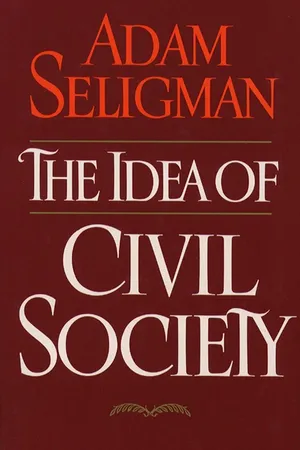
As the countries of East-Central Europe struggle to create liberal democracy and the United States and other Western nations attempt to rediscover their own tarnished civil institutions, Adam Seligman identifies the neglect of the idea of "civil society" as a central concern common to both cultures today. Two centuries after its origins in the Enlightenment, the idea of civil society is being revived to provide an answer to the question of how individuals can pursue their own interests while preserving the greater good of society and, similarly, how society can advance the interests of the individuals who comprise it. However, as Seligman shows, the erosion of the very moral beliefs and philosophical assumptions upon which the idea of civil society was founded makes its revival much more difficult than is generally recognized.
Frequently asked questions
Yes, you can cancel anytime from the Subscription tab in your account settings on the Perlego website. Your subscription will stay active until the end of your current billing period. Learn how to cancel your subscription.
At the moment all of our mobile-responsive ePub books are available to download via the app. Most of our PDFs are also available to download and we're working on making the final remaining ones downloadable now. Learn more here.
Perlego offers two plans: Essential and Complete
- Essential is ideal for learners and professionals who enjoy exploring a wide range of subjects. Access the Essential Library with 800,000+ trusted titles and best-sellers across business, personal growth, and the humanities. Includes unlimited reading time and Standard Read Aloud voice.
- Complete: Perfect for advanced learners and researchers needing full, unrestricted access. Unlock 1.4M+ books across hundreds of subjects, including academic and specialized titles. The Complete Plan also includes advanced features like Premium Read Aloud and Research Assistant.
We are an online textbook subscription service, where you can get access to an entire online library for less than the price of a single book per month. With over 1 million books across 1000+ topics, we’ve got you covered! Learn more here.
Look out for the read-aloud symbol on your next book to see if you can listen to it. The read-aloud tool reads text aloud for you, highlighting the text as it is being read. You can pause it, speed it up and slow it down. Learn more here.
Yes! You can use the Perlego app on both iOS or Android devices to read anytime, anywhere — even offline. Perfect for commutes or when you’re on the go.
Please note we cannot support devices running on iOS 13 and Android 7 or earlier. Learn more about using the app.
Yes, you can access Idea Of Civil Society by Adam Seligman in PDF and/or ePUB format, as well as other popular books in Business & Business General. We have over one million books available in our catalogue for you to explore.
Information
Notes

Introduction
1. Charles Taylor, “Modes of Civil Society,” Public Culture, vol. 3, no. 1 (Fall 1990), pp. 95-118; Edward Shils, “The Virtues of Civil Society,” Government and Opposition, vol. 26, no. 2. (Winter 1991), pp. 3-20; Edward Shils, “Was ist eine Civil Society?” in K. Michelski (ed.), Europa und die Civil Society (Stuttgart: Kult-Cota, 1991), pp. 13-52; Michael Waltzer, “The Idea of Civil Society,” Dissent, Spring 1991, pp. 293-304; Daniel Bell, “American Exceptionalism Revisited: The Role of Civil Society,” The Public Interest, no. 95 (1989), pp. 38-56.
2. Bell, “American Exceptionalism Revisited,” p. 56.
3. Vladimir Tismaneanu, Reinventing Politics: Eastern Europe After Communism (New York: Free Press, 1992).
4. The most complete explication of John Keane’s own views on the idea of civil society is to be found in his volume of essays, Democracy and Civil Society (London: Verso, 1988).
5. Karl Marx, “On the Jewish Question” Collected Works, vol. 3 (Moscow: Progress Publishers, 1975), p. 154.
6. See John Keane, “Despotism and Democracy,” in his Civil Society and the State (London: Verso, 1988), pp. 35-72, as well as Norberto Bobbio, “Gramsci and the Concept of Civil Society,” pp. 73-100 in the same volume. See also Bell, “American Exceptionalism Revisited.”
7. Marcel Mauss, “A Category of the Human Mind: The Notion of Person, the Notion of ‘Self’,” In Marcel Mauss, Sociology and Philosophy (London: Routledge & Kegal Paul, 1979), pp. 85-89; Max Weber, Economy and Society, vol. 2 (Berkeley: University of California Press, 1978), p. 1209.
8. Richard Sennett, The Fall of Public Man (New York: Knopf, 1977).
9. For only one of the more recent examples of this popularity, see Proceedings of the 1991 Annual Convention of the Hungarian Sociological Association, June 24-28, “Magyarország A Világban” (Hungary in the World) in which 42 of the participants presented papers on the idea of civil society.
10. Many of these themes are addressed in the essays compiled by Charles Maier (ed.), Changing Boundaries of the Political (Cambridge: Cambridge University Press, 1987).
11. Carole Pateman, “The Fraternal Social Contract,” in Keane, Civil Society, pp. 101-28.
12. Peter Singer, Animal Liberation (New York: Avon Books, 1975); T. Reagan, The Case for Animal Rights (Berkeley: University of California Press, 1983).
13. Max Weber, “Social Psychology of World Religions,” in H. H. Gerth and C. W. Mills (eds.) From Max Weber: Essays in Sociology (Oxford University Press, 1958), p. 281.
CHAPTER 1 The Modern Idea of Civil Society
1. A good comparative analysis of contract theories in this period can be found in Hermann Klenner, “Social Contract Theories in a Comparative Perspective,” Law and Society (Tokyo: Wasada University Press, 1988), pp. 49-68.
2. By referring to the idea of civil society as an ethical representation of society, I mean something very much along the same lines as Eric Voleglin’s “self-illumination of society,” through which society is represented to its constitutive members as an expression of their “human essence.” On this concept see Eric Voeglin, The New Science of Politics (Chicago: University of Chicago Press, 1952), esp.. ch. 1.
3. The Defensor Pacis of Marsilius of Padua, ed. C.W. Previte-Orton (Cambridge, 1928).
4. George Sabine, A History of Political Thought (New York: Rinehart & Winston, 1950), pp. 141-51.
5. Sheldon Wohlin, Politics and Vision (Boston: Little, Brown & Co., 1960), pp. 69-82.
6. P. Stein, “Roman Law,” in J. H. Burns (ed.), The Cambridge History of Medieval Political Thought c. 350-1450 (Cambridge: Cambridge University Press, 1988), pp. 37-50; C. McIlwain, The Growth of Political Thought in the West (New York: Macmillan, 1932).
7. Cicero, The Republic, III, 7, cited in Sabine, History of Political Thought, p. 164.
8. R. Markus, “The Latin Fathers,” pp. 92-122 in Burns (ed.), Cambridge History, esp. pp. 97, 99-100, 111.
9. R. Carlyle, A History of Medieval Political Theory in the West, 6 vol. (Edinburgh: Blackwood, 1936), vol. 2, 102-13.
10. Ernst Troeltsch, The Social Teachings of the Christian Churches, 2 vols. (New York: Macmillan, 1931), vol. 1, pp. 150-58.
11. Cited in Jaroslav Pelikan, The Christian Tradition: A History of the Development of Dogma, 4 vols. (Chicago: University of Chicago Press, 1971), vol. 3, p. 74.
12. Troeltsch, Social Teachings, vol. 1, p. 262.
13. Ibid., pp. 260-61.
14. Ibid., p. 266.
15. Richard Tuck, Natural Rights Theories (Cambridge: Cambridge University Press, 1979), pp. 32-44.
16. Quentin Skinner, The Foundations of Modern Political Thought, 2 vols. (Cambridge: Cambridge University Press, 1978), vol. 2, pp. 339-42.
17. Tuck, Natural Rights, p. 42.
18. See Otto Gierke, Natural Law and the Theory of Society 500-1800 (Cambridge, 1934).
19. Hugo Grotius, De Jui belli ai pacis, Book I, ch. 1, Section X, p. 1.
20. Ibid., p. 5.
21. Duncan Forber, Hume’s Philosophical Politics (Cambridge: Cambridge University Press, 1975), p. 17.
22. See for example, John Rawls, A Theory of Justice Cambridge, MA: Cambridge University Press, 1971), p. 11.
23. Tuck, Natural Rights, pp. 3, 5, 79, 172-73; John Dunn, The Political Theory of John Locke (Cambridge: Harvard University Press, 1969).
24. Book VII, sct. 89. The authoritative text of Locke’s Treatises is John Locke, Two Treatises of Government, ed. Peter Laslett Cambridge: Cambridge University Press, 1960). This text was not available to me in Budapest while writing this book. Consequently I have identified references by the Book and Section numbers, a practice followed in other cases where the authoritative versions of texts were lacking. In all cases references are to the second treatise.
25. Ibid., Book, VIII, sct. 101.
26. Ibid., Book VII, sct. 87.
27. Ibid., Book II, sct. 4.
28. Ibid., Book II, sct. 6.
29. Dunn, Political Theory, p. 106.
30. Locke, Two Treatises, Book VII, sct. 87.
31. Dunn, Political Theory, p. 127.
32. Locke, Two Treatises, Book XI, sct. 135.
33. Ibid., Book XI, sct. 135.
34. Dunn, Political Theory, p. 103.
35. Ibid., p. 260.
36. Charles Taylor, Sources of the Self: The Making of Modern Identity (Cambridge: Harvard University Press, 1989).
37. Alasdair MacIntyre, Whose Justice, Which Rationality (Notre Dame, IN: University of Notre Dame Press, 1988), p. 268.
38. Adam Ferguson, An Essay on the History of Civil Society, 5th ed. (London, 1782), p. 57.
39. Adam Smith, Theory of Moral Sentiments (Indianapolis: Liberty Classics, 1982), p. 50.
40. Albert Hirschman, The Passions and the Interests (Princeton, NJ: Princeton University Press, 1979), p. 109. See also Nicholas Phillipson, “Adam Smith as Civil Moralist,” in I. Hont and M. Ignatieff (eds.), Wealth and Virtue: The Shaping of Political Economy in the Scottish Enlightenment (Cambridge: Cambridge University Press, 1985, pp. 179-202.
41. Smith, Moral Sentiments, p. 50.
42. Ferguson, Civil Society, p. 52.
43. Ibid., p. 53.
44. Emile Durkheim, “The Dualism of Human Nature and Its Social Condition,” in R. Bellah (ed.), Emile Durkheim on Morality and So...
Table of contents
- Cover Page
- Title Page
- Contents
- The Modern Idea of Civil Society
- The Sources of Civil Society
- Civil Society Citizenship and the Representation of Society
- Jerusalem Budapest Los Angeles
- Concluding Remarks on Civil Society
- Notes
- Index