- 304 pages
- English
- ePUB (mobile friendly)
- Available on iOS & Android
eBook - ePub
Partners In Command
About this book
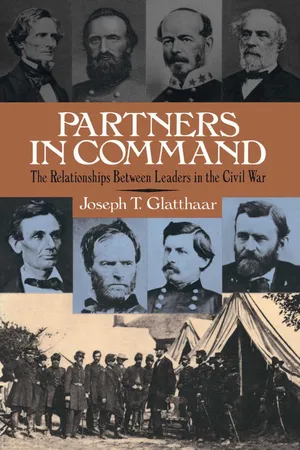
Explores the productive friendships of such contrasting personalities as Grant and Sherman and Robert E. Lee and Stonewall Jackson, bringing to life the struggle between McClellan and Lincoln and Jefferson Davis and Joseph E. Johnston.
Frequently asked questions
Yes, you can cancel anytime from the Subscription tab in your account settings on the Perlego website. Your subscription will stay active until the end of your current billing period. Learn how to cancel your subscription.
No, books cannot be downloaded as external files, such as PDFs, for use outside of Perlego. However, you can download books within the Perlego app for offline reading on mobile or tablet. Learn more here.
Perlego offers two plans: Essential and Complete
- Essential is ideal for learners and professionals who enjoy exploring a wide range of subjects. Access the Essential Library with 800,000+ trusted titles and best-sellers across business, personal growth, and the humanities. Includes unlimited reading time and Standard Read Aloud voice.
- Complete: Perfect for advanced learners and researchers needing full, unrestricted access. Unlock 1.4M+ books across hundreds of subjects, including academic and specialized titles. The Complete Plan also includes advanced features like Premium Read Aloud and Research Assistant.
We are an online textbook subscription service, where you can get access to an entire online library for less than the price of a single book per month. With over 1 million books across 1000+ topics, weâve got you covered! Learn more here.
Look out for the read-aloud symbol on your next book to see if you can listen to it. The read-aloud tool reads text aloud for you, highlighting the text as it is being read. You can pause it, speed it up and slow it down. Learn more here.
Yes! You can use the Perlego app on both iOS or Android devices to read anytime, anywhere â even offline. Perfect for commutes or when youâre on the go.
Please note we cannot support devices running on iOS 13 and Android 7 or earlier. Learn more about using the app.
Yes, you can access Partners In Command by Joseph Glatthaar in PDF and/or ePUB format, as well as other popular books in History & American Civil War History. We have over one million books available in our catalogue for you to explore.
Information
NOTES
Preface and Acknowledgments
1 See James M. McPherson, âLincoln and the Strategy of Unconditional Surrender,â in Abraham Lincoln and the Second American Revolution (New York: Oxford University Press, 1991), pp. 69-70. Definitions for military strategy and operational art are straight from U.S. Department of the Army, Field Manual 100-5, Operations (Washington, DC: U.S. Government Printing Office, 5 May 1986), pp. 9-10, with slight modification. Lecture of COL (Ret) Art Lykke, 24 Sep. 1991 at the U.S. Army War College (USAWC).
Chapter 2. âHe has lost his left arm, but I have lost my rightâ
1 Quoted in Vandiver, Mighty Stonewall, p. 134.
2 Letcher to Lee, 27 Apr. 1861 (The War of the Rebellion: Official Records of the Union and Confederate Armies [hereafter OR], Washington, D.C.: U.S. Government Printing Office, 1880-1901), 1, 2, p. 784. Also see Lee to Jackson, 27 Apr. 1861. OR I, 2, pp. 784-85.
3 For an excellent character analysis of Jackson, see Charles Royster, The Destructive War: William Tecumseh Sherman, Stonewall Jackson, and the Americans (New York: Alfred A. Knopf, 1991). The best biography of Jackson is Frank E. Vandiver, Mighty Stonewall (New York: McGraw-Hill Book Company, 1957). Also see G. F. R. Henderson, Stonewall Jackson and the American Civil War (New York: Longmans, Green and Co., 1949, originally published 1898).
4 Jackson to Lee, 6 and 11 May 1861. OR I, 2, pp. 809-810 and 832. Also see Lee to Jackson, 6 May 1861; Jackson to Lee, 7 May 1861. OR I, 2, pp. 806-807 and 814-15.
5 Lee to Jackson, 9 and 10 May 1861. OR I, 2, 822 and 824-25.
6 Jackson to Johnston, 24 May 1861. OR I, 2, p. 872.
7 Vandiver, p. 152. Also see OR I, 2, pp. 185-86.
8 For a superb study on Jacksonâs first command, see James I. Robertson, Jr., The Stonewall Brigade (Baton Rouge: Louisiana State University Press, 1963).
9 Quotation in John Hennessy, The First Battle of Manassas: An End to Innocence, July 18-21, 1861 (Lynchburg, VA: H. E. Howard, Inc., 1989), pp. 83 and 152; Vandiver, p. 161.
10 Vandiver, p. 166.
11 Quoted in Vandiver, p. 169.
12 See Jackson to Benjamin, 20 Nov. 1861; Johnston to Cooper, 22 Nov. 1861; Benjamin to Loring, 24 Nov. 1861. OR I, 5, pp. 965-69.
13 Taliaferro to Staples, 23 Jan. 1862. Jackson to Johnston, 17 Jan. 1862. OR I, 5, pp. 1042 and 1036. See Chapter 4 for additional information. Jackson no doubt placed the Stonewall Brigade in winter quarters in Winchester not because of favoritism but because he intended to call upon them to reinforce Johnstonâs army against McClellan, and he wanted his best troops in the vanguard. For the charges and specifications against Loring, see OR I, 5, pp. 1065-1066. The War Department transferred Loring out of Virginia.
14 General Orders, No. 14, Adjt. and Insp. Gen.âs Office. 13 Mar. 1862. OR I, 5, p. 1099. Davis to Lee, 2 Mar. 1862. OR I, 5, p. 400. See Abstract from return of the Army of the Potomac for the month of February, 1862. OR I, 5, p. 752.
15 See Douglas Southall Freeman, R. E. Lee: A Biography, 1, (New York: Charles Scribnerâs Sons, 1934), pp. 566-76, 597-98, and 602-604.
16 Fremontâs command actually had approximately 28,000, although 9,000 were outside the campaign area. Lee did not know the precise size of McDowellâs command but believed it to be a substantial force.
17 See Jay Luvaas, âLee and the Operational Art: The Right Place, the Right Time.â Parameters (Autumn, 1992), pp. 2-18, for a marvelous introduction to Lee and the operational art. For an explanation of the operational art of war, see U.S. Department of the Army, Field Manual No. 100-5, Operations (Washington, D.C.: U.S. Government Printing Office, 1986), p. 10.
18 For Hotchkissâs role, see Archie P. McDonald, ed., Make Me a Map of the Valley: The Civil War Journal of Stonewall Jacksonâs Topographer (Dallas: Southern Methodist University Press, 1973).
19 Jackson to Longstreet, 5 Apr. 1862. OR I, 12, 3, p. 844.
20 Lee to Jackson, 25 Apr. 1862. OR I, 12, 3, pp. 865-66. See Jackson to Ewell, 10 Apr. 1862. Lee to Jackson and Lee to Ewell, 21 Apr. 1862. OR I, 12, 3, pp. 845 and 858-60.
21 Lee to Jackson, 1 May 1862. OR I, 12, 3, p. 878. Also see Jackson to Lee, 29 Apr. 1862; Ewell to Lee, 30 Apr. 1862; Jackson to Ewell, 3 and 4 May 1862. OR I, 12, 3, p. 872, 876-79.
22 Quoted in Freeman, Leeâs Lieutenants, 1, p. 355; Jackson to Ewell, 18 May 1862. OR I, 12, 3, p. 897.
23 Lee to Jackson, 16 May 1862. OR I, 12, 3, pp. 892-93. Also see Taylor to Jackson, 14 May 1862. OR I, 12, 3, p. 889.
24 Jackson to Lee, 20 May 1862. OR I, 12, 3, p. 898. Also see Johnston to Ewell and then to Jackson, 17 May 1862. OR I, 12, 3, pp. 896-97; Douglas Southall Freeman, Leeâs Lieutenants: A Study in Command, 1 (New York: Charles Scribnerâs Sons, 1942), p. 371.
25 See Vandiver, pp. 250-55, for a description of the battle.
26 See Vandiver, pp. 268-72 for a clear explanation of Jacksonâs plan and position. At Port Republic, the South Fork of the Shenandoah River splits, becoming the North River and South River.
27 See Vandiver, pp. 275-83. Also see Robert G. Tanner, Stonewall in the Valley: Thomas J. âStonewallâ Jacksonâs Shenandoah Valley Campaign, Spring 1862 (New York: Doubleday & Company, Inc., 1976).
28 Lee to Jackson, 8 and 11 June 1862. OR I, 12, 3, pp. 908 and 910.
29 For the friendship of Stuart and Jackson, see Vandiver, pp. 409-410.
30 Quoted in Vandiver, p. 235. Also see Hill to Stuart, 14 Nov. 1862. James Ewell Brown Stuart Papers, Virginia Historical Society; Robertson, General A. P. Hill, p. 172.
31 One only needs to read letters from Leeâs staff members to notice their inability to grasp the man.
32 See Charles Royster, The Destructive War: William Tecumseh Sherman, Stonewall Jackson, and the Americans (New York: Alfred A. Knopf, 1991), pp. 264-68; and Freeman, fi. E. Lee, II, 440; III, 328, 385, 405, 423-24, 531-32; IV, 118, 194, 220, 297, 402, 483-84, 504-505.
33 Lee to Son, 19 Dec. 1861. R. E. Lee Papers, Duke University. See Royster, The Destructive War, Chapter 2, on Jacksonâs desire to invade the North.
34 Quoted in Freeman, R. E. Lee, II, p. 462.
35 Hill to Stuart, 14 Nov. 1862. James Ewell Brown Stuart Papers, Virginia Historical Society; Robertson, General A. P. Hill, p. 172.
36 Lee to Jackson, 8 and 16 June 1862. OR I, 12, 3, pp. 908 and 913. Also see Lee to Jackson, 11 June 1862. OR I, 12, 3, p. 910.
37 See Vandiver, pp. 293-303; Freeman, Leeâs Lieutenants, pp. 496-502; General Orders, No. 75. HQ, Army of Northern Virginia. 24 June 1862. On I, 11, 2, pp. 498-99.
38 See Vandiver, p. 327.
39 After Action Report (hereafter AAR) of Lee, 18 Apr. ...
Table of contents
- Cover Page
- Half Title Page
- Title Page
- CONTENTS
- PREFACE AND ACKNOWLEDGEMENTS
- The Fabric of War
- âHe has lost his left arm but I have lost my rightâ
- âYou have done your best to sacrifice this Armyâ
- âI cannot direct both parts of my command at onceâ
- âIf I got in a tight place you would comeâif aliveâ
- âI am ready to cooperate with anybody and everybodyâ
- âI cannot spare this man He fights â
- Partners in Command
- APPENDIX MCCLELLANâS TRAGIC FLAWS IN THE LIGHT OF MODERN PSYCHOLOGY
- NOTES
- BIBLIOGRAPHICAL ESSAY
- INDEX