The Responsibility Trap
eBook - ePub

The Responsibility Trap

  1. 288 pages
  2. English
  3. ePUB (mobile friendly)
  4. Available on iOS & Android
eBook - ePub

The Responsibility Trap

About this book

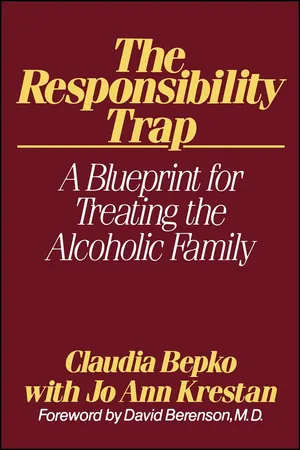
Bepko and Krestan integrate theory and practice in describing the treatment of families with alcohol problems. "This book is the outgrowth of seven years of work in which we have made an attempt to integrate our own understanding of alcoholic dynamics within the framework of systemic family therapy. Since we share both a commitment to the principles of Alcoholics Anonymous, as well as a commitment to approaching problems from a systemic viewpoint, it has always been a source of concern for us that the fields of alcoholism treatment and family therapy seem so polarized in their respective views on the nature of alcoholism as a symptomatic process. Our hope is that this book can provide a bridge between those two viewpoints as well as some new ways of looking at alcoholism that can be clinically useful and relevant to other practitioners." —from The Responsibility Trap
Frequently asked questions

Yes, you can cancel anytime from the Subscription tab in your account settings on the Perlego website. Your subscription will stay active until the end of your current billing period. Learn how to cancel your subscription.
No, books cannot be downloaded as external files, such as PDFs, for use outside of Perlego. However, you can download books within the Perlego app for offline reading on mobile or tablet. Learn more here.
Perlego offers two plans: Essential and Complete
  • Essential is ideal for learners and professionals who enjoy exploring a wide range of subjects. Access the Essential Library with 800,000+ trusted titles and best-sellers across business, personal growth, and the humanities. Includes unlimited reading time and Standard Read Aloud voice.
  • Complete: Perfect for advanced learners and researchers needing full, unrestricted access. Unlock 1.4M+ books across hundreds of subjects, including academic and specialized titles. The Complete Plan also includes advanced features like Premium Read Aloud and Research Assistant.
Both plans are available with monthly, semester, or annual billing cycles.
We are an online textbook subscription service, where you can get access to an entire online library for less than the price of a single book per month. With over 1 million books across 1000+ topics, we’ve got you covered! Learn more here.
Look out for the read-aloud symbol on your next book to see if you can listen to it. The read-aloud tool reads text aloud for you, highlighting the text as it is being read. You can pause it, speed it up and slow it down. Learn more here.
Yes! You can use the Perlego app on both iOS or Android devices to read anytime, anywhere — even offline. Perfect for commutes or when you’re on the go.
Please note we cannot support devices running on iOS 13 and Android 7 or earlier. Learn more about using the app.
Yes, you can access The Responsibility Trap by Claudia Bepko in PDF and/or ePUB format, as well as other popular books in Social Sciences & Global Development Studies. We have over one million books available in our catalogue for you to explore.

PART I
Theoretical Constructs

CHAPTER 1
Alcoholism: A Systemic Perspective

THIS BOOK focuses on the identification and treatment of dynamics that occur in families and in relationships affected by alcoholism. To provide a framework for looking at these problems it is important to clarify how we think about alcoholism, because, ultimately, the way we think about a problem directs what we do about it.
The clinical and etiological aspects of alcoholism are issues that have been debated and researched in great depth and at many levels from many different scientific and sociological perspectives.1 The collective results of this research are as yet inconclusive. Every day new aspects of study, particularly in the areas of neurochemical and biomedical research, seem to suggest different evidence about the very complex and multifaceted dimensions of alcoholic behavior. At present, there exists no unitary or agreed-on definition in the scientific or medical community relative to questions of etiology or clinical progression that are generalizable to all problem drinkers in all situations. Present theories tend to point more to differences than to similarities. The effects of certain patterns of drinking, however, tend to be more predictable and identifiable than their causes, and ultimately, in clinical treatment, it is the effects of drinking behavior to which we must address ourselves. Consequently, instead of asking why a person drinks, we try to understand what changes occur for the individual and those around him when drinking occurs in certain problematic ways.
This particular approach to alcohol problems derives from our orientation as family therapists who operate within the larger framework of general systems theory.
One contribution of systems theory to the mental health field has been to remove our thinking about human behavior from the frame of causality. In systems terms it is more relevant to view complex human behavior from the perspective of interactive process than it is to attempt to identify a specific cause or “reason” for behavior that can be located within a specific individual. Even supposing, for instance, that a genetic or hereditary predisposition exists in a given individual that may render him susceptible to alcohol addiction, numerous other factors in his environment in interaction with that particular biological reality will ultimately affect whether or not he drinks alcoholically.
A systemic perspective on alcoholism suggests that we view alcoholism not as an individual problem but as an interactive one that affects and is affected by interaction and change at many systemic levels.2
While this focus on interaction is our primary context for viewing alcohol problems, we feel that it is equally important to have a basic understanding of the nature of alcoholism as it is defined medically and scientifically because it represents a specific type of symptomatic process. Alcoholism calls for family therapy approaches that may differ from those that are applied to a general range of nonaddictive, interactional, and communication problems in families. Intervention with the family system of an alcoholic may represent necessary, but not sufficient treatment, and it is important for the clinician to integrate many different levels of information and understanding about alcoholic behavior processes and events into her general repertoire of clinical technique.
It is only recently that the family therapy field has begun to acknowledge the need to develop a clinical approach to alcohol-affected families that addresses the specific dynamics set in motion by alcoholic drinking. Peter Steinglass’s comment that “growing research and clinical interest in the alcoholic family has tended to outpace the development of conceptual models useful in viewing alcoholism from a family perspective” (1980:21) speaks to a gap in our understanding of alcoholic dynamics as well as a lack of specific technique that relates to those dynamics. This book represents one attempt to bridge that gap.
The purpose of this chapter is to outline the basic assumptions about alcoholism that direct our treatment and to set the stage for the specific theoretical constructs that follow in chapters 2, 3, and 4. In the interest of conciseness, we assume a basic understanding of both alcoholism and family systems on the reader’s part. We will mention relevant principles only briefly as they relate to our own theoretical constructs.
What Alcoholism Is: Premises and Assumptions
Our primary assumption is that alcoholism represents a systemic, that is, circular process. The behavior of ingesting a psychoactive drug affects and is affected by change and adaptation at many different systemic levels including the genetic, physiological, psychological, interpersonal, and spiritual.
Drinking behavior occurs within a larger social or systemic context; it is shaped by cultural influence and at the same time it represents a type of feedback or commentary about the larger context in which it occurs.
Abuse of alcohol or addiction is a multidetermined phenomenon. Alcohol use may become problematic at different times for different people under different conditions for different reasons. While some patterns are more typical and generalizable, no one set of deterministic or clinical variables holds true for all people who drink.
These assumptions represent our understanding of alcoholism as a process or sequence of events that evolves over time. They do not attempt to explain what causes alcoholism nor do they view alcoholism as a secondary symptom that masks other psychodynamic problems. They suggest that alcoholism is both a cause and an effect of systemic changes that are or become dysfunctional.
Secondly, these assumptions do not speak to the issue of whether or not alcoholism is a disease. This particular question has been the subject of a great deal of controversy and polarization in the mental health field. While the model of classification and progression developed by Jellinek (1960) is generally accepted by most professionals in the alcoholism field as a standard rule of thumb for defining and classifying alcoholism as a distinct disease syndrome, other professionals tend to view alcohol addiction from a more psychological or sociological orientation.
If one accepts the premise that alcoholism is a multilevel phenomenon, it seems clear that the controversy over definition of the problem relates to specific orientations that may define one level of the problem as more dominant than another, and it relates to our capacity to use language in a way that invests certain words with political and psychological power.
If one views the alcoholic process in terms of its effect on human tissue and in terms of the very real organic damage alcohol may cause in the body, alcoholism is certainly a medical problem that has diseaselike effects. If viewed strictly on the level at which addiction represents a compulsive behavior, a more psychologically oriented person may define alcohol abuse as a behavior disorder. Approaching the issue from a holistic perspective, Alcoholics Anonymous defines alcoholism as a “disease of the mind, body, and spirit.” But, whether or not one thinks about the process of alcoholism specifically as a medical disease, it still has diseaselike effects. It does damage to the healthy integration and functioning of an individual and the larger environment at all levels. In its most extreme forms, it is fatal. Certainly, the therapist needs to develop an understanding of appropriate responses to the medical complications always associated with end-stage drinking just as the physician can be of greater help to his patient in the early stages of alcoholic drinking if he understands the more psychological components of the process.
In the sense that it refers to a state of damage, dysfunction, and lack of healthy balance or equilibrium within the individual and within the larger system at many levels, we prefer to use the term disease with respect to alcoholism. It is a word that has a therapeutic psychological valence for our clients when used in a context in which ultimate responsibility for all behavior is assumed to rest with the individual. At the very least, it conveys our belief in the very serious, destructive, and potentially life-threatening effects of a failure to interrupt the process.
Alcoholism as an Interactional Process
We make the assumption that alcoholism constitutes a sequence of interactional events which occur between the drinker and the alcohol, the drinker and himself, and the drinker and others. The physiological and psychological effects of alcohol, over time, set in motion changes that shift the way the drinker interacts with himself and with others in his environment. In turn, interaction with others shapes the way the drinker drinks.
One way that alcoholism or drug abuse differs from most problems treated from a family systems perspective (e.g., schizophrenia) is that it is a behavior which introduces another substance into the informational circuitry affecting a system. The symptomatic individual interacts and exchanges information not only with others in her environment but, in effect, she interacts with the substance as well.
Alcohol is a psychoactive drug with properties that provide mood and behavior altering experiences when ingested into the body. It provides feedback to the drinker in the form of physiological effects that permit certain experiences such as warmth, relaxation, euphoria, and loosening of inhibition. The relationship with the alcohol becomes one in which, at least intermittently, the drinker is given information about himself that is more palatable or acceptable than his experience of himself in a sober state. Consequently, his feeling state is being continually modified by the added dimension of a relationship with a mood altering chemical.
This factor significantly distinguishes systems in which drug or alcohol abuse is a factor from ones in which it isn’t, but more importantly, it adds a dimension of subjective, experiential information that is crucial to the understanding of the disease process.
In other words, when one works with most families with a symptomatic member, the communicational sequences that “surround” or constitute the problem are primarily contained within that family system and the larger contextual structures within which it operates. When the family member is alcohol-involved, however, another dimension of information and communication is introduced into the system—communication based on the distorted feedback about self that one family member receives from her interaction with a substance.
To work effectively with an alcoholic system, it is critical to understand this subjective aspect of the individual’s relationship with alcohol. Both Vernon Johnson (1973) and John Wallace (1977) talk about the individual’s relationship with alcohol as one that is compelling because it is confusing. Johnson indicates that the drink functions initially to cause a shift in self-experience—“the new drinker is on to a good thing. The fact that he can make himself feel better is a real discovery—in due time he knows that when he comes home and feels like this, with one drink he can feel like that” (1973:11). Over time, however, the drinker needs to drink more to achieve the same self-correction, and the more he drinks, the more subtle changes in himself and his environment begin to exact a greater price for his drinking. Increasingly, the effects of drinking become negative, but they are not consistently so, so that the drinker experiences what Wallace refers to as an “epistemological quandary” (1977:7)—he does not know how to know about himself given “the subtly changing perception, feeling, and cognition” (1977:8) and the discontinuity of the experience with the alcohol itself.
Eventually, the behavior that is motivated by an attempt to achieve a corrected experience of self shifts as the drinker experiences the need to correct the negative effects or feedback of the drinking itself. As Johnson says, “the drinker now starts from a position of feeling bad and drinks to try to get to “normal.”
The struggle that Johnson and Wallace describe is one in which the individual uses alcohol to achieve an experience of herself or a “feeling” that appeals to her as more “correct” or comfortable than the one which she experiences in a sober state. This fact presumes that on some level she tells herself that the feeling or experience that she has is not consistent with how she ought to or could feel. In other words, her need or impulse to self-correct is based on certain premises about herself, about who she is and how she “should” be. These premises, of course, are based on interactional feedback received and incorporated from others in her environment. One could argue then that alcohol functions initially to reduce a kind of “cognitive dissonance” in self-experience. In the end, it creates more of that dissonance than it reduces.
Approaching the problem from another systemic level, the anthropologist Gregory Bateson (1972) views this subjective aspect of the relationship with alcohol as directly related to a false set of beliefs about self and about the world that are inherent in the thinking of Western culture. Bateson suggests that the major flaw in the thinking of the alcoholic is a kind of pride—an assertion that one can change, control what one wants to control—as he says, “a repudiation of the proposition, I cannot.” Bateson suggests that the alcoholic’s pride becomes the context for a struggle to achieve domination over self and others (1972:321). The subjective experience of the alcoholic in Bateson’s terms might look something like this:
Joe A takes a drink.
The drink enhances or diminishes some self-perception that reduces Joe’s sense of disharmony with self or others.
Joe takes another drink.
The effect is intensified. Joe comes to feel that he can regulate his emotional status by taking a drink. He gains a false sense of his own power that enables him to feel differently about himself and to operate differently with others.
Joe drinks too much to the point where his attempt to control his own emotional status leads to loss of control. Over time, Joe denies or “forgets” that loss of control and continues to relate to alcohol in such a way that he feels he can regain his “empowered” self by “losing” it to the relationship with the alcohol. He feels equal to the alcohol because he still thinks that he is in control. The more he tries to be in control, the more he loses control to the alcohol. The more he periodically and intermittently loses control and experiences negative feedback about self in terms of the fact that he is out of control, the more he drinks to prove that he is in fact in control. Over time, the singular event of taking the drink becomes a sequence of events in which a fundamental shift occurs in Joe.
In the beginning, according to Bateson’s typologies of relationships,2 Joe relates symmetrically to the alcohol. He feels “equal to it.” Over time, as the consequences of drinking behavior shift his self-perceptions from positive to more negative, and as his views of self are challenged by those around him, he drinks increasingly as a way of asserting his power over the alcohol—that is, his power over himself. The relationship to the alcohol becomes a complementary one at this point in which the alcoholic seeks to assert that he is, in fact, “one-up,” in face of all existing evidence that he is actually “one-down,” or out of control of the relationship. In the initial phase of drinking, when the relationship to the alcohol is experienced as symmetrical, or equal, drinking is an attempt to correct self-perceptions evolved over time during sober states. Eventually, as the perceptions of self become more distorted during the course of the compulsive drinking to correct sober self-perceptions, the alcoholic begins to use the alcohol to correct the corrections—in other words, he drinks more compulsively to change the reality that he is, in fact, out of control of his drinking.
Addiction may be hypothesized to occur at the point where the alcoholic insists that she controls the action of the alcohol instead of experiencing that the action of the alcohol alters or controls her.
In the sense that the person who interacts with alcohol feels and acts one way when he is involved with alcohol, and another way when he isn’t, his experience of self as well as his behavior acquires an oscillating quality. He becomes the Dr. Jekyll/Mr. Hyde so often described by those who relate to alcoholics.
Over time, the oscillations of self-experience become distortions of self-experience prompting the alcoholic to rigidly deny the “sober” aspect of self while insisting that the perceptions and experiences of the drunk state are true representations of self. In the face of mounting negative evidence to the contrary, she denies that the feedback resulting from her interaction with alcohol is now negative rather than positive. She continues to drink in a frantic attempt to achieve self-corrections. Her drinking acquires the nature of a struggle with alcohol to “force” it to provide the perceived “correct” sense of self.
As the alcoholic’s feelings about himself may oscillate from extremes of self-loathing to grandiosity, depression to euphoria, so interactionally, his relationship to alcohol may shift from a symmetrical correction of self-perception to a complementary correction of the one-down status of someone in a relationship who must insist he is one-up (to others) to the alcohol.
Over time, these shifts from one state to the other become more extreme as the alcoholic’s sober behavior increasingly begins to resemble drunk behavior so that the self-perceptions sober and drunk become more alike than different. Eventually, complete breakdown, represented by physical collapse or a succession of extreme consequences for drunkenness, occurs.
The primary characteristic of the interaction between the drinker and the alcohol, then, is the drinker’s attempt to correct or regulate how she feels or experiences herself. She develops assumptions about how she should “be” or feel—as well as the conviction that she can or should change those feelings—from her interactions with others in the environment. In turn, the drinker’s interaction with the alcohol influences the behavior of others toward her.
For instance, if in relationship to person B, person A feels tense, anxious, angry, inadequate, or any other emotion that person A experiences as unacceptable or inadequate based on his perception of how person B experiences him, then one option is in some way to alter behavior or to alter something about the self that gives rise to the discomfort. The classic example of this self-altering or corrective behavior is the person who walks into a social situation feeling tense, anxious, and uncomfortable, and immediately heads for the bar to take a drink. The drink has the effect of correcting tension and shyness, and eventually person or persons B are reacting to a much altered person A who is livelier, more charming, more outgoing and relaxed. A new level of interactional sequences is thus established based on the altering or “corrective” influence of alcohol. Two different versions of person A have attended the party that night—the tense, uncertain and fearful person A, and the corrected, relaxed, “life of the party” person A.
It seems clear that the interactional context in which person A operates both affects and is affected by the process of A’s continued self-corrective drinking. The tense, withdrawn person A progresses to the outgoing, charming person A, who eventually becomes the “passed out” person on the couch. Not only person A’s feelings, responses, and behaviors have been altered during the course of the evening, but the responses and reactions of those relating to A will have been altered as well. By the end of the evening the host who so glibly kept pouring the drinks and who enjoyed A’s quick wit and irreverent humor may eventually become the caretaker who drives him home or otherwise assumes responsibility for his nonfunctional state. Over the course of time, should this sequence of events continue to occur, the relationship between A and the host will be irrevocably altered—the context o...

Table of contents

  1. Cover Page
  2. Title Page
  3. Copyright Page
  4. Dedication
  5. Contents
  6. Foreword by David Berenson, M.D.
  7. Preface
  8. Part I. Theoretical Constructs
  9. Part II. Intervention
  10. Notes
  11. Bibliography
  12. Index