Other Greeks
eBook - ePub

Other Greeks

The Family Farm and the Agrarian Roots of Western

  1. 541 pages
  2. English
  3. ePUB (mobile friendly)
  4. Available on iOS & Android
eBook - ePub

Other Greeks

The Family Farm and the Agrarian Roots of Western

About this book

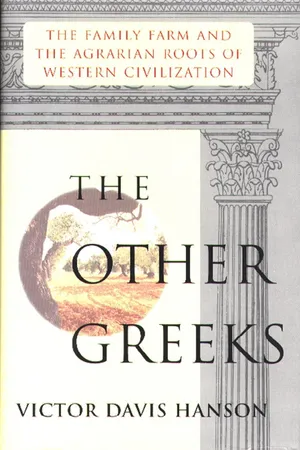
Everyone has been taught that the Greek city-state is the ultimate source of the Western tradition in literature, philosophy, and politics. For generations, scholars have focused on the rise of the city-state and its brilliant cosmopolitan culture. Now Victor Hanson, the author of several studies of ancient warfare and agriculture, has written a book that will completely change our view of Greek society. For Hanson shows that the real "Greek revolution" was not the rise of a free and democratic urban culture, remarkable as this was, but the historic innovation of the independent family farm. The heroes of his book, therefore, are what he calls "the other Greeks" - the neglected freehold farmers, vinegrowers and herdsmen of ancient Greece who formed the backbone of Hellenic civilization. It was these tough-minded, pracitcal, and fiercely independent agrarians, Hanson contends, who gave Greek culture its distinctive emphasis on private property, constitutional government, contractual agreements, infantry warfare, and individual rights.

Hanson's reconstruction of ancient Greek farm life, informed by the hands-on knowledge of the subject (he is a fifth-generation California vine and fruit-grower), is fresh, comprehensive, and totally absorbing. But his detailed chronicle of the rise and tragic fall of the Greek city-state also helps us to grasp the implications of what may be the single most significant trend in American life today - namely, the imminent extinction of the family farm.

Since Thomas Jefferson Hanson points out, American democracy has been though to depend on the virtues that have traditionally been bred on the farm: self-reliance, honesty, skepticism, a healthy suspicion of urban sophistication, and a stern ethic of accountability, which, as the Greeks teach us, have always been the core values of democratic citizenship. Hanson rightly fears the consequences for American democracy when the family farm disappears, taking with it our last links to the agrarian roots of Western civilization.
Frequently asked questions

Yes, you can cancel anytime from the Subscription tab in your account settings on the Perlego website. Your subscription will stay active until the end of your current billing period. Learn how to cancel your subscription.
No, books cannot be downloaded as external files, such as PDFs, for use outside of Perlego. However, you can download books within the Perlego app for offline reading on mobile or tablet. Learn more here.
Perlego offers two plans: Essential and Complete
  • Essential is ideal for learners and professionals who enjoy exploring a wide range of subjects. Access the Essential Library with 800,000+ trusted titles and best-sellers across business, personal growth, and the humanities. Includes unlimited reading time and Standard Read Aloud voice.
  • Complete: Perfect for advanced learners and researchers needing full, unrestricted access. Unlock 1.4M+ books across hundreds of subjects, including academic and specialized titles. The Complete Plan also includes advanced features like Premium Read Aloud and Research Assistant.
Both plans are available with monthly, semester, or annual billing cycles.
We are an online textbook subscription service, where you can get access to an entire online library for less than the price of a single book per month. With over 1 million books across 1000+ topics, we’ve got you covered! Learn more here.
Look out for the read-aloud symbol on your next book to see if you can listen to it. The read-aloud tool reads text aloud for you, highlighting the text as it is being read. You can pause it, speed it up and slow it down. Learn more here.
Yes! You can use the Perlego app on both iOS or Android devices to read anytime, anywhere — even offline. Perfect for commutes or when you’re on the go.
Please note we cannot support devices running on iOS 13 and Android 7 or earlier. Learn more about using the app.
Yes, you can access Other Greeks by Victor Davis Hanson in PDF and/or ePUB format, as well as other popular books in History & Greek Ancient History. We have over one million books available in our catalogue for you to explore.

Information

Publisher
Free Press
Year
1995
Print ISBN
9780029137512
eBook ISBN
9781439105634

Part One THE RISE OF SMALL FARMERS IN ANCIENT GREECE

Image
—W. E. Heitland, 1923:3
The importance of agriculture was and is not merely economic. Its moral value, as a nursery of steady citizens, … was and still should be recognized by thoughtful men. Therefore its condition and its relative prosperity or decay deserve the attention of all historians of all periods.

Chapter 1 THE LIBERATION OF AGRICULTURE

—Lucretius, On the Nature of Things, 5.1361-78 (Copley translation)
But pattern for planting, and seedling’s earliest form were nature herself: she first created things; for berries and acorns falling from trees in time produced a swarm of sprouts beneath them. At whim thereafter, men set shoots in branches and buried fresh cuttings in earth about their fields. They tried to grow first one thing, then another on their loved lands, and saw wild plants turn tame in the soil with coddling and gentle, coaxing care. And with each day they made the woods shrink farther up-mountain, yielding room for farms below, for pastures, ponds and streams, grain-land, lush vineyards, their holdings on hill and plain, for olive-groves to run their blue-gray bands like boundary lines flowing across the hummocks, dales, and fields, as now you see lands everywhere picked out with beauty, lined and adorned with apple trees; and fruitful orchards wall them about.
Greece is not a flat territory of wide-open expanses, with regular precipitation, plentiful rivers, and ubiquitous lakes. Yet it is not a poor country either. The soil is rocky but rich, the harnessing of water possible but only through ingenuity and toil. The growing season is long, predictable, and dry, rarely humid or unsettled, accelerating more often than endangering the maturity of fruit and vegetable. Winters are cold, not harsh, and so provide critical dormancy for trees and vines rather than frosts that stunt limbs and kill canes. True, mountains and hills predominate; but slopes are more often gentle than jagged, and can shelter as well as isolate villages. Stones discourage the ploughing of broad expanses, but can be managed by the hoe and spade in more modest gardens, orchards, and vineyards. Unlike flat land, elevation encourages diverse soils and micro environments, rather than ensuring crop specialization, monotony, and vulnerability. Pasture land can be scarce for horses and cattle, but more than adequate for less impressive sheep and goats.
In agricultural terms, then, Greece offers opportunity but does not guarantee bounty. In any given year trees, vines, and grains neither uniformly fail nor inevitably flourish. Innovation and experimentation, rather than rote and timidity, overcome climate and terrain, with predictable consequences for national character and group identity. The successful harvest leads not to security, riches, and leisure, but simply the guarantee of yet one more year to come. So Greece is a poor candidate for the hydraulic dynasty, replete with vast herds, cavalry, chariotry, crop surpluses, and a complacent and ordered population. But for an insolent, self-reliant man of nerve and muscle, who welcomes the solitary challenge of the mountain terrace, the lone farmstead, the chaos of olive, grape, grain, fig, goat, and pig, the choice to fight beside his family on ancestral ground, it is an altogether hospitable place.
Before agrarianism, the Greek countryside was not extensively worked and could not facilitate population growth. But radical changes in labor, farming technique, and land tenure did more than feed more people. These brilliant adaptions to the unique terrain and geography of Greece also created a new citizen, with a completely different set of values and characteristics. When, where, how, and why he emerged from obscurity are the subjects of the next two chapters.

Before the Polis

Nearly all modern accounts of the end of the Greek Dark Ages concern burials, pottery, the myth and speculation of later Greek literature, or the identification of past migrations through the spread of Greek dialects. This emphasis is understandable. It reflects both the available evidence and the interests of art historians and archaeologists in the beginnings of the urban culture of the Greek polis.
But are not our purposes different here? The countryside, not the polis proper; farmers, not urban elites; changes in agricultural practice, not pottery designs, metals, graves, urban crafts, nor even overseas trade, are the focus. I believe the latter phenomena were only “manifestations.” They were the symptoms or results of far more fundamental changes in the agricultural structure of Greek society. The appearance of these early Greek polis institutions was made possible only by the birth of agrarianism. It alone created the surplus and capital to allow a significant minority of the population to shift its attention from farming and to pursue commerce, trade, craftsmanship, and intellectual development. Only a settled countryside of numerous small farmers could provide the prerequisite mass for constitutional government and egalitarian solidarity.
Demographic, technological, economic, social, and cultural circumstances that prompt dramatic innovations in land use and food production, and hence the stuff of major historical changes in any preindustrial society in general, have been long studied. No monolithic “model” exists for any given historical period. Common sense, however, tells us that a variety of factors can change the way in which people produce food.
In modern communities, the development of new machinery and chemicals dramatically increases agricultural production at lower cost, often leading to a consolidation of land holdings by wealthy partnerships and corporations, which transmit their very different ideas about culture to the society at large. These complex organizations often alone possess the necessary capital to apply innovations pragmatically on a wide scale, resulting in both higher productivity and greater vulnerability. But even breakthroughs in technology do not necessarily change the size and manner of farming nearly as much as the introduction of new crop species, irrigation, government policies including taxes, subsidies, regulations, and inheritance laws, new or lost markets, growing population, and—never to be underestimated—shifting social and cultural attitudes toward manual work, agricultural life, and rural residence.
In the case of Greece in the eighth century, at the end of the so-called Dark Ages, there seems to have been a variety of just such conditions operating in the countryside. None of them was critical in itself, but when taken as a whole, these incremental changes did cause radical transformations in Greek society in general, and left Greece a rural society like none other in the eastern Mediterranean.
The original circumstance of social alteration was the sudden cataclysmic destruction of complex Mycenean society in the thirteenth and twelfth centuries and the subsequent breakdown of the political hierarchy. We are not sure whether the end of this world was due to foreign invaders, dissatisfied subjects, natural phenomena, or general systems collapse; but there is no doubt that in the aftermath came a dramatic depopulation of the Greek peninsula. With it came an erosion of government authority, at least in the centralized, highly regimented form of the past. Judging from archaeological remains and descriptions in literature, Dark-Age Greece (i.e., 1100-800 B.C.) was vastly underpopulated. Society apparently was organized loosely through groups of household units (oikoi). Gradually in the general detritus re-tribalization occurred. Social and political authority was predicated on the possession of large herds, landed estates, and the ability to organize gangs of raiders and warring parties.1
There was also a tradition among the later Greeks that at various places these early clans monopolized power formally, claiming to be descendants of mythical kings, even though actual monarchy, in any regimented, centralized sense, was probably rare after the Mycenean collapse. Thus, near the end of the Dark Ages we hear of the Neleidai at Miletus on the coast of Asia Minor, the Bacchiads of Corinth at the isthmus of Greece. Similar aristocratic cabals sprung up in Ionia, the Aegean islands, and some mainland Greek city-states. Apparently, these powerful regimes of privilege slowly wrested authority from balkanized and petty Dark-Age fiefdoms until most of the Greek countryside was controlled by an elite land-owning nobility, I say “controlled,” but it is a relative term; in no instance was Greek economic life now to be anywhere as structured as under the Mycenean palaces.2
Despite a surprising autonomy for serfs and slaves on isolated rural estates, these Dark-Age aristocracies still had not changed traditional land use and the centuries-old emphasis on livestock and horse breeding very much. Aristotle, at any rate, claimed knowledge about some of these few early aristocratic governments. He associated them with horse rearing, not intensive agricultural practice (e.g., the Hippobotai [horse breeders] at Chalcis and the Hippotrophoi [horse rearers] at Colophon). He also believed that hereditary aristocracy followed monarchy and was supported by elite cavalry rather than landed infantry. On the Aegean island of Samos, the Geômoroi (“land sharers”) were apparently the aristocratic successors to an earlier quasi-monarchy. By the seventh century, the Geômoroi controlled much of the surrounding Samian countryside, operating larger estates, concerned with overseas trade, and raising horses.3
The end of earlier Mycenean culture (1200-1100 B.C.) is usually portrayed negatively by social, economic, and cultural historians. It is true that the impoverished period of the Dark Ages that followed left a far less impressive cultural record in Greece.* But the sudden destruction of the mainland Mycenean fortresses, at least in agrarian terms, was an important first advance for Greece, not a retrogression. Specialization and the subsequent frailty of the early Greek palatial kingdoms are textbook cases in the collapse of complex societies whose imperial directive and bureaucracy strangle agriculture, limiting its range of response and adaptability, drawing off its surplus for elite activities, which bring only marginal returns for the society as a whole.
The Mycenean bureaucracies apparently practiced collectivized agriculture under central control, the age-old anathema to productive agriculture. Such a system could never have led to the free farming of the polis era. Much of the land in Mycenean times had been allotted to local political and religious officials. They supervised vast herds of sheep, crop selection, and agricultural technique, closely monitoring returns, reimbursing seed, and bringing produce back up to the palace stores. True, there was a certain efficiency to such regimentation, but it was a redistributive system of both public and private landholding that ensured little agricultural innovation. Its rigorous complexity could not have allowed much for personal initiative, and thus maximum utilization of both human and natural resources. No city-state, no community of peers could have emerged out of that environment.4
The system was perhaps similar to the collectivized farm in modern authoritarian communist societies. Although some private land must have been outside of palace control, we can be sure the majority of crops was always in the hands of Mycenean overlords. Wealth was not widely distributed. Food production was tightly controlled. Social life was highly regimented. Those conditions of complexity made the entire system both resistant to needed reform and extremely vulnerable to outside challenge.
From our scanty sources—archaeological remains and the Linear B records—Mycenean viticulture and arboriculture were not advanced, in the sense that the range and number of domesticated species of fruit trees and olives were very limited. The total acreage devoted to successful vineyards and orchards of productive varieties was relatively small. Hence the harvests of these species must have been disappointing, given the equally low intensity of labor and productivity in only a moderately populated landscape.5
The collapse of these centralized palace economies in the twelfth century must in some sense have been inevitable. Given the stratification, the bureaucratization, and thus the vulnerability of Mycenean agriculture, the sudden decapitation of the agricultural managerial hierarchy, whether by natural or man-made agency, left many Mycenean farmers directionless. Outside forces may have caused the end of the Myceneans, but the innate complexity and fragility of a palatial society suddenly without directors certainly ensured a disorganized and feeble recovery.*
On a more mundane level, in the ensuing Greek chaos, rural people would simply have been left without stored food of their own. The palace had traditionally usurped most individual agricultural decision making, taking most food surpluses up to the citadel for storage. Even for those farmers outside the direct control of the palatial economy, the citadel often served as a central collection depot of sorts, a “food bank,” which received, stored, exchanged, and lent surplus crops and seeds, both locally and overseas. The net result of bureaucratization was as always the creation of vulnerable dependence and a restriction of agricultural expertise. Without the bureaucrats and the central directive, most farm workers probably floundered and starved until new expertise was acquired.*
Paradoxically, for all the ensuing human misery, the disruption and devastation of this “banking system” at the end of the twelfth century could in time facilitate real agricultural change. If Greek farmland was eventually allowed to fall into as many private hands as possible, and if farmers themselves could retain their own crop surpluses, people could quickly learn new potentialities for land use, novel methods of local food storage, and the grafting and propagation of an entire range of domesticated species of vines and olives. Dissemination of agricultural knowledge and expertise was practicable if—and only if—a large number of farmers gained title to their own pieces of ground, if they became freed from outside interference from the top. In the case of Greece, the process took nearly four hundred years.
No ingredient, I believe, is so dramatically successful in agriculture as free will, the ability to implement a new idea, to develop a proven routine, to learn once, not twice, from the hard taskmaster of error, to be left alone from government planning to grope for a plan of survival. Self-initiative, once turned loose on the soil, can result in spectacular results for both the farmer and the surrounding community. Never have I encountered a farmer who could believe long (and many have wished to, as I can attest) in big government, centralized control, benign bureaucracy.
In the context of early Greek history, it is just this liberation from a stifling and unimaginative officialdom, and the subsequent freedom of agriculture that as much as anything ensured the rise of the Greek polis and the beginning of Western civilization. Individualism in early Greek poetry and philosophy was simply the manifestation of an ongoing and radically new private approach to rural life, and farming in particular.
The decentralized Dark Ages were for all their impoverishment an important first occurrence. They were “dark” only in the sense of not well recorded; in agrarian terms the earlier Mycenean period had been the true dark age. But once Mycenean palace authority was done away with, there was a second opportunity for agrarian transformation by the sheer process of neglect and unconcern, should other critical factors—mainly population growth—ever come into play. The Dark-Age chieftain, in an environment where efficient land use was not necessary, seems to have been indifferent to agriculture. He was more intent on raiding by land and sea, and in acquiring large herds of cattle, sheep, goats, and pigs; if anything, he was more a thug than a bureaucrat.*
As in other societies where population density is low, community life embryonic, and the natural environment characterized by mountains adjoining plains, livestock and nomadic herding naturally spread in preference to intensive agriculture. As long as the population remained static and manageable, do not necessarily envision widespread impoverishment in Dark-Age Greece, which, after all, lasted for nearly four hundred years. The material record of the Dark Ages is bleak, but small communities probably for nearly three to four centuries attained a reasonable food supply from farming cereals on flat plains and concentrating on livestock.6
Under the Myceneans there must have been rigid protocols concerning the operation of “farms” that removed incentives for discovering new species or for mastering optimum methods of production not officially sanctioned. But in the subsequent Dark Ages it was mostly lack of interest, not bureaucratic conservatism and micro-management, that perpetuated agricultural stagnation. There is no evidence that Dark-Age hierarchy was ever as powerfu...

Table of contents

  1. Cover Page
  2. Title Page
  3. CONTENTS
  4. ACKNOWLEDGMENTS
  5. AUTHOR’S NOTE
  6. Part One THE RISE OF SMALL FARMERS IN ANCIENT GREECE
  7. PART TWO THE PRESERVATION OF AGRARIANISM
  8. Part Three TO LOSE A CULTURE
  9. APPENDIX Farming Words
  10. NOTES
  11. ABBREVIATIONS OF ANCIENT AUTHORS AND WORKS
  12. INDEX