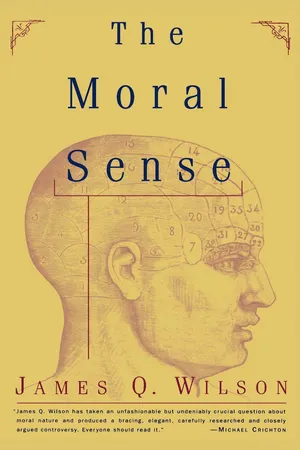
The Moral Sense
eBook - ePub

The Moral Sense

  1. 336 pages
  2. English
  3. ePUB (mobile friendly)
  4. Available on iOS & Android
eBook - ePub

The Moral Sense

About this book

Are human beings naturally endowed with a conscience? Or is morality artificially acquired through social pressure and instruction? Most people assume that modern science proves the latter. Further, most of our current social policies are based upon this "scientific" view of the sources of morality. In this book, however, James Q. Wilson seeks to reconcile traditional ideas with a range of important empirical research into the sources of human behavior over the last fifty years. Marshalling evidence drawn from diverse scientific disciplines, including animal behavior, anthropology, evolutionary theory, biology, endocrinology, brain science, genetics, primatology, education and psychology, Wilson shows that the facts about the origin and development of moral reasoning are not at odds with traditional views predating Freud, Darwin and Marx. Our basic sense of right and wrong actually does have a biological and behavioral origin. This "moral sense" arises from the infant's innate sociability, though it must also be nurtured by parental influence. Thus, this book revives ancient traditions of moral and ethical argument that go back to Aristotle, and reunifies the separate streams of philosophical and scientific knowledge that for so long were regarded as unbridgeable.

Frequently asked questions

Yes, you can cancel anytime from the Subscription tab in your account settings on the Perlego website. Your subscription will stay active until the end of your current billing period. Learn how to cancel your subscription.
No, books cannot be downloaded as external files, such as PDFs, for use outside of Perlego. However, you can download books within the Perlego app for offline reading on mobile or tablet. Learn more here.
Perlego offers two plans: Essential and Complete
  • Essential is ideal for learners and professionals who enjoy exploring a wide range of subjects. Access the Essential Library with 800,000+ trusted titles and best-sellers across business, personal growth, and the humanities. Includes unlimited reading time and Standard Read Aloud voice.
  • Complete: Perfect for advanced learners and researchers needing full, unrestricted access. Unlock 1.4M+ books across hundreds of subjects, including academic and specialized titles. The Complete Plan also includes advanced features like Premium Read Aloud and Research Assistant.
Both plans are available with monthly, semester, or annual billing cycles.
We are an online textbook subscription service, where you can get access to an entire online library for less than the price of a single book per month. With over 1 million books across 1000+ topics, we’ve got you covered! Learn more here.
Look out for the read-aloud symbol on your next book to see if you can listen to it. The read-aloud tool reads text aloud for you, highlighting the text as it is being read. You can pause it, speed it up and slow it down. Learn more here.
Yes! You can use the Perlego app on both iOS or Android devices to read anytime, anywhere — even offline. Perfect for commutes or when you’re on the go.
Please note we cannot support devices running on iOS 13 and Android 7 or earlier. Learn more about using the app.
Yes, you can access The Moral Sense by James Q. Wilson in PDF and/or ePUB format, as well as other popular books in Sozialwissenschaften & Brauchtum & Tradition. We have over one million books available in our catalogue for you to explore.

Information

The Moral Sense
Image

Since daily newspapers were first published, they have been filled with accounts of murder and mayhem, of political terror and human atrocities. Differences in religious belief so minor as to be invisible to all but a trained theologian have been the pretext, if not the cause, of unspeakable savageries. Differences in color and even small differences in lineage among people of the same color have precipitated riots, repression, and genocide. The Nazi regime set about to exterminate an entire people and succeeded in murdering six million of them before an invading army put a stop to the methodical horror. Hardly any boundary can be drawn on the earth without it becoming a cause for war. In parts of Africa, warlords fight for power and booty while children starve. When riots occur in an American city, many bystanders rush to take advantage of the opportunity for looting. If people have a common moral sense, there is scarcely any evidence of it in the matters to which journalists—and their readers—pay the greatest attention.
A person who contemplates this endless litany of tragedy and misery would be pardoned for concluding that man is at best a selfish and aggressive animal whose predatory instincts are only partially and occasionally controlled by some combination of powerful institutions and happy accidents. He would agree with the famous observation of Thomas Hobbes that in their natural state men engage in a war of all against all. In this respect they are worse than beasts; whereas the animals of the forest desire only sufficient food and sex, humans seek not merely sufficient but abundant resources. Men strive to outdo one another in every aspect of life, pursuing power and wealth, pride and fame, beyond any reasonable measure.
But before drawing so bleak a conclusion from his daily newspaper, the reader should ask himself why bloodletting and savagery are news. There are two answers. The first is that they are unusual. If daily life were simply a war of all against all, what would be newsworthy would be the occasional outbreak of compassion and decency, self-restraint and fair dealing. Our newspapers would mainly report on parents who sacrificed for their children and people who aided neighbors in distress. Amazed that such things occurred, we would explain them as either rare expressions of a personality quirk or disguised examples of clever self-dealing. The second reason that misery is news is because it is shocking. We recoil in horror at pictures of starving children, death camp victims, and greedy looters. Though in the heat of battle or the embrace of ideology many of us will become indifferent to suffering or inured to bloodshed, in our calm and disinterested moments we discover in ourselves an intuitive and powerful aversion to inhumanity.
This intuition is not simply a cultural artifact or a studied hypocrisy. The argument of this book is that people have a natural moral sense, a sense that is formed out of the interaction of their innate dispositions with their earliest familial experiences. To different degrees among different people, but to some important degree in almost all people, that moral sense shapes human behavior and the judgments people make of the behavior of others.

Morality versus Philosophy

At one time, the view that our sense of morality shaped our behavior and judgments was widely held among philosophers. Aristotle said that man was naturally a social being who seeks happiness. Thomas Aquinas, the great medieval theologian who sought to reconcile Catholic and Aristotelian teachings, argued that man has a natural inclination to be a rational and familial being; the moral law is, in the first instance, an expression of a natural—that is, an innate—tendency. Adam Smith wrote that man is motivated by sympathy as well as by self-interest, and he developed a moral philosophy squarely based on this capacity for sympathy. No one can say what effect these doctrines had on the way people actually lived, but one can say that for much of Western history philosophy sought to support and explicate the more social side of human nature without denying its selfish and wilder side.
Modern philosophy, with some exceptions, represents a fundamental break with that tradition. For the last century or so, few of the great philosophical theories of human behavior have accorded much weight to the possibility that men and women are naturally endowed with anything remotely resembling a moral sense. Marxism as generally received (and, with some exceptions, as Marx himself wrote it) is a relentlessly materialistic doctrine in which morality, religion, and philosophy have no independent meaning; they are, in Marx’s words, “phantoms formed in the human brain,” “ideological reflexes,” “sublimates of their material life-process.”1 To be sure, in certain places Marx wrote movingly of man’s alienation in a way that implied that in their natural state people value self-realization and uncoerced communal living,* but he never explored in a serious way man’s moral inclinations. Marx’s followers, especially those that used his doctrine to justify their power (Lenin comes especially to mind), were alike in thinking that any means were justified to achieve the communist utopia. And Marx’s own life is testimony to how little he was disposed to let moral considerations affect his political determinations or personal conduct.
If Marx hinted at morality without examining it, much of modern philosophy abandoned morality without even a hint, Analytical philosophers took seriously the argument that “values” could not be derived from “facts,” and tended to relegate moral judgments to the realm of personal preferences not much different from a taste for vanilla ice cream. In 1936 A. J. Ayer asserted that since moral arguments (unlike the theory of gravity) cannot be scientifically verified, they are nothing more than “ejaculations or commands,” “pure expressions of feeling” that have “no objective validity whatsoever,”2 Existentialists such as Jean-Paul Sartre argued that man must choose his values, but provided little guidance for making that choice.3 Of course there are many other, quite different tendencies in modern philosophy, but anyone who has spent much time in a classroom is keenly aware that the skeptical, relativistic themes have been most influential. Richard Rorty, perhaps the most important philosophical writer in present-day America, denies that there is anything like a “core self” or an inherently human quality, and so there is no way for us to say that some actions are inherently inhuman, even when confronted with the horrors of Auschwitz (which, of course, Rorty condemns, but only because history and circumstance have supplied him with certain “beliefs”).4
What Marxism and positivism have meant for philosophy, Freudianism has meant for psychology. It is difficult to disentangle what Freud actually said from what he is widely believed to have said, or one stage in his thinking from another. But it seems clear that Freudianism was popularly understood as meaning that people have instincts, especially sexual and aggressive ones, and not moral senses; morality, to the extent people acquire any, is chiefly the result of learning to repress those instincts. Among the objects of the sexual drive are one’s own parents. Repressing those instincts is necessary for civilization to exist, but that repression can lead to mental illness. People do acquire a conscience—Freud called it the superego—but not out of any natural inclination to be good; rather, their conscience is an internalized fear of losing the love of their parents.5 Freud, at least, argued that conscience existed; some behavioral psychologists, such as B. F. Skinner, denied even that.
People who have never been affected by Marxism or Freudianism and who are indifferent to philosophical disputes may nonetheless have learned, at least secondhand, the teachings of many cultural anthropologists. All of us are aware of the great variety of social customs, religious beliefs, and ritual practices to be found around the world, especially among primitive peoples, a variety so great as to suggest that all morality is relative to time and place. And if we wish to confirm what our imagination suggests, we can find explicit arguments to that effect in some of the leading texts. In 1906 the great sociologist William Graham Sumner wrote that “the mores can make anything right.”6 Thirty years later Ruth Benedict’s best-selling book Patterns of Culture was read to mean that all ways of life were equally valid. Published in 1934, just after the Nazis had come to power, it was probably intended to be a plea for tolerance and an argument for judging one’s own culture only after becoming aware of an alternative to it. But by popularizing the phrase “cultural relativism” and discussing cannibalism without explicitly condemning it, she was read as saying something like what Sumner had said: culture and the mores of society can make anything right and anything wrong.7

Is Everything Permitted?

If modern man had taken seriously the main intellectual currents of the last century or so, he would have found himself confronted by the need to make moral choices when the very possibility of making such choices had been denied. God is dead or silent, reason suspect or defective, nature meaningless or hostile. As a result, man is adrift on an uncharted sea, left to find his moral bearings with no compass and no pole star, and so able to do little more than utter personal preferences, bow to historical necessity, or accept social conventions.
Countless writers have assumed that man is in precisely this predicament. Recall the phrases with which writers and poets have characterized our times. We have been described as “hollow men” living in a “wasteland” or “the age of anxiety,” from which there is “no exit,” part of a “lonely crowd” that seeks refuge in either “possessive individualism” or “therapeutic individualism.” To escape from the emptiness of being we either retreat inward to mystical or drug-induced self-contemplation or outward to various fanatical ideologies.*
If this were true, then my argument that there is in human nature the elements of a natural moral sense would be untrue. There can scarcely be anything worth calling a moral sense if people can be talked out of it by modern philosophy, secular humanism, Marxist dialectics, or pseudo-Freudian psychoanalysis. But I doubt that most people most of the time are affected by these intellectual fashions. The intellectuals who consume them may be affected. If they think life is without moral meaning, they may live accordingly, creating an avant-garde in which “meaning” is to be found in self-expressive art, a bohemian counterculture, or anarchistic politics. But the lives of most people are centered around the enduring facts of human existence—coping with a family, establishing relationships, and raising children. Everywhere we look, we see ordinary men and women going about their daily affairs, happily or unhappily as their circumstances allow, making and acting on moral judgments without pausing to wonder what Marx or Freud or Rorty would say about those judgments. In the intimate realms of life, there will be stress, deprivation, and frustration, but ordinarily these will not be experienced as a pervasive spiritual crisis.
Two errors arise in attempting to understand the human condition. One is to assume that culture is everything, the other to assume that it is nothing. In the first case there would be no natural moral sense—if culture is everything, then nature is nothing. In the second, the moral sense would speak to us far more clearly than it does. A more reasonable assumption is that culture will make some difference some of the time in the lives of most of us and a large difference much of the time in the lives of a few of us.
An example of how modern intellectual currents have a modest effect on the lives of people who are exposed to them can be found in some of our educational fashions. Most pupils are well behaved; a few are not. Controlling the few who are not can only become more difficult if teachers embrace the view that their task is to address questions of right and wrong by helping children “choose” and “clarify” their “values.” The “values clarification” approach to moral education that began in the late 1960s warned teachers to avoid “moralizing, criticizing, giving values, or evaluating.” They were especially to avoid “all hints of ‘good’ or ‘right’ or ‘acceptable.’”8 One wonders what students thought of teachers who studiously avoided suggesting that any course of action was better than any other. There is no evidence that this bit of pedagogical idiocy had any direct effect on the beliefs of children,9 but it may have had an indirect effect on their actions. If a child cheated on an exam, did the teacher respond by helping the student “clarify” the “value” he attached to honesty and dishonesty? And if the pupil valued a good grade even if dishonestly obtained, how was the teacher supposed to respond? This approach was so at odds with common sense and the requirements of everyday life that, not surprisingly, it fell into disrepute in many quarters.10
But values clarification—or more accurately, the philosophical on which it was based—left its traces. Ask college students to make and defend a moral judgment about people or places with which they are personally unfamiliar. Many will act as if they really believed that all cultural practices were equally valid, all moral claims were equally suspect, and human nature was infinitely malleable or utterly self-regarding. In my classes, college students asked to judge a distant people, practice, or event will warn one another and me not to be “judgmental” or to “impose your values on other people.” These remarks are most often heard when they are discussing individual “life-styles,” the modern, “nonjudgmental” word for what used to be called character. If students know anything at all about these folk, it is usually what they have learned from books written by anthropologists who believe that no other culture but their own can or should be judged. If asked to defend their admonitions against “being judgmental,” the students sometimes respond by arguing that moral judgments are arbitrary, but more often they stress the importance of tolerance and fair play, which, in turn, require understanding and even compassion. Do not condemn some practice—say, drug use or unconventional sexuality—that ought to be a matter of personal choice; do not criticize some group—say, ghetto rioters—whom you do not know and whose beliefs and experiences you do not understand.
But tolerance and fair play are moral dispositions; a commitment to personal liberty is a moral conviction; a belief that one ought to enter imaginatively and sympathetically into the minds of others is a moral urging. When asked why people should be tolerant, act fairly, or respect liberty, many students will look at me as if I were merely engaging in professorial cleverness, while a few will attempt to construct intellectual defenses of these notions, defenses typically based on utility: for example, society is better off if everybody behaves that way.
Most people, however, do not act fairly or sympathetically because they have decided that “society” (whatever that is) will be better off as a consequence. It is not hard to think of cases in which “society” might be better off if at least some people were treated unfairly or unsympathetically.* In fact, when people act fairly or sympathetically it is rarely because they have engaged in much systematic reasoning. Much of the time our inclination toward fair play or our sympathy for the plight of others are immediate and instinctive, a reflex of our emotions more than an act of our intellect, and in those cases in which we do deliberate (for example, by struggling to decide what fair play entails or duty requires in a particular case), our deliberation begins, not with philosophical premises (much less with the justification for them), but with feelings—in short, with a moral sense. The feelings on which people act are often superior to the arguments that they employ.
These students are decent people. In most respects, their lives are exemplary. Thus it was all the more shocking when, during a class in which we were discussing people who at great risk to themselves had helped European Jews during the Holocaust, I found that there was no general agreement that those guilty of the Holocaust itself were guil...

Table of contents

  1. Cover
  2. Title Page
  3. Dedication
  4. Contents
  5. Preface
  6. Acknowledgments
  7. 1. The Moral Sense
  8. Part One: Sentiments
  9. Part Two: Sources
  10. Part Three: Character
  11. Notes
  12. References
  13. Index