Tess of the D'Urbervilles
eBook - ePub

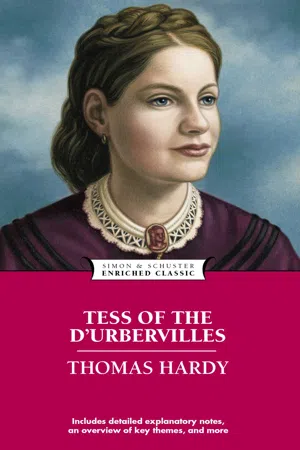
Tess of the D'Urbervilles

  1. 560 pages
  2. English
  3. ePUB (mobile friendly)
  4. Available on iOS & Android
eBook - ePub

Tess of the D'Urbervilles

About this book

A young woman challenges the conventions of her time in this classic novel about nineteenth century English society. At the time of its publication in 1891, Tess of the d'Urbervilles was scorned by readers for what was then considered its indictment of Victorian society and its unconventional heroine, Tess Durbeyfield. Now considered one of the major classic novels of nineteenth century literature, Tess is the compelling story of an extraordinary woman and her tragic destiny—a brilliant, transcendent work of compassion and courage by one of the finest English novelists, Thomas Hardy. This edition includes:
-A concise introduction that gives readers important background information
-A chronology of the author's life and work
-A timeline of significant events that provides the book's historical context
-An outline of key themes and plot points to help readers form their own interpretations
-Detailed explanatory notes
-Critical analysis, including contemporary and modern perspectives on the work
-Discussion questions to promote lively classroom and book group interaction
-A list of recommended related books and films to broaden the reader's experience Enriched Classics offer readers affordable editions of great works of literature enhanced by helpful notes and insightful commentary. The scholarship provided in Enriched Classics enables readers to appreciate, understand, and enjoy the world's finest books to their full potential.
Frequently asked questions

Yes, you can cancel anytime from the Subscription tab in your account settings on the Perlego website. Your subscription will stay active until the end of your current billing period. Learn how to cancel your subscription.
No, books cannot be downloaded as external files, such as PDFs, for use outside of Perlego. However, you can download books within the Perlego app for offline reading on mobile or tablet. Learn more here.
Perlego offers two plans: Essential and Complete
  • Essential is ideal for learners and professionals who enjoy exploring a wide range of subjects. Access the Essential Library with 800,000+ trusted titles and best-sellers across business, personal growth, and the humanities. Includes unlimited reading time and Standard Read Aloud voice.
  • Complete: Perfect for advanced learners and researchers needing full, unrestricted access. Unlock 1.4M+ books across hundreds of subjects, including academic and specialized titles. The Complete Plan also includes advanced features like Premium Read Aloud and Research Assistant.
Both plans are available with monthly, semester, or annual billing cycles.
We are an online textbook subscription service, where you can get access to an entire online library for less than the price of a single book per month. With over 1 million books across 1000+ topics, we’ve got you covered! Learn more here.
Look out for the read-aloud symbol on your next book to see if you can listen to it. The read-aloud tool reads text aloud for you, highlighting the text as it is being read. You can pause it, speed it up and slow it down. Learn more here.
Yes! You can use the Perlego app on both iOS or Android devices to read anytime, anywhere — even offline. Perfect for commutes or when you’re on the go.
Please note we cannot support devices running on iOS 13 and Android 7 or earlier. Learn more about using the app.
Yes, you can access Tess of the D'Urbervilles by Thomas Hardy in PDF and/or ePUB format, as well as other popular books in Letteratura & Classici. We have over one million books available in our catalogue for you to explore.

Information

Year
2007
eBook ISBN
9781416592167
Subtopic
Classici

PHASE THE FIRST THE MAIDEN

I

ON AN EVENING in the latter part of May a middle-aged man was walking homeward from Shaston to the village of Marlott, in the adjoining Vale of Blakemore or Blackmoor. The pair of legs that carried him were rickety, and there was a bias in his gait which inclined him somewhat to the left of a straight line. He occasionally gave a smart nod, as if in confirmation of some opinion, though he was not thinking of anything in particular. An empty egg-basket was slung upon his arm, the nap of his hat was ruffled, a patch being quite worn away at its brim where his thumb came in taking it off. Presently he was met by an elderly parson astride on a gray mare, who, as he rode, hummed a wandering tune.
ā€œGood night t’ee,ā€ said the man with the basket.
ā€œGood night, Sir John,ā€ said the parson.
The pedestrian, after another pace or two, halted, and turned round.
ā€œNow, sir, begging your pardon; we met last market-day on this road about this time, and I zaid ā€˜Good night,ā€ and you made reply ā€˜Good night, Sir John,’ as now.ā€
ā€œI did,ā€ said the parson.
ā€œAnd once before that—near a month ago.ā€
ā€œI may have.ā€
ā€œThen what might your meaning be in calling me ā€˜Sir John’ these different times, when I be plain Jack Durbeyfield, the haggler?ā€1
The parson rode a step or two nearer.
ā€œIt was only my whim,ā€ he said; and, after a moment’s hesitation: ā€œIt was on account of a discovery I made some little time ago, whilst I was hunting up pedigrees for the new county history. I am Parson Tringham, the antiquary, of Stag-foot Lane. Don’t you really know, Durbeyfield, that you are the lineal representative of the ancient and knightly family of the d’Urbervilles, who derive their descent from Sir Pagan d’Urberville, that renowned knight who came from Normandy with William the Conqueror, as appears by Battle Abbey Roll?ā€2
ā€œNever heard it before, sir!ā€
ā€œWell, it’s true. Throw up your chin a moment, so that I may catch the profile of your face better. Yes, that’s the d’Urberville nose and chin—a little debased. Your ancestor was one of the twelve knights who assisted the Lord of Estremavilla in Normandy in his conquest of Glamorganshire. Branches of your family held manors over all this part of England; their names appear in the Pipe Rolls3 in the time of King Stephen. In the reign of King John one of them was rich enough to give a manor to the Knights Hospitallers; and in Edward the Second’s time your forefather Brian was summoned to Westminster to attend the great Council there. You declined a little in Oliver Cromwell’s time, but to no serious extent, and in Charles the Second’s reign you were made Knights of the Royal Oak for your loyalty.4 Aye, there have been generations of Sir Johns among you, and if knighthood were hereditary, like a baronetcy, as it practically was in old times, when men were knighted from father to son, you would be Sir John now.ā€
ā€œYe don’t say so!ā€
ā€œIn short,ā€ concluded the parson, decisively smacking his leg with his switch, ā€œthere’s hardly such another family in England.ā€
ā€œDaze5 my eyes, and isn’t there?ā€ said Durbeyfield. ā€œAnd here have I been knocking about, year after year, from pillar to post, as if I was no more than the commonest feller in the parish…. And how long hev this news about me been knowed, Pa’son Tringham?ā€
The clergyman explained that, as far as he was aware, it had quite died out of knowledge, and could hardly be said to be known at all. His own investigations had begun on a day in the preceding spring when, having been engaged in tracing the vicissitudes of the d’Urberville family, he had observed Durbeyfield’s name on his waggon, and had thereupon been led to make inquiries about his father and grandfather till he had no doubt on the subject.
ā€œAt first I resolved not to disturb you with such a useless piece of information,ā€ said he. ā€œHowever, our impulses are too strong for our judgment sometimes. I thought you might perhaps know something of it all the while.ā€
ā€œWell, I have heard once or twice, ’tis true, that my family had seen better days afore they came to Blackmoor. But I took no notice o’t, thinking it to mean that we had once kept two horses where we now keep only one. I’ve got a wold6 silver spoon, and a wold graven seal at home, too; but, Lord, what’s a spoon and seal?… And to think that I and these noble d’Urbervilles were one flesh all the time. ’Twas said that my gr’t-grandfer had secrets, and didn’t care to talk of where he came from…. And where do we raise our smoke, now, parson, if I may make so bold; I mean, where do we d’Urbervilles live?ā€
ā€œYou don’t live anywhere. You are extinct—as a county family.ā€
ā€œThat’s bad.ā€
ā€œYes—what the mendacious family chronicles call extinct in the male line—that is, gone down—gone under.ā€
ā€œThen where do we lie?ā€
ā€œAt Kingsbere-sub-Greenhill: rows and rows of you in your vaults, with your effigies under Purbeck-marble canopies.ā€
ā€œAnd where be our family mansions and estates?ā€
ā€œYou haven’t any.ā€
ā€œOh? No lands neither?ā€
ā€œNone; though you once had ’em in abundance, as I said, for your family consisted of numerous branches. In this county there was a seat of yours at Kingsbere, and another at Sherton, and another at Millpond, and another at Lullstead, and another at Wellbridge.ā€
ā€œAnd shall we ever come into our own again?ā€
ā€œAh—that I can’t tell!ā€
ā€œAnd what had I better do about it, sir?ā€ asked Durbeyfield, after a pause.
ā€œOh—nothing, nothing; except chasten yourself with the thought of ā€˜how are the mighty fallen.’7 It is a fact of some interest to the local historian and genealogist, nothing more. There are several families among the cottagers of this county of almost equal lustre. Good night.ā€
ā€œBut you’ll turn back and have a quart of beer wi’ me on the strength o’t, Pa’son Tringham? There’s a very pretty brew in tap at The Pure Drop—though, to be sure, not so good as at Rolliver’s.ā€
ā€œNo, thank you—not this evening, Durbeyfield. You’ve had enough already.ā€ Concluding thus the parson rode on his way, with doubts as to his discretion in retailing this curious bit of lore.
When he was gone Durbeyfield walked a few steps in a profound reverie, and then sat down upon the grassy bank by the roadside, depositing his basket before him. In a few minutes a youth appeared in the distance, walking in the same direction as that which had been pursued by Durbeyfield. The latter, on seeing him, held up his hand, and the lad quickened his pace and came near.
ā€œBoy, take up that basket! I want ’ee to go on an errand for me.ā€
The lath-like stripling frowned. ā€œWho be you, then, John Durbeyfield, to order me about and call me ā€˜boy’? You know my name as well as I know yours!ā€
ā€œDo you, do you? That’s the secret—that’s the secret! Now obey my orders, and take the message I’m going to charge ’ee wi’…. Well, Fred, I don’t mind telling you that the secret is that I’m one of a noble race—it has been just found out by me this present afternoon, P.M.ā€ And as he made the announcement, Durbeyfield, declining from his sitting position, luxuriously stretched himself out upon the bank among the daisies.
The lad stood before Durbeyfield, and contemplated his length from crown to toe.
ā€œSir John d’Urberville—that’s who I am,ā€ continued the prostrate man. ā€œThat is if knights were baronets—which they be. ’Tis recorded in history all about me. Dost know of such a place, lad, as Kingsbere-sub-Greenhill?ā€
ā€œEes. I’ve been there to Greenhill Fair.ā€
ā€œWell, under the church of that city there lieā€”ā€
ā€œ ’Tisn’t a city, the place I mean; leastwise ’twaddn’ when I was there—’twas a little one-eyed, blinking sort o’ place.ā€
ā€œNever you mind the place, boy, that’s not the question before us. Under the church of that there parish lie my ancestors—hundreds of ’em—in coats of mail and jewels, in gr’t lead coffins weighing tons and tons. There’s not a man in the county o’ South Wessex that’s got grander and nobler skillentons8 in his family than I.ā€
ā€œOh?ā€
ā€œNow take up that basket, and goo on to Marlott, and when you’ve come to The Pure Drop Inn, tell ’em to send a horse and carriage to me immed’ately, to carry me hwome. And in the bottom o’ the carriage they be to put a noggin o’ rum in a small bottle, and chalk it up to my account. And when you’ve done that goo on to my house with the basket, and tell my wife to put away that washing, because she needn’t finish it, and wait till I come hwome, as I’ve news to tell her.ā€
As the lad stood in a dubious attitude, Durbeyfield put his hand in his pocket, and produced a shilling, one of the chronically few that he possessed.
ā€œHere’s for your labour, lad.ā€
This made a difference in the young man’s estimate of the position.
ā€œYes, Sir John. Thank ā€˜ee. Anything else I can do for ā€˜ee, Sir John?ā€
ā€œTell ’em at hwome that I should like for supper,—well, lamb’s fry if they can get it; and if they can’t, black-pot; and if they can’t get that, well, chitterlings will do.ā€
ā€œYes, Sir John.ā€
The boy took up the basket, and as he set out the notes of a brass band were heard from the direction of the village.
ā€œWhat’s that?ā€ said Durbeyfield. ā€œNot on account o’ I?ā€
ā€œ ’Tis the women’s club-walking, Sir John. Why, your da’ter is one o’ the members.ā€
ā€œTo be sure—I’d quite forgot it in my thoughts of greater things! Well, vamp9 on to Marlott, will ye, and order that carriage, and maybe I’ll drive round and inspect the club.ā€
The lad departed, and Durbeyfield lay waiting on the grass and daisies in the evening sun. Not a soul passed that way for a long while, and the faint notes of the band were the only human sounds audible within the rim of blue hills.

II

THE VILLAGE OF Marlott lay amid the north-eastern undulations of the beautiful Vale of Blakemore or Black-moor aforesaid, an engirdled and secluded region, for the most part untrodden as yet by tourist or landscape-painter, though within a four hours’ journey from London.
It is a vale whose acquaintance is best made by viewing it from the summits of the hills that surround it—except perhaps during the droughts of summer. An unguided ramble into its recesses in bad weather is apt to engender dissatisfaction with its narrow, tortuous, and miry ways.
This fertile and sheltered tract of country, in which the fields are never brown and the springs never dry, is bounded on the south by the bold chalk ridge that embraces the prominences of Hambledon Hill, Bulbarrow, Nettlecombe-Tout, Dogbury, High Stoy, and Bubb Down. The traveller from the coast, who, after plodding northward for a score of miles over calcareous downs and corn-lands, suddenly reaches the verge of one of these escarpments, is surprised and delighted to behold, extended like a map beneath him, a country differing absolutely from that which he has passed through. Behind him the hills are open, the sun blazes down upon fields so large as to give an unenclosed character to the landscape, the lanes are white, the hedges low and plashed, the atmosphere colourless. Here, in the valley, the world seems to be constructed upon a smaller and more delicate scale; the fields are mere paddocks, so reduced that from this height their hedgerows appear a network of dark green threads overspreading the paler green of the grass. The atmosphere beneath is languorous, and is so tinged with azure that what artists call the middle distance partakes also of that hue, while the horizon beyond is of the deepest ultramarine. Arable lands are few and limited; with but slight exceptions the prospect is a broad rich mass of grass and trees, mantling minor hills and dales within the major. Such is the Vale of Blackmoor.
The district is of historic, no less than of topographical interest. The Vale was known in former times as the Forest of White Hart, from a curious legend of King Henry III’s reign, in which the killing by a certain Thomas de la Lynd of a beautiful white hart which the king had run down and spared, was made the occasion of a heavy fine.1 In those days, and till comparatively recent times, the country was densely wooded. Even now, traces of its earlier condition are to be found in the old oak copses and irregular belts of timber that yet survive upon its slopes, and the hollow-trunked trees that shade so many of its pastures.
The forests have departed, but some old customs of their shades remain. Many, however, linger only in a metamorphosed or disguised form. The May-Day dance, for instance, was to be discerned on the afternoon under notice, in the guise of the club revel, or ā€œclub-walking,ā€ as it was there called.
It was an interesting event to the younger inhabitants of Marlott, though its real interest was not observed by the participators in the ceremony. Its singularity lay less in the retention of a custom of walking in procession and dancing on each anniversary than in the members being solely women. In men’s clubs such celebrations were, though expiring, less uncommon; but either the natural shyness of the softer sex, or a sarcastic attitude on the part of male relatives, had denuded such women’s clubs as remained (if any other did) of this their glory and consummation. The club of Marlott alone lived to uphold the local Cerealia.2 It had walked for hundreds of years, if not as benefit-club, as votive sisterhood of some sort; and it walked still.
The banded ones were all dressed in white gowns—...

Table of contents

  1. Cover
  2. Introduction: ā€˜Tess of the d’Urbervilles’: What’s in a Name?
  3. Chronology of Thomas Hardy’s Life and Work
  4. Historical Context of ā€˜Tess of the d’Urbervilles’
  5. Tess of the d’Urbervilles
  6. Explanatory Note to the First Edition
  7. Preface to the Fifth and Later Editions
  8. Phase the First: The Maiden
  9. Phase the Second: Maiden No More
  10. Phase the Third: The Rally
  11. Phase the Fourth: The Consequence
  12. Phase the Fifth: The Woman Pays
  13. Phase the Sixth: The Convert
  14. Phase the Seventh: Fulfilment
  15. Interpretive Notes
  16. Critical Excerpts
  17. Questions for Discussion
  18. Suggestions for the Interested Reader
  19. Notes
  20. Copyright