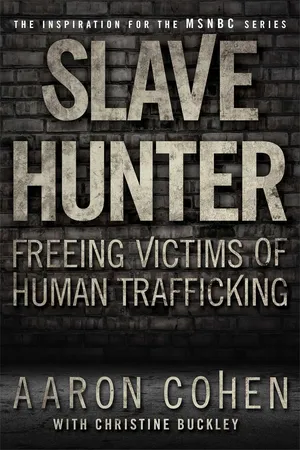
Slave Hunter
eBook - ePub

Slave Hunter

One Man's Global Quest to Free Victims of Human Trafficking

  1. 320 pages
  2. English
  3. ePUB (mobile friendly)
  4. Available on iOS & Android
eBook - ePub

Slave Hunter

One Man's Global Quest to Free Victims of Human Trafficking

About this book

Aaron Cohen left behind his closest friends, his dying father, and the rock-star life for an unyielding one-man global pursuit. Aaron Cohen left behind his closest friends, his dying father, and the rock-star life for an unyielding one-man global pursuit. At a time when more people than ever before are enslaved on this planet, Aaron Cohen found himself on a path of spiritual discovery that both transformed and endangered his life. Once the best friend and business partner to Jane's Addiction frontman Perry Farrell, Cohen now works alone, navigating the oppressive territory of pimps and drug lords from the shantytowns of Cambodia to the sweltering savannahs of Sudan. The flesh trade is the world's fastest growing and most deadly illegal enterprise— even more profitable and easier to hide than guns, drugs, and precious gems. Cohen, posing as a sex tourist, slips into brothels, urged by madams to select from a lineup of girls as young as six. Sometimes he can save them from their captors, but more often than not, he must leave them behind, taking only the evidence he hopes will eventually lead to their rescue. In a remarkable, unprecedented exposĆ© of the sinister trade, the rocker-turned-activist reveals the fast-paced, inspiring, and unforgettable story of a real-life slave hunter.
Frequently asked questions

Yes, you can cancel anytime from the Subscription tab in your account settings on the Perlego website. Your subscription will stay active until the end of your current billing period. Learn how to cancel your subscription.
No, books cannot be downloaded as external files, such as PDFs, for use outside of Perlego. However, you can download books within the Perlego app for offline reading on mobile or tablet. Learn more here.
Perlego offers two plans: Essential and Complete
  • Essential is ideal for learners and professionals who enjoy exploring a wide range of subjects. Access the Essential Library with 800,000+ trusted titles and best-sellers across business, personal growth, and the humanities. Includes unlimited reading time and Standard Read Aloud voice.
  • Complete: Perfect for advanced learners and researchers needing full, unrestricted access. Unlock 1.4M+ books across hundreds of subjects, including academic and specialized titles. The Complete Plan also includes advanced features like Premium Read Aloud and Research Assistant.
Both plans are available with monthly, semester, or annual billing cycles.
We are an online textbook subscription service, where you can get access to an entire online library for less than the price of a single book per month. With over 1 million books across 1000+ topics, we’ve got you covered! Learn more here.
Look out for the read-aloud symbol on your next book to see if you can listen to it. The read-aloud tool reads text aloud for you, highlighting the text as it is being read. You can pause it, speed it up and slow it down. Learn more here.
Yes! You can use the Perlego app on both iOS or Android devices to read anytime, anywhere — even offline. Perfect for commutes or when you’re on the go.
Please note we cannot support devices running on iOS 13 and Android 7 or earlier. Learn more about using the app.
Yes, you can access Slave Hunter by Aaron Cohen, Christine Buckley in PDF and/or ePUB format, as well as other popular books in Social Sciences & Slavery. We have over one million books available in our catalogue for you to explore.

Information

PART I:

CAMBODIA

NIGHT FRIGHTING

PHNOM PENH, CAMBODIA
November 2004
I don’t feel like I can change the world. I don’t even try. I only want to change this small life that I see standing in front of me, which is suffering. I want to change this real small thing that is the destiny of one little girl. And then another, and another, because if I didn’t, I wouldn’t be able to live with myself or sleep at night.


—Somaly Mam, The Road of Lost Innocence: The True Story of a Cambodian Heroine
THE CRESCENT MOON HAS ALREADY RISEN, AND Venus is shining brightly in the night sky. I’m following the commander and his men down an unlit back street. At this hour, the metal gates on the neighborhood’s living room emporiums are all down. The relative quiet belies the not-so-clandestine activities of the city’s shadow world, which bursts into life after dark. I watch drunken men stagger away from makeshift street bars and roar off into the dark on throaty Chinese motorbikes. Children in dirty T-shirts and plastic sandals are splashing in swampy puddles created by a combination of daily rain and ruts deep enough to lose sight of a rat, of which there are more than a few.
We pass a small night market, with a cluster of low red and blue plastic tables and stools where small groups of men have gathered to slurp soup and homemade rice moonshine. The vendors’ candles flicker and cast a dim glow on some of the exotic delicacies on offer. Locusts roasted on tiny coal grills. Duck blood with fresh herbs. Deep-fried tarantulas.
Toward the back of this makeshift market, I spot a dozen or so dogs crammed into cages, ready and waiting for the hot pot. I can hear a few of the puppies whimpering in the darkness, see them chewing at their chains. I wonder if they slaughter them right here, too. No one else seems to notice. We enter our fourth karaoke bar of the night through a door so low I have to fold my six-foot-five-inch frame almost in half to make it through.
The darkened room is long and narrow, with a U-shaped leather sectional facing a large-screen TV blaring karaoke in Khmer, the Cambodian language. A young Vietnamese woman in a short blue dress grabs my elbow and leads me to a spot in the middle of the couch. Other hostesses seat the commander and his men—all in Royal Cambodian Armed Forces uniform—on either side of me. These guys are the Cambodian elite, and I need their approval. Although I’m dressed up in a collared white shirt, I’m suddenly self-conscious about my unruly hair and dark jeans next to their pressed fatigues and linear haircuts.
The images of the dogs don’t go away when I close my eyes for a second. I feel for the tiny bottle of green eucalyptus oil in my jacket, shake out a few drops, and slowly rub it into my temples, but it can’t prevent the slideshow of canine slaughter scenarios flickering behind my closed eyelids. It’s after midnight and there’s a full glass of Johnnie Walker Black on the table in front of me, next to a stack of thick plastic binders bursting with photocopied lyrics in six different languages. The table is so low it barely hits my shins.
The rest of the men in the room, whose faces I can’t make out in the dim light, are waiting for me to sing. One of them hands me a microphone.
ā€œU.S.A. song,ā€ the man in the uniform insists, nudging me. I don’t want to sing, not now, not here. I need to focus on the long and ugly night ahead, and it’s hard to keep the mood light. But everyone is smiling, prodding me to go on. This is part of the game I’ve played for the last few years in a dozen other countries. Now I’ll sing ā€œPeace Frogā€ or ā€œSounds of Silence,ā€ and the commander will applaud, smile encouragingly, and pass me the dried squid as if to tell me not to worry. Life here is like this. Sing another karaoke number to take your mind off reality.
Blood in the streets it’s up to my ankles
I’m the only one in the room who knows what I’m singing about—the only one seemingly bothered by the room’s crimson bulbs casting a bloody glow over our gathering. I’ve got to smile, to reassure these men that I can party with them, show them I am not shaken by any of what we’ve seen or are about to see. No one goes home until the commander says it’s time.
As I continue to sing, I notice a young, pretty girl wearing too much lip gloss. She pours more whiskey over a big chunk of ice, picks up the glass with both hands, and offers it to me with a winning smile. I accept it with a nod, then put the glass down immediately and go for the beer instead, which seems more reasonable considering my physical condition. I never get enough time in one place to recover from the jet lag. I haven’t fully unpacked my suitcase for a long time now.
The girl with the lip gloss’s name is Mai and her English is pretty good. She has been translating for Commander Nam, along with Anh, who’s sitting on Nam’s other side, feeding him spicy dried peas.
Bloody red sun of phantastic L.A….
Only I’m not Jim Morrison in fantastic seventies L.A. I haven’t been home for two weeks now, and haven’t had a good night’s sleep in even longer.
The commander’s men are clapping and humming along to the guitar licks, and I almost start to enjoy myself. But after the familiar Doors lyrics flow out of my mouth, the words of a Cambodian song I heard last night come back to torment my addled mind:
Bright red blood splatters the cities and plains
And over the plain of Kampuchea, our motherland.
The blood of good workers and peasants…
Blood spills out into great indignation…
Blood that frees us from slavery.1
They are part of the national anthem the Khmer Rouge adopted when they took power in 1975, turning the country’s clock back to ā€œYear Zeroā€ and unleashing four years of genocidal terror on their people. Yesterday I watched a bootleg copy of a new documentary on the Khmer Rouge’s tragic reign that brought all the horror back to the forefront.
Shaken by the resurgence of the film’s images and sound, I forfeit the microphone to the soldier next to me, who passes it directly to Commander Nam. He’s already programmed in the next song, a thumping Thai love anthem that has the girls shimmying in their seats.
ā€œCheers!ā€ Nam turns to me, holding up an Angkor beer with a muscular arm and waiting for me to clink my bottle with his. The aged whiskey’s presence on the table indicates Nam’s high status, as do the abundant tiny plates of salty snacks and spicy dipping sauces. There is an assault rifle leaning up against the sofa next to a square-shouldered bodyguard. The inevitable strains of what seems to be every Southeast Asian man’s favorite American song echo from the huge TV speakers:
On a dark desert highway, cool wind in my hair…
It’s my turn again, and I sing the verses by heart without even looking at the screen, stopping every so often to answer Nam’s pointed questions about my past. He listens intently as Mai translates the encapsulated version: my years at the U.S. Air Force Academy, slave retrievals in Sudan, the work with human trafficking victims. I intentionally leave out the part about Jane’s Addiction—the proverbial sex, drugs, and rock and roll.
You can check out any time you like, but you can never leave…
My opportunity comes during the long guitar solo.
ā€œCommander, I’m going to Siem Reap to retrieve slave girls,ā€ I say. ā€œI’d like your authorization, sir, and a unit to back me up.ā€
I can’t do this kind of work alone or extrajudicially. In order to escape jail, kidnapping charges, or mafia bullets, I have to put together my own paramilitary team before leaving Phnom Penh. No matter how anarchic it seems to the outside observer, Cambodia still has its own rules—ones that have to be learned and followed. I can’t just crash into a brothel on a white horse and break out some girls.
The Cambodian equivalent of a written warrant is an official authorization from within the ranks of the police or the Royal Cambodian Armed Forces, the select corps of men with the access I need. Which is why I have been introduced to Commander Nam.
Nam just nods and makes ā€œMmmā€ noises while flipping through the plastic binder, making his next selection. I ask him about a raid my contacts at the American Embassy have told me about in the infamous brothel town of Svay Pak, known to locals as K11—named after its location eleven kilometers from the city center. I’ve heard there were hundreds of young children enslaved there.
After a long, uneasy silence, Nam makes eye contact with me. Yes, he says, his military unit participated in that bust, which was successful in that most of the brothels there have been forced to temporarily shut their doors. But the traffickers simply found a new location, known as Two o’Clock, which he calls ā€œworse than K11.ā€ There’s not a lot he can do about it.
One of my friends in the charity world has recommended Nam, so I’m sure he’s one of the good guys. Unfortunately, it seems there are plenty of men wearing the same uniform who are not on our side.
Nam watches me consider this, then taps my knee and says in English, ā€œDon’t worry, don’t worry, my friend, my friend.ā€
Anh is translating now. ā€œMr. Nam say you want his men help you, you must to do some thing for him before.ā€
ā€œOf course,ā€ I say.
ā€œOkay. You get for him girls on video, say what bad things happen, names of who big boss, pictures where the rooms, what look like, where mamasan, where big boss sleeping.ā€
ā€œI can do that,ā€ I say. I can start to feel the adrenaline flowing. We’re going to do this.
Nam reaches into his pocket, pulls out a silver pen, and writes down a phone number on a paper napkin. ā€œYou call Mr. Heng,ā€ he says, putting his index and pinkie to his ear as though talking on the phone. Mai and Anh beam at the commander’s successful utterance of a complete English sentence. Anh hand-feeds him a morsel of seaweed while Mai pours us both a celebratory glass of whiskey. Both girls take sips from their tall glasses of orange soda.
ā€œMr. Heng speak good English,ā€ says Mai. ā€œBetter than me. You call him tomorrow.ā€
ā€œOkay,ā€ I say, after telling Mai that her English is very, very good—at least better than my Khmer or Vietnamese—and we all laugh and clink glasses again. Our meeting is over, and—as my military education has taught me to do—I wait for Commander Nam to stand up before me. But first he has a parting song in mind for us.
I recognize the opening bars of a song from my childhood, written by David Gates. It’s hard to imagine that while my brother, sister, and I were gathered around our turntable in Southern California singing Bread songs, half a world away hundreds of thousands of Cambodians were being summarily exterminated, tortured, or starved to death.
There’s no one home but you…you’re all that’s left me too.
Sappy as the song may be, I’m suddenly singing my heart out, forgetting my surroundings, and drifting away to thoughts of my bedridden father in California. I know he’s probably asking Juanita and Maxima, his live-in nurses, how much longer it will be until I come home to take care of him. I miss him, too. Our relationship has grown stronger as his body and mind have grown weaker. Missing him this way, I can’t help but sing the song to Papa in my heart.
Commander Nam grabs my arm and shakes me out of my reverie. Concern for my father is rising up in my chest, but I can’t let Nam see that my thoughts have drifted elsewhere. He’s decided it’s time to go, even though the song is only half through. I quietly lay down the microphone and do my best to tidy up the table while I wait for the signal. I’m used to dealing with military men, and have learned how to follow their sometimes capricious orders.
We walk out of the karaoke room through a different door than the one we entered and find ourselves standing in a modest family kitchen. The folding table is sticky with fish sauce and littered with used rice bowls and chopsticks. The karaoke parlor must be this family’s living room. Mai and Anh will probably have to wash these dishes and clean up our mess, too. But I can’t bother the commander with thoughts like this. He brushes past me and slides up the metal grill, stepping into the empty street. It’s 3 A.M. and we both want to get some sleep.
Nam’s driver opens the back door of his black Mercedes and gestures for us to slide in. We bump through the side streets of the city for a few minutes before bursting onto the smooth tarmac of Norodom Boulevard. Now we’re back in the other Phnom Penh, where shiny SUVs with tinted windows are starting to outnumber cheap imitation-Honda motorbikes. The contrast between Phnom Penh’s dusty back alleys and its revamped riverfront is jarring. On the way back to the Phnom Penh Hotel, my tired eyes take in Independence Monument, Wat Phnom, and a shiny, ultramodern shopping mall complete with pop music blasting from outdoor speakers. The display of wealth is harder to swallow when it’s juxtaposed with the kind of desperation I’ve witnessed today. But a small part of me wants to find an air-conditioned bookstore, sit down to sip a chai latte and block out the present for a few moments.
The next morning I wake up in my hotel room with a slight hangover. It’s only eight o’clock, but the humidity is already heavy on the flimsy rayon curtain half covering the window. I may still look the part, but at thirty-nine I just don’t feel like a party boy in the mornings anymore. Regardless, a party boy looking for underage girls has to appear to be drinking while he thinks—it’s part of the image. Guys ordering round after round of Pepsi might as well be admitting they’re vice agents.
No matter how exhausted I am, I always make time for my morning ritual. Reading scripture, meditating, and praying immediately after waking centers me and gives me the perspective to face the challenges of days like these. I flip open to the book of Exodus, and reread the passage where Moses confronts Pharaoh and the magicians about the slaves in Egypt, asking them to ā€œlet my people go.ā€ But today there isn’t time for as much study or reflection as I’d like. I’ve got to move before the heat reaches its peak. I dress quickly in jeans and a loose-fitting cotton shirt and take the back stairs so as to avoid the lobby staff. I’m still not sure whom I can trust.
A motodop driver is straddling his motorbike just outside the front door, waiting for me. ā€œToday Mr. A-Ron I take you to Killing Fields! You understand Cam-BO-DYA, you go Killing Fields very important,ā€ he says enthusiastically.
Rith was my driver the night before last. He thinks I’m an American tourist here to have a good time—see the sights, maybe find a nice girl to hang out with for a couple of days. He took me to what he called the ā€œbestā€ party places and then waited outside for me for hours, purely in the hope of getting the one-dollar fare home. ā€œI must to eat!ā€ Rith had said with a smile when he saw me nod in his direction. I had just stepped out of my fifth and final karaoke parlor of the night—bleary-eyed from all the whiskey and Cokes—and it was good to see a familiar face. I had paid Rith twice the regular price—so it’s only normal he should want to be my escort today at his cou...

Table of contents

  1. Cover
  2. Title Page
  3. Copyright
  4. Dedication
  5. Author’s Note
  6. Contents
  7. Foreword
  8. PART I: CAMBODIA
  9. Night Frighting
  10. In the Face of Darkness
  11. PART II: CALIFORNIA
  12. Scream
  13. Lollapalooza!
  14. Go Sound the Jubilee!
  15. Drop the Debt
  16. PART III: SUDAN
  17. Prelude to Darfur
  18. The Time When the World Was Spoiled
  19. 9/11: Not Good for Business
  20. Allez, Allez, Allez!
  21. The Freedom Party
  22. PART IV: LATIN AMERICA
  23. Si Dios Quiere
  24. Sour Lake
  25. Tie Yourself to the Mast
  26. Ein Sof
  27. PART V: MYANMAR
  28. A Simple Twist of Fate
  29. Amazing Grace
  30. PART VI: MIDDLE EAST
  31. Israel: The Problem with Men
  32. Iraq: Their Last Concern
  33. Epilogue
  34. Get Involved
  35. Victim Updates
  36. Notes
  37. Further Reading
  38. Acknowledgments
  39. About the Coauthor
  40. About the Author