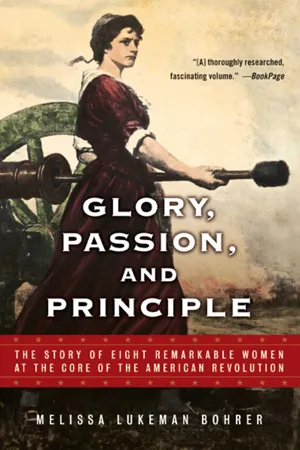
Glory, Passion, and Principle
eBook - ePub

Glory, Passion, and Principle

The Story of Eight Remarkable Women at the Core of the American Revolution

  1. 288 pages
  2. English
  3. ePUB (mobile friendly)
  4. Available on iOS & Android
eBook - ePub

Glory, Passion, and Principle

The Story of Eight Remarkable Women at the Core of the American Revolution

About this book

Much has been written of the brave deeds, acts of heroism, and intellectual prowess of the men who drafted the Declaration of Independence over two hundred years ago, yet almost no attention has been paid to the extraordinary women of that time -- women who helped found our nation with courage, sacrifice, and intellect equal to any of the famed male politicians of 1776. Glory, Passion, and Principle tells the story of eight incredible women, each deprived of formal education, world travel, or equal status, and yet all managed to flourish against incredible odds. Whether advising such men as John Adams, Thomas Jefferson, or Benjamin Franklin on political theory; publishing poems and plays that would rouse a nation to independent furor; helping negotiate treaties; acting as spies; or fighting alongside men in the military -- these women broke the limiting definitions imposed upon them, much as America was doing for itself, and helped form and found the country that is America today. Each chapter is dedicated to a different woman, starting with Abigail Adams, political confidante and wife of John Adams. Using her intellect to influence her husband's position in the Continental Congress, she earned the distinction of being the only person to put Thomas Jefferson in his place. Nancy Ward, the brave and diplomatic leader of the Cherokee tribe, matured from a young widow to bold warrior, risking her life and those of her people when she warned the Patriots of imminent attack by Native American tribes. She became a strong voice when the Treaty of Hopewell was signed in 1785.Yet another bright light was Sybil Ludington, a seventeen-year-old who took it upon herself to alert her town's militia that the British were coming, and survived a ride twice as long as Paul Revere's. And where Revere got caught, Ludington did not. Alongside Ludington, Adams, and Ward, the five other chapters chronicle the lives of Deborah Sampson, Lydia Darragh, Mercy Otis Warren, Phillis Wheatley, and Molly Hays. Filled with unimaginable heartbreak, personal sacrifice, and cunning survival skills, Glory, Passion, and Principle is an inspiring testament to the women who undoubtedly made a considerable dent in our great nation's history.
Frequently asked questions

Yes, you can cancel anytime from the Subscription tab in your account settings on the Perlego website. Your subscription will stay active until the end of your current billing period. Learn how to cancel your subscription.
No, books cannot be downloaded as external files, such as PDFs, for use outside of Perlego. However, you can download books within the Perlego app for offline reading on mobile or tablet. Learn more here.
Perlego offers two plans: Essential and Complete
  • Essential is ideal for learners and professionals who enjoy exploring a wide range of subjects. Access the Essential Library with 800,000+ trusted titles and best-sellers across business, personal growth, and the humanities. Includes unlimited reading time and Standard Read Aloud voice.
  • Complete: Perfect for advanced learners and researchers needing full, unrestricted access. Unlock 1.4M+ books across hundreds of subjects, including academic and specialized titles. The Complete Plan also includes advanced features like Premium Read Aloud and Research Assistant.
Both plans are available with monthly, semester, or annual billing cycles.
We are an online textbook subscription service, where you can get access to an entire online library for less than the price of a single book per month. With over 1 million books across 1000+ topics, we’ve got you covered! Learn more here.
Look out for the read-aloud symbol on your next book to see if you can listen to it. The read-aloud tool reads text aloud for you, highlighting the text as it is being read. You can pause it, speed it up and slow it down. Learn more here.
Yes! You can use the Perlego app on both iOS or Android devices to read anytime, anywhere — even offline. Perfect for commutes or when you’re on the go.
Please note we cannot support devices running on iOS 13 and Android 7 or earlier. Learn more about using the app.
Yes, you can access Glory, Passion, and Principle by Melissa Lukeman Bohrer in PDF and/or ePUB format, as well as other popular books in History & Early American History. We have over one million books available in our catalogue for you to explore.

Information

Breaking the Chains of Silence
PHILLIS WHEATLEY

image
In every human Breast, God has implanted a Principle, which we call Love of Freedom; it is impatient of Oppression, and pants for Deliverance.
—PHILLIS WHEATLEY
Africa, 1761
THE FIRE BLAZED out of control, casting a majestic red throughout the village as men, women, and children fled in terror. She struggled to keep up as her mother yelled her name, falling back every few minutes, only to be pulled forward. The crackle of the fire and the smell of burned flesh kept the terrorized seven-year-old girl going, but she reached a point when she suddenly couldn’t go any farther. That is when it reached up and pulled her on, the hand she thought was her mother’s. It was too late when she realized it was not. It was a different hand, a white hand, one that would take her from her family, her home, her country, and her freedom.
Phillis stood shackled to the man in front of her as she was forced to board an enormous schooner. All around her, hundreds of Africans pressed forward, every step carrying them farther away from home and closer to hell. She had looked for her mother earlier, but could not find her then, and still could not see her now.
She clutched her frail little hands in front of her and lowered her head. The wooden plank beneath her creaked and tilted, while the rough water below churned ominously. She had never been on a boat before, much less to sea. Her grandfather had told her all sorts of scary stories, though, and fear filled her heart. The bright sky—where she had stared at the stars with her father only the night before; where she had watched her mother bow to the rising sun every morning of her short life—slowly faded from view as she descended the stairs to the middle deck of the ship. She lifted her head one last time before the hope-filled sky.
Phillis was crammed with nearly seventy-five other girls in a room measuring only thirteen by twenty feet and only three feet, eight inches high. The ship was damp and cold; the smell of body odor and salt filled the air. The others were so close, she could feel their skin rub up against her own. The damp, choking darkness of the room suffocated her every time she tried to breathe. She curled into a little ball in the corner, where she would remain for nearly a month, thinking of her family. The ship pushed off, and the cabin filled with screams, the little girls falling on top of each other, the boat creaking loudly. Phillis looked up and caught one last glimpse of Africa, and felt an awful certainty that she would never see her parents again.
image
The sad and dreadful history of the African slave trade began in 1442, when a small Portuguese ship captured twelve blacks on a raid off the Atlantic coast of Africa. The slaves were carried back to Lisbon to become the slaves of Prince Henry the Navigator. Soon after, another expedition successfully captured 235 prisoners and carried them back to Portugal as well. By the early 1500s the slave trade was well under way, with the court at Lisbon eagerly pushing the profitable business with Africa. At that point in history both England and France looked down upon human cargo as trade, and Spain and Portugal commanded the field. By 1492, however, with Columbus’s discovery of America, the idea of slave labor quickly began to take hold. Columbus and the colonists first focused on the Native Americans, a people they saw as inferior, whose lands were ripe for the taking. Many Native Americans revolted or died from the harsh labor, the brutal treatment, or white man’s diseases against which they had no immunity. When this happened, the colonists looked to Africa. Charles V, king of Spain, granted a license to import slaves from Africa to the New World, and by 1540 ten thousand slaves a year were being carried in chains across the Atlantic to the West Indies, while others were taken to South America and Mexico.
The Portuguese monopoly on the slave trade began to break up when the English decided to get involved. In 1562 Admiral John Hawkins led three ships to the coast of Guinea, later called the Slave Coast: for his services, he was knighted by Queen Elizabeth two years later. The Dutch pushed the Portuguese off the African coast in 1642, and by the 1700s the English and French had become the two leading nations in the trafficking of slaves. In the late 1700s Europeans were operating forty slave stations on the African coast, the great majority coming from West Africa, along the three thousand miles of coast from Senegal in the north to Angola in the south.
North America became involved late in the game when, in 1619, a Dutch ship entered Jamestown in the colony of Virginia and sold twenty slaves in exchange for food and goods. By that time a million blacks had already been brought from Africa to South America and the Caribbean. But not until 1730, when staple agriculture—such crops as cotton, rice, and tobacco—began to spread, did North America import sizable numbers of slaves, linking the two countries both politically and economically.1 The years from 1730 to the outbreak of the American Revolution saw a surge of imports: by 1776 the slave population had climbed to more than 500,000. American traders did not have their own posts in Africa, so they used those of the English. Rhode Island was the colony most active; her ships made about a thousand voyages to Africa in one century, bringing over 100, 000 slaves to America. New York, Pennsylvania, and Massachusetts actively “plied the trade” as well, although relatively few slaves were brought to the northern colonies.
The Atlantic slave trade, as it came to be known, referred to the voyage of a trader from Europe to Africa, from Africa to the Americas, and from the Americas back to Europe, with the trip from Africa to the Americas being called the Middle Passage. But while this passage was fraught with danger and death, both for the slave and the trader, the ordeal for the kidnapped slave often began weeks or months before she set foot on the deck of the ship. Slaves brought to the coast from the interior of Africa were forced to march hundreds of miles to the sea in shackles; men, women, and children were bound in iron, their feet in fetters, their necks fastened to one another by rope or twisted thongs. Skeletons littered the earth surrounding the Gambia River.
Those who survived would sometimes have to wait many weeks at the mouth of the river, chained to the ship that waited, patiently, for enough human cargo to justify its setting sail. Many perished during this brutal wait; food and drink were scarce, conditions on the ship a nightmare. The physical conditions aboard a slave ship were not fit for animals, much less humans. The ships, steeped in filth, reeking with the vile stench of human excrement basting in heat, perspiration, fish, and sea mixed together, sat at the docks ready to greet their cargo.
And then the most dangerous, brutal part of all: the Middle Passage, the sea voyage across the Atlantic in a slave ship where men, women, and children were packed like sardines into the lower recesses, not an inch separating one from another. Slaves were forced down into the lower decks, beaten, flogged, and starved. Many died of dysentery, measles, smallpox, yellow fever, dehydration, or a variety of “fevers” that spread through ships like wildfire due to the unsanitary conditions. The Spanish contracts relating to slavery usually made an allowance for a death rate of up to 40 percent during the three-to-four-month voyage. A slave named Olaudah Equiano, in an account of his time on board a slave ship, described the stench as “so intolerably loathsome it was dangerous to remain there for any time,” bringing on a “sickness among the slaves of which many died.”2 He continued by saying, “This wretched situation was again aggravated by the galling of the chains … and the filth of the necessary tubs, into which the children often fell, and were almost suffocated. The shrieks of the women, and the groans of the dying, rendered the whole a scene of horror almost inconceivable.”3 Men, women, and children were split up, so that even if a family had remained together through their kidnapping, by the time they were aboard the ship, they would be separated. Many children, like Phillis, had been taken from their parents and placed on one of these ships all alone. The African slave trade to the Americas lasted for more than three and a half centuries.
Boston, 1761
Susannah and John Wheatley arrived at the dock just as the slave ship Phyllis finished unloading. A handsome, aristocratic couple, they had seen the advertisement for “Slaves to Be Sold” in the Boston Evening Post the night before, and Susannah had decided it was time to purchase a young slave girl, one who would care for her in old age. The slaves she already owned were older, not as malleable, she thought. She had cultivated in them neither love nor loyalty; and there was now no chance of their being anything other than domestics. But a young girl—that was a different story. A young girl could be loyal if treated right, if raised to know only Susannah as a mother figure; then, in old age, she would not be alone. She had children of her own—two, in fact—but children grow up, marry, leave home. Susannah wanted the assurance of having someone by her side when the time came.
The Wheatleys lived in an imposing mansion on Boston’s residential King Street (the same King Street that would host the Boston Massacre ten years later). John, one of Boston’s wealthier merchants, had begun as a tailor and had prospered with his own business. They shared two teenage children, Mary and Nathaniel. The Wheatleys were well established in Boston’s upper social circles, having both wealth and Christianity on their side.
They were standing toward the front of the crowd, near the auction block, where they had a clear view of the platform lined with black men, women, and children. It was a sweltering July afternoon, and the crowd was growing impatient for the auction to begin. It was Susannah who first caught sight of the little girl, standing with the others but hidden by the larger girls in front of her. She stood at the end of the line, off to the side, wrapped only in a dirty little carpet about her waist, her two small hands holding it up. She appeared so frail and sickly, her arms and legs thin as a skeleton, her long black hair matted around her face, her eyes facing downward, that it seemed an effort for her simply to stand. The sight tugged at Susannah’s heart as she made her way over to inquire.
After receiving no information from the slave master, a man too busy to be bothered with details of the child’s life, Susannah bent down to look into the child’s eyes: there was a desperation and fear in them, a sadness she had never seen before. She asked the girl her name, but did not receive an answer. An auctioneer, watching Susannah with bemused interest, answered that the child’s name was Phillis, pointing to the ship she had just arrived in. Susannah understood immediately: the little girl’s real name was unknown, her history lost. (Phillis would never regain her memory of life before her abduction, except to describe her mother as bowing to the morning sun at the start of each day. Historians have only guessed that she was an African of the Kaffir tribe who inhabit the country between Cape Colony and Delagoa Bay, or that she was an inhabitant of the Gambia River colony, or that she was possibly even from Senegal.)
“Can you speak, child?” Susannah asked, bending low enough to meet the child eye to eye.
The girl tried to open her mouth, revealing two missing teeth, but nothing came out. “The child must be only seven or eight years old, John,” Susannah cried, troubled by the thought of such a young child traveling as she had, so far from her land, alone in such wretched conditions. “She is just a baby. I am quite frankly amazed she has survived the trip at all.”
John looked at little Phillis himself and considered the fate she might come to in the hands of the wrong person. Even he, a slave owner, ach...

Table of contents

  1. Cover
  2. Dedication
  3. PREFACE
  4. With the Wind in Her Hair: SYBIL LUDINGTON
  5. Breaking the Chains of Silence: PHILLIS WHEATLEY
  6. First Adviser: ABIGAIL ADAMS
  7. Her Pen as Sword: MERCY OTIS WARREN
  8. Spy Games: LYDIA DARRAGH
  9. A Sister in Arms: MOLLY PITCHER
  10. Soldier with a Secret: DEBORAH SAMPSON
  11. A Woman Warrior: NANCY WARD
  12. Acknowledgments
  13. Notes
  14. Bibliograph
  15. Copyright