
- 352 pages
- English
- ePUB (mobile friendly)
- Available on iOS & Android
eBook - ePub
About this book
Virginia Mendenhall, a Quaker from North Carolina, is thirty-three years old when she travels to the arid plains of eastern Colorado in the mid-1930s to marry Alfred Bowen, ten years her senior. They have met only twice and have come to love each other through letters. Now, on an isolated ranch in the Dust Bowl, they must adjust to the harsh ranching life and the dangers of an untamed landscape, as well as the differences between them.
With an extended drought worsening the impact of the Depression in the West, neighbors turn against neighbors, and secrets from Alfred and Virginia's pasts come back to haunt them. But it is the arrival of Virginia's troubled brother on the ranch that sets off a chain of events with life-and-death consequences for them all.
Plain Language is a beautifully told tale of a man and woman fighting against tremendous odds for their land -- and their love.
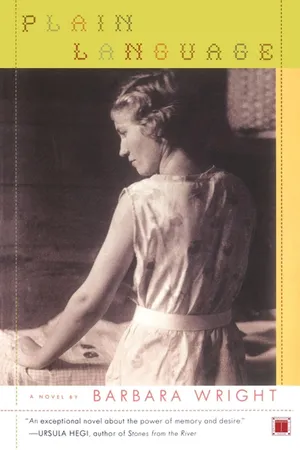
With an extended drought worsening the impact of the Depression in the West, neighbors turn against neighbors, and secrets from Alfred and Virginia's pasts come back to haunt them. But it is the arrival of Virginia's troubled brother on the ranch that sets off a chain of events with life-and-death consequences for them all.
Plain Language is a beautifully told tale of a man and woman fighting against tremendous odds for their land -- and their love.
Frequently asked questions
Yes, you can cancel anytime from the Subscription tab in your account settings on the Perlego website. Your subscription will stay active until the end of your current billing period. Learn how to cancel your subscription.
No, books cannot be downloaded as external files, such as PDFs, for use outside of Perlego. However, you can download books within the Perlego app for offline reading on mobile or tablet. Learn more here.
Perlego offers two plans: Essential and Complete
- Essential is ideal for learners and professionals who enjoy exploring a wide range of subjects. Access the Essential Library with 800,000+ trusted titles and best-sellers across business, personal growth, and the humanities. Includes unlimited reading time and Standard Read Aloud voice.
- Complete: Perfect for advanced learners and researchers needing full, unrestricted access. Unlock 1.4M+ books across hundreds of subjects, including academic and specialized titles. The Complete Plan also includes advanced features like Premium Read Aloud and Research Assistant.
We are an online textbook subscription service, where you can get access to an entire online library for less than the price of a single book per month. With over 1 million books across 1000+ topics, weāve got you covered! Learn more here.
Look out for the read-aloud symbol on your next book to see if you can listen to it. The read-aloud tool reads text aloud for you, highlighting the text as it is being read. You can pause it, speed it up and slow it down. Learn more here.
Yes! You can use the Perlego app on both iOS or Android devices to read anytime, anywhere ā even offline. Perfect for commutes or when youāre on the go.
Please note we cannot support devices running on iOS 13 and Android 7 or earlier. Learn more about using the app.
Yes, you can access Plain Language by Barbara Wright in PDF and/or ePUB format, as well as other popular books in Literature & Literature General. We have over one million books available in our catalogue for you to explore.
Information
FOUR
Alfred rode west to the windmill pasture. Frost sparkled on the tumbleweed trapped against the fence, and the early morning light caught the tiny specks of sand embedded in the earth. His horse, a sorrel mare he bought to replace Sage, had acquired a shaggy winter coat. Though not athletically gifted, the horse was even-tempered and sure-footed. Alfred had not yet named her, and had no inclination to do so. He called her the Sorrel, and for now that was enough.
The sun created a halo through the whirling windmill blades. Overnight, ice had formed in the tank. Alfred unstrapped his ax and took it out of its leather sheath. The wind picked up out of the east. He pulled down the fleece flaps on his cap and raised his collar. The cattle munched on saltbush along the far fence.
He scattered ash on the skirt of ice at the base of the tank where water had overflowed. He hated to see water wasted like that, but he couldnāt disconnect the windmill or the pipes and hoses might freeze. When he found a spot where he could stand without slipping, he brought the ax head down hard on the ice in the tank. Glittering chips flew from beneath the blade like sparks. Several cows drifted over and eyed him with interest, their heads tilted and alert.
Before long, sweat was rolling down his back, and he took off his jacket and cap. When he broke through the ice, water splashed on his leather gloves and soaked his jeans. He lifted out the large ice chunks he had loosened and heaved them away from the tank.
As soon as he finished, a few aggressive cows moved in, plunged their noses into the icy water, and drank until their sides bulged. The more timid cows waited their turn and then shyly approached, skimming their noses along the surface and flicking the water into their mouths with their tongues.
The wind was too high for him to work on the windmill blades, so he rode over to the section of the ranch that he had leased from the school. By the time he got there, his jeans had frozen stiff. When he dismounted, his jeans cracked like boards at the knees. The fingers of his leather work gloves were stiff and woody, like an old gnarled root. His woollen underwear hung damp about his legs and chest and gave him a deep chill. Before he started his work, he gathered some driftwood and brush and started a fire. He held his hands close to the flames, palms up first, then down, waiting for the sensation to return. When he was able to move his fingers again, he warmed his lunch of leftovers on the flames.
Lunch was not something he looked forward to. One thing about Virginiaāshe could not cook. Not that he was complaining. At least, not to her. Lord knows, she tried. That was one thing he admired about herāhow much effort she put into things. But she did not take naturally to the kitchen the way his mother did, or, for that matter, the way he did. He had cooked for himself for years, before Virginia arrived, and he was not a bad cook, if he did say so himself. Most of his bachelor friends never fixed a dish with more than one ingredient: hot dogs, rice, potatoes. Virginia wasnāt that bad, but how anyone could ruin natureās humblest and most delicious offering, the potato, was beyond him. Her boiled potatoes were soggy, her mashed potatoes had the texture of Cream of Wheat, and her baked potatoes shriveled up and pulled away from the skin. Her cornbread tasted like sawdust, and the meat she fixed, regardless of the cut, reminded him of the long brown slabs of chewing tobacco in Daveās General Storeāno matter how much you chewed, it never dissolved.
In his years of cooking for himself, he had picked up a few pointers. An onion could improve anything. Salt pork added flavor to vegetables and meats. Friends in Mexico had taught him how to spice up dishes with garlic and red pepper. But Alfred didnāt pass these suggestions on to Virginia, for fear of insulting her. She was insecure about her cooking. Instead he tried to encourage her with enthusiastic comments that were misleading without being downright dishonest, such as, āThis really hits the spot,ā or, āMashed potatoesāmy favorite!ā
But he didnāt dwell on her cooking. After all, she had improved his life in so many ways. Nothing had prepared him for the pleasures of marriage. The great physical discomfort and isolation of ranch work became so much more bearable, knowing that she was at the house waiting for him. At the end of the day, he achedābone, muscles, jointsāyet still he felt energized as he headed home. It surprised him how longing could regenerate a body that had been pushed beyond its endurance. Emotions embarrassed him. Physical pleasure did not. It was so pure, so uncomplicated.
After four months of marriage, the newness had not worn off, and he delighted in discovering things about her. He admired her willingness to tackle new projects, her ability to laugh at herself, to make him take himself less seriously. There was something very masculine about the way she went about her businessāpurposeful, set on getting the job done so she could get on to something elseāan approach that worked well for housework and chores, if not for cooking.
She was opinionated without being pushy. When choosing a book to read aloud, she would try to interest him in those spunky English heroines she liked so much. He proposed Thucydides, but he understood how she, being a Quaker, did not want to read about the Peloponnesian War. They came together on Henry James.
She was mildly eccentric without crossing the line into downright peculiarity. He found it endearing how, over a game of Lexikon, she would stick out her tongueājust the tipāwhen concentrating on the letter tiles on the board. And the way she got her back up over a small transgression of the rules.
He suspected that, having lived alone for so many years, he had developed his own share of odd ticks and traits. When he was growing up, he had known a fair number of crotchety codgers who lived in remote mountain cabins, cut off by snow for months at a time. Not one would pass for what you might call normal. Hard life and isolation had honed their eccentricities to a fine point. He thought of Juke, who had more toes than teeth, or one-eyed Joe, who braided his beard in a pigtail. Old man Bollinger grew out the fingernail on his little finger until it curved over his wrist like a scythe. Men without women were a strange lot. It was hard to say whether they had turned strange being alone, or whether they were strange to begin with and therefore unable to attract a woman.
Alfred suspected that he, too, might have been susceptible to profound weirdness, had he remained alone for many more years. Perhaps all men who lived alone had that potential. His father certainly did, having quit school in the seventh grade to help his crippled father on the ranch; but he benefited from the softening influence of his wife, a cultured woman who traded a job as a piano teacher for the hard life on a ranch. He had encouraged her interest in music. He wanted her to have a semblance of the intellectual and artistic life he could not provide. But when she taught young Alfred to play the piano, Alfredās father became enraged. Music was not a manly pursuit. It was not a worthy way to spend oneās time when there was so much work to be done on the ranch.
Alfred resorted to deception, and his mother was a willing collaborator. She gave his father the impression that school let out an hour later than it did, and Alfred would sneak home and practice the piano before going to help his father and brother on the ranch.
One afternoon, his father returned unexpectedly to the house. Alfred was practicing a Chopin nocturne, a slow, lyrical melody of the kind that is challenging because there are no technically demanding passages to cover up any other failings. He looked up and saw his father standing in the doorway. Alfredās fingers went limp, as if his tendons had been severed.
āI do believe you have your motherās gift,ā his father said. āPity you werenāt born a woman.ā
Alfred wanted to continue practicing, just to show his father. But he could play no more. He simply could not move his fingers.
His father was wrong. He lacked his motherās gift. He was moderately talented, nothing more. He did not pursue a career in music, but he never thought heād want to go into ranching. And then in Mexico he began to yearn for the cool, high meadows, the ice-tipped peaks, the trout stream, the aspen groves, and the pine forests of his fatherās mountain ranch.
So he returned from Mexico after a long absence, hoping his father would take him in. But time and distance had done nothing to improve their relationship. While his mother fluttered and fussed over him, his father remained distant. At the dinner table on the night of his return, Alfredās mother asked him about his future plans. Alfred said, āIāve been thinking about going into ranching.ā
His father pushed his chair back and crossed his arms. He was a not a large man, but he had a large effect. āHow are you going to do that?ā he said. He did not countenance fools, sissies, intellectuals, or sheep, and his son was suspect on three of the four counts.
āIāve got money saved up,ā Alfred said. āLand is cheap, especially in the eastern part of the state.ā
His father laughed. āSure itās cheapādirt cheap. And thereās a reason.ā
Alfred had forgotten how effectively his father could cut him down to size with a few well-chosen words. He would have thought, after so many years, that heād be out of practice, the way Alfredās fingers had lost their dexterity after being away from the piano.
His mother rushed in to smooth things over, as was her habit. āYouāve been out of the country and havenāt read the papers. Every week it seems thereās another article about ranchers on the plains selling out and moving on.ā
āWeāre lucky weāve got water from the mountains,ā his father said. āBut out east, the landās just drying up and blowing away.ā
āI canāt afford mountain land,ā Alfred said.
It was the perfect opportunity for his father to say, āWhy donāt you come work with me on the ranch?ā Thatās what Alfred had hoped for. He hadnāt counted on it, for damn sure heād never ask, but he had hoped. After all, Alfredās father had worked on the mountain ranch with his own father until he died, when Alfred was ten.
But clearly Alfredās father had no intention of carrying on that family tradition. He cleared his throat, mumbled something under his breath, and excused himself from the table.
Alfredās mother patted his hand and said, āWe have complete confidence in you, whatever you decide to do.ā It was an old trick of hers, to include his father in her āweāāāWe love youā¦. Weāre fascinated by your letters about Mexican cultureā¦. We canāt wait for you to return to Colorado.ā Surely she knew that his father did not fit comfortably under the umbrella of her āwe.ā
āHe doesnāt think I can do it,ā Alfred said.
āOf course he does. Youāre his son. Being a cattleman is in your blood.ā
He did not contradict her, but got up and left. He would show the old man. Heād make a go of it on his own, even if it killed him.
If his brother, Shrine, were alive, heād be working at his fatherās side. No one had mentioned him since Alfred had returned from Mexico, but Alfred felt Shrineās presence in the house.
Shrineās real name was Samuel, after his father, but everybody called him Shrine. He was two years older than Alfred and was adored by his father. Shrine was quick and athletic. He was mutton-busting by the age of fiveāa pint-sized fellow riding a sheep like a bucking bronco. As a child, Shrine carried a rope looped over his shoulder and lassoed everything in sightāfence posts, yucca bushes, bales of hay fitted with a stuffed-fabric cowās head. He soon moved on to calves. His coordination and sense of timing were exceptional, and as he grew up, he excelled at roping calves, breaking horses, and cutting cattle.
As a child, Alfred had been dreamy and shy. Because he had inherited his motherās love of reading and music, he had been tagged a sissy. Both Shrine and his father belittled him. If Alfred made a mistake, it was proof of his incompetence. If Shrine made the same mistake, he was just having a bad day.
Alfred shrank from competition: Shrine thrived on it. Shrine had a fierce need to win even the stupidest gameāmany of which he inventedāas long as it was something he wanted to be best at. Whenever Alfred won an award at school fo...
Table of contents
- Cover
- Colophon
- ALSO BY BARBARA WRIGHT
- Title Page
- Copyright
- Dedication
- ONE
- TWO
- THREE
- FOUR
- FIVE
- SIX
- SEVEN
- EIGHT
- NINE
- TEN
- ELEVEN
- TWELVE
- THIRTEEN
- FOURTEEN
- FIFTEEN
- SIXTEEN
- SEVENTEEN
- EIGHTEEN
- ACKNOWLEDGMENTS