A Magnificent Catastrophe
eBook - ePub

A Magnificent Catastrophe

The Tumultuous Election of 1800, America's First Presidential Campaign

  1. 352 pages
  2. English
  3. ePUB (mobile friendly)
  4. Available on iOS & Android
eBook - ePub

A Magnificent Catastrophe

The Tumultuous Election of 1800, America's First Presidential Campaign

About this book

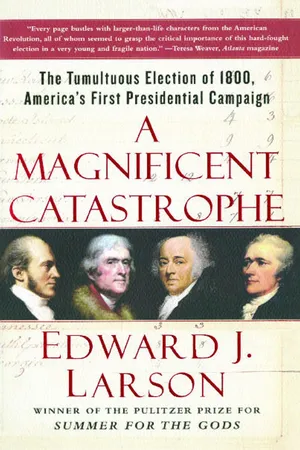
CHOICE Outstanding Academic Title "They could write like angels and scheme like demons." So begins Pulitzer Prize-winner Edward Larson's masterful account of the wild ride that was the 1800 presidential election—an election so convulsive and so momentous to the future of American democracy that Thomas Jefferson would later dub it "America's second revolution."This was America's first true presidential campaign, giving birth to our two-party system and indelibly etching the lines of partisanship that have so profoundly shaped American politics ever since. The contest featured two of our most beloved Founding Fathers, once warm friends, facing off as the heads of their two still-forming parties—the hot-tempered but sharp-minded John Adams, and the eloquent yet enigmatic Thomas Jefferson—flanked by the brilliant tacticians Alexander Hamilton and Aaron Burr, who later settled their own differences in a duel.The country was descending into turmoil, reeling from the terrors of the French Revolution, and on the brink of war with France. Blistering accusations flew as our young nation was torn apart along party lines: Adams and his elitist Federalists would squelch liberty and impose a British-style monarchy; Jefferson and his radically democratizing Republicans would throw the country into chaos and debase the role of religion in American life. The stakes could not have been higher.As the competition heated up, other founders joined the fray—James Madison, John Jay, James Monroe, Gouverneur Morris, George Clinton, John Marshall, Horatio Gates, and even George Washington—some of them emerging from retirement to respond to the political crisis gripping the nation and threatening its future.Drawing on unprecedented, meticulous research of the day-to-day unfolding drama, from diaries and letters of the principal players as well as accounts in the fast-evolving partisan press, Larson vividly re-creates the mounting tension as one state after another voted and the press had the lead passing back and forth. The outcome remained shrouded in doubt long after the voting ended, and as Inauguration Day approached, Congress met in closed session to resolve the crisis. In its first great electoral challenge, our fragile experiment in constitutional democracy hung in the balance. A Magnificent Catastrophe is history writing at its evocative best: the riveting story of the last great contest of the founding period.
Frequently asked questions

Yes, you can cancel anytime from the Subscription tab in your account settings on the Perlego website. Your subscription will stay active until the end of your current billing period. Learn how to cancel your subscription.
At the moment all of our mobile-responsive ePub books are available to download via the app. Most of our PDFs are also available to download and we're working on making the final remaining ones downloadable now. Learn more here.
Perlego offers two plans: Essential and Complete
  • Essential is ideal for learners and professionals who enjoy exploring a wide range of subjects. Access the Essential Library with 800,000+ trusted titles and best-sellers across business, personal growth, and the humanities. Includes unlimited reading time and Standard Read Aloud voice.
  • Complete: Perfect for advanced learners and researchers needing full, unrestricted access. Unlock 1.4M+ books across hundreds of subjects, including academic and specialized titles. The Complete Plan also includes advanced features like Premium Read Aloud and Research Assistant.
Both plans are available with monthly, semester, or annual billing cycles.
We are an online textbook subscription service, where you can get access to an entire online library for less than the price of a single book per month. With over 1 million books across 1000+ topics, we’ve got you covered! Learn more here.
Look out for the read-aloud symbol on your next book to see if you can listen to it. The read-aloud tool reads text aloud for you, highlighting the text as it is being read. You can pause it, speed it up and slow it down. Learn more here.
Yes! You can use the Perlego app on both iOS or Android devices to read anytime, anywhere — even offline. Perfect for commutes or when you’re on the go.
Please note we cannot support devices running on iOS 13 and Android 7 or earlier. Learn more about using the app.
Yes, you can access A Magnificent Catastrophe by Edward J. Larson in PDF and/or ePUB format, as well as other popular books in History & Military & Maritime History. We have over one million books available in our catalogue for you to explore.

Information

CHAPTER ONE

FROM FRIENDS TO RIVALS

ALTHOUGH the friendship between Adams and Jefferson took root in Philadelphia during the opening days of the American Revolution, it blossomed in Paris at war’s end. Again, the scene included Franklin. For the scene in Philadelphia, John Trumbull created the enduring image of the trio in his monumental painting, The Declaration of Independence. They stood together, seemingly larger than life, at the focal point of attention amid a sea of delegates at the Continental Congress, their purposeful eyes gazing forward as if into the future. A war with Britain lay ahead, and the task of building a new nation.
They had changed by the time the war finally ended and they could begin building on the promise of peace. Already the oldest signer of the Declaration in 1776, Franklin was seventy-eight in 1784, stooped with gout and kidney stones, when Jefferson reached Paris to augment the American diplomatic delegation there. Shortly after declaring the nation’s independence, Congress had dispatched Franklin to seek French support for the Revolution. Adams joined him in 1778 and, although Franklin had obtained an alliance with France by then, they worked together with a shifting array of American diplomats to secure loans from the Dutch, peace with Britain, and commercial treaties with other nations.
Of middling height and decidedly square shouldered, Adams had added to his girth on a diplomat’s diet. Tall for his day, Jefferson had grown into his height by 1784 and typically held himself more upright than before. When the three patriot leaders reunited as diplomats in Paris, the physical contrast between them had become almost comical. Upon making their initial joint appearance at the royal court in Versailles, one bemused observer likened them to a cannonball, a teapot, and a candlestick. America, however, never enjoyed abler representation in a foreign capital.
Franklin arrived in France already a celebrity and enhanced his reputation further while there. Hailed as the Newton of his day for his discoveries in electricity and renowned also as an inventor, writer, practical philosopher, and statesman, Franklin vied only with Voltaire as the public face of the Enlightenment, which then dominated French culture and influenced thought throughout Europe and America. When the two senior savants embraced at a public meeting of the French Academy of Sciences in 1778, it seemed as if all Europe cheered—or so Adams reported with evident envy. “Qu’il etoit charmant,” he caustically commented in two languages. “How charming it was!”
The sage of Philadelphia became a fixture in the finest salons of Paris and continued his scientific studies even as he served as America’s senior diplomat in Europe. Ladies of the court particularly favored him, and he them, which gave Franklin access to the inner workings of pre-Revolutionary French society. These activities complemented each other by reinforcing Franklin’s already legendary stature. Born in poverty on the edge of civilization and content to play the part of an American rustic by wearing a bearskin cap in fashion-conscious Paris, Franklin received honors and tributes from across Europe. A gifted diplomat, he secured what America needed from France to win the Revolution and secure its independence.
While in France, Adams always served in Franklin’s shadow. At first, he accepted the shade. “The attention of the court seems most to Franklin, and no wonder. His long and great reputation…[is] enough to account for this,” Adams wrote during his first year in Paris. Adding to his aggravation, however, was that Europeans seemingly took pains to distinguish him from his better-known cousin, the revolutionary firebrand Samuel Adams. “It was a settled point at Paris and in the English newspapers that I was not the famous Adams,” the proud New Englander complained, “and therefore the consequence was settled absolutely and unalterably that I was a man of whom nobody ever heard before, a perfect cipher.”
Gradually, Adams turned his rancor on Franklin, which soured their relationship. Except for John Jay (who joined them in negotiating peace with Britain), prior to Jefferson none of the diplomats sent by Congress to work with Franklin and Adams could bridge the growing divide. “The life of Mr. Franklin was a scene of continued dissipation. I could never obtain the favor of his company,” Adams observed bitterly. “It was late when he breakfasted, and as soon as breakfast was over, a crowd of carriages came to his…lodgings, with all sorts of people: some philosophers, academicians, and economists…but by far the greater part were women and children who came to see the great Franklin.” Then came formal dinners, parties, and concerts. “I should have been happy to have done all the business, or rather all the drudgery, if I could have been favored with a few moments in a day to receive his advice,” Adams complained, “but this condescension was not attainable.” Yet, Franklin managed a triumph at every turn despite (or perhaps because of ) his socializing, which rankled the Puritan in Adams.
The only respite came in 1779 when, after Franklin secured the alliance with France and became America’s sole ambassador to the French court, Adams returned to Massachusetts. He was back in Europe before year’s end, however, assigned to work with Franklin and Jay in negotiating peace with Britain.
Despite their animosities, Franklin and Adams labored on with amazing success, each putting his nation’s interests above his own. Always blunt and sometimes explosive, Adams was an unnatural diplomat at best. The odd-couple blend of Franklin’s tact and Adams’s tirades produced results. The alliance with France held, Britain conceded a generous peace, and America gained and maintained its independence from both of those grasping world powers. Between the two men, however, their personal relationship never recovered. Franklin’s characterization of Adams stuck to him like tar and stained him forever: “Always an honest man, often a wise one, but sometimes, in some things, absolutely out of his senses.”
Both men rejoiced in 1784 when Jefferson arrived in Paris to join them in seeking postwar treaties of commerce and friendship with the various European nations. For Franklin, the attraction was obvious. A scientist and philosopher in his own right, Jefferson shared Franklin’s Enlightenment values and religious beliefs. As fellow Deists, they acknowledged a divine Creator but, as Jefferson once wrote, they trusted in “the sufficiency of human reason for the care of human affairs.” If they prayed for anything from God, it was for wisdom to seek answers rather than for the answers themselves. Better yet for their relationship, Jefferson accepted Franklin’s greatness without a trace of envy. In 1785, when Congress granted Franklin’s longstanding request to retire and tapped Jefferson to serve as America’s ambassador in Paris, the Virginian stressed that he would merely succeed Franklin: No one could replace him.
Adams seemed as happy as Franklin to receive Jefferson. His “appointment gives me great pleasure,” Adams exulted at the time. “He is an old friend…in whose abilities and steadiness I always found great cause to confide.” Best of all for Adams, Jefferson readily deferred to him and treated him as a senior colleague. “Jefferson is an excellent hand,” Adams soon wrote. “He appears to me to be infected with no party passions or natural prejudices or any partialities but for his own country.” Adams highly valued these traits. He accepted a political hierarchy founded on talent and believed in disinterested service by the elite. Jefferson seemed to exemplify these characteristics. Adams now spoke of the “utmost harmony” that reigned within the American delegation. “My new partner is an old friend and coadjutor whose character I studied nine or ten years ago, and which I do not perceive to be altered. The same industry, integrity, and talents remain without diminution,” Adams observed.
Although Adams may not have noticed it at first, Jefferson had, however, changed. He now carried his height with dignity and hid his insecurities behind an ever more inscrutable facade. Never as self-confident as Adams, Jefferson learned to ignore the type of slights that often enraged Adams. In 1776, frustrations with public life and concerns about his wife’s health led Jefferson to resign from Congress and decline appointment as a commissioner to France. He needed time at his beloved Monticello plantation. Once home, Jefferson reclaimed his seat in the Virginia legislature; worked to reform state laws to foster such republican values as voting and property rights, the separation of church and state, and public education; and served two troubled one-year terms as governor during the darkest days of the Revolution. After his wife, Martha, died following a difficult childbirth in 1782, Jefferson agreed once more to represent Virginia in Congress and, two years later, accepted the renewed offer to represent America in Paris. With his wife gone, he needed to leave Monticello as much as he once needed to be there. He grieved for her greatly and kept the vow purportedly made by him to her on her deathbed never to remarry.
During the week that Jefferson arrived, Adams’s wife and three younger children joined Adams and their two older children in Paris after five painful years of separation. The Adamses welcomed the lonely Virginian into their happy home. For Jefferson, Abigail Adams became a trusted source of personal and family advice from a woman who was his intellectual equal. She also took Jefferson’s two surviving children under her wing at times. He reciprocated in a manner that led John Adams to comment later to Jefferson that, in Paris, young John Quincy “appeared to me to be almost as much your boy as mine.” Upon Adams’s departure from Paris in 1785 to become the first American ambassador to Britain, Abigail expressed her regret about leaving Jefferson, whom she described as “the only person with whom my companion could associate with perfect freedom and unreserve.” To Adams, Jefferson wrote, “The departure of your family has left me in the dumps. My afternoons hang heavy on me.”
With both Franklin and Adams gone, however, Jefferson came into his own as the leading American diplomat on the European continent. Immersing himself in French culture as Adams never did, he became attached to the French people and hoped for their freedom from monarchic despotism and Catholic clericalism. “I do love this people with all my heart and think that with a better religion and a better form of government…their condition and country would be most enviable,” Jefferson wrote to Abigail Adams in 1785. The French royals, personified for some by the debauched queen Marie Antoinette, and many French aristocrats and church leaders lived in splendid isolation from the grinding poverty of the forgotten masses.
For a time, the friendship between Adams and Jefferson survived their separation. In 1787, for example, after Jefferson’s closest political ally and confidant in Virginia, James Madison, questioned Adams’s character, Jefferson (while conceding Adams’s vanity and irritability) replied, “He is so amiable that I pronounce you will love him if ever you become acquainted with him.” Two years later, Adams concluded a letter to Jefferson with the words, “I am with an affection that can never die, your friend and servant.” At heart, however, it was a friendship between political allies fixed in time and place.
In both Philadelphia and Paris, Adams and Jefferson represented similar or the same interests far from home, and did so with extraordinary passion and ability. This united them. As their political goals for America diverged, however, their ideological zeal drove them apart. These were serious, ambitious men with deep beliefs and grand ideas. Whenever and wherever their paths crossed, Adams and Jefferson were destined to become either fast friends or formidable foes.
During their early lives in the mid-1700s, no one could have guessed that the paths of Adams and Jefferson would ever cross—much less assume overlapping courses during the late 1700s and then collide in 1800. Prior to the coming of the American Revolution, the northern and southern colonies might as well have occupied separate continents. A Virginian and a New Englander—even two such cosmopolitan lawyers as Adams and Jefferson—would have little occasion to meet each other, except perhaps in London on imperial business. Instead they met in Philadelphia at the Second Continental Congress in 1775 with the shared goal of freeing the colonies from Britain’s yoke. Their ambitions for themselves and their new nation became the basis for their special friendship.
Ambition marked these men. Both were the first sons in rising families at a time when social custom and inheritance law placed special opportunities and obligations on the eldest male heir. Jefferson’s industrious father had greatly expanded the family’s land and slave holdings in central Virginia, and passed them to his eldest boy along with a lively intellect, a craving for material possessions, and a fierce streak of independent self-reliance. Adams’s father was also driven, but in a pious Puritan sense that pushed him to expand his modest Massachusetts farm, accept positions of trust within his local church and community, and sacrifice to send his firstborn son to Harvard College with a hope that, through formal education, the son could outshine the father in every good and virtuous endeavor. Like his father, Adams tried to live well within his means. Indeed, he enjoyed nothing more than being with his family and smoking a good cigar, both of which he did as often as he could.
Adams and Jefferson drank in their fathers’ ambitions and made them their own. “Reputation ought to be the perpetual subject of my thoughts, and the aim of my behavior,” Adams chided himself in his diary while still a young lawyer in 1759. He soon wrote to a friend, “I am not ashamed to own that a prospect of an immortality in the memories of all the worthy to [the] end of time would be a high gratification to my wishes.” To achieve this goal, he devoted himself to study far beyond the requirements of his profession. Indeed, few colonists of his day could boast of as deep or broad a legal education as Adams’s—except perhaps Thomas Jefferson.
At the College of William and Mary, Jefferson chose study over social life in a manner wholly foreign to the convivial spirit of that place as a finishing school for the planter elite. He “could tear himself away from his dearest friends and fly to his studies,” one classmate recalled. Others estimated that Jefferson worked fifteen hours a day. He wanted to learn the law, Jefferson admitted, so that he would “be admired.” Simply becoming a lawyer and planter was not enough, however, because he continued his bookish studies long after passing the bar and inheriting his father’s plantation. Indeed, in 1767, he counseled a young lawyer about the “advantage” of ongoing study, and recommended reading science and theology before breakfast; the law during the forenoon; politics at lunch; history in the afternoon; and literature, criticism, and rhetoric “from dark to bedtime.” Jefferson imposed just such a regimen on himself as a young lawyer and continued a disciplined program of self-education throughout his long life. “Determine never to be idle. No person will have occasion to complain of want of time who never loses any. It is wonderful how much may be done if we are always doing,” he wrote to his daughter Martha in 1787. “A mind always employed is always happy.”
As young lawyers, the greatest challenge faced by Adams and Jefferson lay in gaining sufficient scope for their ambitions. No American colony could provide a suitable stage to display their talents, and the British Empire offered only bit parts to colonial actors. Thinking back in later life about their prospects as ambitious young men, both Adams and Jefferson recalled that initially they could conceive of no higher positions for themselves than appointment to the King’s Council (or senate) for their respective colonies. Perhaps that fed their disillusionment with the imperial regime. They wanted so much more than the King would allow his colonists.
Vain to a fault, Adams never hid his ambitions. In 1760, for example, before the first stirrings of the American Revolution, he wrote prophetically to a friend, “When heaven designs an extraordinary character, one that shall distinguish his path thro’ the world by any great effects, it never fails to furnish the proper means and opportunities; but the common herd of mankind, who are to be born and eat and sleep and die, and be forgotten, is thrown into the world as it were at random.” Adams saw himself in the former class—as did Jefferson—but colonial America could not offer him a “proper means” to glory. Not content with waiting upon heaven to supply the means, Adams examined his options. “How shall I gain reputation?” he wrote in a 1759 diary entry. Shall I patiently build my law practice or “shall I look out for a cause to speak to, and exert all the soul and all the body I own to cut a flash…? In short shall I walk a lingering, heavy pace or shall I take one bold determined leap?” He chose to leap.
In 1765, new stamp taxes on newspapers and other printed matter imposed by Britain solely on American colonists gave Adams his first chance to attach himself to a larger cause. He began testing his revolutionary rhetoric by denouncing the new taxes as “fabricated by the British Parliament for battering down all the rights and liberties in America.” This assault appeared in Adams’s private diary, however. Although he met frequently with patriot leaders and drafted stern instructions from his town to the colonial legislature condemning “taxation without representation,” Adams mostly pulled his punches in public or published his words anonymously, perhaps in part to protect his growing legal practice. When Britain repealed the repressive levy in response to widespread colonial protests, Adams envied the glory heaped upon more-visible patriots, including his fiery cousin Samuel.
By the time of the Townshend Duties crisis in 1768, which erupted after Britain imposed added tariffs on American imports, Adams wrote privately that his legal career “will neither lead me to fame, fortune, [or] power, nor to the service of my friends, clients or country.” Determined to make his mark, increasingly he became the public leader of the patriot cause in Massachusetts through his writings, speeches, and government service. He became an early advocate of independence at a time when most Americans still thought that they could work out their differences with Britain amicably. In comparison with his public service, the private practice of law became a “desultory life” for Adams: he called it “dull,” “tedious,” and “irksome.”
Jefferson gradually reached the same conclusion as Adams about the law and his career. He privately dismissed legal literature as “mere jargon” as early as 1763 and abandoned his law practice altogether in 1774, after receiving a sizable inheritance following his father-in-law’s death. Almost immediately, Jefferson emerged within the Virginia colonial legislature as a prominent critic of British rule. He had a bearing and intellectual depth that commanded respect—even awe.
Drawing on their years of training and practice, Adams and Jefferson turned from defending private clients to prosecuting the American Revolution. They had found their path to glory and a stage equal to their ambitions and abilities: the United States of America.
Adams went to the First Continental Congress in 1774 as a committed proponent of independence. Jefferson joined him a year later at the Second Continental Congress, which met continously during the American Revolution. They shared a resolve to break with the mother country, making them staunch allies. Their kindred spirits—at once philosophical and practical—also made them friends who could converse and conspire in confidence. In Congress, both men quickly gained the respect and influence that naturally flows to members with firm convictions, superior intelligence, and an ability to persuade others. Although Jefferson spoke little in formal sessions of Congress, Adams recalled that from their first encounters he found the Virginian “so prompt, frank, explicit, and decisive upon committees...

Table of contents

  1. Cover
  2. Colophon
  3. ALSO BY EDWARD J. LARSON
  4. Title Page
  5. Copyright
  6. Dedication
  7. Epigraph
  8. Contents
  9. Preface
  10. INTRODUCTION: Independence Day, July 4, 1776
  11. CHAPTER ONE: From Friends to Rivals
  12. CHAPTER TWO: Crossing the Bar
  13. CHAPTER THREE: “Electioneering Has Already Begun”
  14. CHAPTER FOUR: Burr v. Hamilton
  15. CHAPTER FIVE: Caucuses and Calumny
  16. CHAPTER SIX: A New Kind of Campaign
  17. CHAPTER SEVEN: For God and Party
  18. CHAPTER EIGHT: Insurrection
  19. CHAPTER NINE: Thunderstruck
  20. CHAPTER TEN: The Tie
  21. EPILOGUE: Inauguration Day, March 4, 1801
  22. Notes
  23. Index
  24. ILLUSTRATION CREDITS
  25. ABOUT THE AUTHOR
  26. Photographic Insert