Grand Obsession
eBook - ePub

Grand Obsession

A Piano Odyssey

  1. 320 pages
  2. English
  3. ePUB (mobile friendly)
  4. Available on iOS & Android
eBook - ePub

Grand Obsession

A Piano Odyssey

About this book

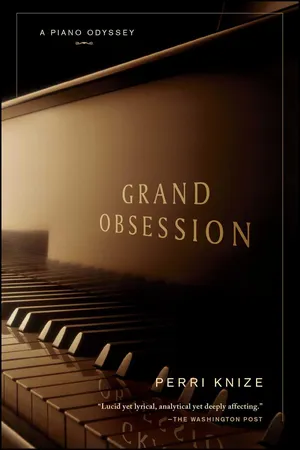
A fascinating, lyrical memoir about one woman's obsessive search for the perfect piano-and about finding and pursuing passion at any age How can a particular piano be so seductive that someone would turn her life upside down to answer its call? How does music change human consciousness and transport us to rapture? What makes it beautiful? In this elegantly written and heartfelt account, Perri Knize explores these questions with a music lover's ardor, a poet's inspiration, and a reporter's thirst for knowledge. The daughter of a professional musician, Knize was raised in a home saturated in classical music, but years have passed since she last played the instrument that mesmerized her most: the piano. Surprised by a sudden, belated realization that she is meant to devote her life to the instrument, she finds a teacher and soon decides to buy a piano of her own. What begins as a search for a modestly priced upright leads Knize through dozens of piano stores all over the country, and eventually ends in a New York City showroom where she falls madly in love with the sound of a rare and pricey German grand. "At the touch of the keys, I am swept away by powerful waves of sound, " Knize writes. "The middle section is smoky and mysterious, as if rising from the larynx of a great contralto. The treble is bell-like and sparkling, full of color, a shimmering northern lights. A soul seems to reside in the belly of this piano, and it reaches out to touch mine, igniting a spark of desire that quickly catches fire." The seduction is complete. But the piano far exceeds Knize's budget. After a long and painful dalliance, she refinances her house to purchase the instrument that has transfixed her. The dealer ships it to her home in Montana, and she counts the days until its arrival. When at last she sits down to play, almost delirious with anticipation, the magical sound is gone and the tone is dead and dull. Devastated, she calls in one piano technician after another to "fix" it, but no one can. So begins the author's epic quest to restore her piano to its rightful sound, and to understand its elusive power. This journey leads her into an international subculture of piano aficionados -- concert artists, passionate amateurs, dealers, technicians, composers, and builders -- intriguing characters all, whose lives have also been transformed by the spell of a piano. Along the way she plays hundreds of pianos, new and vintage, rare and common, always listening for the bewitching tone she once heard from her own grand, a sound she cannot forget. In New York, she visits the high-strung technician who prepared her piano for the showroom, and learns how a wire tightened just so, or an artfully softened hammer can transform an unremarkable instrument into one that touches listeners to their core. In Germany, she watches the workers who built her piano shape wood, iron, wool, and steel into musical instruments, and learns why each has its own unique voice. In Austria, she hikes the Alps to learn how trees are selected to build pianos, and how they are grown and harvested. With each step of her journey, Knize draws ever-closer to uncovering the reason her piano's sound vanished, how to get it back, and the deeper secret of how music leads us to a direct experience of the nature of reality. Beautifully composed, passionately performed, Grand Obsession is itself a musical masterpiece.
Frequently asked questions

Yes, you can cancel anytime from the Subscription tab in your account settings on the Perlego website. Your subscription will stay active until the end of your current billing period. Learn how to cancel your subscription.
No, books cannot be downloaded as external files, such as PDFs, for use outside of Perlego. However, you can download books within the Perlego app for offline reading on mobile or tablet. Learn more here.
Perlego offers two plans: Essential and Complete
  • Essential is ideal for learners and professionals who enjoy exploring a wide range of subjects. Access the Essential Library with 800,000+ trusted titles and best-sellers across business, personal growth, and the humanities. Includes unlimited reading time and Standard Read Aloud voice.
  • Complete: Perfect for advanced learners and researchers needing full, unrestricted access. Unlock 1.4M+ books across hundreds of subjects, including academic and specialized titles. The Complete Plan also includes advanced features like Premium Read Aloud and Research Assistant.
Both plans are available with monthly, semester, or annual billing cycles.
We are an online textbook subscription service, where you can get access to an entire online library for less than the price of a single book per month. With over 1 million books across 1000+ topics, we’ve got you covered! Learn more here.
Look out for the read-aloud symbol on your next book to see if you can listen to it. The read-aloud tool reads text aloud for you, highlighting the text as it is being read. You can pause it, speed it up and slow it down. Learn more here.
Yes! You can use the Perlego app on both iOS or Android devices to read anytime, anywhere — even offline. Perfect for commutes or when you’re on the go.
Please note we cannot support devices running on iOS 13 and Android 7 or earlier. Learn more about using the app.
Yes, you can access Grand Obsession by Perri Knize in PDF and/or ePUB format, as well as other popular books in Media & Performing Arts & Music. We have over one million books available in our catalogue for you to explore.

Information

Publisher
Scribner
Year
2008
Print ISBN
9780743276399

I

1

Epiphany

In the autumn of my forty-third year, I remembered, quite unexpectedly, that I was meant to be a pianist.
I was alone in my car, on my way to spend a weekend with friends. I fumbled through a box of cassette tapes I kept on the front passenger seat and found one my brother gave me: pianist Arthur Rubinstein performing Chopin waltzes. This might make a good soundtrack for the trip, I thought, and I pushed the cassette into the tape deck.
From the opening notes of Opus 18—quick, percussive repetitions of B-flat—the car seemed to rock in sympathy to the driving three-quarter-time beat, taken at a wildly joyous tempo. Rubinstein’s complete freedom within the music astonished me, and his abandonment to it was contagious—the music seemed to enter my pulse and carbonate my blood.
Meanwhile, through the windshield, Montana’s luminous Indian summer performed a fitting accompaniment: a sapphire sky hung behind the Elkhorn Mountains, where tawny grasses gleamed in the lowering sun. Quaking aspen lined the banks of the Boulder River; their burnished leaves turned up their bellies to the wind and trembled in unison, a ribbon of gold threading its way up the valley.
I found myself gripping the steering wheel, as if I were hanging on for the ride, gripped myself by a piano-induced rapture that was as sweet as it was searing.
This is all that I want to do with my life. These words arose as if from nowhere in my mind, astonishing me. This is all that I want to do with my life. They hit with the force of an inner directive that cannot be questioned. They arose again and again, as if rising on the swells of the music itself.
The beauty of the day intensified the heartbreak: I felt as if I’d missed an urgent and critical appointment that could never be rescheduled. I had reached my own autumn, and the leaves would soon fall. How then could I devote my life to the piano?
I recognized this inner voice—it was that of the child I had been, eight years old and asking for piano lessons that were not forthcoming.
• • •
“Which instrument will you choose?” my father asked one spring evening. He peered at me from beneath his knotted brow, heavy with an ever-present intensity that always suggested an impending storm. That day my third-grade class had attended a presentation of all the band and orchestra instruments; they were available to rent for school music lessons in the coming fall.
Some people are passionate about music. My father was ferocious about it. Until I came along, he was a professional musician. In the 1940s, he played first clarinet with the Denver, Columbus, Chicago Civic, and Ballet Russe de Monte Carlo orchestras. During the war years, while undergoing army intelligence training at Yale, he studied with the great German neoclassicist composer Paul Hindemith, and dreamed of becoming a conductor. In the early 1950s, at the end of his still-youthful music career, he played first clarinet in the Metropolitan Opera Orchestra and with the Metropolitan Quintet.
Though he gave up professional performing at the age of thirty-five for a more lucrative career as a design manager at a stereo company, his life and our home remained saturated in music. When I was a child, his love of music penetrated my every cell and pore. Each night I fell asleep listening to the sonorous sounds of his clarinet as he accompanied recordings of his favorite works. A clarinet was never just a clarinet to me, and never will be: it is the sound of my father’s voice.
There is no time I can remember when he was not training me to have a musician’s ear. I had my own high-fidelity component system before I was two, and my own collection of classic children’s records: The Carnival of the Animals by Saint-Saëns, Peter and the Wolf by Prokofiev, The Nutcracker Suite by Tchaikovsky, and the opera Hansel and Gretel by Englebert Humperdinck (the composer, not the pop star).
But the stereo was never just on—no!—this was not background music! We were, rather, to always listen closely: “See how the theme from the beginning comes in again now, except in a different key?” my father would point out.
Nor was the radio ever just on when we drove somewhere in the car. The dial was tuned to a classical station, and I listened with all my being as my father described the qualities of the soloist—“He has a ‘juicy’ sound,” my father would say—or noted the tempo: “See? He’s rushing. You must never rush. You must play each note for its full value.”
I listened closely because there would be a quiz—before the work ended my father would ask me to identify the composer, the conductor, the orchestra, and the soloist. Then, when the announcer came on, we would see how well I did. My father, with great deliberation, was teaching me how to listen.
This was not a wasted effort on his part—I had a very good ear, good enough that my father often used me as his rehearsal coach, and took my judgment of his playing seriously. I did not reject the gifts he shared with me, but embraced them, and worshipped him as one might an Old Testament–style god—with an equal mixture of fear and admiration. I took his theology, his only religion—music—as my own.
My father applied this sort of rigorous training to my intellectual upbringing as well. He taught me to question all assumptions, to carefully read between all lines, to always think for myself. Each Sunday we applied critical analysis to the stories in the newspaper—to both the content and the caliber of the writing. What questions went unasked? Where was the reader misled? And in every conversation with my father, no matter how serious or trivial, these skills were honed to a high polish: suspect, question, investigate, skewer. He taught them as contentiously as I imagine a rabbi might grill a Yeshiva boy over the Talmud. It is no wonder I ultimately became an investigative reporter and put those powerful tools to work.
Meanwhile, I plundered his vast record collection with his tacit approval. I wore out his copies of Nathan Milstein playing the Tchaikovsky violin concerto, the Vienna Octet playing the Schubert Octet, and Karl Böhm conducting the Berlin Philharmonic’s rendition of Brahms’s first symphony. This last became a kind of personal anthem, and I would spend hours alone listening to it in my room, conducting before a mirror.
Yet the enormous musical universe I inhabited was isolating. I could not play the music I loved for my friends—they would not have understood, and I would have become an outcast. As vast as this music was, as exalted as it made me feel, it also induced claustrophobia: it belonged only to me, my father, and, infrequently, my father’s musical friends.
Some Sunday mornings, his friends would arrive with their instruments—strings, or other woodwinds—and they would have a few rousing hours playing chamber music in our living room. Mozart, Hindemith, Beethoven, Couperin, Brahms, Schubert. My father’s musician friends were always relaxed, full of jokes and witticisms that went over my head. They were nothing like other parents I knew: they laughed loudly, told dirty stories, and winked at me frequently. I loved to be near them.
My mother served what she called “Jewish breakfast”: bagels and lox and cream cheese, smoked whitefish, and jelly donuts. My younger brother and I could partake of the food, and we could sit quietly and listen, but we were not to interrupt or ask questions.
My father’s question was really a series of questions: Which instrument would I choose to join him on his musical journey? Which instrument would be mine when we played duets together? Which instrument would I contribute to his chamber music gatherings? And finally, with which instrument would I fulfill the musical promise he himself had abandoned?
In my father’s universe, music was a serious business, and so, by deduction, the choice of one’s instrument could not be a casual thing, but rather was fraught with larger implications for one’s ultimate destiny. I was too young to think this consciously, but I sensed it, I felt its heft, and it felt too heavy for me, too dark, and too oppressive. For I was growing up not only in the shadow of my father’s musical achievements, but also under the long, dark pall of his abandoned musical ambitions and the force of his enormous, deeply frustrated, and explosive personality.
Answering my father was rarely easy. He was an intimidating giant of a man, a former college football player, six foot two and a swollen 245 pounds, with thick, meaty hands, every finger broken and bent. His once luxuriantly curly hair was mostly gone now, his dark, handsome face puffy from intemperance, worry, and overwork. His expression was often a scowl, his voice brusque, the tone irritated and angry, even when he said he wasn’t. Sometimes, at the sound of that voice, his children would burst into tears.
I had an idea of the answer my father wished to hear, but for just a moment I heard instead my own small, inner voice whisper to me: the piano.
Our piano was a beat-up, turn-of-the-century upright player my mother bought at an auction when I was three. When we moved to a spacious colonial home in Annapolis, Maryland, the following year, she painted it white, with house paint, to make it fit in with the décor of the 1830s plantation house. When I lifted the fallboard to reveal the yellowed ivories, the original mahogany finish still showed. There was no name on the fallboard. This was one of millions of nameless pianos produced during the instrument’s Golden Age, in the early years of the twentieth century, when every middle-class home aspired to own a piano. At that time, pianos were the family hearth, the center of home entertainment. Soon they were replaced by the phonograph, the radio, television, and now the computer.
This old upright was to become my longtime friend. The day it arrived, as soon as it was placed in our den, my mother sat down before the keyboard, pulled me onto her knees, and began working the foot treadles behind the opened doors of the piano’s lower compartment. The treadles cranked and creaked and thunked, working the bellows that sucked air through a pneumatic player mechanism that turned a spool upon which a paper roll was wound. The paper had holes punched through it, in a perforated pattern like a ticker tape.
The doors of the upper panel were parted so we could see the paper roll turn on the spool. As the paper passed over a tracker bar, air was sucked through the perforations, each representing a note on the piano. The vacuum activated a pneumatic striking mechanism, which then activated the hammers. As the hammers struck the strings they pulled the ivory keys along with them.
The sight of the keys moving up and down, depressed and released as if by ghostly invisible hands, mesmerized me. The creaking and groaning of the treadles, the wheezing of the bellows in the belly of the old player were spooky. The music was a turn-of-the-century standard, “Daisy, Daisy,” silly and fun and bright. I shrieked with delight as my beautiful, young mother sang along with the music and held me on her rollicking lap, in her arms, her legs pumping under me as if she were using a bicycle to wind an enormous music box.
When my mother’s father came to visit, he always played the piano for us. Grandpa Joe had never learned how to read music, but he was a natural, with big hands and an unerring ear. You could sing him anything and he could sound out the melody and make up a chord accompaniment on the spot, and then he was off and running. But mostly he played the same kind of music that was on the piano rolls, songs recalling the summers he spent as a lifeguard at the beach on Coney Island in the ’teens, and his time as a soldier in World War I. He’d play “Take Me Out to the Ball Game,” “Who’s Sorry Now?” “Shine On, Harvest Moon,” and “Baby Face,” and my grandmother would sing along, rocking in the rocking chair, tapping her foot, grinning, no doubt remembering the days of their youth.
Grandpa Joe was an unpretentious man with a goofball, faintly racy sense of humor. When my mother was a girl, during the Great Depression and World War II, he went to the record store once a week to pick out the silliest recording he could find. I inherited his record collection because none of his children wanted it—my uncle Carl put all the 78 rpm records together in one album and labeled it “Junk” and gave it to my mother. My mother passed it on to me. Playing the collection now reminds me of my grandfather’s irreverence: Spike Jones singing “Der Fuehrer’s Face” with its fart noises, and “The Sheik of Araby” with its obscene gargling sound effects; Eddie Cantor singing “I’m Hungry for Beautiful Girls.” There are World War I popular tunes: “I Don’t Want to Get Well—I’m in Love with a Beautiful Nurse,” which includes the coy lyric “I always get a Band-Aid every time she feels my pulse.”
My friends and I beat on the old upright often; it was the center of our playtime, with hyperkinetic renditions of “Chopsticks” and “Heart and Soul” the order of the day. Babysitters entertained us on it, and once, after I had...

Table of contents

  1. Cover
  2. Dedication
  3. Prelude: From a Tree in the Forest
  4. Part I
  5. Part II
  6. Part III
  7. Acknowledgments
  8. About The Author
  9. Copyright