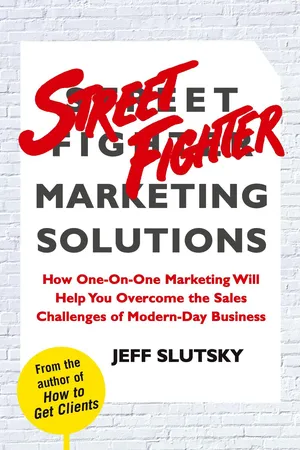
Street Fighter Marketing Solutions
eBook - ePub

Street Fighter Marketing Solutions

How One-On-One Marketing Will Help You Overcome the Sales Challenges of Modern-Day Business

  1. 288 pages
  2. English
  3. ePUB (mobile friendly)
  4. Available on iOS & Android
eBook - ePub

Street Fighter Marketing Solutions

How One-On-One Marketing Will Help You Overcome the Sales Challenges of Modern-Day Business

About this book

For any business owner, franchise operator, or marketing executive who seeks to increase sales while lowering marketing costs, Jeff Slutsky offers a new way of thinking. In this indispensable guide to getting more bang for your buck, the well-known marketing consultant tells business managers to think tactically and locally -- using nontraditional, highly targeted forms of marketing and advertising.

The tactics, ideas, approaches, and strategies in Street Fighter Marketing Solutions are geared for the bewildering new challenges that confront business- people in the new hypercompetitive, advertising-polluted environment in which they must seek profits.

With pressures from "big box" retailers, internet competition, and a glut of other immediate competitors, businessmen and businesswomen need a war chest of proven ideas and strategies to help them thrive. Additionally, local businesses suffer from advertising price increases despite eroding audiences from the local media, especially newspapers, radio, and TV. This book could be the answer to your current and future marketing problems.

You'll learn how to mold and manipulate traditional advertising methods while supplementing or supplanting them with alternative, novel techniques for lower cost and higher reward.

National and regional corporations who sell their products and services through a network of local retailers, franchisees, or dealers will also benefit greatly from this book. It will provide them with an easy-to-understand blueprint on how to develop, roll out, and maintain a practical, money-saving, sales-generating Street Fighter Marketing program throughout their organization.

In a book full of success stories, Slutsky discusses in a clear, practical, straightforward manner how Street Fighter Marketing techniques can work for you. The first step to growing your market share may well be to spend a few hours in the company of one of the nation's most savvy and engaging business tacticians.

For more information and a downloadable video, visit www.streetfightermarketing.com.
Frequently asked questions

Yes, you can cancel anytime from the Subscription tab in your account settings on the Perlego website. Your subscription will stay active until the end of your current billing period. Learn how to cancel your subscription.
At the moment all of our mobile-responsive ePub books are available to download via the app. Most of our PDFs are also available to download and we're working on making the final remaining ones downloadable now. Learn more here.
Perlego offers two plans: Essential and Complete
  • Essential is ideal for learners and professionals who enjoy exploring a wide range of subjects. Access the Essential Library with 800,000+ trusted titles and best-sellers across business, personal growth, and the humanities. Includes unlimited reading time and Standard Read Aloud voice.
  • Complete: Perfect for advanced learners and researchers needing full, unrestricted access. Unlock 1.4M+ books across hundreds of subjects, including academic and specialized titles. The Complete Plan also includes advanced features like Premium Read Aloud and Research Assistant.
Both plans are available with monthly, semester, or annual billing cycles.
We are an online textbook subscription service, where you can get access to an entire online library for less than the price of a single book per month. With over 1 million books across 1000+ topics, we’ve got you covered! Learn more here.
Look out for the read-aloud symbol on your next book to see if you can listen to it. The read-aloud tool reads text aloud for you, highlighting the text as it is being read. You can pause it, speed it up and slow it down. Learn more here.
Yes! You can use the Perlego app on both iOS or Android devices to read anytime, anywhere — even offline. Perfect for commutes or when you’re on the go.
Please note we cannot support devices running on iOS 13 and Android 7 or earlier. Learn more about using the app.
Yes, you can access Street Fighter Marketing Solutions by Jeff Slutsky in PDF and/or ePUB format, as well as other popular books in Business & Entrepreneurship. We have over one million books available in our catalogue for you to explore.

Information

Publisher
Free Press
Year
2007
Print ISBN
9780743299145
eBook ISBN
9781416546153

1

THE PROBLEMS WITH THE FUTURE OF MARKETING

What is the best form of advertising? This question is asked more times than any other at our Street Fighter Marketing seminars and workshops. At the risk of sounding evasive (or like an adult diaper), the answer is “Depends.” Nearly every form of advertising can be effective, and every form of advertising can be a total waste of your money. It depends on a number of different factors that are specific to your situation. Those variables include your type of business, your marketplace, your position in the marketplace, your brand equity, the season, your product lines, and so on. It’s like asking a doctor which drug is the best. It depends on what the ailment is, what other drugs you’re taking, what other conditions you have, and your overall health.
I would also like to point out that the question itself is flawed. What should be asked is, “Which form of marketing is best?” Advertising is just one part of marketing. Marketing also includes many other tools, like public relations, telemarketing, sales, direct mail, sponsorships, the internet, and a host of others. To continue with the doctor analogy, drugs are just one of the tools at a doctor’s disposal. She can also recommend surgery, physical therapy, psychotherapy, nutritional counseling, and exercise or other types of behavior modification. The solutions recommended to a given patient depend on the specific needs of that patient.
Unfortunately, media salespeople often like to play doctor but have one treatment regardless of the problem. And they all want to perform a special surgical procedure called a “cashectomy.” It’s often done without a proper diagnosis and administered without anesthetic—the three-martini lunch notwithstanding. As a result, in spite of administering a costly remedy, you suffer the same ailment.
Most advertising and marketing have become less effective because the consumer has become increasingly immune to them. While the advertising media is charging more to deliver messages, those messages are less likely to get noticed and remembered. A study by Yankelovich Partners, an American marketing-services consultancy, found that 65 percent of people now feel “constantly bombarded” by ad messages, and 59 percent feel that ads have very little relevance to them. Almost 70 percent said they would be interested in products or services that would help them avoid marketing pitches. Think about that: 70 percent of consumers will spend money to avoid being bombarded with the never-ending proliferation of marketing messages.
“It has been calculated that the average American is subjected to some three thousand advertising messages every day,” wrote the authors. “If you add in everything from the stickers on cars to slogans on sweatshirts, and the ads in newspapers, on taxis, and in subways, then some people could be exposed to more than that number just getting to the office. No wonder many consumers seem to be developing the knack of tuning out advertising.”
“Consumers are getting harder to influence as commercial clutter invades their lives,” says a report by Deutsche Bank. It examined the effectiveness of TV advertising on twenty-three new and mature brands of packaged goods and concluded that in some cases it was a waste of time, not to mention a waste of money. Although TV advertising would lead to a short-term incremental increase in volume sales in almost every case, there was a positive cash return on that investment in only 18 percent of cases. Over a longer term, the picture improved, with 45 percent of cases showing a return on investment. The study concluded that ‘increased levels of marketing spending were less important than having new items on the shelf and increasing distribution.’”1
Let’s examine more closely the reasons that marketing and advertising dollars are rapidly becoming less and less effective. We’ll look at two different areas. The first will be the traditional mass media. The second will be a variety of nonmedia-oriented marketing approaches that many businesses attempt to use to increase their overall effectiveness.
TRADITIONAL ADVERTISING MEDIA
The Daily Newspaper
In most markets, the daily newspaper is a primary advertising medium for all types and sizes of local businesses. Despite the major mergers, the increased cost of newsprint, and the downsizing of news staffs, the big problems from an advertiser’s standpoint are these:

Problem: Newspaper circulation is down, yet advertising rates go up.

  1. Circulation continues to decline annually.
  2. Advertising rates increase annually.
  3. Competition increases from alternate sources for news, sports, business, entertainment, and promotion delivery.
  4. An attitude of superiority has developed with an inferior service.
According to an article published by Jouralism.org, a media-research organization:
Newspaper circulation is in decline. The root problems go back to the late 1940s, when the percentage of Americans reading newspapers began to drop. But for years the U.S. population was growing so much that circulation kept rising and then, after 1970, remained stable. That changed in 1990, when circulation began to decline in absolute numbers. And the problem now appears to be more than fewer people developing the newspaper habit. People who used to read every day now read less often. Some people who used to read a newspaper have stopped altogether. Today, just more than half of Americans (54 percent) read a newspaper during the week, somewhat more (62 percent) on Sundays, and the number is continuing to drop.2
With circulation declining and readership habits such that your ads are less likely to be seen by readers, you’re working with a less efficient medium. Combine that with ever-increasing advertising rates, and it’s easy to see that local businesses are spending more money to reach dramatically fewer potential customers. Despite this bleak forecast, there are still times that it might make sense to use newspaper advertising. Even then, however, the managements at the newspapers act as if they had the same monopolistic power in the marketplace as they once enjoyed several decades earlier. This attitude forces local businesses to seek alternative forms of advertising even after initially considering using the local newspaper.
The Consumers’ Choice Award in Indianapolis, Indiana (www.ccaindy.com), is a client of ours who has used newspaper advertising successfully for many years. Every year, it would publish a full-color tabloid insert in all of the newspapers in its markets, including the Indianapolis Star, promoting the winners of its award. The licensing fee for participating in the program included a quarter-page ad in the tabloid. After several years of the Consumers’ Choice Award increasing the number of pages of its insert, the Star decided that it wanted to sell the advertising directly to the winners and would not permit the Consumers’ Choice Award to publish its insert like it had in years past.
What the management team at the Star didn’t realize was that most of the participants in the program did not usually buy newspaper advertising. But since it was included in the licensing fee, they were happy to take advantage of it. As a result, the Consumers’ Choice Award took that newspaper budget of around $50,000 and used it to purchase advertising time on local television. (This budget will likely double in the next few years.) Much to its delight, the TV campaign made a much bigger impact than the inserts ever did. So even if the Star offered to allow the insert again, it would have to drop the price dramatically for the Consumers’ Choice Award to consider such a move, based on the newfound return on the marketing investment, or ROMI.3
Several of the licensees had never used television advertising before. As a result of this experience, some moved big portions of their marketing budgets from purchasing print to purchasing broadcast space.
Broadcast Television
Local television stations have been a powerful advertising medium to many local businesses over the years. But unlike the daily newspapers, there has been and continues to be some competition among the four major networks and several of the local independent stations. And like the daily newspapers, local television audiences have been eroding at the same time that spot rates have increased. Broadcast television has lost audience to cable, satellite TV, video gaming, and the internet. Remote-control units and digital video recorder (DVR) services like TiVo allow television viewers to avoid viewing commercials.
A survey released by the Association of National Advertisers (ANA) and Forrester Research found that:
78 percent of advertisers feel that traditional television advertising has become less effective in the past two years. The survey also found that marketers are exploring emerging technologies to help bolster their television advertising spending.
Key highlights of the ANA/Forrester survey include:
  • Almost 70 percent of advertisers think that DVRs and video-on-demand will reduce or destroy the effectiveness of traditional thirty-second commercials.
  • When DVRs spread to thirty million homes, close to 60 percent of advertisers say that they will spend less on conventional TV advertising.
  • Advertisers are also looking at alternatives to traditional TV advertising and will spend more of their advertising budgets on: branded entertainment within TV programs (61 percent); TV program sponsorships (55 percent), interactive advertising during TV programs (48 percent), online video ads (45 percent), and product placement (44 percent).4
Like the newspaper, local television attracts fewer viewers but charges more, and the viewers that it gets are less likely to even see your commercials. Television still has the power to reach a lot of people, but to get any kind of return, you’ll have to think like a Street Fighter.
Cable TV
Local cable television was a great way to supplement a local broadcast TV schedule. For more modest budgets, it was an affordable way to take advantage of sight, sound, and motion in your advertising. At a local level, it could allow you to be on a number of different national television programs. It was affordable, which allowed you to buy enough frequency to get your message remembered. But just as cable television is starting to come into its own as an effective advertising medium, it is being challenged:
Though cable television remains the predominant technology for the delivery of video programming, cable’s share has fallen from almost 100 percent a decade ago to about 75 percent of pay TV subscribers. This is due to competition from direct broadcast satellite TV service, which first became commercially available in 1993. Today almost 22 percent subscribe to a satellite service.5
Radio
Radio stations have been very good at combining promotional opportunities with their standard programming. Radio is also the most flexible of the mass advertising media. One of the biggest problems with getting results from radio is that there are just too many choices: choosing the right station (usually based on format like country, talk, top 40, etc.), at the right day-part, with the right number of commercials (frequency), for an effective duration of time (schedule), with the right message (creative). Then you have to factor in what other media and marketing approaches you are using along with it (media mix). Plus, there’s one element that often gets overlooked, and that’s the cost to reach each member of the listening audience. This element is generally expressed as the Cost Per Thousand (CPM; “M” stands for one thousand here). In comparing stations, you need to know what you’re paying to reach each one thousand listeners of your target audience. Just because a station is rated number one doesn’t mean that it’s number one for you. Too often, the biggest mistake local businesses make with radio is buying too little too often to really make it work. Even if you figure all that out, you have to come up with a message that gets the job done for you.
In the face of all those choices, radio may be also suffering from an erosion of its audience. A local radio now competes with satellite radio, audio CDs, DVDs, iPods, cell phones, and global positioning system (GPS).
Bridge Ratings recently did a study to see what effect MP3 players are having on radio listenership among twelve-to eighteen-year olds. Not surprisingly, people who owned players have tuned in less since the purchase of their MP3 player. They also mention in an earlier study that listeners are listening to a wider variety of music genres, forcing radio stations to change their programming.6
Yet radio is perhaps the most affordable of all the major mass media, and it’s one of the most flexible as well. But just because you can afford to buy it doesn’t mean you are going to see a return on your investment. We’ve had attendees at our seminars tell us that they tried radio, and it didn’t work for them. Their assumption was that radio doesn’t work. In fact, they didn’t use the medium correctly to get results.
Outdoor Advertising
Due to the increasing restrictions for new billboards by most communities, there is a shrinking amount of good inventory in outdoor advertisin...

Table of contents

  1. Cover
  2. Colophon
  3. Title Page
  4. Copyright
  5. Dedication
  6. Contents
  7. INTRODUCTION: HOW THIS BOOK HELPS YOUR BUSINESS
  8. 1: THE PROBLEMS WITH THE FUTURE OF MARKETING
  9. 2: SHOW ME THE ROMI (RETURN ON MARKETING INVESTMENT)
  10. 3: MAXIMIZING YOUR LOCAL MASS MEDIA
  11. 4: NEIGHBORHOOD MARKETING STRATEGIES (TAKING IT TO THE STREETS)
  12. 5: NEIGHBORHOOD MARKETING TACTICS (DOING IT IN THE STREETS)
  13. 6: DIRECT MAIL THAT WON’T GET TRASHED
  14. 7: INSIDER MARKETING
  15. 8: INTER NET PROFIT
  16. 9: PROFITING FROM NONPROFITS
  17. 10: ÜBER OUTDOOR ADVERTISING
  18. 11: EMAIL, VOICE MAIL, PHONE, AND FAX
  19. 12: PUBLICITY PLAIN AND SIMPLE
  20. 13: DATA MINING, INTELLIGENCE GATHERING, AND COVERT OPERATIONS
  21. 14: EXPANDING YOUR HORIZONS WITH EVENTS
  22. ENDNOTES
  23. ACKNOWLEDGMENTS
  24. ABOUT THE AUTHOR