
- 336 pages
- English
- ePUB (mobile friendly)
- Available on iOS & Android
eBook - ePub
About this book
Russ Feingold is a rarity in American politics. A staunch civil libertarian, he was the only member of the U.S. Senate who voted against the ill-conceived USA Patriot Act that was rushed through Congress in the wake of the September 11 terrorist attacks. In 2002, while the Bush administration's fabrications and scare tactics persuaded an overwhelming majority of the Senate to vote for the Iraq war resolution, Feingold opposed it. Washington insiders thought such controversial votes could doom Feingold's 2004 reelection. But he won by a near landslide, far outdistancing his party's presidential candidate, John Kerry.
Sanford D. Horwitt writes in this timely, compelling independent biography that Russ Feingold "represents the progressive side of the Democratic divide more clearly and authentically than any successful politician on the national stage." The third-term senator's willingness to take bold stands -- he was the first in the Senate to call for a timetable for redeploying U.S. troops from Iraq -- has inspired a growing number of rank-and-file Democrats across the country.
Drawing on scores of interviews and historical documents, Horwitt shows that Feingold's authenticity is deeply rooted in the old progressive tradition personified by one of his heroes, Robert M. La Follette, the legendary Wisconsin governor and U.S. senator. "Fighting Bob" and the other great reformers of the Progressive Era placed a high value on honest, efficient government, investment in public education, health and infrastructure, and curbs on corporate power and other wealthy interests in the political process.
Feingold became known to a national audience when he teamed up with Republican John McCain on campaign finance reform legislation. After a seven-year battle, the McCain-Feingold bill became the first major reform of the campaign laws since the Watergate era.
Feingold, who grew up in a small southeastern Wisconsin town, is a man of modest means and the grandson of Jewish immigrants. In this lively portrait, Horwitt evokes mid-century Janesville, a Republican stronghold on the banks of the Rock River, where a precocious Rusty Feingold absorbed lifelong lessons about the importance of community and personal integrity.
Beginning with his first election to public office, he has defied conventional political wisdom and long odds, Horwitt tells us, a pattern that has been repeated throughout his career. Feingold has shown how a new, reinvigorated Democratic Party can stand for progressive ideals, resist the corrupting influence of special interests and win elections.
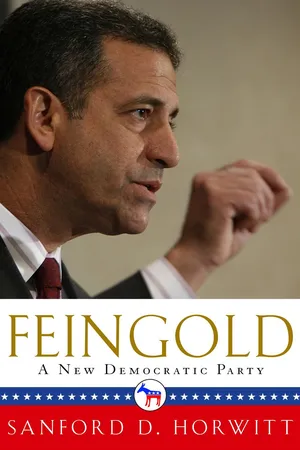
Sanford D. Horwitt writes in this timely, compelling independent biography that Russ Feingold "represents the progressive side of the Democratic divide more clearly and authentically than any successful politician on the national stage." The third-term senator's willingness to take bold stands -- he was the first in the Senate to call for a timetable for redeploying U.S. troops from Iraq -- has inspired a growing number of rank-and-file Democrats across the country.
Drawing on scores of interviews and historical documents, Horwitt shows that Feingold's authenticity is deeply rooted in the old progressive tradition personified by one of his heroes, Robert M. La Follette, the legendary Wisconsin governor and U.S. senator. "Fighting Bob" and the other great reformers of the Progressive Era placed a high value on honest, efficient government, investment in public education, health and infrastructure, and curbs on corporate power and other wealthy interests in the political process.
Feingold became known to a national audience when he teamed up with Republican John McCain on campaign finance reform legislation. After a seven-year battle, the McCain-Feingold bill became the first major reform of the campaign laws since the Watergate era.
Feingold, who grew up in a small southeastern Wisconsin town, is a man of modest means and the grandson of Jewish immigrants. In this lively portrait, Horwitt evokes mid-century Janesville, a Republican stronghold on the banks of the Rock River, where a precocious Rusty Feingold absorbed lifelong lessons about the importance of community and personal integrity.
Beginning with his first election to public office, he has defied conventional political wisdom and long odds, Horwitt tells us, a pattern that has been repeated throughout his career. Feingold has shown how a new, reinvigorated Democratic Party can stand for progressive ideals, resist the corrupting influence of special interests and win elections.
Frequently asked questions
Yes, you can cancel anytime from the Subscription tab in your account settings on the Perlego website. Your subscription will stay active until the end of your current billing period. Learn how to cancel your subscription.
No, books cannot be downloaded as external files, such as PDFs, for use outside of Perlego. However, you can download books within the Perlego app for offline reading on mobile or tablet. Learn more here.
Perlego offers two plans: Essential and Complete
- Essential is ideal for learners and professionals who enjoy exploring a wide range of subjects. Access the Essential Library with 800,000+ trusted titles and best-sellers across business, personal growth, and the humanities. Includes unlimited reading time and Standard Read Aloud voice.
- Complete: Perfect for advanced learners and researchers needing full, unrestricted access. Unlock 1.4M+ books across hundreds of subjects, including academic and specialized titles. The Complete Plan also includes advanced features like Premium Read Aloud and Research Assistant.
We are an online textbook subscription service, where you can get access to an entire online library for less than the price of a single book per month. With over 1 million books across 1000+ topics, we’ve got you covered! Learn more here.
Look out for the read-aloud symbol on your next book to see if you can listen to it. The read-aloud tool reads text aloud for you, highlighting the text as it is being read. You can pause it, speed it up and slow it down. Learn more here.
Yes! You can use the Perlego app on both iOS or Android devices to read anytime, anywhere — even offline. Perfect for commutes or when you’re on the go.
Please note we cannot support devices running on iOS 13 and Android 7 or earlier. Learn more about using the app.
Yes, you can access Feingold by Sanford D. Horwitt in PDF and/or ePUB format, as well as other popular books in Politica e relazioni internazionali & Biografie in ambito politico. We have over one million books available in our catalogue for you to explore.
Information
CHAPTER1
“I’M FOR KENNEDY!”
For much of the twentieth century, the two biggest annual events in Janesville, Wisconsin, were the week-long Rock County 4-H Fair and the Labor Day parade, a fitting tandem for a town surrounded by cornfields and pastures and home to a huge, sprawling General Motors plant.
In August of 1960, when seven-year-old Rusty Feingold and his dad, Leon, went to the fair, as locals called it, there were far more four-legged animals in Rock County than people. In fact, there were three times as many milk cows, hogs and pigs, and sheep and lambs as there were men, women and children. Slightly more than 35,000 of the two-legged variety lived in Janesville, the county seat. Janesville experienced a population explosion of 40 percent between 1950 and 1960, mostly the result of post–World War II births among existing Janesville families. The Feingolds were an example: while Nancy and David were born during the war, the number of Feingold children doubled when Russ was born in 1953 and his sister Dena two years later. So, while the town now had many more people, most of the families who lived there had not changed. In 1960, the “City in the Country,” as the Janesville Gazette liked to call it, looked the same and had the same traditions for as long as most could remember.
Going to the fair was one of those traditions. Billed as the country’s oldest 4-H county fair, the first was held in 1930 on some thirty-five acres along Milwaukee Street in the heart of Janesville. Throughout Rock County, young people belonged to local 4-H Clubs, which was part of a national leadership and education program for rural youth. They pledged “their allegiance to the improvement of the Head (thinking), Heart (loyalty), Hands (skills) and Health.” In the summer, they would come to the fair in Janesville to compete for blue ribbons by exhibiting their calves, pigs, sheep, canned goods, baked items and sewing skills.
There were other attractions at the fair in 1960, such as the music by Red Hedgecock and the Hedgechoppers, the annual horse-pulling contest and the sideshow and carnival rides. Like all children, the Feingold kids looked forward to the rides. But it was not the first thing they were allowed to do. Each of the four children has a clear memory of their parents saying: “No, first you’re going to go through the barns. And you’re going to see the animals and see the people who really make this area what it is.” And it was also made clear to the children, Russ Feingold recalls, that their father’s livelihood as a lawyer in town was connected to the hard work and success of the area’s farmers. The Gazette, the conservative, staunchly Republican daily newspaper, expanded on Leon Feingold’s lecture to his children in an editorial on the eve of the 1960 fair. “The big reason for coming to the fair next week is to view once more the products and the work which give this area and the nation its agricultural assets and to renew appreciation…of the competitive system which flows through American life.” The fair, the Gazette noted, will give youth the chance to “experience triumphs and disappointments in preparation for adult life” in the free enterprise system. And so, before they hit the midway, the Feingold children and their parents would dutifully walk through the dairy barn and the sheep barn and maybe get to talk with an eventual blue-ribbon winner like the girl from Johnstown whose 935-pound Shorthorn steer named Buddy was declared “the champion over all breeds” that year. Another Feingold family tradition was buying a lamb at the county fair auction. The auction was started in 1955; it’s always held on Friday and continues to this day. Leon and his wife, Sylvia, would buy a lamb that was being sold by the son or daughter of a friend or a client of Leon’s. After the lamb was slaughtered, the Feingolds either shared the meat with friends or froze it and used it throughout the year.
By Tuesday, August 2, the opening day of the 1960 fair, trucks and trailers hauling families and their animals had descended on Janesville from the little towns in Rock County, a nearly perfect square 28 miles across with a southern boundary that touches Illinois. For Janesville and other Rock County residents, the fair was certainly about agriculture and economics, but it was also a celebration of civic and political life. The fair was largely organized and run by volunteers, hundreds of them from every sector of the community—blue-collar workers from the GM plant and the Parker Pen Company, their bosses, small businessmen, bankers and professionals who represented the Kiwanis and Rotary Clubs, and mothers and even their children. Women volunteers helped with the annual “Fashion Fiesta,” which attracted some one thousand spectators at the big home economics auditorium tent on Friday night. On Saturday night, three volunteers—the wife of a high school agriculture teacher, a 4-H adult leader and Leon Feingold representing the Janesville Chamber of Commerce—were judges for the gala parade in front of the grandstand. The fair, the grandest event in Janesville year in and year out and the source of great local pride, was dependent on the goodwill, cooperation and participation of its citizens for its success.
The Rock County 4-H Fair was a must-stop event for local politicians and party activists. In an election year such as 1960, it was a good place to pass out campaign literature, schmooze and press the flesh, especially when the weather cooperated. And the weather throughout the 1960 fair was ideal, except for a violent summer storm of high winds and rain that ripped through the fairgrounds on opening day. Although brief, it was the worst storm in the fair’s history. Worst hit were the Republican Party’s tent and the sideshow tent at the far north end of the midway. There, according to a report, “Coy Mangram, the bearded snake charmer, was sleeping on a cot near his snake pit when the big tent went down.” Fortunately, he suffered only minor injuries and, by noon the next day, Mr. Mangram, his snakes and the Republicans were back in business.
When it came to politics in Rock County, whether it was at the fair or at the voting booth on election day, Republicans ruled. For the first sixty years of the twentieth century, only two Democratic presidential candidates carried Rock County or Janesville: Franklin Roosevelt in 1936, and Harry Truman by a whisker in 1948. For most of those sixty years, Wisconsin was a Republican-dominated state, and small farming communities such as Janesville and the rest of Rock County were where the Republican base lived. The political expression “rock-ribbed Republican” did not originate in Rock County, but it was an apt description of the county’s politics.
Although Rusty Feingold couldn’t have imagined the special scene of a presidential year at the fair before he arrived with his dad, he came that day already possessing a keen, even extraordinary interest in politics. Oh yes, like many other seven-year-old boys, Rusty was interested in baseball because his dad was. But unlike other young boys, Rusty was also soaking up his dad’s even greater passion for politics. “He talked about politics incessantly,” Feingold recalls almost a half-century later. “I knew who the state senator was and the state representative. My dad was nuts about politics, whether it was a [local] judicial election or for president. He’d sit there at dinner, talking about Kennedy, Adlai Stevenson, Gaylord Nelson, the city councilman down the street.” Feingold remembers it as a great political feast. “It was like all you could eat,” he says. “And I just sat there and listened to it all and remembered it all.”
Leon Feingold, a staunch Democrat, may not have realized what kind of life-altering impact he was having on his younger son—that his passion for politics, especially for elective politics, was being transplanted deep into his son’s soul. There is an irony here because, many years later when Russ Feingold was in his twenties and telling his dad that he wanted to run for office, Leon tried to discourage him. He himself had run twice for local office as a young man, but as a father he had come to believe it was not a good career choice for one of his children. For Russ, of course, Leon’s midlife reappraisal came much too late. “That’s where my father made his mistake,” Feingold says, recalling the lasting impact of all of those vivid, wonderful political stories his dad told around the dinner table. But it wasn’t only the stories; the deal may have been sealed at the 1960 county fair.
To an adult, the political scene at the fair was familiar. The Republican and Democratic tents were separated by a hundred paces, as they always were. And the hand-pumping and backslapping was a time-honored ritual. But to Rusty Feingold, the world that he had only heard about was suddenly vivid and real, with sights and sounds that were beyond his imagination.
On a given day, there was more action at the Republican tent, which that year “centered largely on the Republican congressional primary,” the Gazette reported. The winner of the three-person contest was assured a seat in Congress. When his Democratic dad stopped by the Republican tent, Russ Feingold remembers the warm, friendly greeting, “Hey, Leon,” and soon his dad was shaking hands and chatting with everybody. Even then, Rusty Feingold was struck by the exchange of friendliness and mutual respect. “We walked right in there, and it was the most important thing he ever taught me [about politics],” Feingold recalls. “We shook everyone’s hand. They kidded him [because] they were friends. And he introduced me to the state senator. This guy was like a god. He was a state senator! I was impressed by that, like some kids would be impressed if they met a baseball player.”
But the real attraction at the fair, the one Rusty had been waiting for, was in the other tent. “I was a little guy with glasses,” Feingold says, and “all I wanted to do was go to the Democratic tent because my dad had talked this up.” There he saw a big, captivating photo of John F. Kennedy, maybe not life-size but lifelike and inspiring. Kennedy’s voice filled the tent, energetic excerpts of his speeches flowing out of the loudspeakers. And when the speeches were not being played, Feingold remembers seeing “one of those old record players. And there was Frank Sinatra’s voice coming out: ‘He’s got high hopes, he’s got high hopes, he’s got high in the sky, apple pie hopes.’ It was John F. Kennedy’s campaign song.” All of this was immediately thrilling, and on the spot Feingold remembers announcing, “I’m for Kennedy!” And not only that, Feingold admits, but it was around this time that “I was running around telling people I wanted to be president, that I wanted to be the first Jewish president.” He recalls this with a good amount of amusement and recounts the teasing he’s taken over the years about his childhood presidential ambitions. But he also admits that “it would be impossible for me to pretend that at any point between the ages of seven and twenty-nine that I didn’t want to go into politics.”
On election day in 1960, John F. Kennedy fared a lot better nationally than he did in Rusty Feingold’s second-grade classroom. In fact, Rusty was the only student who voted for Kennedy. He was crushed and crying when he got home and told his mother what had happened. Clearly, it had not been much of a consolation that his teacher also voted for Kennedy. Maybe she did it to comfort her lone, devastated Democrat. Or maybe she, too, identified with the new president-elect. Rusty Feingold’s second-grade teacher just happened to be named Mrs. Kennedy.
Russ’s grandfather Max Feingold’s journey to Janesville started in a shtetl near the city of Minsk, and included a decade-long layover in Rochester, New York. He came alone, a Yiddish-speaking, Russian-Jewish boy of fourteen, in 1906. By the time his ship docked in New York, he was not only in the New World, but he had adopted a new identity. He boarded the ship as Max Winogradoff and stepped off as Max Feingold. How and why this happened is not entirely clear. The family version that has been handed down over the years is that Max was angry with his uncle who had arranged the trip. In mid-voyage, he decided that he was no longer a Winogradoff and, figuratively speaking, plucked Feingold out of the air. If there was a more earthly inspiration, nobody remembers it.
Either in New York City or in Rochester, where Max stayed with relatives, he met Dina Katz, who came from Minsk. They were married while Max worked a variety of jobs, including a stint at Bausch & Lomb. But his labor-union-organizing activities were not helping his economic prospects, and in 1917, Max, Dina and their two children, Leon and daughter Voltairine, or Volty as she was called, headed to Janesville. Max Feingold’s first appearance in the Janesville City Directory lists his occupation as “junk peddler,” a job that may have been connected with the small scrap metal business started by two of Dina’s brothers who were already living in the town.
When Max Feingold and his family arrived, Janesville was on the cusp of great changes that would reshape the town’s economy and government for the remainder of the twentieth century. It was the beginning of a new, transformed Janesville in which Max and Dina’s children and many of their grandchildren, including Russ, would grow up.
The old Janesville had been created by the first white settlers in the mid-1830s after the Black Hawk War of 1832. The war, which spread along the Rock River in Illinois and into Wisconsin, was named after the courageous American Indian Black Hawk, leader of the Fox-Sauk. Although Black Hawk was ultimately driven off the land by frontiersmen and the military, his fierce resistance to the brutal, relentless pursuit of him and his people made him a hero in the eyes of many enlightened Americans.
By June of 1836, one of the early settlers who appeared on the scene was Henry F. Janes. He laid claim to land in soon-to-be Janesville that would also become the site of the Rock County seat. Janes “immediately prepared to establish himself as a permanent settler,” building a cabin that served as a tavern for a new settlement on the east side of the Rock River. The Rock would become something of a dividing line between the east and west sides of town. But while Henry Janes put the “Janes” into Janesville, his stay was brief. In fact, he turned out to be a peripatetic, promiscuous father of other Janesvilles stretching from Iowa to California.
For much of Janesville’s first seventy-five years, the land that surrounded it defined the town’s fortunes and fabric. An early, hometown history of the Janesville area noted with pride that “the county of Rock is one of the best agricultural districts in the West, [and] there is scarcely an acre within its limits which cannot be profitably used for farming purposes.” The first big crop was wheat, and flour mills soon popped up in Janesville. But before the turn of the century, the wheat had depleted the phosphates in the soil and was replaced by other crops including tobacco, plus dairy farming. Janesville changed accordingly, boasting new tanneries, shoe and cigar makers, dairies and farm implement manufacturers to satisfy the need for plows, threshers and reapers. And for a time in the late nineteenth and early twentieth centuries, one of the largest Janesville industries was the cotton mills, where the majority of workers were women.
Most of Janesville’s economic activity was local until the railroads connected the area to a larger world, including Chicago ninety miles southeast and Milwaukee seventy miles to the northeast. Janesville became a big railroad town. By the beginning of the twentieth century, scores of freight trains and passenger trains chugged through each day. Even by the late 1950s, there were still enough trains running through Janesville that they captured the imagination of young Rusty Feingold. Almost a half-century later, he recalls the enchanting sound of the train whistles disappearing into the darkness of a summer night.
The Janesville that Feingold’s grandparents, Max and Dina, entered in 1917 was not rich or poor, not boom or bust, not backward but not especially innovative or dynamic either. It was mainly a blue-collar town run by small businessmen who took turns as Janesville’s mayor. The population had increased only modestly in recent years to about 14,000. New Englanders such as Henry Janes had founded Janesville, but small waves of German Lutheran, Irish Catholic and some Scandinavian immigrants rolled in throughout the late nineteenth century.
With the Irish low on the socioeconomic ladder, “Janesville’s political culture expressed a fusion of New England pietism and German Lutheranism,” according to a historical study of early Janesville. In 1917, there were very few Jews in Janesville—for a time, Dina’s brothers’ families may have been the only ones—and that would not change much even up to the present.
Janesville was not known for having many visionaries. One of the exceptions was Joseph A. Craig, after whom Russ Feingold’s high school would be named. By 1918, Craig was the general manager of Janesville’s largest business, the Janesville Machine Company. It made farm implements, as did a struggling California company that had been purchased by Detroit-based General Motors and its founder, William C. Durant. Durant tried to entice Craig to Detroit to revitalize his faltering Sampson Tractor operation. Instead, the cagey Craig convinced Durant to move the operation to Janesville and merge with his company. The new operation, GM’s Sampson Tractor Division, was up and running by the spring of 1919—and soon new workers poured into Janesville. Within eighteen months, the town’s population zoomed from 14,000 to 20,000.
It was around this time that Max Feingold and a partner, Harry Filvaroff, also a Jewish immigrant, opened a small grocery store, the Blackhawk, on Vista Avenue, on Janesville’s East Side. They later moved into a somewhat larger location a half-dozen blocks away on Racine Street where Max would stay until the late 1940s.
After what seemed like such a promising start, the Sampson Tractor Division was shut down in 1922, the victim of a farm depression and poor tractor designs. But the Janesville GM factory also started making Chevrolet trucks and, later, Chevrolet cars—and, almost immediately, this operation was a big success.
When J. A. Craig convinced GM’s Durant to locate a manufacturing plant in Janesville, part of the deal was that Janesville would improve its schools, housing, roads, bridges—everything that was required to attract and sustain a much larger workforce. Previously, the city fathers’ governing philosophy, such as it was, was “the epitome of fiscal conservatism,” and that government should do “as little as possible.” Janesville’s teachers were often among the lowest paid in the state, schools were overcrowded and the city streets and sidewalks were frequently in bad repair. All of this changed in the new, post-GM Janesville when Janesville adopted a city manager form of government and hired Henry Traxler as its first city manager, in 1923. He served in the post for twenty-eight years, the longest of any chief administrator in Janesville history.
Traxler, a Jew born in Milwaukee in 1899, was trained as a civil engineer. His engineering background helped when Janesville embarked on long-delayed public works projects, but he also brought to Janesville a vie...
Table of contents
- Cover
- Colophon
- ALSO BY SANFORD D. HORWITT
- Title Page
- Copyright
- Dedication
- Contents
- Introduction: Living in the Real World
- Chapter 1. “I’m for Kennedy!”
- Chapter 2. “Renegade by Nature”
- Chapter 3. The Sixties Come to 1207 Vista Avenue
- Chapter 4. Not Too Seriously
- Chapter 5. The F.L.
- Chapter 6. A True Progressive
- Chapter 7. Home Movies
- Chapter 8. Mr. Feingold Goes to Washington
- Chapter 9. Profile in Courage
- Chapter 10. Iraq
- Epilogue
- Notes
- Acknowledgments
- Index
- Illustration Credits
- About the Author
- Photographic Insert