
- 320 pages
- English
- ePUB (mobile friendly)
- Available on iOS & Android
eBook - ePub
About this book
Divided America tells the biggest story in American politics today. It's the story behind the emergence of a ferocious power struggle between conservative Republicans and liberal Democrats that is tearing the country's politics apart.
Drawing on extensive polling data and close analyses of presidential, senatorial, and congressional elections over the past fifty years, two eminent political scientists show, for the first time, how partisan warfare has reduced both major parties to minority status and locked them into fierce power struggles in each election cycle, thereby making America less stable and more difficult to govern.
Because the two major parties are now evenly balanced in the national electorate, control of the White House and Congress can shift dramatically with each election. Neither Republicans nor Democrats operate with any "lock" on the presidency, House of Representatives, or Senate, as demonstrated by the 2006 congressional elections.
Earl Black and Merle Black examine the party battles as they've played themselves out in the nation's five principal geographic areas. Each party has developed two important regional strongholds, as exemplified in the 2004 elections, when Republicans won all the electoral votes and sizable majorities of House and Senate seats in the South and Mountain/Plains states while the Democrats won almost all the electoral votes and large majorities in the Northeast and the Pacific Rim states. The Midwest is the perennial swing region.
The authors describe the enormous changes that have occurred in the electorates of each region over the past fifty years -- with emphasis on how the size and partisan affiliations of key groups have changed -- and show how these transformations have generated today's unstable two-party battles. Although the relentlessly competitive nature of modern American politics is generally appreciated, the regional causes underlying this new state of affairs are not well understood. Because neither Democrats nor Republicans can produce national majorities simply by sweeping their regional strongholds, they are locked in a fierce power struggle in each election. Divided America tells the story of these remarkable developments in clear, vigorous prose and provides a pragmatic understanding of the strengths and weaknesses of each party.
For the foreseeable future, each party will be within striking distance of winning -- or losing -- political power in every national institution. Understanding the party battles in America's regions is vital to understanding how today's losers can become tomorrow's winners
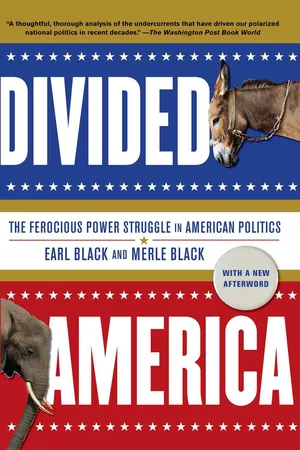
Drawing on extensive polling data and close analyses of presidential, senatorial, and congressional elections over the past fifty years, two eminent political scientists show, for the first time, how partisan warfare has reduced both major parties to minority status and locked them into fierce power struggles in each election cycle, thereby making America less stable and more difficult to govern.
Because the two major parties are now evenly balanced in the national electorate, control of the White House and Congress can shift dramatically with each election. Neither Republicans nor Democrats operate with any "lock" on the presidency, House of Representatives, or Senate, as demonstrated by the 2006 congressional elections.
Earl Black and Merle Black examine the party battles as they've played themselves out in the nation's five principal geographic areas. Each party has developed two important regional strongholds, as exemplified in the 2004 elections, when Republicans won all the electoral votes and sizable majorities of House and Senate seats in the South and Mountain/Plains states while the Democrats won almost all the electoral votes and large majorities in the Northeast and the Pacific Rim states. The Midwest is the perennial swing region.
The authors describe the enormous changes that have occurred in the electorates of each region over the past fifty years -- with emphasis on how the size and partisan affiliations of key groups have changed -- and show how these transformations have generated today's unstable two-party battles. Although the relentlessly competitive nature of modern American politics is generally appreciated, the regional causes underlying this new state of affairs are not well understood. Because neither Democrats nor Republicans can produce national majorities simply by sweeping their regional strongholds, they are locked in a fierce power struggle in each election. Divided America tells the story of these remarkable developments in clear, vigorous prose and provides a pragmatic understanding of the strengths and weaknesses of each party.
For the foreseeable future, each party will be within striking distance of winning -- or losing -- political power in every national institution. Understanding the party battles in America's regions is vital to understanding how today's losers can become tomorrow's winners
Frequently asked questions
Yes, you can cancel anytime from the Subscription tab in your account settings on the Perlego website. Your subscription will stay active until the end of your current billing period. Learn how to cancel your subscription.
At the moment all of our mobile-responsive ePub books are available to download via the app. Most of our PDFs are also available to download and we're working on making the final remaining ones downloadable now. Learn more here.
Perlego offers two plans: Essential and Complete
- Essential is ideal for learners and professionals who enjoy exploring a wide range of subjects. Access the Essential Library with 800,000+ trusted titles and best-sellers across business, personal growth, and the humanities. Includes unlimited reading time and Standard Read Aloud voice.
- Complete: Perfect for advanced learners and researchers needing full, unrestricted access. Unlock 1.4M+ books across hundreds of subjects, including academic and specialized titles. The Complete Plan also includes advanced features like Premium Read Aloud and Research Assistant.
We are an online textbook subscription service, where you can get access to an entire online library for less than the price of a single book per month. With over 1 million books across 1000+ topics, we’ve got you covered! Learn more here.
Look out for the read-aloud symbol on your next book to see if you can listen to it. The read-aloud tool reads text aloud for you, highlighting the text as it is being read. You can pause it, speed it up and slow it down. Learn more here.
Yes! You can use the Perlego app on both iOS or Android devices to read anytime, anywhere — even offline. Perfect for commutes or when you’re on the go.
Please note we cannot support devices running on iOS 13 and Android 7 or earlier. Learn more about using the app.
Yes, you can access Divided America by Earl Black,Merle Black in PDF and/or ePUB format, as well as other popular books in Politics & International Relations & Political Campaigns & Elections. We have over one million books available in our catalogue for you to explore.
Information
1
COMPETITIVE AMERICA
THE BIGGEST STORY OF MODERN AMERICAN POLITICS—a story with no end in sight—is the ferocious power struggle between conservative Republicans and liberal Democrats over each elected institution of the national government. Because the two major parties are now evenly balanced in the national electorate, control of the presidency, the Senate, and the House of Representatives can shift with each round of elections. And because Republicans and Democrats disagree so fundamentally over the direction of countless public policies, changes in partisan control can seriously affect millions of people in the United States and even larger numbers elsewhere in the world.
America’s tight national battle results from opposing political developments in five different regions. Each party has developed two regional strongholds: the Northeast and the Pacific Coast for the Democrats versus the South and the Mountains/Plains for the Republicans. The Midwest is the nation’s swing region. In this opening chapter, however, our focus will be on the entire nation. Once national trends have been established, the rest of the book will show how Republicans and Democrats have worked themselves into distinctive tight corners. Regional strengths are offset by regional weaknesses. Democratic and Republican leaders can ordinarily aspire—at best—to narrow national victories.
Permanently competitive and ideologically charged politics is a new reality for America. Governing the United States requires agreement among “separated institutions sharing powers.”1 America’s unstable power politics generates relentlessly bitter conflicts over a huge range of domestic and foreign policies and motivates activists in both parties to compete fiercely all the time. The 9/11/01 terrorist attacks on New York and Washington restored national security issues to the forefront of American politics. In response, President George W. Bush’s decision to confront terrorism in Afghanistan and Iraq divided the nation along prowar and antiwar lines and further intensified the national party battle. Close national elections between ideologically distinct parties give American politics its harsh tones and its extraordinarily high stakes, thus magnifying the difficulties of governing the world’s only superpower.
By comparison with the national landslides underlying Franklin D. Roosevelt’s New Deal or Lyndon Johnson’s Great Society, in 2000 Bush barely won the electoral vote and lost the popular vote. His victory in 2004 was solid but not overwhelming. He won reelection by an electoral vote margin of 53 percent to 47 percent and a popular vote majority of 51 percent to 48 percent. Had the Republicans lost either Ohio or Florida, their most challenging contests in large states, John Kerry would have been elected president. Republicans maintained their majority in the House of Representatives by the identical close margin of 53 percent to 47 percent. They did improve their majority in the Senate, emerging after the election with a lead of fifty-five to forty-five seats. Even in the Senate, however, Republicans lacked the sixty votes needed to break any determined Democratic filibuster.
Conservative Republicans and liberal Democrats—as politicians, financial contributors, activists, and voters—are more than ever the driving forces in American politics. Ideological purity has been achieved most dramatically in Congress, where strong partisans prevail as both leaders and followers. Far more than they ever did in the past, senators and representatives in both parties vote with their leaders most of the time. Some of the most die-hard participants in American politics are the members of Congress who daily settle scores and recount the latest partisan outrages on network news, cable news, and C-SPAN.
Ideological purity is trickier to achieve in presidential politics. Here the fundamental challenge for each party is building winning coalitions that begin with a party’s ideological base but also reach into the “center” of the electorate to achieve national majorities. Finding ways to disguise, finesse, or modify ideological positions that repel as well as attract centrist voters has thus become a basic task of campaign strategy. Republicans Ronald Reagan and George W. Bush and Democrat Bill Clinton all found creative ways to retain their most ideological partisans while attracting support that transcended their bases.
The tremendous personal, partisan, and ideological differences that polarize Democratic and Republican politicians are paralleled among the voters that make up the rival parties. The liberal wing of the Democratic Party—white liberals plus minorities—is a substantial majority among voters who claim to be Democrats, just as the Republicans’ conservative wing—white conservatives plus minorities—makes up a large majority among voters who identify as Republicans. In 1976 only 37 percent of America’s Democrats belonged to its liberal wing. In 2004 white liberals plus minorities comprised 63 percent of all Democrats. The size of the Republicans’ conservative wing grew from 52 percent in 1976 to 66 percent in the 2004 election.2 Ideologically, as political scientists Alan I. Abramowitz and Kyle L. Saunders have shown, America’s two major parties are more polarized than ever before.3
Yet while liberals and conservatives are sizable majorities within their parties, their influence on American politics represents a tremendous leveraging of their actual size among all voters. In the 2004 presidential election, 15 percent of the voters were liberal Democrats, and 24 percent were conservative Republicans. Members of the two polar groups comprise about two-fifths of the entire electorate.4 Finding sufficient allies outside their respective bases to forge majorities is the perennial task of conservative Republican and liberal Democratic politicians.
Increased ideological clarity within the Republican and Democratic parties has made the American party battle more divisive than in the past. For decades Democrats had an influential conservative wing that moderated the policies pursued by national party leaders. Though located primarily in the South, conservative Democrats were also present in much of rural and small-town America. Along with moderate Democrats, conservative Democrats influenced policy and constrained the liberal wing of the party. As late as 1976, the Democratic Party included almost as many white conservatives (19 percent) as white liberals (22 percent). By 2004 conservative Democrats were almost extinct: white liberals outnumbered white conservatives 27 percent to 6 percent among all Democrats.
Republicans traditionally had a moderate wing, as well as a few liberals, that restrained its conservatives. Within the Republican Party, white moderates declined from 42 percent in 1976 to 34 percent in 2004. The white liberal wing of the Republican Party, only 8 percent of all Republicans in 1976, was down to 4 percent in 2004. Ideological splits within the parties have largely been transformed into sharpened ideological divisions between the parties. Leaders of both parties still have to formulate policies that will satisfy their moderates, but Democratic leaders do not worry about the opinions and interests of conservatives, just as Republican leaders pay no attention to liberal viewpoints.
America’s confrontational politics, reported and interpreted by an extraordinarily diverse array of news media, talk radio, bloggers, and Internet advocacy forums on a nonstop basis, places extraordinary demands on politicians who aspire to the presidency or leadership roles in Congress. When each new wave in the political ocean is sincerely believed to make all the difference between winning or losing power, bitter fights can and do occur over practically everything. Robust conflict is obviously inherent in a democracy, but incessant personal attacks mean that especially thick skins are necessary for America’s leading politicians. President Bush and Senator Kerry must have wondered from time to time if winning the White House was worth the personal abuse that each of them received during the 2004 presidential campaign.
THE NEW WASHINGTON BATTLEGROUND
A hallmark of the modern American power struggle is the revival of the Republicans as a governing party. Republicans once dominated American politics. Emerging from the Civil War as the victorious champions of Union and emancipation, for seven decades Republicans usually controlled the White House and both houses of Congress. GOP domination collapsed with the Great Depression. Under Roosevelt’s charismatic and optimistic leadership, Democrats became the country’s new majority party. In the New Deal era, Democrats won five straight presidential elections, a feat never again approached by either party. Indeed, Democrats held the White House and both branches of Congress in nine of the ten elections from 1932 through 1950.
It is now considerably more difficult for either party to control the White House, the Senate, and the House of Representatives at the same time. Between 1952 and 2004, national elections resulted in divided partisan control—that is, one party controlled two institutions, and the other party controlled the third—in 63 percent of the elections.5 Democrats last achieved unified control of the national government for more than a single Congress during Jimmy Carter’s presidency in the late 1970s. Until their back-to-back victories in 2002 and 2004, Republicans had to look back to the 1920s to find a similar accomplishment.
Republicans’ recovery from the Great Depression took generations. A good way to appreciate the GOP’s utter devastation is to identify the points at which the Republican Party next won consecutive victories in specific national institutions. The initial Republican revival came in presidential elections, with General Dwight D. Eisenhower’s victories in 1952 and 1956. The hero of World War II, untainted by the Republicans’domestic failures and unrivaled in the area of national security, reestablished the Republican Party in presidential politics. Republicans have won nine of the fourteen presidential elections from 1952 through 2004.
Presidential recovery did not extend to Congress. The GOP’s first sustained majorities in the Senate arrived three decades after its presidential breakthrough. Consecutive majorities in 1980, 1982, and 1984, aided enormously by Reagan’s decisive victories, reestablished the Republicans as a frequent governing party in the Senate. Between 1980 and 2004, Republicans were more successful than Democrats (eight to five victories) in controlling the Senate. Every senator is now well aware that partisan control of the chamber can change in the next election.
The House of Representatives proved far more resistant to Republican recovery. Democrats held the House in all but two of thirty-two congressional elections from 1930 through 1992. All Democrats and most Republicans believed that Democrats were an unchallengeable, permanent majority party. In 1994 Republicans achieved a breakthrough victory in the House. They did so by overcoming some Democratic incumbents and capturing many open seats. Many of their gains came in districts previously won by Republican presidential candidates. Republicans’ success in the House of Representatives was no fluke. From 1994 through 2004, the Republicans won six consecutive national majorities. However, Republican House majorities have been slim and fragile in comparison with preceding Democratic majorities.
Republican gains in 1994 transformed the national political landscape far beyond the House of Representatives. Democrats’ defeat in the House greatly magnified the stakes of the partisan power struggles already being waged over the White House and the Senate. It has been a long, long time since most American politicians really believed that partisan control of every single national institution could shift in every election cycle.
AMERICA’S COMPETITIVE
MINORITY PARTIES
MINORITY PARTIES
America’s power struggle is waged in a political system that does not have a majority party. Close national elections rest upon the nearly equal size of the two minority parties. Drawing upon a half century of public opinion polling, figure 1.1 tracks the American party battle in the national electorate. Excluding independents, it charts the percentage of American voters who classified themselves as Republicans or Democrats in presidential elections from 1952 through 2004.6
The Democratic Party’s national advantage persisted long after the Great Depression and the Second World War. Although no longer attracting a majority of voters, midway through the twentieth century Democrats remained the dominant minority party. From 1952 through 1980, on average, 45 percent of all presidential voters were Democrats, while only 29 percent were Republicans. This substantial Democratic lead in the national electorate underlay virtually continuous Democratic control of the Senate and the House of Representatives, though obviously it did not produce similar success for the party’s presidential candidates.
Reagan’s presidency reshaped the national party battle. Beginning with his reelection in 1984, the wide gap between Democrats and Republicans narrowed to a smaller Democratic lead and, by 2004, to a partisan tie. During the presidential elections from 1984 through 2004, on average, Democrats fell to 39 percent, and Republicans rose to 36 percent of American voters. In the 2004 exit poll, 39 percent (rounding up) of voters were Republicans, and 38 percent were Democrats. A huge Democratic advantage in the electorate has thus narrowed to a partisan dead heat in the opening decade of the twenty-first century.
Figure 1.1
The American Party Battle

Three Patterns of Partisanship
To understand the dynamics of modern American politics, the crucial first step is to analyze voters by their race or ethnicity. In the United States, the three main building blocks of Republican and Democratic coalitions are whites, African Americans, and New Minorities (Latinos plus other minorities). For any group, the key political resources are its size and unity. How big is the group? How unified is it politically? The answers to these basic questions reveal the big picture of party politics in America.
We begin with size (figure 1.2). In presidential elections, what proportion of voters are whites, African Americans, and New Minorities? White voters have historically dominated the electorate. As late as 1952, whites made up 96 percent of voters in the United States. Since the 1950s, new groups have entered the electo...
Table of contents
- Cover
- Colophon
- Also by Earl Black and Merle Black
- Title Page
- Copyright
- Dedication
- Contents
- Preface
- 1 Competitive America
- 2 America’s Political Regions
- 3 The Republican Strongholds
- 4 The Democratic Strongholds
- 5 The Divided Midwest
- 6 The Presidential Power Struggle
- 7 The Power Struggle in the House of Representatives
- 8 The Power Struggle in the Senate
- 9 The American Power Struggle
- Appendix
- Notes
- Acknowledgments
- Index
- About the Authors