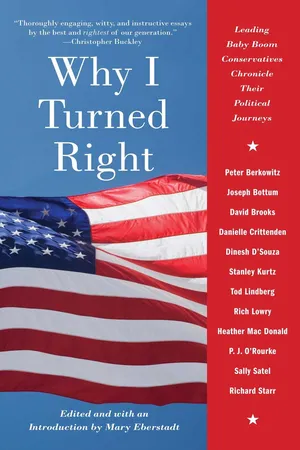
Why I Turned Right
eBook - ePub

Why I Turned Right

Leading Baby Boom Conservatives Chronicle Their Political Journeys

  1. 304 pages
  2. English
  3. ePUB (mobile friendly)
  4. Available on iOS & Android
eBook - ePub

Why I Turned Right

Leading Baby Boom Conservatives Chronicle Their Political Journeys

About this book

Political vicissitudes aside, with or without a conservative administration, whether or not America is engaged in war, or regardless of who next holds the majority either in Congress or the Court, the United States as a whole (as the infamous red and blue map made unforgettably clear) has boldly, unabashedly moved Right. But the question remains: Why? How did a movement that appeared so sidelined and embattled only a generation ago emerge as such a strong, influential, and enduring united front? In Why I Turned Right, eminent and rising conservatives -- at odds themselves on a number of issues from religion, family, sex, to stem cell research, abortion, and war -- answer the question. And they answer it not through polemic, reactionary preaching, or rage, but in the most practical and sensible way possible: via the sharp, critical, and unfiltered voices and canny observations of uniquely positioned authors, editors, humorists, and political refugees inadvertently born of the sexual revolution and the PC movement, who ultimately landed on the conservative side of America's red-blue divide -- in some cases, much to their own surprise. A fascinating intellectual journey, this "family of opinions, " as contributor Peter Berkowitz terms it, represents the extraordinarily varied paths that have led these authors from the championed liberalism of their youth to eventually fuel the world of conservative think tanks, magazines, blogs, and book publishing. Whether you are for the Right or against, guarded supporter or puzzled progressive, Why I Turned Right proves an entertaining, enlightening, and edifying read for anyone with an open mind -- both the red and the blue, and everyone in between.
Frequently asked questions

Yes, you can cancel anytime from the Subscription tab in your account settings on the Perlego website. Your subscription will stay active until the end of your current billing period. Learn how to cancel your subscription.
No, books cannot be downloaded as external files, such as PDFs, for use outside of Perlego. However, you can download books within the Perlego app for offline reading on mobile or tablet. Learn more here.
Perlego offers two plans: Essential and Complete
  • Essential is ideal for learners and professionals who enjoy exploring a wide range of subjects. Access the Essential Library with 800,000+ trusted titles and best-sellers across business, personal growth, and the humanities. Includes unlimited reading time and Standard Read Aloud voice.
  • Complete: Perfect for advanced learners and researchers needing full, unrestricted access. Unlock 1.4M+ books across hundreds of subjects, including academic and specialized titles. The Complete Plan also includes advanced features like Premium Read Aloud and Research Assistant.
Both plans are available with monthly, semester, or annual billing cycles.
We are an online textbook subscription service, where you can get access to an entire online library for less than the price of a single book per month. With over 1 million books across 1000+ topics, we’ve got you covered! Learn more here.
Look out for the read-aloud symbol on your next book to see if you can listen to it. The read-aloud tool reads text aloud for you, highlighting the text as it is being read. You can pause it, speed it up and slow it down. Learn more here.
Yes! You can use the Perlego app on both iOS or Android devices to read anytime, anywhere — even offline. Perfect for commutes or when you’re on the go.
Please note we cannot support devices running on iOS 13 and Android 7 or earlier. Learn more about using the app.
Yes, you can access Why I Turned Right by Mary Eberstadt in PDF and/or ePUB format, as well as other popular books in Politics & International Relations & Conservatism & Liberalism. We have over one million books available in our catalogue for you to explore.

Choices and
Consequences

TOD LINDBERG
Tod Lindberg is a research fellow at the Hoover Institution, Stanford University. He is editor of Policy Review, Hoover’s Washington, D.C.–based bimonthly journal, and author of The Political Teachings of Jesus (Regan Books/HarperCollins, April 2007). He writes a weekly column about politics for the Washington Times and is a contributing editor to the Weekly Standard. He is the editor of Beyond Paradise and Power: Europe, America and the Future of a Troubled Partnership (Routledge, 2005).
AS MY WIFE, friends, and colleagues will attest, I hated turning forty. At the time, February 2000, I thought it had something to do with fleeting youth—midlife crisis as one’s arrival at the inflection point between the cradle and the grave. Cure: none. Known palliatives: Category Three, mistress, Everest expedition; Category Two, affair, sports car; Category One, subscriber internet websites, golf.
But it wasn’t really fleeting youth or visions of mortality. I think the forty problem, rather, is about facing the notion that the gap between becoming who you are and being who you are is finite and rapidly closing. What comes into view around that age is the realization that the world is not one of infinite possibilities; that by one’s own choices one has decisively foreclosed certain avenues; and that the net effect is rapid convergence on a person one had not yet met or even imagined the existence of: oneself. One will be spending the rest of one’s life with this self; if all goes well, as this self—unalienated, that is, from the person one has become and the world one inhabits. But he arrives uninvited.
I don’t mean to suggest that a life characterized by an awareness of forgone possibilities is necessarily melancholic. Whether it is would seem to depend on the nature of the possibilities forgone; surely it’s good, not bad, to have shut the door on bad options, including some that were fun at the time. To pick a relatively safe example of naughtiness from a broad menu of possible citations, I have quit smoking, am happy to have done so, have no intention of resuming, yet can muster no real regret for having taken up the practice in the first place.
More seriously, one could say that the essence of mortal being and free will is to make choices that foreclose possibilities. Immortals do not have this problem: In an infinite amount of time, everything that can happen will happen; every binary choice resolved one way will present itself again for resolution the other way. There would be no being at the end of becoming, and so the passage of time would amount to no more than a bad infinity of essentially meaningless experiences. Not a cheery thought, that.
The alternative, however—a world in which people forgo the impossible for themselves by making choices—may turn out not to be so bad. The real test is the person emerging at the end. No, I will never conduct a symphony orchestra, nor play Hamlet. One’s confrontation with these facts begins with the appearance on the scene of the figure of who one is—real but still distant, visible in silhouette but not in detail. And for me, at least, it was disconcerting. Who is that guy? Where did he come from? What does he want?
I don’t have much use for assigning myself an ideological label these days. I don’t mind being called a conservative or a neoconservative, except by people who don’t understand that an important strain of modern “conservative” thought is nothing other than classically liberal thought. But there are, broadly speaking, two tendencies in answering the question of who you are, and by extension who others are; one is broadly “left” in political orientation, the other broadly “right.”
The first is to ascribe the events of your life and the lives of others mainly to circumstances beyond your control: life lived imprisoned in the false consciousness of the oppressed proletariat, for example, or as the injured psyche produced by a broken home—or for that matter as the undeserving beneficiary by dint of fortunate conception of good looks, brains, and money. Now, no one really believes this in its radical form, just as no one embraces the comparably radical approach from the right, namely, that one is and must be master in all respects of one’s fate, a kind of superman in the rank-ordering of human types. But the serious conservative alternative to the view that in general circumstance drives us to become who we are is the view that whatever circumstances may be, even quite awful circumstances, they never fully obliterate the human capacity to make consequential choices for better or for worse.
I think that’s correct. So, that figure drawing closer and beckoning to me, what does he want? For me to take my share of responsibility for who I am.
space
I recall two quite specific childhood anxieties: The first was that I would become a criminal. The second was that one day, I would lose control of my car.
It’s hard to say which of the two was more upsetting to contemplate. On the criminal side, the question was how could I, a reasonably well-mannered only child from a loving family, end up so horribly on the wrong side of the law? How could I be driven to a life of crime, eventually to be caught and go to prison? Or perhaps even the electric chair? What possible sequence of events could come before me and produce such an outcome? The world had lots of criminals. They were all once children. For whatever reason, the life path of the criminal appeared before them and they set out upon it, only to come to a nefarious end. How awful that would be: the humiliation of going to prison for one’s crimes, the disgrace one would visit upon one’s family.
On the other hand, to lose control of one’s car: In this case, I have a vivid recollection of the source of this anxiety: sitting in the passenger seat of the car, Mom or Dad driving, the AM radio on, the newscaster describing a crash in which someone died after having “lost control of the car.” Here I was, riding in the passenger seat or stretched out in the back with my blue blanket on the way to my grandparents’ house, feeling generally safe and happy, Mom or Dad driving, apparently fully competent at the task and at ease. And then, another one of those news bulletins. What was it about cars that caused people to lose control of them? To me, cars seemed very predictable, yet clearly, they were not. Otherwise, how could they wrest control from their drivers? Apparently, or at least so it seemed from all the radio reports of car crashes, this could happen to anyone, more or less at any time.
It’s not hard to see where the problem lies here. I didn’t really understand that the question of whether to be a criminal—to rob and kidnap and murder on the way to an untimely death in the electric chair—was actually up to me and no one else. Nor did I understand that in the normal course of events, cars do not deprive people of the power to control them. Barring catastrophic mechanical failure, when people lose control, it is generally their own fault. Your fate, at least in part, is something you make for yourself.
I can’t remember exactly when I sorted this out. Certainly before I became a teenager. Around the age of eleven, I had settled on an ambition: I would become a lawyer. A friend of my aunt Marge’s had introduced me to the wonders of the law: “Look around you—negligence everywhere, as far as the eye can see.” “How about that person crossing the street outside the crosswalk,” I asked, “is that negligence?” “It sure is.” The perspective was illuminating. Suddenly, from a world of blamelessness in which the cruel fate of a life of crime was thrust without warning upon the innocent, and in which cars took away control from their drivers, I found myself in a world in which everyone was at fault for something if only you looked closely enough. This would, of course, include oneself.
But wait. What’s the difference between the two worlds? In the first case, a cruel fate grabs you by the scruff of the neck and drags you to your doom. In the second, your awareness of the internal demons of your own deficiencies leaves you defenseless against the charge that whatever bad happens to you it is simultaneously beyond your control and your own fault, as the ill that finds others is theirs. And I suppose that if good things come your way, there is no other way to view them except as the happy accidents of a temporary condition that the negligence of mankind will sooner or later disrupt.
space
I had a recurring dream during my teenage years and on into my early twenties. It was that my mother had come back.
She died when I was thirteen. Possibly fourteen. It was summer. August. Sometime around the twenty-third or twenty-fourth. She had stomach cancer, at first misdiagnosed as an ulcer. I think she might have lived about three months after the doctors got the disease right. She died at home, in bed, on a Sunday. My father and I were out for a drive. My grandmother was at home. When we got back, the priest was there. Or maybe he had been there and left. He left mass early to come right over, they said.
During the final weeks of her life, once it was clear that the chemotherapy was useless, I adopted the ambition to make sure that the last words I said to her were “I love you.” And I think they were, though I can’t say for sure.
OK, I give up. What do you tell a thirteen-year-old (or a fourteen-year-old) by way of explanation for the fact that Mom is dead? I can’t even remember what anybody tried.
The scar tissue here is rather thick, and that’s the way I like it. I don’t pick at it. I leave it alone. I didn’t appreciate it when others caused me to take note of it as the scar tissue was forming, even when their purpose was to express sympathy. It is no small thing to be a bit vague on the question of how old you were when your mother died. It takes a certain determination. A lot needs forgetting.
One day many years later, after Dad and I said a final good-bye at the vet’s to our family dog, Otto—who had permanently ingratiated himself with my mother by burrowing into the side pocket of the short fur coat she was wearing when we went to see about the dachshund puppy for sale—we stopped for several weepy scotches at the Tally Ho, Dad’s main bar. We even managed to discuss our ability to cry over the dog but not over Mom.
The dream: I am at home, and there’s Mom! There she is in the kitchen, sometimes making dinner. She’s back. I thought she was dead, but there she is. Great! But she isn’t saying anything. Where has she been? Why did I think she was dead if she had just gone away for a while? Why had she gone away for a while? Leaving me to think she was dead? What kind of mom would go away for a while without any explanation, leaving the impression she was dead? That’s mean. Mom wouldn’t do that.
Ah, right, no, she wouldn’t. She is dead. This is not really Mom. This is a dream about Mom. A dream in which the pure joy of the return of Mom is fatally disrupted by the incomprehensibility of a figure capable of generating such joy by coming back ever having gone away in the first place. The emergence of this paradox in the dream always woke me up.
I would have to say that I woke up relieved. What are the contortions through which one has put oneself in order to wake up relieved that one’s mother is, after all, dead? It’s enough to make you think fate grabs you willy-nilly by the nape of the neck and does with you as it pleases.
space
Downside: no Mom. Upside: complete freedom.
Dad didn’t care what I did so long as—well, I don’t know. If there were, as the diplomats say, red lines, apparently I didn’t cross them.
My house was the clubhouse. Usually, it was a boys’ club, but girls were always welcome. The editor of this volume is the author of a book called Home-Alone America, which describes the trouble kids are prone to get themselves into when left to fend for themselves unsupervised. Exactly. Who needs the backseat of a car when a room is available? Dad did become vexed once when he found evidence that people had been using his room. But in truth, a man of infinite generosity and bonhomie, Dad was more interested in the ongoing opportunity the incident afforded for teasing the male perpetrator.
I always thought of myself as an underachiever. I took German in high school, but I couldn’t possibly have been bothered actually to learn the language with any degree of fluency. This sense of self lingers, no doubt because it is accurate. I am both a journalist who can’t touch-type and a scholar without a Ph.D. I lack discipline as such as well as a discipline.
One day near the end of the second quarter of my sophomore year in high school—my worst period of what would today be called “slacking” and the only time I was at risk (not great) of taking a seriously wrong turn—my honors English teacher took me aside as I was walking by her classroom. Somewhat dazed for a variety of reasons, I found her overture unnerving—at the time, one would have said I was feeling “paranoid.” An expression of solemnity on her face (her features, but not her expression that day, reminded me of my mother’s), she informed me that under the percentile criterion by which she graded the class, I had not made an A—and that she had therefore decided to regrade the class on a curve because she thought I ought to have an A. Astonished, I thanked her much, awash in the edgy pleasure that attaches to getting away with something you shouldn’t.
I was a Boy Scout; needless to say, I didn’t make Eagle. There was something (I can’t remember what) that I considered offensive in the requirements for the “Citizenship in the Community” merit badge, so I couldn’t be bothered. Dad, an Eagle Scout himself, was disappointed. But our troop, which was under the leadership of my gang of neighborhood cronies, and was accordingly organized around the requirements of our permanent, floating nickel-ante, quarter-limit poker game, had an absolutely uncanny knack for winning every single competition at every single campout and jamboree we attended. Orienteering, bridge-building, watermelon-eating: We won them all.
One day at summer camp, we got mad at the j...

Table of contents

  1. Cover
  2. Colophon
  3. Title Page
  4. Copyright
  5. Contents
  6. Introduction
  7. The Unthinking Man’s Guide to Conservatism
  8. Killer Rabbits and the Continuing Crisis
  9. Confessions of a Greenwich Village Conservative
  10. Recollections of a Campus Renegade
  11. Down and Out with Paul De Man
  12. Pig Heads
  13. The Events Leading Up to My Execution
  14. Pacifists, Pacifiers, and Snakeskin Miniskirts
  15. Choices and Consequences
  16. The Most Dangerous Psychiatrist in America
  17. The Longer Way
  18. I was a Teenage Conservative
  19. Bibliography
  20. Acknowledgments
  21. About the Editor