The Osama bin Laden I Know
eBook - ePub

The Osama bin Laden I Know

An Oral History of al Qaeda's Leader

  1. 480 pages
  2. English
  3. ePUB (mobile friendly)
  4. Available on iOS & Android
eBook - ePub

The Osama bin Laden I Know

An Oral History of al Qaeda's Leader

About this book

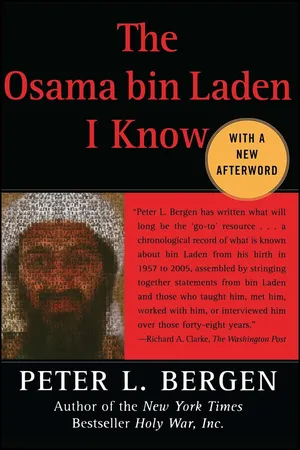
The Osama bin Laden I Know is an unprecedented oral history of Osama bin Laden's rise to revered leader of al Qaeda.
Peter Bergen takes the reader onto the battlefields of Afghanistan as bin Laden goes from a shy, quiet teen to a leader; he brings you into Osama's intimate family life as he lives under the radar in Sudan, then Afghanistan; he puts you right in the room for al Qaeda's very first meeting; and he uses eyewitness accounts to relate what bin Laden said, and thought on 9/11 as he watched the twin towers fall.
Derived from Bergen's interviews with more than 50 people who know bin Laden personally, from his highschool teacher to an early al Qaeda member who later became a US informant, The Osama bin Laden I Know recounts individual experiences with the man who has declared the US, and its allies, his greatest enemies.
Frequently asked questions

Yes, you can cancel anytime from the Subscription tab in your account settings on the Perlego website. Your subscription will stay active until the end of your current billing period. Learn how to cancel your subscription.
At the moment all of our mobile-responsive ePub books are available to download via the app. Most of our PDFs are also available to download and we're working on making the final remaining ones downloadable now. Learn more here.
Perlego offers two plans: Essential and Complete
  • Essential is ideal for learners and professionals who enjoy exploring a wide range of subjects. Access the Essential Library with 800,000+ trusted titles and best-sellers across business, personal growth, and the humanities. Includes unlimited reading time and Standard Read Aloud voice.
  • Complete: Perfect for advanced learners and researchers needing full, unrestricted access. Unlock 1.4M+ books across hundreds of subjects, including academic and specialized titles. The Complete Plan also includes advanced features like Premium Read Aloud and Research Assistant.
Both plans are available with monthly, semester, or annual billing cycles.
We are an online textbook subscription service, where you can get access to an entire online library for less than the price of a single book per month. With over 1 million books across 1000+ topics, we’ve got you covered! Learn more here.
Look out for the read-aloud symbol on your next book to see if you can listen to it. The read-aloud tool reads text aloud for you, highlighting the text as it is being read. You can pause it, speed it up and slow it down. Learn more here.
Yes! You can use the Perlego app on both iOS or Android devices to read anytime, anywhere — even offline. Perfect for commutes or when you’re on the go.
Please note we cannot support devices running on iOS 13 and Android 7 or earlier. Learn more about using the app.
Yes, you can access The Osama bin Laden I Know by Peter L. Bergen in PDF and/or ePUB format, as well as other popular books in Politics & International Relations & Political Biographies. We have over one million books available in our catalogue for you to explore.

1

Arabia

Osama bin Laden grew up during the 1960s and 1970s in what was then the sleepy city of Jeddah, a port on the Red Sea, which for the past millennia and a half has served as a gateway to the holy city of Mecca, thirty miles away. It was in Jeddah’s port that Osama’s father, Mohammed Bin Ladin, would get his start in 1930 working as a porter for pilgrims on their way to Mecca.
Bin Laden came of age as the Muslim world was experiencing an Islamic awakening known as theSahwa.This awakening came after Egypt, Syria, and Jordan had suffered a devastating defeat in the 1967 war with Israel, so exposing the ideological bankruptcy of Arab nationalism/socialism, which had been the dominant intellectual current in the Middle East since the 1950s. And that defeat came a year after the execution of the Egyptian writer Sayyid Qutb, whose writings and “martyrdom” would also play a key role in the burgeoning Islamist movement.
This period of Islamic awakening peaked in 1979—the first year of a new century on the Muslim calendar—with four seismic events that would profoundly influence bin Laden and other future members of al Qaeda: the overthrow of the Shah of Iran by the cleric Ayatollah Khomeni; the armed takeover of Islam’s holy of holies, the mosque in Mecca, by Saudi militants; Egypt’s historic cease-fire agreement with Israel; and, finally, the Soviet Union’s invasion of Afghanistan. It was a thrilling time to be a deeply committed Muslim, as the twenty-two-year-old bin Laden already was.
This chapter traces bin Laden’s first two decades. It was during this period that bin Laden first married, attended university, and started working intensively in the family business.
space
Osama bin Laden speaking to Jamal Ismail, a correspondent for Al Jazeera television in an interview that aired in 1999.1
God Almighty was gracious enough for me to be born to Muslim parents in the Arabian Peninsula, in al Malazz neighborhood in Riyadh, [Saudi Arabia] on March 10, 1957. Then God was gracious to us as we went to Holy Medina six months after I was born. For the rest of my life I stayed in Hejaz [a Saudi province], moving between Mecca, Jeddah, and Medina.
As it is well known, my father, Sheikh Muhammad bin Awad Bin Ladin, was born in Hadramaut [in southern Yemen]. He went to work in Hejaz at an early age, more than seventy years ago. Then God blessed him and bestowed on him an honor that no other building contractor has known. He built the holy Mecca mosque and at the same time—because of God’s blessings to him—he built the holy mosque in Medina. Then when he found out that the government of Jordan announced a tender for restoration work on the Dome of the Rock Mosque [in Jerusalem], he gathered engineers and asked them: “Calculate only the cost price of the project.” When they did, they were surprised that [my father], God have mercy on his soul, reduced the cost price in order to guarantee that God’s mosques are well served. He was awarded the project.
Because of God’s graciousness to him, sometimes he prayed in all three mosques [in Mecca, Medina, and Jerusalem] in one single day. May God have mercy on his soul. It is not a secret that he was one of the founders of the infrastructure of the Kingdom of Saudi Arabia.
Afterward, I studied in Hejaz. I studied economics at Jeddah University, or the so-called King Abdul Aziz University. I worked at an early age on roads in my father’s company, may God have mercy on his soul. My father died when I was ten years old. This is something brief about Osama bin Laden.
Brian Fyfield-Shayler is a British citizen who lived in Saudi Arabia between 1964 and 1974, where he taught English to a number of the bin Laden boys.2
The old man Bin Ladin only had one eye. He was very much a rough laborer–looking kind of person. He could never be smart and elegant. One of the things about Hadramaut [in Yemen], it’s not a classless society. A lot of it goes on whereabouts in Hadramaut you come from. If you came from Wadi Hadramaut, no one could criticize you because that’s where the two ruling dynasties came from. But I suspect the people in Wadi Do’an [Bin Ladin’s home valley] were quite low down the pecking order. And of course, there is another reason for this, and that is that your occupation depended on which area you came from. Different valleys and different villages supplied laborers and others supplied jewelers and others supplied people into import and exports; other areas supplied cloth merchants. So it was a bit like a medieval market in Western cities, that where you came from influenced the kind of profession you were likely to move into. So there is a pecking order within the Hadramis and although, of course, they were all aware that they were all one notch down from the top Saudi classes, within them there were infinite gradations.
Mohammed Bin Ladin was from a laboring class, but of course as the Bin Ladins made more and more money, they became more and more acceptable. It’s a bit like the new money in England: after twenty, thirty, fifty years, it becomes much more acceptable.
The mothers of [Mohammed Bin Ladin’s] children were very simple women from the villages around the construction camps where he developed. There are a lot of stories about how he acquired some of his very young wives. And they were, I think, primarily chosen, one, because they were Saudi Bedouin and, two, because they were young. That was his interest. All the sons are very good looking and they are quite striking. I don’t think that I have ever met any ugly Bin Ladins. Osama’s mother, I am told, she was a great beauty.
Since his father never had more than four wives at any one time, he was constantly divorcing the third and the fourth and taking in new ones, I don’t know how many different mothers there are.3 And there’s only one more family in Saudi Arabia you can compare that with. This was an anachronism even in the 1950s and ’60s, when bin Laden was doing this. The only family that was behaving like this was, in fact, King Abdul Aziz’s and King Saud’s. I think Bin Ladin probably even outnumbered King Abdul Aziz’s children and number of wives.
The British are terrible snobs about class and the Saudis also have their sensitivities, and one of them, in fact, is color, which no Saudi will ever admit to. But, of course, when anyone gets married in Saudi Arabia, the first question the women ask is: “What color? What shade?” And there is a great hierarchy—the people who are white, which is beautiful, down to black, which is not beautiful. And so any great brain or terribly able person in Saudi Arabia who tends to be in the darker spectrum tends to be passed over for promotion and other things. Bin Laden is quite fair.
I was born in 1942 in Reading, near London. I went to university at Oxford, studied English there, got a degree, and my first job when I graduated in 1963 was in Ghana teaching English. I looked around for more jobs in the teaching world. And so I applied for three jobs: one in Saudi Arabia, one in Libya, and one in Ethiopia, and the Saudi interview was the first to come up. I was interviewed in the embassy in London in the spring/early summer of ’64. I arrived in Saudi Arabia about the end of August, and was based in Al Thagr School.
The Al Thagr School was a prestige school, had hundreds of visitors every week. There were presidents of all sorts of countries arriving, parliamentary delegations from England came. In the secondary school there were perhaps twenty students in the first class, and I think sixteen, seventeen only in the top third class. So it was, in fact, a very small school. I had a fleet of Jordanians, Egyptians, Syrian, and a Sudanese teacher of English, who were all very good indeed. They were hand-picked from their countries.
King Faisal (who became king in 1964), one of the first things he did was to order that all the princes should educate their children in Saudi Arabia, and this was a tremendous upheaval because a number of his brothers and cousins had been in the habit of sending their sons to schools abroad. So from 1964 onwards there was a huge influx of young Saudi princes who had been educated in all sorts of ridiculous schools abroad—some of them couldn’t even read and write Arabic—who were brought back forcefully to Saudi Arabia, kicking and screaming in some cases. It became known that it was no longer socially acceptable to send all your children abroad for education, so the top business families had to follow the example of the princes and consider putting their sons in schools in Saudi Arabia.
The pupils [at Al Thagr] were the elite in all ways. First of all, the sons of the princes and the ministers who were based in Jeddah. And then, of course, there were the top business families. So if you looked along King Abdul Aziz Street, which was the main shopping street in those days, and you looked at the names over the shops, many of them second generation Hadrami businessmen, then those were the names that formed a very big slice of the school; a roll call of the school register.
The school has been criticized for being just for the toffs, but in fact it wasn’t. My taxi driver’s son was at the school. And so it tended to be that the cleverest boys in each class were in fact not from the princely families and not even always from the top business families, but were just extremely bright kids from middle-income or very low-income families.
The school didn’t owe much to the old Koranic madrassas of Arabia. The headmaster had toured schools in England and picked up some ideas. The curriculum was constantly in a state of development. The school prided itself on its science. I heard no criticism of the curriculum, no criticism at all of the scientific bias of the syllabus while I was there—remember the fundamentalists were not known to be a major influence in Saudi society in the 1960s.
We had this theater, which we built in the school, that was mostly used as an assembly hall for the great and the good of Jeddah, who would come to be addressed by the Crown Prince Faisal, who was chairman of the board of governors. It was his school. And at the end of my first year in the school the headmaster said that he was sitting on a committee to form a new university in Jeddah. This was what became King Abdul Aziz University (which bin Laden would attend a decade later). So in my second year in Saudi Arabia [in 1965], I began to attend these meetings of the founding committee of King Abdul Aziz University. By the end of that year, it was decided to have a grand meeting of all the wealthy people in Jeddah—businessmen, bankers, princes—who would pledge money to set up King Abdul Aziz University. And so this huge meeting was held inside our school. It was one of many occasions in which [Mohammed] Bin Ladin was present. All the businessmen were vying with each other to pledge more of their money. Of course, when the first person pledged a million riyals that was a big event. A huge applause went up in the hall. Bin Ladin was in his element there and was thoroughly enjoying himself; outbidding people and upping the ante. So he was a very familiar figure around the school.
From an official history of the Saudi Binladin Group that was once published on the Internet, disappearing after the 9/11 attacks.4
The history of Binladin began in 1931 when Mohammed Binladin founded the company. From its humble beginnings as a general contractor, the company has grown and prospered in parallel with the growth and prosperity of the Kingdom of Saudi Arabia. Over the years the company has been entrusted with many major construction projects, projects that helped the Kingdom to develop its resources and expand its infrastructure.
Under the leadership of the late M. Binladin, the company diversified into other areas and became an international conglomerate with interests ranging from its traditional construction business [to] industrial and power projects, petroleum, chemicals and mining, telecommunications, operations and maintenance, manufacturing and trading.
The 1967 Six-Day War that Israel fought against Egypt, Syria, and Jordan, when bin Laden was ten, had a profound impact effect on the Arab world. The Egyptian government had promised a quick victory against Israel; instead it was a spectacular defeat that called into question the very basis of Egyptian President Gamal Nasser’s regime, which was built on secular Arab nationalism and socialism. The defeat would energize the Islamist movement around the Arab world. Essam Deraz, an Egyptian army officer who would spend more than a year with bin Laden on the frontlines in Afghanistan during the 1980s, recalls what the ’67 defeat meant to Deraz and his fellow Islamists.5
I can tell you what the war of ’67 did to the region. I was a reconnaissance officer, so I was moving in front of troops, so I saw this whole war as a movie. The Egyptian officers and soldiers saw their colleagues burned by napalm. We saw the army of our country destroyed in hours. We thought that we would conquer Israel in hours.
I discovered that it wasn’t Israel that defeated us, but it was the [Egyptian] regime that defeated us, and I started to be against the regime. It wasn’t a military defeat. It became a civilizational defeat. We didn’t know that we were so backward, we were so retarded, so behind the rest of the modern civiliz...

Table of contents

  1. Cover
  2. Colophon
  3. Also by Peter L. Bergen
  4. Title Page
  5. Copyright
  6. Dedication
  7. Epigraph
  8. Contents
  9. Dramatis Personae
  10. Osama bin Laden Timeline
  11. Introduction
  12. 1 Arabia
  13. 2 The Afghan War
  14. 3 From Donor to Holy Warrior
  15. 4 The Birth of al Qaeda
  16. 5 Al Qaeda Goes Global
  17. 6 Afghanistan, Again
  18. 7 Al Qaeda Attacks
  19. 8 The Charismatic Leader
  20. 9 The 9/11 Plot
  21. 10 The Fall of the Taliban and the Flight to Tora Bora
  22. 11 Al Qaeda’s Quest for Weapons of Mass Destruction
  23. 12 How al Qaeda Took Root in Iraq and the Story of Abu Musab al Zarqawi
  24. 13 Bin Laden on the Run
  25. 14 Bin Laden’s Legacy
  26. Appendix A Where Are They Now?
  27. Appendix B Osama bin Laden’s Immediate Family
  28. Appendix C The BinLadin Family Business
  29. Notes
  30. Acknowledgments
  31. Index
  32. Photographs