Selling is 85% emotional and 15% logical. Forget everything you've been taught about selling -- forget the hardsell, forget negotiation strategies, forget those closing techniques. In The Inner Game of Selling, Ron Willingham debunks the familiar myths about "sales skills, " showing that those tired methods are too shallow and manipulative to do anything but alienate potential customers and drain you of energy and dignity. Today's consumers are wise to the old-fashioned gimmicks, extremely informed about their options, and very particular about what they want. The old tricks simply do not work anymore. Willingham, author of Integrity Service and CEO of Integrity Systems, opens your eyes to a whole new truth about selling: Your ability to sell is more a question of who you are than of what you know. Accordingly, why you sell is far more important than how you sell. Salespeople perform according to their inner beliefs about themselves, about what it is possible for them to sell and earn, and about what they deserve to achieve. These beliefs set the boundaries of their self-image and ultimately determine their success or failure. Willingham has synthesized his decades of experience, field-tested research, and a career-long dedication to ethical and passionate salesmanship to arrive at the groundbreaking insight that you will sell at your highest level only when you achieve emotional and spiritual alignment. Your sense of your own self-worth combined with a belief in your product will inspire that crucial ingredient in potential customers: trust. The Inner Game of Selling shows you how to overcome self-limiting beliefs and move on to a new relationship with your customers and, more important, a new relationship with yourself. Your new inner strengths will truly benefit you and your customers in any sales situation. Willingham is at the leading edge of a values shift in sales culture, from product-focus to personal empowerment. The Inner Game of Selling establishes a groundbreaking new paradigm that will utterly transform the philosophy and practice of selling.
eBook - ePub
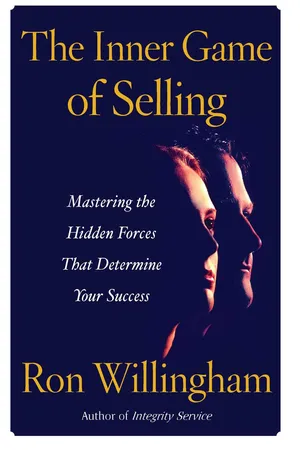
The Inner Game of Selling
Mastering the Hidden Forces that Determine Your Success
- 288 pages
- English
- ePUB (mobile friendly)
- Available on iOS & Android
eBook - ePub
About this book
Information
Table of contents
- Cover
- Description
- Back Cover
- Title Page
- Copyright Page
- Dedication
- Contents
- Introduction: How This Book Can Help You
- Chapter 1: Self-Understanding: Discovering Why You Sell What You Sell
- Chapter 2: Boundaries: Examining Your Current Belief Boundaries
- Chapter 3: Breakthrough: Shattering Blockages of Your Success
- Chapter 4: Achievement: Understanding the Four Core Success Factors
- Chapter 5: Abundance: Setting Goals for the Future You
- Chapter 6: Creativity: Discovering Your Creative Goal-Seeking Mechanism
- Chapter 7: Customer Focus: How to Sell the Way Customers Want to Buy
- Chapter 8: Energy: Releasing Unlimited Achievement Drive
- Chapter 9: Control: Handling the Emotional Side of Selling
- Chapter 10: Social Skills: Helping People Feel Understood
- Chapter 11: Self-Talk: Choosing What to Say When You Talk to Yourself
- Chapter 12: Purpose: Finding Meaning in What You Do
- Chapter 13: Values: Deciding What You Stand For
- Afterword
- About the Author
Trusted by 375,005 students
Access to over 1.5 million titles for a fair monthly price.
Study more efficiently using our study tools.
Frequently asked questions
Yes, you can cancel anytime from the Subscription tab in your account settings on the Perlego website. Your subscription will stay active until the end of your current billing period. Learn how to cancel your subscription
No, books cannot be downloaded as external files, such as PDFs, for use outside of Perlego. However, you can download books within the Perlego app for offline reading on mobile or tablet. Learn how to download books offline
Perlego offers two plans: Essential and Complete
- Essential is ideal for learners and professionals who enjoy exploring a wide range of subjects. Access the Essential Library with 800,000+ trusted titles and best-sellers across business, personal growth, and the humanities. Includes unlimited reading time and Standard Read Aloud voice.
- Complete: Perfect for advanced learners and researchers needing full, unrestricted access. Unlock 1.5M+ books across hundreds of subjects, including academic and specialized titles. The Complete Plan also includes advanced features like Premium Read Aloud and Research Assistant.
We are an online textbook subscription service, where you can get access to an entire online library for less than the price of a single book per month. With over 1.5 million books across 990+ topics, we’ve got you covered! Learn about our mission
Look out for the read-aloud symbol on your next book to see if you can listen to it. The read-aloud tool reads text aloud for you, highlighting the text as it is being read. You can pause it, speed it up and slow it down. Learn more about Read Aloud
Yes! You can use the Perlego app on both iOS and Android devices to read anytime, anywhere — even offline. Perfect for commutes or when you’re on the go.
Please note we cannot support devices running on iOS 13 and Android 7 or earlier. Learn more about using the app
Please note we cannot support devices running on iOS 13 and Android 7 or earlier. Learn more about using the app
Yes, you can access The Inner Game of Selling by Ron Willingham in PDF and/or ePUB format, as well as other popular books in Business & Business General. We have over 1.5 million books available in our catalogue for you to explore.