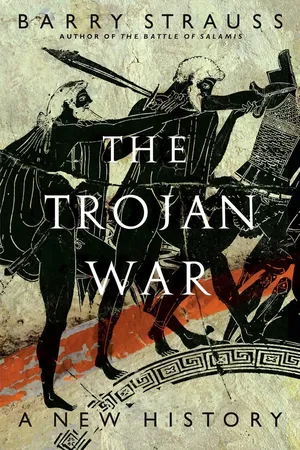
The Trojan War is the most famous conflict in history, the subject of Homer's Iliad, one of the cornerstones of Western literature. Although many readers know that this literary masterwork is based on actual events, there is disagreement about how much of Homer's tale is true. Drawing on recent archeological research, historian and classicist Barry Strauss explains what really happened in Troy more than 3,000 years ago.
For many years it was thought that Troy was an insignificant place that never had a chance against the Greek warriors who laid siege and overwhelmed the city. In the old view, the conflict was decided by duels between champions on the plain of Troy. Today we know that Troy was indeed a large and prosperous city, just as Homer said. The Trojans themselves were not Greeks but vassals of the powerful Hittite Empire to the east in modern-day Turkey, and they probably spoke a Hittite-related language called Luwian. The Trojan War was most likely the culmination of a long feud over power, wealth, and honor in western Turkey and the offshore islands. The war itself was mainly a low-intensity conflict, a series of raids on neighboring towns and lands. It seems unlikely that there was ever a siege of Troy; rather some sort of trick -- perhaps involving a wooden horse -- allowed the Greeks to take the city.
Strauss shows us where Homer nods, and sometimes exaggerates and distorts, as well. He puts the Trojan War into the context of its time, explaining the strategies and tactics that both sides used, and compares the war to contemporary battles elsewhere in the eastern Mediterranean. With his vivid reconstructions of the conflict and his insights into the famous characters and events of Homer's great epic, Strauss masterfully tells the story of the fall of Troy as history without losing the poetry and grandeur that continue to draw readers to this ancient tale.
- 288 pages
- English
- ePUB (mobile friendly)
- Available on iOS & Android
eBook - ePub
About this book
Information
Topic
HistoriaSubtopic
Historia europeaTable of contents
- Cover
- Copyright
- Dedication
- Author’s Note
- Timetable of Events Relating to the Trojan War
- A Note on Ancient History and Archaeology
- Introduction
- Chapter One: War for Helen
- Chapter Two: The Black Ships Sail
- Chapter Three: Operation Beachhead
- Chapter Four: Assault on the Walls
- Chapter Five: The Dirty War
- Chapter Six: An Army in Trouble
- Chapter Seven: The Killing Fields
- Chapter Eight: Night Moves
- Chapter Nine: Hector’s Charge
- Chapter Ten: Achilles’ Heel
- Chapter Eleven: The Night of the Horse
- Conclusion
- Glossary of Key Names
- Photographs
- Notes
- A Note on Sources
- Acknowledgments
- Index
Trusted by 375,005 students
Access to over 1.5 million titles for a fair monthly price.
Study more efficiently using our study tools.
Frequently asked questions
Yes, you can cancel anytime from the Subscription tab in your account settings on the Perlego website. Your subscription will stay active until the end of your current billing period. Learn how to cancel your subscription
No, books cannot be downloaded as external files, such as PDFs, for use outside of Perlego. However, you can download books within the Perlego app for offline reading on mobile or tablet. Learn how to download books offline
Perlego offers two plans: Essential and Complete
- Essential is ideal for learners and professionals who enjoy exploring a wide range of subjects. Access the Essential Library with 800,000+ trusted titles and best-sellers across business, personal growth, and the humanities. Includes unlimited reading time and Standard Read Aloud voice.
- Complete: Perfect for advanced learners and researchers needing full, unrestricted access. Unlock 1.5M+ books across hundreds of subjects, including academic and specialized titles. The Complete Plan also includes advanced features like Premium Read Aloud and Research Assistant.
We are an online textbook subscription service, where you can get access to an entire online library for less than the price of a single book per month. With over 1.5 million books across 990+ topics, we’ve got you covered! Learn about our mission
Look out for the read-aloud symbol on your next book to see if you can listen to it. The read-aloud tool reads text aloud for you, highlighting the text as it is being read. You can pause it, speed it up and slow it down. Learn more about Read Aloud
Yes! You can use the Perlego app on both iOS and Android devices to read anytime, anywhere — even offline. Perfect for commutes or when you’re on the go.
Please note we cannot support devices running on iOS 13 and Android 7 or earlier. Learn more about using the app
Please note we cannot support devices running on iOS 13 and Android 7 or earlier. Learn more about using the app
Yes, you can access The Trojan War by Barry Strauss in PDF and/or ePUB format, as well as other popular books in Historia & Historia europea. We have over 1.5 million books available in our catalogue for you to explore.