
eBook - ePub
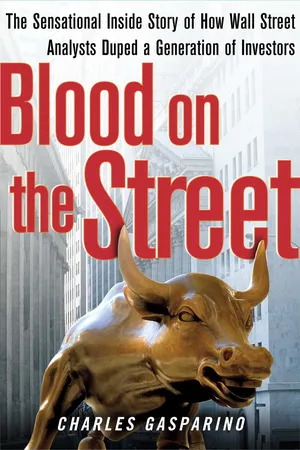
Blood on the Street
The Sensational Inside Story of How Wall Street Analysts Duped a Generation of Investors
- 368 pages
- English
- ePUB (mobile friendly)
- Available on iOS & Android
eBook - ePub
Blood on the Street
The Sensational Inside Story of How Wall Street Analysts Duped a Generation of Investors
About this book
Blood on the Street is a riveting account of the Wall Street scam in which ordinary investors lost literally billions of dollars -- in many cases their life savings -- in one of the greatest deceptions ever, by the crack reporter who broke the original story.
In one of the most outrageous examples of dirty dealing in the history of Wall Street, hundreds of millions of dollars in illicit profits were made during the booming 1990s as a result of research analysts issuing positive stock ratings on companies that kicked back investment banking business. Now, for the first time, award-winning journalist Charles Gasparino reveals the whole fascinating story of greed, arrogance, and corruption.
It was Gasparino's front-page reporting in The Wall Street Journal that brought the story to national attention and spurred New York State attorney general Eliot Spitzer to launch an official probe. Now, Gasparino goes behind his own headlines to tell the inside story of this spectacular swindle -- with revelations from his unprecedented access to never-before-published depositions and documents, including e-mail exchanges leading all the way up to Citigroup CEO Sanford Weill.
Drawing on his research and interviews with industry insiders, Gasparino takes readers into the back rooms of Wall Street's top investment firms and captures the outsize personalities of three key players: Salomon Smith Barney's Jack Grubman, a braggart with one of the largest salaries on Wall Street; Merrill Lynch's Henry Blodget, the Yale graduate who hyped his way to the top of the research pyramid; and Morgan Stanley's Mary Meeker, the "Queen of the Internet," who foresaw the market catastrophe but gave in to the pressures Blood on the Street shows how regulators, like former SEC chairman Arthur Levitt, allowed the deceptive practices to fester and grow during the 1990s bubble, leaving the door open for a then- little-known attorney general from New York State to step in and make his mark by holding Wall Street accountable.
Gasparino provides the first major account of Spitzer's rise to prominence, detailing how the attorney general pursued key players to build his case against Wall Street, including his shifting allegiance to the powerful New York Stock Exchange chairman Richard Grasso.
A fast-paced narrative rich in sharp insights, Blood on the Street is the definitive book on the financial debacle that affected millions of Americans.
In one of the most outrageous examples of dirty dealing in the history of Wall Street, hundreds of millions of dollars in illicit profits were made during the booming 1990s as a result of research analysts issuing positive stock ratings on companies that kicked back investment banking business. Now, for the first time, award-winning journalist Charles Gasparino reveals the whole fascinating story of greed, arrogance, and corruption.
It was Gasparino's front-page reporting in The Wall Street Journal that brought the story to national attention and spurred New York State attorney general Eliot Spitzer to launch an official probe. Now, Gasparino goes behind his own headlines to tell the inside story of this spectacular swindle -- with revelations from his unprecedented access to never-before-published depositions and documents, including e-mail exchanges leading all the way up to Citigroup CEO Sanford Weill.
Drawing on his research and interviews with industry insiders, Gasparino takes readers into the back rooms of Wall Street's top investment firms and captures the outsize personalities of three key players: Salomon Smith Barney's Jack Grubman, a braggart with one of the largest salaries on Wall Street; Merrill Lynch's Henry Blodget, the Yale graduate who hyped his way to the top of the research pyramid; and Morgan Stanley's Mary Meeker, the "Queen of the Internet," who foresaw the market catastrophe but gave in to the pressures Blood on the Street shows how regulators, like former SEC chairman Arthur Levitt, allowed the deceptive practices to fester and grow during the 1990s bubble, leaving the door open for a then- little-known attorney general from New York State to step in and make his mark by holding Wall Street accountable.
Gasparino provides the first major account of Spitzer's rise to prominence, detailing how the attorney general pursued key players to build his case against Wall Street, including his shifting allegiance to the powerful New York Stock Exchange chairman Richard Grasso.
A fast-paced narrative rich in sharp insights, Blood on the Street is the definitive book on the financial debacle that affected millions of Americans.
Frequently asked questions
Yes, you can cancel anytime from the Subscription tab in your account settings on the Perlego website. Your subscription will stay active until the end of your current billing period. Learn how to cancel your subscription.
No, books cannot be downloaded as external files, such as PDFs, for use outside of Perlego. However, you can download books within the Perlego app for offline reading on mobile or tablet. Learn more here.
Perlego offers two plans: Essential and Complete
- Essential is ideal for learners and professionals who enjoy exploring a wide range of subjects. Access the Essential Library with 800,000+ trusted titles and best-sellers across business, personal growth, and the humanities. Includes unlimited reading time and Standard Read Aloud voice.
- Complete: Perfect for advanced learners and researchers needing full, unrestricted access. Unlock 1.4M+ books across hundreds of subjects, including academic and specialized titles. The Complete Plan also includes advanced features like Premium Read Aloud and Research Assistant.
We are an online textbook subscription service, where you can get access to an entire online library for less than the price of a single book per month. With over 1 million books across 1000+ topics, weâve got you covered! Learn more here.
Look out for the read-aloud symbol on your next book to see if you can listen to it. The read-aloud tool reads text aloud for you, highlighting the text as it is being read. You can pause it, speed it up and slow it down. Learn more here.
Yes! You can use the Perlego app on both iOS or Android devices to read anytime, anywhere â even offline. Perfect for commutes or when youâre on the go.
Please note we cannot support devices running on iOS 13 and Android 7 or earlier. Learn more about using the app.
Yes, you can access Blood on the Street by Charles Gasparino in PDF and/or ePUB format, as well as other popular books in Business & Business General. We have over one million books available in our catalogue for you to explore.
Information
CHAPTER ONE
The Seeds of the Scandal
By the start of the great stock market bubble of the 1990s, Jeff Liddle had built a reputation as one of the meanest and toughest lawyers on Wall Street. Balding, with broad shoulders, a bad temper, and a passing resemblance to Mr. Clean, Liddleâs specialty was getting the big Wall Street firms to cough up large settlements to brokers and other Wall Street executives who claimed they were âwrongfully dismissedâ from their firms.
There was no one better at getting Wall Street to pay than Liddle, and opponents point to his hardball tactics as the secret of his success. Liddle has sued at least one opposing lawyer on behalf of a client for slander. Several times he has been criticized by arbitration panels over belligerent behavior. Maybe most telling, Liddle openly brags that the best time he ever had in a courtroom was the eight days he spent grilling an executive, who also happened to be his ex-wife.
But what ultimately gave Liddle his edge was an inside knowledge of the inner workings of Wall Street. He was an attorney for the infamous Drexel Burnham Lambert, and knew the seedier side of the brokerage business better than the vast majority of his peers, from the ass grabbing that women regularly endure on trading desks to the boardroom power plays that leave a trail of firings and potential clients in their wake. âMost of the firms on Wall Street are so poorly managed that almost anything goes,â he once said.
Liddle believed that Wall Street research easily fit within his world-view. By the mid-1990s, Wall Street research had strayed far from practices employed by Donaldson Lufkin & Jenrette Securities, the first âindependentâ research firm. DLJ, as it was known on the street, built a business model based on issuing research to money managers who were more than willing to pay for honest stock tips and business analysis. The payment came through stock trading commissions, which covered analystsâ salaries.
DLJâs first research report, titled âCommon Stock and Common Sense,â argued that the only thing holding investors back was a âlack of knowledgeâ about the markets, and by the end of the 1960s founders Bill Donaldson, Dan Lufkin, and Dick Jenrette had become millionaires several times over thanks to their success in selling investor-focused research. Donaldson ultimately sought out a career in politics and would become chairman of the New York Stock Exchange, while Jenrette and Lufkin became some of the key players on Wall Street.
But DLJâs high-minded business model wouldnât fare as well. The turning point came in May 1975, when Congress approved a major change in Wall Street trading practices. No longer would trading commissions be âfixedâ by the NYSE. Instead, a new floating-rate system was installed, allowing market forces to control commissions.
Almost immediately, trading commissions floated lower. DLJ, like the rest of Wall Street, was forced to remake itself into an investment banking firm and pay analysts from revenues gleaned from investment banking deals. Now that the gravy train was over, it didnât take long for analysts to become de facto investment bankers, attending road shows and hyping their assessments of banking prospects in an attempt to win business and earn their keep.
As the investment banking booms of the 1980s and 1990s accelerated the commingling of these activities, DLJ seemed to embody everything its founders were against. âWe used to joke that the house that research built was turning into the house that investment banking runs,â says Tom Brown, a former DLJ analyst who claims he was fired from the firm after criticizing an important investment banking client. Brown wasnât the only analyst to notice the change. During much of the 1990s, analysts at DLJ openly complained about being pressured to hype ratings to win deals. (A DLJ contract offered to a prospective analyst guaranteed âbanking related compensation of at least $1,500,000 during the calendar years covered by [the agreement].â) One afternoon, a DLJ analyst and eventual stock research chief, Mark Manson, had some words of wisdom for analysts at the firm under pressure to hype ratings to win banking business, recalls Brown. âThe key to working with investment banking,â Brown says Manson told the group, âis learning how to say âForgive me, father, for I have sinned.â â (Manson doesnât recall making the statement.)
Others at DLJ were even more direct. During a management meeting, one executive was given a list of candidates for a stock research job. âWhich one is the least offensive, we have a big banking calendar,â the executive quipped, according to one of the other participants. Many former DLJ executives say that the firm maintained its traditionally high research standards. But inside DLJ, the decline of research was obvious. In the 1990s, both Dick Jenrette and Bill Donaldson were working as DLJ consultants with offices at the company. One afternoon, Jenrette burst into Donaldsonâs office and asked his old partner to look at a recent research report published by a DLJ analyst. âIsnât this one of the worst things youâve ever seen?â Jenrette said. Donaldson agreed.
By the summer of 1995, Liddle was ready to show that Merrill Lynch practices werenât much different. He had filed an arbitration case on behalf of a former Merrill oil and energy stock analyst named Suzanne Cook, who said that she was fired from the firm even though she excelled at the single most important part of her job as an analyst: winning investment banking business. Cook sought back pay and an unspecified amount of damages, charging that her supervisors at Merrill gave her the boot to make room for a male less qualified at snaring banking deals.
Liddle loved the case for several reasons. First, he considered gender discrimination fertile ground for big settlements since men outnumber women across all the Wall Street job classifications (except secretary). Meanwhile, Liddle believed that Wall Street locker-room behavior was still alive and well at most of the big brokerage firms, with fancy strip clubs like Scores in New York becoming hubs of deal-making activity. Merrill stock research chief Andrew Melnick also made a particularly inviting target, Liddle believed. Melnick had fired Cook in 1992 just a few months after she and other top analysts received an invitation to dine with company CEO Dan Tully as part of a special program to advance the firmâs top analysts. Cook claimed that Melnick at one point reminded her that working for a Wall Street firm is a âmanâs job.â Melnick denied making the remark, but Liddle couldnât wait to get Melnick on the stand. Melnickâs monotone voice and thick glasses made him seem like an odd duck rather than a top research executive. During the early days of the case, Liddle even came up with a nickname for Melnick: âThe Creature,â for the way he ate a tuna fish sandwich one afternoon during a break in the proceedings.
But even more promising for Liddle was the fact that Cook came ready to expose some controversial practices inside Merrillâs research department. Analysts at Merrill were far from the green-eyeshade types the company had portrayed to small investors who bought stocks through its massive brokerage network. After reading thousands of documents, Liddle believed that the final productâthe Merrill Lynch research report with its stock recommendations targeted for unsophisticated small investorsâwas nothing more than a tool used by the firmâs bankers to win lucrative stock deals.
Melnick, Liddle believed, was a key player in this conflicted process. He kept detailed records of how many deals each analyst worked on, the bankers involved in the transaction, and how they rated the analystsâ work. Liddle hit pay dirt when he found one memo from Melnick titled âIBK Impactâ (shorthand for investment banking impact) in which analysts were asked to fill out a form listing their contributions to the firmâs investment banking efforts âin order to properly credit your efforts.â Maybe more telling, each month Melnick prepared a separate report for his boss Jack Lavery that helped senior management determine bonuses for their analysts. These reports, known as Monthly Executive Operating Reports, or MEORs (pronounced meeors) listed all the deals his team of analysts worked on, in addition to other factors that went into the bonus calculation. As Liddle would discover, Melnick loved to trumpet analystsâ role in winning business when lobbying for higher compensation for his people. One MEOR dated September 1992 was particularly telling: âWith the growing sense that IBK [investment banking] requires research to do business, or that our investment bankers are not of the quality to win investment banking business without research, the balance of compensation at year-end should be tilted toward research,â he wrote.
Melnick added that âit is important that the firm should adjust to the fact that our best analysts should be compensated, considering their increasing importance to the firm, to what we and other firms are willing to pay to attract good commercial analysts. Our budget process should take this into account.â
Liddle found evidence that top officials at Merrill were well aware of these practices. Lavery, Melnickâs supervisor, wrote his own memo touting analystsâ contribution to the firmâs banking work that each month was passed on to top executives, including Merrillâs chairman and CEO. Both Melnick and Lavery, of course, were supporting their employees, but they were also underscoring the inherent conflicts in Merrillâs research operations. They werenât pleading for more money just because their analysts had a good record for picking stocks, or claiming that picking stocks was even a priority for analysts at Merrill. Instead, both Melnick and Lavery revealed just how much time Merrill analysts spent on a bigger priority at the firm, namely, winning banking deals.
That said, Merrill wasnât ready to concede defeat just yet. In addition to defending its research policies, Merrill was prepared to argue that Cook was nothing more than a second-rate analyst by directing attention to what they said was her own poor record. Bolstering their case was the fact that in April 1995, an administrative law judge found Cook guilty of securities fraud, a decision that was later reversed. The decision stemmed from a civil case in which the SEC alleged that Cook had helped prepare an upbeat press release for a small energy service outfit that contained both false and misleading financial information. The SEC said Cook prepared the report knowing that the company was âalmost certain to sustain a loss.â (Cook maintained that she had no idea that the company was misleading investors.) The reasons the SEC asserted for Cookâs actions appeared even more damaging. Her husband won a consulting contract from the company around the time his wife began meeting with officials as part of her work with Merrill. There were other conflicts as well; the SEC said Cookâs husband was introduced to the companyâs CEO through his wifeâs contacts within the outfit, and that he later became one of the highest-paid employees there. Cook herself stood to benefit from this relationship; she conceded to the SEC that she was working several deals involving the company, including a proposal to merge it with another Merrill client.
The case, Cook v. Merrill Lynch, was filed with the National Association of Securities Dealers, Wall Streetâs self-regulatory organization in August1995. Wall Street, it should be noted, has a peculiar way of settling disputes. Outside of the brokerage business, courts have become the final word on everything from employment disputes to claims of improper business dealings. But on Wall Street, brokerage clients and employees waive the right to go to court, opting for a system of arbitration, where a panel of supposedly independent people make the rulings.
Each year, arbitration panels award hundreds of millions of dollars in damages to disgruntled employees, investors, and countless others who maintain they were wronged by the brokerage industry in one way or another. Investor advocates, meanwhile, claim that many of the panels often side with the big firms and that investors would fare better in the courts. One thing is certain: The process is conducted in secrecy, meaning that unless a decision is reached, much of the damaging evidence is never made public.
Liddle seemed to luck out from the beginning, though. The arbitrators, two men and a woman, granted nearly every request Liddle made, ensuring the disclosure of thousands of pages of confidential documents, and the testimony of several top Merrill officials including Melnick, the man who developed the firmâs research strategy. The proceedings took place in Dallas; according to NASD rules, arbitration panels conduct proceedings in the city where the employee last worked. (Cook had worked in Merrillâs Dallas office.) For the next two years, some of Merrillâs top officials, such as Jerome Kenney, who reported to the firmâs CEO, Daniel Tully and later David Komansky, were forced to take time out of their busy schedules to appear before the panel. Melnickâs testimony came on a hot July morning in 1997. Dressed in a dark suit and wearing the thick, horn-rimmed glasses that had become his trademark, Melnick appeared haggard as he walked into a large conference room at the Adolphus Hotel for his deposition. He complained of a bad cold, but as it turned out, that was the least of his problems.
When the proceedings began, Liddle was primed for action. He asked Melnick to describe his academic and professional experience, how many people he supervised in the past, his fields of expertise, and how he paid his employees. Wall Street executives receive a relatively nominal salary, a six-figure number that varies from firm to firm. Most of their compensation comes in the form of a bonus, usually doled out toward the end of the year, and often many times larger than their annual salary. What Liddle believed he discovered from the memos was that investment banking work was given more weight than other factors, such as the accuracy of research, when Melnick handed out bonus checks.
Liddle addressed the compensation issue head-on. âWhen did you learn what your responsibilities would be regarding bonuses?â he asked. Melnick pointed out that he inherited the bonus system when he joined Merrill in 1988. The âdominating factorâ in analystâs compensation, he explained, was the size of the firmâs bonus pool. The larger the pool the more money he had to parcel out. Unlike many firms, analysts at Merrill were paid not specifically for banking work. âWhat weâre trying to avoid is that the analyst will do a deal just because (he or she) would be paid for a deal,â Melnick said.
But Liddle wasnât buying the explanation. He pressed Melnick on how he made bonus decisions on specific analysts. Melnick said such decisions were made on a case-by-case basis, based on how well the individual analyst worked as part of the Merrill Lynch research team, and the accuracy of their research calls. But toward the end of his answer, Melnick cited another considerationââThe sense from investment banking.â It was the answer Liddle was waiting for. âThe third thing you said was that you wanted to get a sense of how the investment bankers viewed the value of the analyst,â Liddle asked.
âThatâs correct,â Melnick responded.
âWhat do you mean, get a sense of it?â Liddle pressed. âWas it like you call them up anonymously and ask them what their thoughts were, or did you formally ask them for their opinion?â
Melnickâs answer surprised Liddle in its honesty. Certainly, he said, Merrill practiced quality control. Analysts must sign off on any deal that the firm chooses to underwrite, meaning that if they are not comfortable with a companyâs finances, the firm canât underwrite the stock. But Melnick said he got his âsenseâ of how well analysts fared with investment bankers through a detailed process of record keeping, interviews, and cross evaluations that allowed senior management at Merrill to understand just how much each analyst contributed to the firmâs investment banking business.
The process began early each year, he explained. In January or February analysts were ordered to submit forms that listed all the deals they worked on, what services they contributed to getting the deal, and what bankers they worked with. Liddle pressed for more details on how Melnick kept track of all the banking work analysts completed. As it turned out, while Merrill didnât pay analysts on a per deal basis, Melnick created the next best thing, an âindex based on the amount of money involved and the sense of the contribution of the analyst.â
In fact, Melnick was so concerned about how analysts performed on banking deals that bankers themselves actually evaluated the analystsâ performance. Cook had issued several reports that predicted a decline in energy prices, often a prelude to energy stocks falling as well. Many of those were Merrill investment banking clients, and Melnick said he reprimanded her for the reports, saying she needed to get his approval before issuing an opinion contrary to that of the firmâs upbeat assessment. For Cook, the implication was simple: Donât mess with investment banking clients. That point was driven home after several bankers complained to Melnick about her work. Several, he said, âwere not comfortable with what she did.â Cook had apparently crossed swords with the most powerful banker at Merrill, Barry Friedberg, who complained to Melnick that Cook didnât issue a report on the stock of one company that was an investment banking client. Liddle argued that Friedberg had basically conceded that at Merrill, companies received coverage if they were investment banking clients.
As the arbitration continued, Liddleâs accusations became more and more sensational. At one point, he boasted that he was âwilling to betâ that Melnick put a âcheck mark next to every femaleâs name at Merrill Lynch,â as part of a method to pay women like Cook less than men. At another point, Liddle argued that Melnickâs discrimination may have been a subconscious act. Melnick, Liddle said, ânever satisfied himself that in some subliminal way or some other way, that female employees were being undercompensated in relation to their male counterparts.â
While it was unclear if Liddle had been able to prove that his client was the victim of sex discrimination, as the case dragged on, Merrillâs vaunted Chinese Wall separating research and banking looked less and less solid. During one presentation to the arbitration panel, Liddle contended that Cookâs problem was not only that she was a woman, but also she was not willing to shade her opinions to win business. He mentioned one situation involving a âroad showâ presentation to clients. Analysts were often required to work with investment bankers to market new stock deals to investors. These âroad showâ presentations were not just common to Merrill Lynch, but to all of Wall Street, as a way of drumming up interest from investors for deals in the pipeline. Cook wasnât always willing to play along. During one such presentation before large investors in the natural gas industry, Cook broke from the script and said that natural gas prices would fall, meaning shares of companies, many of them banking clients, would fall as well. It was not exactly the kind of message Merrill wanted to be sending investors, and according to Liddle, Cook paid for it. When the presentation was over, Liddl...
Table of contents
- Cover
- Colophon
- Title Page
- Copyright
- Dedication
- Contents
- Prologue
- 1. The Seeds of the Scandal
- 2. âThis Guyâs Going to be Troubleâ
- 3. âArenât You the Internet Lady?â
- 4. The Bloviator
- 5. Sucker Money
- 6. Oh, Henry!
- 7. The Queen Falls
- 8. Jack in a Box
- 9. Keystone Cops
- 10. The Accidental Attorney General
- 11. And the Walls Come Tumbling Down
- 12. Jack on the Stand
- 13. Upgrades and Preschools
- Epilogue
- Acknowledgments
- Notes
- About the Author