No story of World War II is more triumphant than the liberation of France, made famous in countless photos of Parisians waving American flags and kissing GIs, as columns of troops paraded down the Champs Élysées. Yet liberation is a messy, complex affair, in which cultural understanding can be as elusive as the search for justice by both the liberators and the liberated. Occupying powers import their own injustices, and often even magnify them, away from the prying eyes of home.
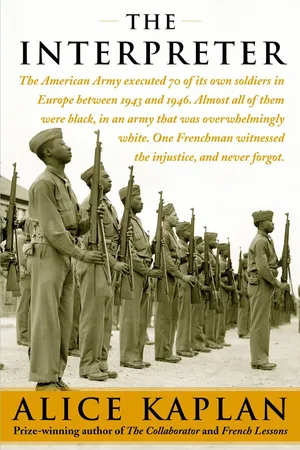
One of the least-known stories of the American liberation of France, from 1944 to 1946, is also one of the ugliest and least understood chapters in the history of Jim Crow. The first man to grapple with this failure of justice was an eyewitness: the interpreter Louis Guilloux. Now, in The Interpreter, prize-winning author Alice Kaplan combines extraordinary research and brilliant writing to recover the story both as Guilloux first saw it, and as it still haunts us today.
When the Americans helped to free Brittany in the summer of 1944, they were determined to treat the French differently than had the Nazi occupiers of the previous four years. Crimes committed against the locals were not to be tolerated. General Patton issued an order that any accused criminals would be tried by court-martial and that severe sentences, including the death penalty, would be imposed for the crime of rape. Mostly represented among service troops, African Americans made up a small fraction of the Army. Yet they were tried for the majority of capital cases, and they were found guilty with devastating frequency: 55 of 70 men executed by the Army in Europe were African American -- or 79 percent, in an Army that was only 8.5 percent black.
Alice Kaplan's towering achievement in The Interpreter is to recall this outrage through a single, very human story. Louis Guilloux was one of France's most prominent novelists even before he was asked to act as an interpreter at a few courts-martial. Through his eyes, Kaplan narrates two mirror-image trials and introduces us to the men and women in the courtrooms. James Hendricks fired a shot through a door, after many drinks, and killed a man. George Whittington shot and killed a man in an open courtyard, after an argument and many drinks. Hendricks was black. Whittington was white. Both were court-martialed by the Army VIII Corps and tried in the same room, with some of the same officers participating. Yet the outcomes could not have been more different.
Guilloux instinctively liked the Americans with whom he worked, but he could not get over seeing African Americans condemned to hang, Hendricks among them, while whites went free. He wrote about what he had observed in his diary, and years later in a novel. Other witnesses have survived to talk to Kaplan in person.
In Kaplan's hands, the two crimes and trials are searing events. The lawyers, judges, and accused are all sympathetic, their actions understandable. Yet despite their best intentions, heartbreak and injustice result. In an epilogue, Kaplan introduces us to the family of James Hendricks, who were never informed of his fate, and who still hope that his remains will be transferred back home. James Hendricks rests, with 95 other men, in a U.S. military cemetery in France, filled with anonymous graves.
- 256 pages
- English
- ePUB (mobile friendly)
- Available on iOS & Android
eBook - ePub
The Interpreter
About this book
Information
Table of contents
- Cover
- Colophon
- ALSO BY ALICE KAPLAN
- Title Page
- Copyright
- Dedication
- Epigraph
- Contents
- PART I: LIBERATION
- PART II: UNITED STATES VERSUS PRIVATE JAMES E. HENDRICKS
- PART III: UNITED STATES VERSUS CAPTAIN GEORGE P. WHITTINGTON
- PART IV: HISTORY AND MEMORY
- EPILOGUE
- Photos
- Notes
- Acknowledgments
- Index
- ABOUT THE AUTHOR
Trusted by 375,005 students
Access to over 1.5 million titles for a fair monthly price.
Study more efficiently using our study tools.
Frequently asked questions
Yes, you can cancel anytime from the Subscription tab in your account settings on the Perlego website. Your subscription will stay active until the end of your current billing period. Learn how to cancel your subscription
No, books cannot be downloaded as external files, such as PDFs, for use outside of Perlego. However, you can download books within the Perlego app for offline reading on mobile or tablet. Learn how to download books offline
Perlego offers two plans: Essential and Complete
- Essential is ideal for learners and professionals who enjoy exploring a wide range of subjects. Access the Essential Library with 800,000+ trusted titles and best-sellers across business, personal growth, and the humanities. Includes unlimited reading time and Standard Read Aloud voice.
- Complete: Perfect for advanced learners and researchers needing full, unrestricted access. Unlock 1.5M+ books across hundreds of subjects, including academic and specialized titles. The Complete Plan also includes advanced features like Premium Read Aloud and Research Assistant.
We are an online textbook subscription service, where you can get access to an entire online library for less than the price of a single book per month. With over 1.5 million books across 990+ topics, we’ve got you covered! Learn about our mission
Look out for the read-aloud symbol on your next book to see if you can listen to it. The read-aloud tool reads text aloud for you, highlighting the text as it is being read. You can pause it, speed it up and slow it down. Learn more about Read Aloud
Yes! You can use the Perlego app on both iOS and Android devices to read anytime, anywhere — even offline. Perfect for commutes or when you’re on the go.
Please note we cannot support devices running on iOS 13 and Android 7 or earlier. Learn more about using the app
Please note we cannot support devices running on iOS 13 and Android 7 or earlier. Learn more about using the app
Yes, you can access The Interpreter by Alice Kaplan in PDF and/or ePUB format, as well as other popular books in History & African American History. We have over 1.5 million books available in our catalogue for you to explore.