New York Night
eBook - ePub

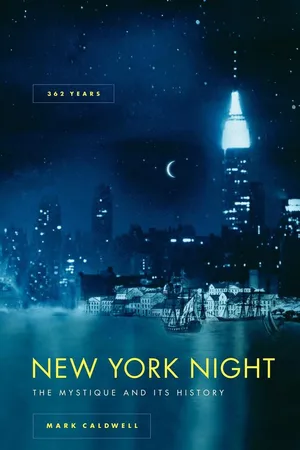
New York Night

The Mystique and Its History

  1. 416 pages
  2. English
  3. ePUB (mobile friendly)
  4. Available on iOS & Android
eBook - ePub

New York Night

The Mystique and Its History

About this book

Who among us cannot testify to the possibilities of the night? To the mysterious, shadowed intersections of music, smoke, money, alcohol, desire, and dream? The hours between dusk and dawn are when we are most urgently free, when high meets low, when tongues wag, when wallets loosen, when uptown, downtown, rich, poor, black, white, gay, straight, male, and female so often chance upon one another. Night is when we are more likely to carouse, fornicate, fall in love, murder, or ourselves fall prey. And if there is one place where the grandness, danger, and enchantment of night have been lived more than anywhere else -- lived in fact for over 350 years -- it is, of course, New York City.
From glittering opulence to sordid violence, from sweetest romance to grinding lust, critic and historian Mark Caldwell chronicles, with both intimate detail and epic sweep, the story of New York nightlife from 1643 to the present, featuring the famous, the notorious, and the unknown who have long walked the city's streets and lived its history. New York Night ranges from the leafy forests at Manhattan's tip, where Indians and Europeans first met, to the candlelit taverns of old New Amsterdam, to the theaters, brothels, and saloon prizefights of the Civil War era, to the lavish entertainments of the Gilded Age, to the speakeasies and nightclubs of the century past, and even to the strip clubs and glamour restaurants of today.
We see madams and boxers, murderers and drunks, soldiers, singers, layabouts, and thieves. We see the swaggering "Sporting Men, "the fearless slatterns, the socially prominent rakes, the chorus girls, the impresarios, the gangsters, the club hoppers, and the dead. We see none other than the great Charles Dickens himself taken to a tavern of outrageous repute and be so shocked by what he witnesses that he must be helped to the door. We see human beings making their nighttime bet with New York City. Some of these stories are tragic, some comic, but all paint a resilient metropolis of the night.
In New York, uniquely among the world's great cities, the hours of darkness have always brought opposites together, with results both creative and violent. This is a book that is filled with intrigue, crime, sex, violence, music, dance, and the blur of neon-lit crowds along ribbons of pavement. Technology, too, figures in the drama, with such inventions as gas and electric light, photography, rapid transit, and the scratchy magic of radio appearing one by one to collaborate in a nocturnal world of inexhaustible variety and excitement.
New York Night will delight history buffs, New Yorkers in love with their home, and anyone who wants to see how human nocturnal behavior has changed and not changed as the world's greatest city has come into being. New York Night is a spellbinding social history of the day's dark hours, when work ends, secrets reveal themselves, and the unimaginable becomes real.
Frequently asked questions

Yes, you can cancel anytime from the Subscription tab in your account settings on the Perlego website. Your subscription will stay active until the end of your current billing period. Learn how to cancel your subscription.
At the moment all of our mobile-responsive ePub books are available to download via the app. Most of our PDFs are also available to download and we're working on making the final remaining ones downloadable now. Learn more here.
Perlego offers two plans: Essential and Complete
  • Essential is ideal for learners and professionals who enjoy exploring a wide range of subjects. Access the Essential Library with 800,000+ trusted titles and best-sellers across business, personal growth, and the humanities. Includes unlimited reading time and Standard Read Aloud voice.
  • Complete: Perfect for advanced learners and researchers needing full, unrestricted access. Unlock 1.4M+ books across hundreds of subjects, including academic and specialized titles. The Complete Plan also includes advanced features like Premium Read Aloud and Research Assistant.
Both plans are available with monthly, semester, or annual billing cycles.
We are an online textbook subscription service, where you can get access to an entire online library for less than the price of a single book per month. With over 1 million books across 1000+ topics, we’ve got you covered! Learn more here.
Look out for the read-aloud symbol on your next book to see if you can listen to it. The read-aloud tool reads text aloud for you, highlighting the text as it is being read. You can pause it, speed it up and slow it down. Learn more here.
Yes! You can use the Perlego app on both iOS or Android devices to read anytime, anywhere — even offline. Perfect for commutes or when you’re on the go.
Please note we cannot support devices running on iOS 13 and Android 7 or earlier. Learn more about using the app.
Yes, you can access New York Night by Mark Caldwell in PDF and/or ePUB format, as well as other popular books in History & North American History. We have over one million books available in our catalogue for you to explore.

Information

Publisher
Scribner
Year
2005
Print ISBN
9780743242776
eBook ISBN
9780743274784

Chapter One

New Amsterdam Noir

The Dark Nights of Dutch Manhattan

FOUR HUNDRED YEARS AGO the sun, sinking into the water meadows west of the Hudson, left Manhattan a dark outpost in the wilderness, lit only by candle and lamp flames, here and there feebly visible through shutters clapped to at dusk. Stranded and lonely New Amsterdam was, 3,000 miles from grandmother Europe and mother Amsterdam, and preternaturally silent it often was. But calm, peaceful, sunk in torpid sleep—never. Early Manhattan’s nights were from the beginning a drama of outsized characters. Insider bearded outsider, neighbor crossed paths with neighbor, and meetings might end in farce, melodrama, love, tragedy, or all at once. The triangle of narrowing island was tiny, but its life immense, striking the spark that has illuminated the New York night ever since—bringing, as day often forbids, stranger into the company of stranger and transforming, into love or hatred, the relations between friend and friend.
In 17th-century New Amsterdam the European settlers strove to dominate a borderless territory whose scale they didn’t realize and wouldn’t have been able to comprehend if they were aware of it. Outside their makeshift village, the Indians—the rightful occupants by any fair measure—still gathered in seasonal encampments in the woods and along the shores, surrounding the presumptuous little Dutch fort with its straggle of houses. European and native had, in the colony’s earliest decades, locked into an expedient but also distrustful interdependence. They daily needed, sometimes loved, often resented, fought, or murdered, and almost always misunderstood each other.
But during the winter and early spring of 1643 their relations spilled across the brink of catastrophe. Everyone was feeling the strain—particularly the two men who, late on the evening of Monday, April 6, 1643, sat in the pocket-sized Wooden Horse tavern, a warm beacon in an ocean of darkness. The muddy village lanes were unlit, and would remain so for half a century more, when feeble candle lanterns appeared, by city ordinance, to be hung from every seventh house on moonless nights. There would be no formally designated Town Hall until 1653, ten years in the future. Apart from the Schout Fischal—part sheriff, part prosecutor—and his minions, often as riotous as the drunks and thieves they hounded, no organized force patrolled the streets overnight until the first official night watch went on duty in 1658. There were no hospitals until 1660.
It was well past ten o’clock, the town’s widely flouted bar closing hour. But alcohol was New Amsterdam’s fuel, the volatile elixir that alternately glued it together and blew it apart. It was the colony’s steadiest source of income, and trade in it was so profitable that it had early on become a nuisance: a 1648 ordinance complained that “one full fourth of the City of New Amsterdam has been turned into taverns for the sale of brandy, tobacco and beer.” Any night, all night, even if the bars were shut, you could buy bootleg liquor from boats that quietly plied the rivers, selling to settlers and Indians alike: a 1656 law decried the rampant trade in alcohol along the riverbanks by “yachts, barks, scows, ships and canoes, going up and down.”
Philip Geraerdy, the tavernkeeper, looked on uneasily as Jan Jansen Damen got drunker and drunker. The Wooden Horse, set in its own small yard, was eighteen feet by 25, with a single door, one window, and a thatched roof. Probably, like most Dutch taverns of the era, it had a locking cabinet for the drinks, and a rack of the clay pipes that were constant companions, both in business and pleasure.* By the 1640s the Wooden Horse had established itself as a rendezvous for soldiers from the garrison, but also attracted officials of the Dutch West India Company and prosperous landholders who owned the bouweries, or farms (perhaps Damen favored the place because his wife, Adrienne Cuville, was, like Geraerdy, French by birth).
Modest though his establishment was, Geraerdy was a forefather of New York nightlife. Born Philippe GĂ©rard in France, he had come to the colony with his wife, Marie, sometime before 1639. In 1641 he built his tavern on the northeast corner of today’s Stone and Whitehall Streets. The name seems to have been a wry joke: as a soldier with the garrison Geraerdy had been sentenced to ride the wooden horse—a painful punishment in which the victim straddled two boards nailed together to form a sharp wedge that rested on four legs. A wooden horse’s head adorned the front, and a tail the rear. Geraerdy rode with a pitcher in one hand and a sword in the other, probably to signify that he’d been shirking military duty by running a bar as a sideline.
Geraerdy’s customer, Jan Jansen Damen, was 38 years old. Born in 1605, he’d emigrated from Holland to Albany around 1631, then resettled in New Amsterdam, where he quickly ingratiated himself with the colony’s mercurial governor, Willem Kieft. By the late 1630s Damen was wheeling and dealing to combine several parcels of land just north of today’s Wall Street into a farmstead that eventually stretched from the Hudson to the East River and included the ground on which Trinity Church now stands. Damen appears often in town records as a precipitator of both business deals and brawls, a quarrelsome and forbidding personage, respected for his business acumen (or at least his money) but held at arm’s length because of his bad temper, drunkenness, and occasional violence.
In one imbroglio over money at his house he once struck his stepdaughter, Christina, threw her outdoors, whipped out a knife, raked it down her skirt, tore off her cap, and began pummeling her with his fists. Her husband, Dirck Holgerson, threw a pewter can at Damen’s head to defend her. Damen lunged at him with the knife, and Holgerson prevailed over this berserk father-in-law only by stunning him with a blow on the head from a post picked up in the yard.
Such was the not-to-be-trifled-with figure who now sat in the Wooden Horse. He had stayed on long past closing time and drunk hard before he rose to leave. By then Geraerdy was alarmed enough to quietly slip his customer’s sword out of its scabbard, and—sometime between midnight and one o’clock in the early morning of Tuesday, April 7, 1643—to escort him home. The neighborhood was, as always, awash in the sound of Manhattan’s two great rivers, restlessly sweeping and eddying with their tides and currents. The Heerewegh was the main thoroughfare, up which Damen and Geraerdy were about to take perhaps the first midnight walk recorded in the history of the street later renamed Broadway by the English. In 1643 it was unpaved but began near where it does today, in a wide space before the Fort—roughly today’s Bowling Green. In the 1640s, before a long-running series of landfill projects shouldered the rivers back, there was no Battery; the East River was 600 feet and the Hudson 1,200 feet closer to today’s Bowling Green. Nothing in New Amsterdam could compete with the night sky or the water ceaselessly lapping at the land. Within a few hundred feet north of the Fort buildings began to thin, giving way to a cemetery along the Hudson, then gardens and vacant land, then another cemetery. The countryside, dotted with swamps and a refuge for hostile Indians, was beautiful by day but frightening at night.
Once Geraerdy and Damen had left the tavern, they probably walked toward the Fort—a wooden paling protected by a much trodden and deteriorating earthen berm, which the town was only now beginning to face with stone. Inside, along with the flagpole, there was a new stone church, just visible over the battlements. Then they turned right on today’s Whitehall Street, heading north; the West India Company’s windmill came into view, standing motionless at night, alongside the Hudson and just beyond the northwest bastion of the Fort. Taking a second right onto the Heerewegh, they now passed two more taverns on the left, the soldier-friendly establishments of Peter Cock and Martin Crugier. Then houses—mere cottages, most of them, at this hour, shuttered, dark, dead to the world, and surrounded by sizable gardens, even small orchards.
Damen lived just a quarter mile’s up-island walk from the White Horse, but at night the muddy Heerewegh was frightening, haunted by drunks, the occasional insomniac pig, and Indians, whom Damen had good and very personal reasons to fear. The town was quiet, but not without hints of threat, even before the current tension between the Dutch and the Indians. Whoring sailors were not supposed to be abroad, but a 1638 law ordering them to return to their ships by sundown had been widely ignored. Town dwellers, seeking firewood or building materials, were known to steal out after nightfall to tear down the wooden fences that guarded outlying pastures and farm plots.
Damen and Geraerdy passed the West India Company’s gardens, today the south graveyard of Trinity Church. Just beyond Wall Street—not yet laid out and still without the wall it was named for—they came to Damen’s farm. At today’s Pine Street, where the ground rose slightly, they turned right down a dirt lane. On their right was Damen’s house* with its orchard and kitchen gardens. The land was still leased and much of it remained uncultivated, but Damen would own it outright the following year. Retracing their steps today, from the Transit Authority office building, 2 Broadway (whose saturnine bulk hunkers over any remaining buried traces of the Wooden Horse), the walk takes only fifteen minutes.
Then as now the after hours were, as Geraerdy seems to have sensed, the time for passions to flare out. As they approached Damen’s house, they found it dark, locked, silent. Prolonged pounding, however, finally roused Dirck, Damen’s servant (the records aren’t clear as to whether this was the same man as his son-in-law), who suddenly jerked open the door and, pistol in hand, announced that he meant to kill Damen on the spot. A scuffle ensued, with Dirck brandishing the gun and the soused Damen lunging at him with his empty scabbard. Geraerdy held Dirck off with Damen’s sword, while the enraged burgher stormed inside and emerged with a knife, which—in the pitch darkness—he sliced by mistake down Geraerdy’s back, carving a gash underneath his right shoulder blade.

What Happened at Midnight:
February 25, 1643

Geraerdy survived (though his wound required attention from Dr. Hans Kierstede, New Amsterdam’s leading surgeon). Geraerdy insisted he bore Damen no grudge. But this goodwill put him in a minority: Damen had become a pariah, one of the most hated men in the colony, and Dirck’s sudden assault on his master was not anomalous. For all New Amsterdam was on edge in the aftermath of a far more harrowing night a few weeks earlier, in which Damen had been deeply involved. Now neighbor was snarling at neighbor, and the leading clergyman, Dominie (i.e., pastor) Everardus Bogardus, was denouncing Kieft, the increasingly hated governor. The tension broke out everywhere: by day in the restrained but still palpable agitation of the colony’s official records, and by night in tavern brawls.
New York’s reputation both for lawlessness, and for its clash of races, ethnicities, languages, and classes, is often traced back to the 1800s. But the colony had been contentious from the beginning, founded by the Dutch West India Company not as a utopian experiment but as pure business, unsoftened by sentiment. The settlers were as polyglot and combative as the New Yorkers of later eras: Governor Kieft told the Jesuit missionary Isaac Jogues, visiting in 1643, that among them they spoke eighteen different languages. The company was authoritarian in spirit, but the three months’ arduous sail across the Atlantic put it out of touch with day-to-day events. Also, while the fur trade was still in its infancy, the company had kept New Amsterdam afloat by selling wine, beer, and distilled liquor, and the colony acquired a reputation for dissoluteness: one agent wrote back to Amsterdam in September 1626 complaining that the inhabitants, from Peter Minuit down to the farmers and laborers, “draw their rations and pay in return for doing almost nothing, without examining their conscience or considering their bounden duty and what they promised to do upon their engagement.”
But the darkest episodes of these early years rose not from tensions within the immigrant populace, but from the tense bond, half dependence and half suspicion, that had formed between the settlers and the much larger native population of Indians—a primordial instance of the uneasy dance of insider and outsider that would give the city night its rhythm. The tension could be rich and productive, but in Dutch Manhattan, it exploded in one of the most violent and macabre nights in New York history. Damen, up to his neck in the catastrophe, tried to dissociate himself from it but fooled no one.
Wednesday evening, February 25, 1643, began with a seemingly innocent supper party hosted by Kieft at his mansion in the Fort. As described by a later visitor, its large wood-paneled hall was decorated by 300 polished blunderbusses. In the study a collection of books vied with still more weaponry: “pistolls set in Rondellos,
also sundry Indian weapons, an Indian Stone hatchette, an ax, a Buckler, a poleax,” and “some Scimitars very pretty to behold.”* Among Kieft’s guests in these gloomy chambers, two were worth remarking. One was Adrienne Cuville, Damen’s wife (New Amsterdam women often kept their maiden names). The other was David de Vries, the governor’s advisor, who, despite misgivings about his employer, seems not to have known what was afoot. Perhaps it was some sinister edge in Kieft’s or Cuville’s manner that unsettled him. “I remained that night at the Governor’s sitting up,” de Vries later remembered.
I went and sat by the kitchen fire, when about midnight I heard a great shrieking, and I ran to the ramparts of the fort, and looked over to Pavonia [across the Hudson in New Jersey]. Saw nothing but firing, and heard the shrieks of the savages murdered in their sleep. I returned again to the house by the fire. Having sat there awhile, there came an Indian with his squaw, whom I knew well, and who lived about an hour’s walk from my house, and told me that they two had fled in a small skiff, which they had taken from the shore at Pavonia; that the Indians from Fort Orange had surprised them; and that they had come to conceal themselves in the fort. I told them that they must go away immediately; that this was no time for them to come to the fort to conceal themselves; that they who had killed their people at Pavonia were not Indians, but the Swannekens, as they call the Dutch, had done it.
Indeed it was a night of atrocities, far worse than de Vries probably imagined at the time because it was no impulsive outburst but a cold-blooded plot, first laid in January or February, when Kieft and his co-conspirators had secretly authorized a massacre of Wiechquaesgeck and Tappan Indians. By the time the butchery was over, about 120 Indian men, women, and children had been slaughtered, about 40 at Corlaer’s Hook (two miles beyond Damen’s house), and 80 at Pavonia, across the Hudson in New Jersey. After midnight, the raiders began returning to the Fort flaunting their trophies: wounded, sometimes atrociously mutilated captives and a cargo of severed heads. De Vries may have been struck to the quick by this spectacle. But Adrienne Cuville was delighted—as became clear when, after the seven years it took for news of the slaughter to reach Amsterdam and be acted on, the Dutch West India Company dispatched a sternly worded interrogatory to Cuville, insisting that she respond under oath. Was it true, the dispatch demanded, that “when the heads of certain slain Indians were brought to the Manhattans,” Cuville rushed out to “exult over the circumstance, and with her feet kick the heads which were brought in?”
Other records differ as to whether she kicked just one head or many, but even hers was not the direst of the night’s atrocities. “Infants,” de Vries reported, “were torn from their mother’s breasts, and hacked to pieces in the presence of the parents, and the pieces were thrown into the fire and in the water, and other sucklings, being bound to small boards were cut, stuck, and pierced and miserably massacred in a manner to move a heart of stone.” The next morning “some came to our people in the country with their hands, some with their legs cut off and some holding their entrails in their arms, and others had such horrible cuts and gashes that worse than they were could never happen.”
Many if not most of the settlers had no inkling of the Kieft conspiracy and were appalled by the next morning’s grisly news. Kieft took the brunt of their anger: people began remembering his mysterious behavior in the weeks leading up to the incident. De Vries noted that on Tuesday, February 24, the day before the massacre, “the Governor
began to state his intentions, that he had a mind to wipe the mouths of the savages.” But, as Adrienne Cuville’s behavior at the Fort hints, Damen too was part of the conspiracy. So were several other owners of outlying farms, notably including Cornelis Van Tienhoven, who was both Damen’s neighbor to the northeast and a relative: Van Tienhoven’s wife, Rachel, was Adrienne Cuville’s daughter by an earlier marriage.
Kieft had been spoiling for an attack, and apparently found a ready ear in landholders, like Damen and Van Tienhoven, who felt particularly vulnerable to Indian raids. This is suggested by another pointed question among the Dutch West India Company’s written interrogatories, this one directed to Van Tienhoven, and asking about an entertainment given at Damen’s house shortly before the February massacre. “Was not a mysterious toast dr[u]nk at an entertainment at the house of Jan Damen, by some few, though not by all then present, without the major part having been aware what it meant?
What was this mysterious toast and what was its purport?” Kieft proposed the toast, and while its exact words have been lost it seems to have been a coded permission to proceed to those in the know—including Damen and Van Tienhoven. The company further demanded, “what relationship exists between him, [Van] Tienhoven, and Jan Damen?” Evidently, this and follow-up questions imply Damen and several other plotters, having heard the toast, had then asked Van Tienhoven to draw up a petition to Kieft, seeking his permission to attack the Indians.
Nobody else at the gathering was to know exactly what was afoot until the early morning hours of Thursday, February 26, and when the plotters began hauling trunks and heads and body parts into the Fort. Outrage was the common response. The Eight Men, an elected board of advisors to Kieft, had included Damen. But his seven fellow councilors were so outraged by his involvement in the massacre that they refused to sit with him at a meeting (he protested that he’d signed the petition only at Kieft’s urging). Enmities festered for years, rupturing friendships and alliances, flashing out in violent brawls. When the servant Dirck attacked Damen a few weeks after the massacre, it was surely a spillover from the general reservoir of poison still brimming, and mild under the circumstances.
Damen was a hated man, Adrienne Cuville a despised woman, and her daughter Rachel not much better thought of than her mother and stepfather. In 1641 she’d been publicly called “a woman in or about the fort” (a prostitute, in other words) “who pays money to boot”—apparently so ravenous for sex that if a prospect turned her down, she’d offer cash just for the pleasure of the tumble. This didn’t, however, raise any impediment to Cornelis Van Tienhoven, who married her and in whom she more than met her match. As described by contemporaries, he was repellent: pale-haired and obese, with a bloated red face and a wen bulbing out from the side of one cheek. One complaint ...

Table of contents

  1. Cover
  2. Colophon
  3. Also by Mark Caldwell
  4. Title Page
  5. Copyright
  6. Contents
  7. Prologue
  8. Chapter One New Amsterdam NoirThe Dark Nights of Dutch Manhattan
  9. Chapter Two Rattle Watch NightsCity Streets After Sundown, from Peter Stuyvesant to the Early Republic
  10. Chapter Three Hearthside and RushlightOld New York at Home
  11. Chapter Four Broadway After DarkPleasures and Horrors of Federal New York
  12. Chapter Five “Bowery Gals Will You Come Out To-night?”Nighttime on the Bowery Before the Civil War
  13. Chapter Six “Under the Rain of Gaslights”From the Civil War to the Gilded and Gruesome 1870s
  14. Chapter Seven Electric Costumes and Brass KnucklesGlamour, Crime, Sports, and the Commercialization of Night in the 1890s
  15. Chapter Eight Mr. Dieter Vanishes, November 1923The Volstead Act, Jazz, and Earl Carroll’s Vanities
  16. Chapter Nine From Poorhouse to Penthouse and BackAt Home, Homeless, and On the Town in the Mid-1930s
  17. Chapter Ten When the Lights Went OutWorld War II, the 1950s, and the Suburbanization of Night
  18. Chapter Eleven Full Moon Over the StonewallThe Gay Epiphany, Discomania, and the Surfacing of Hidden Night
  19. Epilogue Spring 2004 Back to the Wooden Horse
  20. Notes and Sources
  21. Notes
  22. Archival Sources
  23. Bibliography
  24. Acknowledgments
  25. Index
  26. About the Author