
- 304 pages
- English
- ePUB (mobile friendly)
- Available on iOS & Android
eBook - ePub
About this book
WINNER OF THE NOBEL PRIZE IN LITERATURE
The celebrated first memoir from arguably the most influential singer-songwriter in the country, Bob Dylan.
“I’d come from a long ways off and had started a long ways down. But now destiny was about to manifest itself. I felt like it was looking right at me and nobody else.”
So writes Bob Dylan in Chronicles: Volume One, his remarkable book exploring critical junctures in his life and career. Through Dylan’s eyes and open mind, we see Greenwich Village, circa 1961, when he first arrives in Manhattan. Dylan’s New York is a magical city of possibilities—smoky, nightlong parties; literary awakenings; transient loves and unbreakable friendships. Elegiac observations are punctuated by jabs of memories, penetrating and tough. With the book’s side trips to New Orleans, Woodstock, Minnesota, and points west, Chronicles: Volume One is an intimate and intensely personal recollection of extraordinary times.
By turns revealing, poetical, passionate, and witty, Chronicles: Volume One is a mesmerizing window on Bob Dylan’s thoughts and influences. Dylan’s voice is distinctively American: generous of spirit, engaged, fanciful, and rhythmic. Utilizing his unparalleled gifts of storytelling and the exquisite expressiveness that are the hallmarks of his music, Bob Dylan turns Chronicles: Volume One into a poignant reflection on life, and the people and places that helped shape the man and the art.
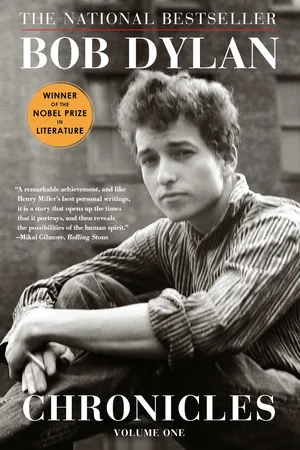
The celebrated first memoir from arguably the most influential singer-songwriter in the country, Bob Dylan.
“I’d come from a long ways off and had started a long ways down. But now destiny was about to manifest itself. I felt like it was looking right at me and nobody else.”
So writes Bob Dylan in Chronicles: Volume One, his remarkable book exploring critical junctures in his life and career. Through Dylan’s eyes and open mind, we see Greenwich Village, circa 1961, when he first arrives in Manhattan. Dylan’s New York is a magical city of possibilities—smoky, nightlong parties; literary awakenings; transient loves and unbreakable friendships. Elegiac observations are punctuated by jabs of memories, penetrating and tough. With the book’s side trips to New Orleans, Woodstock, Minnesota, and points west, Chronicles: Volume One is an intimate and intensely personal recollection of extraordinary times.
By turns revealing, poetical, passionate, and witty, Chronicles: Volume One is a mesmerizing window on Bob Dylan’s thoughts and influences. Dylan’s voice is distinctively American: generous of spirit, engaged, fanciful, and rhythmic. Utilizing his unparalleled gifts of storytelling and the exquisite expressiveness that are the hallmarks of his music, Bob Dylan turns Chronicles: Volume One into a poignant reflection on life, and the people and places that helped shape the man and the art.
Frequently asked questions
Yes, you can cancel anytime from the Subscription tab in your account settings on the Perlego website. Your subscription will stay active until the end of your current billing period. Learn how to cancel your subscription.
No, books cannot be downloaded as external files, such as PDFs, for use outside of Perlego. However, you can download books within the Perlego app for offline reading on mobile or tablet. Learn more here.
Perlego offers two plans: Essential and Complete
- Essential is ideal for learners and professionals who enjoy exploring a wide range of subjects. Access the Essential Library with 800,000+ trusted titles and best-sellers across business, personal growth, and the humanities. Includes unlimited reading time and Standard Read Aloud voice.
- Complete: Perfect for advanced learners and researchers needing full, unrestricted access. Unlock 1.4M+ books across hundreds of subjects, including academic and specialized titles. The Complete Plan also includes advanced features like Premium Read Aloud and Research Assistant.
We are an online textbook subscription service, where you can get access to an entire online library for less than the price of a single book per month. With over 1 million books across 1000+ topics, weāve got you covered! Learn more here.
Look out for the read-aloud symbol on your next book to see if you can listen to it. The read-aloud tool reads text aloud for you, highlighting the text as it is being read. You can pause it, speed it up and slow it down. Learn more here.
Yes! You can use the Perlego app on both iOS or Android devices to read anytime, anywhere ā even offline. Perfect for commutes or when youāre on the go.
Please note we cannot support devices running on iOS 13 and Android 7 or earlier. Learn more about using the app.
Yes, you can access Chronicles by Bob Dylan in PDF and/or ePUB format, as well as other popular books in Media & Performing Arts & Literary Biographies. We have over one million books available in our catalogue for you to explore.
Information
1
Markinā Up the
Score
LOU LEVY, top man of Leeds Music Publishing company, took me up in a taxi to the Pythian Temple on West 70th Street to show me the pocket sized recording studio where Bill Haley and His Comets had recorded āRock Around the Clockāāthen down to Jack Dempseyās restaurant on 58th and Broadway, where we sat down in a red leather upholstered booth facing the front window.
Lou introduced me to Jack Dempsey, the great boxer. Jack shook his fist at me.
āYou look too light for a heavyweight kid, youāll have to put on a few pounds. Youāre gonna have to dress a little finer, look a little sharperānot that youāll need much in the way of clothes when youāre in the ringādonāt be afraid of hitting somebody too hard.ā
āHeās not a boxer, Jack, heās a songwriter and weāll be publishing his songs.ā
āOh, yeah, well I hope to hear āem some of these days. Good luck to you, kid.ā
Outside the wind was blowing, straggling cloud wisps, snow whirling in the red lanterned streets, city types scuffling around, bundled upāsalesmen in rabbit fur earmuffs hawking gimmicks, chestnut vendors, steam rising out of manholes.
None of it seemed important. I had just signed a contract with Leeds Music giving it the right to publish my songs, not that there was any great deal to hammer out. I hadnāt written much yet. Lou had advanced me a hundred dollars against future royalties to sign the paper and that was fine with me.
John Hammond, who had brought me to Columbia Records, had taken me over to see Lou, asked him to look after me. Hammond had only heard two of my original compositions, but he had a premonition that there would be more.
Back at Louās office, I opened my guitar case, took the guitar out and began fingering the strings. The room was clutteredāboxes of sheet music stacked up, recording dates of artists posted on bulletin boards, black lacquered discs, acetates with white labels scrambled around, signed photos of entertainers, glossy portraitsāJerry Vale, Al Martino, The Andrews Sisters (Lou was married to one of them), Nat King Cole, Patti Page, The Crew Cutsāa couple of console reel-to-reel tape recorders, big dark brown wooden desk full of hodgepodge. Lou had put a microphone on the desk in front of me and plugged the cord into one of the tape recorders, all the while chomping on a big exotic stogie.
āJohnās got high hopes for you,ā Lou said.
John was John Hammond, the great talent scout and discoverer of monumental artists, imposing figures in the history of recorded musicāBillie Holiday, Teddy Wilson, Charlie Christian, Cab Calloway, Benny Goodman, Count Basie, Lionel Hampton. Artists who had created music that resonated through American life. He had brought it all to the public eye. Hammond had even conducted the last recording sessions of Bessie Smith. He was legendary, pure American aristocracy. His mother was an original Vanderbilt, and John had been raised in the upper world, in comfort and easeābut he wasnāt satisfied and had followed his own heartās love, music, preferably the ringing rhythm of hot jazz, spirituals and bluesāwhich he endorsed and defended with his life. No one could block his way, and he didnāt have time to waste. I could hardly believe myself awake when sitting in his office, him signing me to Columbia Records was so unbelievable. It would have sounded like a made-up thing.
Columbia was one of the first and foremost labels in the country and for me to even get my foot in the door was serious. For starters, folk music was considered junky, second rate and only released on small labels. Big-time record companies were strictly for the elite, for music that was sanitized and pasteurized. Someone like myself would never be allowed in except under extraordinary circumstances. But John was an extraordinary man. He didnāt make schoolboy records or record schoolboy artists. He had vision and foresight, had seen and heard me, felt my thoughts and had faith in the things to come. He explained that he saw me as someone in the long line of a tradition, the tradition of blues, jazz and folk and not as some newfangled wunderkind on the cutting edge. Not that there was any cutting edge. Things were pretty sleepy on the Americana music scene in the late ā50s and early ā60s. Popular radio was sort of at a standstill and filled with empty pleasantries. It was years before The Beatles, The Who or The Rolling Stones would breathe new life and excitement into it. What I was playing at the time were hard-lipped folk songs with fire and brimstone servings, and you didnāt need to take polls to know that they didnāt match up with anything on the radio, didnāt lend themselves to commercialism, but John told me that these things werenāt high on his list and he understood all the implications of what I did.
āI understand sincerity,ā is what he said. John spoke with a rough, coarse attitude, yet had an appreciative twinkle in his eye.
Recently he had brought Pete Seeger to the label. He didnāt discover Pete, though. Pete had been around for years. Heād been in the popular folk group The Weavers, but had been blacklisted during the McCarthy era and had a hard time, but he never stopped working. Hammond was defiant when he spoke about Seeger, that Peteās ancestors had come over on the Mayflower, that his relatives had fought the Battle of Bunker Hill, for Christsake. āCan you imagine those sons of bitches blacklisting him? They should be tarred and feathered.ā
āIām gonna give you all the facts,ā he said to me. āYouāre a talented young man. If you can focus and control that talent, youāll be fine. Iām gonna bring you in and Iām gonna record you. Weāll see what happens.ā
And that was good enough for me. He put a contract in front of me, the standard one, and I signed it right then and there, didnāt get absorbed into detailsādidnāt need a lawyer, advisor or anybody looking over my shoulder. I would have gladly signed whatever form he put in front of me.
He looked at the calendar, picked out a date for me to start recording, pointed to it and circled it, told me what time to come in and to think about what I wanted to play. Then he called in Billy James, the head of publicity at the label, told Billy to write some promo stuff on me, personal stuff for a press release.
Billy dressed Ivy League like he could have come out of Yaleāmedium height, crisp black hair. He looked like heād never been stoned a day in his life, never been in any kind of trouble. I strolled into his office, sat down opposite his desk, and he tried to get me to cough up some facts, like I was supposed to give them to him straight and square. He took out a notepad and pencil and asked me where I was from. I told him I was from Illinois and he wrote it down. He asked me if I ever did any other work and I told him that I had a dozen jobs, drove a bakery truck once. He wrote that down and asked me if there was anything else. I said Iād worked construction and he asked me where.
āDetroit.ā
āYou traveled around?ā
āYep.ā
He asked me about my family, where they were. I told him I had no idea, that they were long gone.
āWhat was your home life like?ā
I told him Iād been kicked out.
āWhat did your father do?ā
ā ālectrician.ā
āAnd your mother, what about her?ā
āHousewife.ā
āWhat kind of music do you play?ā
āFolk music.ā
āWhat kind of music is folk music?ā
I told him it was handed down songs. I hated these kind of questions. Felt I could ignore them. Billy seemed unsure of me and that was just fine. I didnāt feel like answering his questions anyway, didnāt feel the need to explain anything to anybody.
āHow did you get here?ā he asked me.
āI rode a freight train.ā
āYou mean a passenger train?ā
āNo, a freight train.ā
āYou mean, like a boxcar?ā
āYeah, like a boxcar. Like a freight train.ā
āOkay, a freight train.ā
I gazed past Billy, past his chair through his window across the street to an office building where I could see a blazing secretary soaked up in the spirit of somethingāshe was scribbling busy, occupied at a desk in a meditative manner. There was nothing funny about her. I wished I had a telescope. Billy asked me who I saw myself like in todayās music scene. I told him, nobody. That part of things was true, I really didnāt see myself like anybody. The rest of it, though, was pure hokumāhophead talk.
I hadnāt come in on a freight train at all. What I did was come across the country from the Midwest in a four-door sedan, ā57 Impalaāstraight out of Chicago, clearing the hell out of thereāracing all the way through the smoky towns, winding roads, green fields covered with snow, onward, eastbound through the state lines, Ohio, Indiana, Pennsylvania, a twenty-four-hour ride, dozing most of the way in the backseat, making small talk. My mind fixed on hidden interestsā¦eventually riding over the George Washington Bridge.
The big car came to a full stop on the other side and let me out. I slammed the door shut behind me, waved good-bye, stepped out onto the hard snow. The biting wind hit me in the face. At last I was here, in New York City, a city like a web too intricate to understand and I wasnāt going to try.
I was there to find singers, the ones Iād heard on recordāDave Van Ronk, Peggy Seeger, Ed McCurdy, Brownie McGhee and Sonny Terry, Josh White, The New Lost City Ramblers, Reverend Gary Davis and a bunch of othersāmost of all to find Woody Guthrie. New York City, the city that would come to shape my destiny. Modern Gomorrah. I was at the initiation point of square one but in no sense a neophyte.
When I arrived, it was dead-on winter. The cold was brutal and every artery of the city was snowpacked, but Iād started out from the frostbitten North Country, a little corner of the earth where the dark frozen woods and icy roads didnāt faze me. I could transcend the limitations. It wasnāt money or love that I was looking for. I had a heightened sense of awareness, was set in my ways, impractical and a visionary to boot. My mind was strong like a trap and I didnāt need any guarantee of validity. I didnāt know a single soul in this dark freezing metropolis but that was all about to changeāand quick.
The CafĆ© Wha? was a club on MacDougal Street in the heart of Greenwich Village. The place was a subterranean cavern, liquorless, ill lit, low ceiling, like a wide dining hall with chairs and tablesāopened at noon, closed at four in the morning. Somebody had told me to go there and ask for a singer named Freddy Neil who ran the daytime show at the Wha?
I found the place and was told that Freddy was downstairs in the basement where the coats and hats were checked and thatās where I met him. Neil was the MC of the room and the maestro in charge of all the entertainers. He couldnāt have been nicer. He asked me what I did and I told him I sang, played guitar and harmonica. He asked me to play something. After about a minute, he said I could play harmonica with him during his sets. I was ecstatic. At least it was a place to stay out of the cold. This was good.
Fred played for about twenty minutes and then introduced all the rest of the acts, then came back up to play whenever he felt like it, whenever the joint was packed. The acts were disjointed, awkward and seemed to have come from the Ted Mack Amateur Hour, a popular TV show. The audience was mostly collegiate types, suburbanites, lunch-hour secretaries, sailors and tourists. Everybody performed from ten to fifteen minutes. Fred would play for however long he felt, however long the inspiration would last. Freddy had the flow, dressed conservatively, sullen and brooding, with an enigmatical gaze, peachlike complexion, hair splashed with curls and an angry and powerful baritone voice that struck blue notes and blasted them to the rafters with or without a mike. He was the emperor of the place, even had his own harem, his devotees. You couldnāt touch him. Everything revolved around him. Years later, Freddy would write the hit song āEverybodyās Talkinā.ā I never played any of my own sets. I just accompanied Neil on all of his and thatās where I began playing regular in New York.
The daytime show at the CafĆ© Wha?, an extravaganza of patchwork, featured anybody and anythingāa comedian, a ventriloquist, a steel drum group, a poet, a female impersonator, a duo who sang Broadway stuff, a rabbit-in-the-hat magician, a guy wearing a turban who hypnotized people in the audience, somebody whose entire act was facial acrobaticsājust anybody who wanted to break into show business. Nothing that would change your view of the world. I wouldnāt have wanted Fredās gig for anything.
At about eight oāclock, the whole daytime menagerie would come to a halt and then the professional show would begin. Comedians like Richard Pryor, Woody Allen, Joan Rivers, Lenny Bruce and commercial folksinging groups like The Journeymen would command the stage. Everyone who had been there during the day would pack up. One of the guys who played in the afternoons was the falsetto-speaking Tiny Tim. He played ukulele and sang like a girlāold standard songs from the ā20s. I got to talking to him a few times and asked him what other kinds of places there were to work around here and he told me that sometimes he played at a place in Times Square called Hubertās Flea Circus Museum. Iād find out about that place later.
Fred was constantly being pestered and pressured by moocher types who wanted to play or perform one thing or another. The saddest character of all was a guy named Billy the Butcher. He looked like he came out of nightmare alley. He only played one songāāHigh-Heel Sneakersā and he was addicted to it like a drug. Fred would usually let him play it sometime during the day, mostly when the place was empty. Billy would always preface his song by saying āThis is for all you chicks.ā The Butcher wore an overcoat that was too small for him, buttoned tight across the chest. He was jittery and sometime in the past heād been in a straitjacket in Bellevue, also had burned a mattress in a jail cell. All kinds of bad things had happened to Billy. There was a fire between him and everybody else. He sang that one song pretty good, though.
Another popular guy wore a priestās outfit and red-topped boots with little bells and did warped takes on stories from the Bible. Moondog also performed down here. Moondog was a blind poet who lived mostly on the streets. He wore a Viking helmet and a blanket with high fur boots. Moondog did monologues, played bamboo pipes and whistles. Most of the time he performed on 42nd Street.
My favorite singer in the place was Karen Dalton. She was a tall white blues singer and guitar player, funky, lanky and sultry. Iād actually met her before, run across her the previous summer outside of Denver in a mountain pass town in a folk club. Karen had a voice like Billie Holidayās and played the guitar like Jimmy Reed and went all the way with it. I sang with her a couple of times.
Fred always tried to make a place for most performers and was as diplomatic as possible. Sometimes the room would be inexplicably empty, sometimes half-empty and then suddenly for no apparent reason it would be flushed with people with lines outside. Fred was the man down here, the main attraction and his name was on the marquee, so maybe a lot of these people came to see him. I donāt know. He played a big dreadnought guitar, lot of percussion in his playing, piercing driving rhythmāa one-man band, a kick in the head singing voice. He did fierce versions of hybrid chain gang songs and whomped the audience into a frenzy. Iād heard stuff about him, that he was an errant sailor, harbored a skiff in Florida, was an underground cop, had hooker friends and a shadowy past. Heād come up to Nashville, drop off songs that he wrote and then head for New York where heād lay low, wait for something to blow over and fill up his pockets with wampum. Whatever it was, it wasnāt a huge story. He seemed to have no aspirations. We were very compatible, didnāt talk personal at all. He was very much like me, polite but not overly friendly, gave me pocket change at the end of the day, said āHereā¦so youāll keep out of trouble.ā
The best part of working with him, though, was strictly gastronomicalāall the French fries and hamburgers I could eat. At some point during the day, Tiny Tim and I would go in the kitchen and hang around. Norbert the cook would usually have a greasy burger waiting. Either that, or heād let us empty a can of pork and beans or spaghetti into a frying pan. Norbert was a trip. He wore a tomato-stained apron, had a fleshy, hard-bitten face, bulging cheeks, scars on his face like the marks of clawsāthought of himself as a ladyās manāsaving his money so he could go to Verona in Italy and visit the tomb of Romeo and Juliet. The kitchen was like a cave bored into the side of a cliff.
One afternoon I was in there pouring Coke into a glass from a milk pitcher when I heard a voice coming cool through the screen of the radio speaker. Ricky Nelson was singing his new song, āTravelinā Man.ā Ricky had a smooth touch, the way he crooned in fast rhythm, the tonation of his voice. He was different than the rest of the teen idols,...
Table of contents
- Cover
- 1. Markinā Up the Score
- 2. The Lost Land
- 3. New Morning
- 4. Oh Mercy
- 5. River of Ice
- Copyright